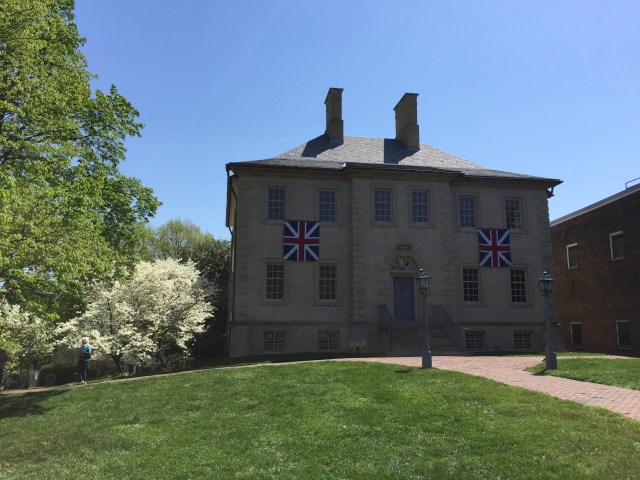
William Griffith’s examination of the Carlyle House Congress last month (The Carlyle House Congress and Britain’s Military Objectives for 1755) reminded me that I had been remiss in not visiting the site. So, the family and I set off for Alexandria, VA and a visit to John Carlyle’s home.
George Washington’s estate on the Potomac River is one of the most-visited places in the greater Washington, DC area, as befits the home of the Father of his Country. Just twelve miles south (by road), however, sits an equally impressive 18th century plantation home. Gunston Hall was the estate of George Mason IV (1725-1792). Best known as one of the delegates to the Constitutional Convention who in the end opposed the Constitution’s ratification, Mason doesn’t always get his due in the stories of America’s founding fathers. But, he was a critical and thoughtful voice in forming the early United States government and enshrining its first ten amendments, the Bill of Rights. Fortunately, his home is open to the public and easily accessible from the metropolitan Washington area.
Emerging Revolutionary War welcomes back guest historian Michael Aubrecht
John Trumbull
John Trumbull’s paintings represent some of the most familiar depictions from the time of the American Revolution. Trumbull was a graduate of Harvard University and the gifted son of the Governor of Connecticut. As a child, Trumbull showed a remarkable talent for an attention to detail. This aptitude set his drawings apart from his contemporaries. Trumbull traveled to London in 1784 to study painting under the master Benjamin West. It was then that he started painting some of his most notable pieces. There he honed his expertise for realistic painting. A year later later Trumbull traveled to the City of Paris to do commissioned artworks. He later did portraits of George Washington, John Adams, Alexander Hamilton and Thomas Jefferson. In 1816, he was selected as the president of the American Academy of the Fine Arts where he would serve for 20 years. Emphasizing classic traditions Trumbull attempted to teach the skills he had acquired while overseas. Following his death in 1843 at the age of 87, Trumbull was buried beneath the Art Gallery at Yale University which he had designed. In 1867, his collection of artworks were displayed at the Street Hall building on the same grounds. He and his wife’s remains were later re-interred and buried on the grounds of that building. Trumbull’s approach to painting has been studied by art students around the world. Today Trumbull’s paintings remain some of the most cherished ever to be painted by an American artist. Continue reading “The Brush of John Trumbull”→
In honor of April being National Poetry Month, we share the connection of the literary icons of Concord (MA) and its American Revolution heritage. Concord historian Jayne Gordon wrote about these connections in an appendix in our recent release “A Single Blow.” Below is part of that text.
None of the eighteenth-century Concord authors lived through the American Revolution, yet reminders of that eighteenth-century war abounded in Concord in their lifetimes. Their neighbors were the grandchildren of the minutemen; veterans of the war were still among the townsfolk. Buildings, gravestones, old roads, and other landmarks evoked that part of the past, and they were surrounded by the stories of the fateful day of April 19, 1775. They each drew on their interpretations of the Revolution’s symbolic meaning, and incorporated those ideas into both their private and public writings.
The “Old Manse” next to the North Bridge in Concord
In the case of RALPH WALDO EMERSON (1803-1882), there was a direct historical link to a grandfather who had played a significant role in the beginnings of the Revolution. Sixty years after colonial militiamen confronted the British troops at the North Bridge within sight of the Old Manse, the grandson of patriot minister Reverend William Emerson would come to his ancestral home to stay, writing in his journal, “Hail to the quiet fields of my fathers! . . . Henceforth I design not to utter any speech, poem, or book that is not entirely & peculiarly my work.”Continue reading “THE AUTHORS AND THE AMERICAN REVOLUTION IN CONCORD”→
A member of one of Virginia’s first families, Richard Henry Lee was a critical voice in America’s struggle against Great Britain. Born at the family home, Stratford Hall, in Westmoreland County, Lee was educated in England. In 1758, he entered Virginia’s House of Burgesses. Seven years later, Lee’s efforts on the road to independence began.
In response to the recent passage of the Stamp Act, Lee co-authored what became known as the Westmoreland Resolves. The document condemned fellow colonists who paid the related tax as well as the British Parliament. As tensions rose with Britain, Lee proposed a means for the individual colonies to communicate with one another. This idea birthed the Committees of Correspondence. In 1774, Lee was elected to the Continental Congress which met in Philadelphia. It was here in the early summer of 1776 that Lee suggested a bill for the colonies to break all allegiance with England and form a United States. The proposal was the basis of the Declaration of Independence. Continue reading “Review: First Founding Father: Richard Henry Lee and the Call for American Independence by Harlow Giles Unger”→
Modern Replica of Fort Randolph in Point Pleasant, WV (Wikimedia Commons)
At Fort Randolph, erected on the old Point Pleasant battlefield, Captain Matthew Arbuckle decided to take matters with the Shawnee into his own hands. He was already suspicious of the Shawnee in general, and Cornstalk in particular. In 1776, he reported that Cornstalk had traveled to Detroit and was “Treating with the English.”[i] Of course, this was William Wilson’s attempt to preserve the neutrality of tribes nearer Detroit by inviting them to a pace conference. Cornstalk had gone on the mission to lend weight to Wilson’s voice with those tribes. Arbuckle did not know that. Continue reading “Chief Cornstalk’s American Revolution (part two)”→
David Smith, Whispers Across the Atlantick: General William Howe and the American Revolution, (NY: Osprey Publishing, 2017).
If it’s true that George Washington lost all his battles, but won the war, then it’s equally true that Sir William Howe won all his battles and lost the war. Of course, neither premise is accurate, but they pithily sum up the conventional interpretation of each commander’s accomplishments on the battlefield, wrong as they may be. Washington’s role as Commander-in-Chief has come under increased scrutiny as Americans revisit their history. His chief adversary, however, Sir William Howe, has largely escaped focused study. David Smith set out to rectify that shortfall in his doctoral dissertation, which became the basis of Whispers Across the Atlantick. Historians should thank him for it. Continue reading “Winning the Battles and Losing the War: A Review of Whispers Across the Atlantick: General William Howe and the American Revolution, by David Smith”→
Love brought Dr. Samuel Prescott, a practicing physician, to the town of Lexington on the night of April 18, 1775. The young doctor was courting Ms. Lydia Mulliken, when the alarm of the British soldiers marching from Boston went out to the local militia. Lydia’s brother was one of those called to gather.
Love. That emotion also drew Dr. Prescott back toward his hometown of Concord—this time to alert friends, neighbors, and family members of the urgent news of the evening. En route, Dr. Prescott along with Paul Revere and William Dawes, alerted the countryside of the moving British troops. After being vetted and vouchsafed as a true friend of liberty, Dr. Prescott rode posthaste to his hometown, where his word carried greater weight.
A artist’s interpretation of Paul Revere’s (or maybe William Dawes or Dr. Samuel Prescott)’s ride to warn the Massachusetts countryside. (courtesy of VFW)
Emerging Revolutionary War welcomes guest historian Eric Sterner.
In February 1778, Brigadier General Edward Hand, commanding Continental forces at Fort Pitt on the American frontier, launched what may be one of the oddest campaigns of the American Revolution, more famous for its fecklessness than any benefit to the American war effort. Born in Ireland, Hand arrived in the colonies with the 18th Royal Irish Regiment as a surgeon’s mate. He eventually left service in 1774 and set up a medical practice in Philadelphia. The siege of Boston found him among the besiegers as Lieutenant Colonel of a Pennsylvania Rifle Battalion. He fought under Washington on Long Island, at White Plains, and then Princeton, after which Washington successfully pursued the rank of Brigadier for him before sending him to Pittsburgh.[1] Hand arrived in June, 1777, finding just two companies of the 13th Virginia.[2] As was often the case on the frontier, Fort Pitt was under-garrisoned and Continental officers would have to scrounge constantly for troops, largely relying on local militia forces to defend the frontier.
General Edward Hand (courtesy of Ohio History Central)
Hand hoped to conduct a campaign to the west, driving toward British power at Detroit, but was unable to raise sufficient forces that fall. Instead, he settled for a trip down the Ohio to ensure local garrisons were in proper order.[3] Around Christmas, Hand received information that the British had established a small magazine on the Cuyahoga River, likely somewhere close to where it empties into Lake Erie in the current city limits of Cleveland.[4] As December gave way to January and February, Hand resolved to do something about it. At the beginning of the month, he wrote Colonel William Crawford, formerly of the 13th Virginia, currently of the Pennsylvania militia and a well-respected local leader, entreating the colonel to undertake an expedition: “As I am credibly informed that the English have lodged a quantity of arms, ammunition, provision, and clothing at a small indian Town, about one hundred miles from Fort Pitt to support the savages in their excursions against the inhabitants of this and the adjacent counties, I ardently wish to collect as many brave, active lads as are willing to turn out, to destroy this magazine. Every man must be provided with a horse, and every article necessary to equip them for the expedition, except ammunition, which, with some arms, I can furnish.”Continue reading “General Edward Hand: The Squaw Campaign”→
While reading background on the siege and victory at Yorktown, Virginia in October 1781, I came across the following passage written by historian Jerome Greene.
“The officer was then quickly escorted to Washington’s headquarters in a nearby house, where he delivered Cornwallis’s message: “I propose a Cessation of Hostilities for 24 hours, & that two Officers may be appointed by each side, to meet at Mr. Moore’s house to settle terms for the Surrender of the Posts of York & Gloucester.” One can only imagine the emotions coursing through Washington’s body as he read these words.”
That last line is what really struck me.
Every image we have of George Washington depicts a stoic expression staring back out of us. Historians have a few instances from a long life of the Washington behind the marble, behind the self-imposed restraint, that he crafted for posterity.
However, he was human, he did have a fiery temper and he was a passionate person. One of the reasons he strove so hard to mask those emotions, to keep them in check, to keep perspective, and to persevere.
Those competing inclinations would have been bubbling at the surface on October 17, 1781, when that written communication was handed to him outside Yorktown, Virginia. What that moment must have been like, for Washington, for the French and American forces, and for all those fighting in favor of American independence.
Jerome Greene wondered about it. I am curious about it. Are you?




 Emerging Revolutionary War Era