

In the aftermath of the April 19, 1775 fighting at Lexington, Concord, Menotomy, and the road back to Boston, militia swarmed from across New England to surround the British forces in Boston. With fighting now underway, a wave of enthusiasm swept through the region, with a decade of tension now broken by actual combat.
The British army was trapped in Boston, and the next battle at Breed’s (Bunker) Hill in June resulted in a British victory but at tremendous cost. By summer, what I call the Militia Myth was firmly in place. After these early victories in Massachusetts, American revolutionaries were convinced that citizen soldiers would win the day against the British army. Volunteer soldiers would suffice to stand up to the British regulars and ensure the protection of American liberties. Citizen soldiers had virtue, paid soldiers fought for tyranny. “Standing” armies of professional soldiers were, after all, one source of tyranny which the colonies claimed threatened their rights.
Nothing more represented oppression than the rigid discipline of the British military. Yet, ironically, in protecting their liberties, Americans grudgingly came to accept that they had to create a force modeled on the British army. There was intense debate on the issue, John Adams saying that such power should be watched “with a jealous eye.”
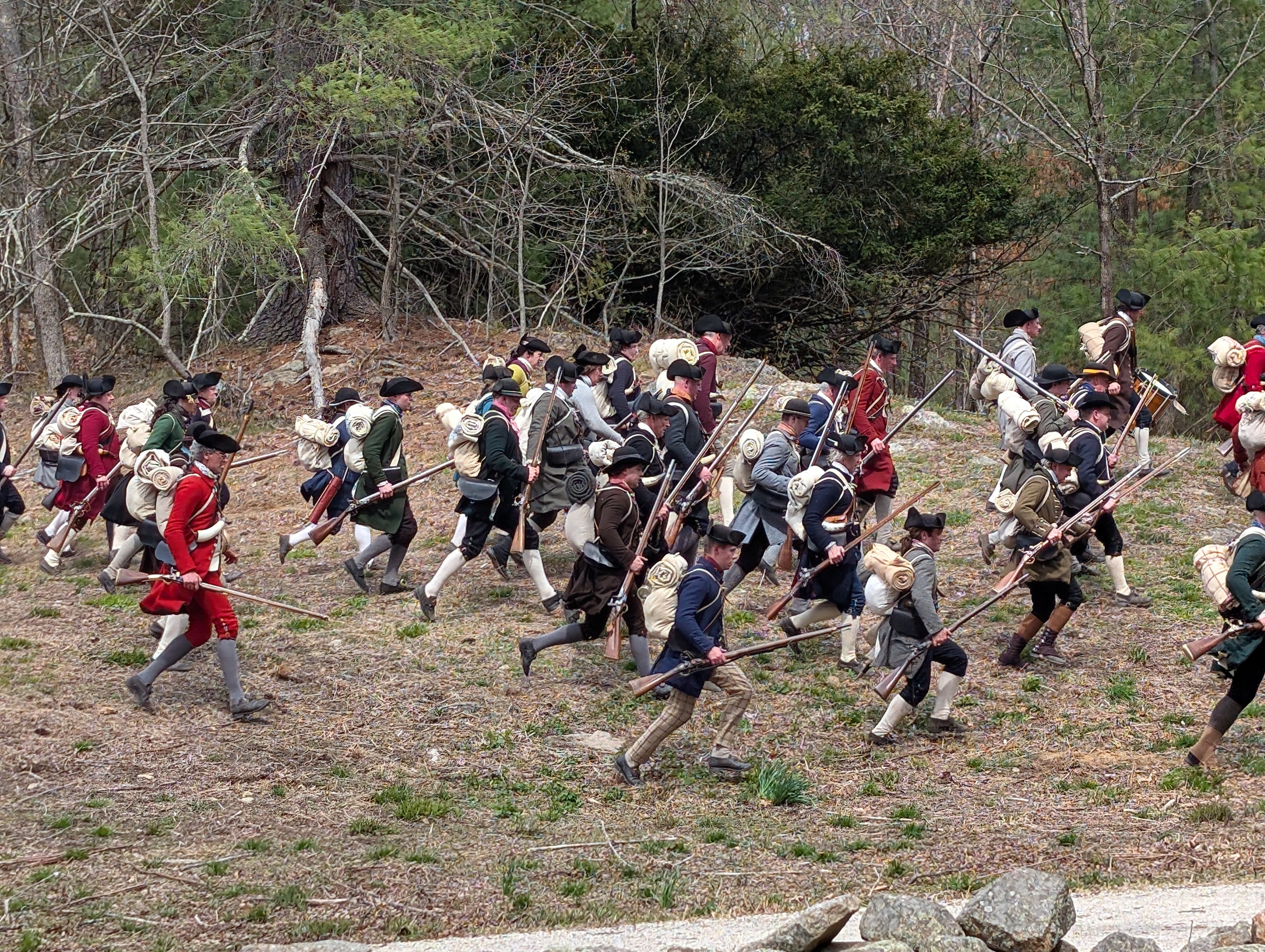
Militia did well in the Massachusetts battles: they knew the terrain and road network, were defending home ground, and often had the element of surprise. Yet in the next series of battles reliance on militia (and short term enlistments) proved disastrous. British forces attacked at New York City in August and September, defeating the Americans at Long Island and Kip’s Bay, fighting to a draw at Harlem Heights, and inflicting two more defeats on the Americans at White Plains and Fort Washington.
Washington wrote to Congress after the loss of New York City, “I am persuaded, as I am of any fact that has happened, that our Liberties must be of necessity greatly hazarded, if not entirely lost, if their defense is left to any but a permanent standing Army.”
Over the course of the war Congress granted the ability to enlist soldiers long terms and professionalize the army. Yet there was always an ideological struggle to do so. John Adams wrote to General Horatio Gates that “We don’t choose to trust you Generals, with too much Power, for too long Time.” In the end, what Washington needed, and what won the war, was what he termed a “respectable army.”
The debate between virtue and discipline lasted throughout the Revolution. After the initial wave of enthusiasm wanned, willing volunteers were not enough to fill the ranks. States turned to bounties to entice men to fill the ranks. While Revolutionaries saw the value in trusting their liberties to an army of civilian volunteers, an army of drafted men, or men who enlisted for pay, and were professionally trained, was quite different.
Militia could be effective in certain situations, and fought well in battles like Cowpens, Kings Mountain, Oriskany, and others. Yet in open field battles, militia generally could not stand up to British troops. Nor could the militia system enable the Americans to win what would become a long war. What I term the Militia Myth had its origins in the fighting at Lexington, Concord, Battle Road, and Bunker Hill 250 years ago.
 Emerging Revolutionary War Era
After reading the article, I’m still not sure what you mean by the militia ‘myth’. In the counties on the frontier, such as Bedford County in Pennsylvania, the militia was necessary to guard the families who were living on the edge that separated the civilized world and the wilderness. They provided shelter to isolated frontier families and went on ranging expeditions to search out and subdue any threats. The standing ‘continental’ army would have been f little use on the frontier, and there was more frontier than the narrow band of ‘civilized’ towns along the coast. The militia might have been a myth to the people of Massachusetts, but they certainly were not just a myth to the people of the Pennsylvania frontier.
LikeLike
Hi
Yes, absolutely, militia was vital on the frontier, and that is where their service was most useful. In my article I was focusing on the main theater of the war: in the settled area on the coast, not the frontier.
LikeLike