

Jefferson: Self-governance and “the field of knowledge”

RevWarWednesdays-header

tjmonticellostatueThe final part in a four-part series

“The field of knowledge,” said Thomas Jefferson, “is the common prosperity of all mankind.”

Jefferson’s words are inscribed in big bold letters in the entryway of Monticello’s visitor center. They’re written in architectural perpetuity in Jefferson’s “academical village,” the University of Virginia. They’re enshrined in the very concept of democracy.

“Whenever the people are well-informed, they can be trusted with their own government,” Jefferson said. Knowledge enables self-determination. Continue reading “Jefferson: Self-governance and “the field of knowledge””
Jefferson: The Man Who Moved Mountains

RevWarWednesdays-header

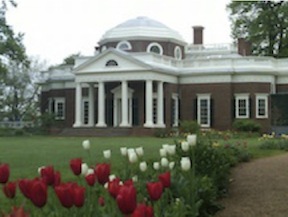
Montecello TulipsThe second in a four-part series

He leveled the top of the mountain with gunpowder.

He began the project in 1768, when he was twenty-five. He had his slaves literally sheer off the tip of the mountaintop, peeling away soil rich in iron and clay, revealing bedrock of a local variety known as Catoctin greenstone.

On the flattened plane, he built his dream home. Over the next fifty-eight years, Thomas Jefferson would significantly remodel the house twice more as his personal tastes evolved. The house has a splash of Cavalier Virginia to it, but it also has touches of the classical and the continental.

Jefferson called it “my essay in architecture.” He named his “essay” Monticello. Continue reading “Jefferson: The Man Who Moved Mountains”