On February 1, 2017 at 7:00 p.m. join Emerging Revolutionary War’s Derek Maxfield for the launch of the “Historical Horizons Lecture Series” sponsored by the Genesee Community College History Club.
Two of the most important men in American History are John Adams and Thomas Jefferson. From the time they met in Philadelphia in 1775 until their deaths in 1826, these two men had a most fascinating relationship; much of the time it was one of admiration and love, but it was interrupted by a period of intense partisan strife that nearly ended the friendship. Come hear the intriguing story of how the friendship was restored.
The lecture is part of the Historical Horizons Lecture Series sponsored by the GCC History Club. Get the complete spring semester line-up here: https://gcchistoricalhorizons.wordpress.com/
All events are FREE and open to the public at the Genesee Community College Batavia campus, room T102 of the Conable Technology Building.
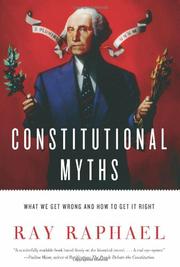
Constitutional Myths by Ray Raphael is a well written, if potentially controversial book that takes a fairly in-depth look at eight constitutional interpretations that are currently popular political positions. The 301-page monograph provides an excellent, brief synopsis for each topic, which is referred to as a “myth”. Each constitutional “myth” has a more elaborate explanation after the initial brief summary with a significant amount of supporting primary source evidence.
Constitutional Myths by Ray Raphael
Raphael, a scholar of the Founding Fathers, has written extensively on the early United States and his frequent footnotes often refer to his previous research and primary documents from the period in question. Of particular note is his constant reference to the two most extensive constitutional documents, Notes of Debates in the Federal Convention and The Federalist Papers.
From the very beginning of the book, Raphael makes it clear that the Constitutional Convention set out to remedy the defects in the Articles of Confederation. Some of these defects were the inability of the central government to tax, draft citizens to form an army, or pass a variety of laws. In short order, this lead to a number of problems in the states and in all likelihood, the demise of a number of states to European powers. The pendulum that had swung to a severe distrust of a distant, powerful government was on its way back to establishing a strong government that could look out for the interests of its constituents.
Readers of the more conservative persuasion, who often take a position in favor of small government, impartial Founding Fathers, and originalism, will likely find some of the positions in Constitutional Myths controversial. Despite some of the positions that present day conservatives argue the founding fathers supported, Raphael goes to great lengths to refute those modern day positions and provide the context behind the decisions that were made in 1787.
One of the best examples of this in Constitutional Myths was the chapter devoted to The Federalist Papers. As detailed, The Federalist Papers were written by three authors; James Madison, Alexander Hamilton, and John Jay. They were written as a tool to advocate for the adoption of the Constitution, not to provide commentary on the finer points of the Constitution. Additionally, a number of the points in The Federalist Papers were made by delegates who did not necessarily agree with the argument they were making, but believed in the compromises of the constitution and were trying to sell the agreement to the necessary number of states for ratification.
Raphael’s treatment of originalism is especially thought provoking given its popularity in today’s political climate. The Constitution and its interpretation have been open for debate from the moment it was ratified. The delegates of the Constitutional Convention created a compromise and it would be a mistake to ascribe any specific meaning to the original intent; as any given founder may have had differing thoughts on what a particular clause might mean. The author makes the astute point that the Constitution is a framework inside which the various states, United States Congress, Supreme Court, and the president are meant to work.
Details:
336 pages, ISBN-13: 978-1595588326
Published by: New Press
*Jim Howell is a librarian in Northern Virginia and enjoys reading modern military history and science fiction*
On August 2, 1776, in Philadelphia, Pennsylvania, the majority of the 56 men who would forever be known as the “Signers of the Declaration of Independence” placed quill to ink and affixed their signature.
On September 17, 1787, the men who persevered, haggled, and agreed on the United States Constitution, dipped a quill into ink and placed their signatures on that famous document.
If one looks closely and reads the names of the signers, six gentlemen’s names would appear on both documents. If one hazarded a quick guess, Thomas Jefferson, John Hancock, John or Samuel Adams, George Washington, and Benjamin Franklin would most likely be the first names to spill off the tongue.
Only one of those names would be correct; Benjamin Franklin. This post, the first in the series, will shed light on whose these men were, who had the great fortune–or luck?–to sign both famous political documents. The first of the “Six Signing Signers” is…..
The city of Boston, Massachusetts is steeped in American Revolutionary War history. The city has designed an entire trail–the “Freedom Trail”–a footpath that leads interested visitors around the city to the areas of most importance.
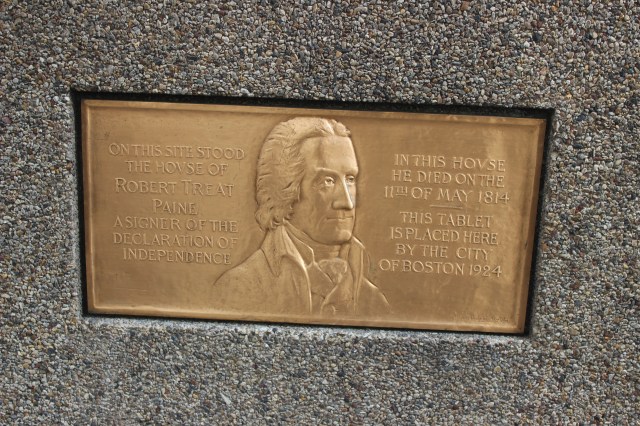
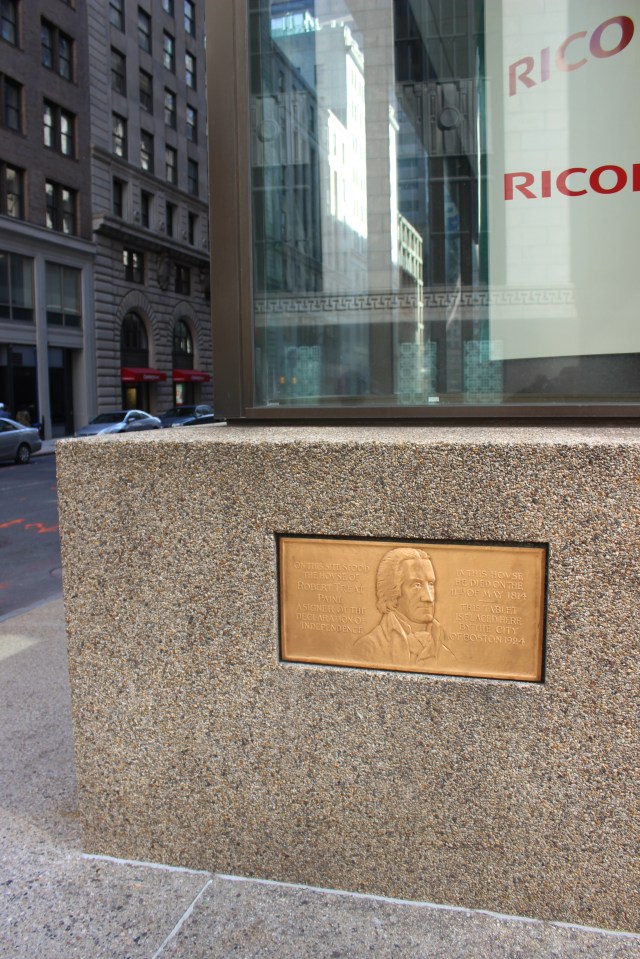
Yet, some history, is just, literally, stuck right on the walls of Boston. On the side of a modern office building, is situated the plaque below:
One of the 56 men that affixed his signature to the Declaration of Independence, Paine was born in Boston on March 11, 1731 and was actually given a middle name, a family tribute. His family legacy was well-established in the colonies and Paine himself was counted as an early advocate for the patriotic cause.
Yet, like the more famous John Adams, Paine also was a lawyer and dedicated to the law and order. He was the second attorney, along with the aforementioned Adams, to represent the British soldiers in the “Boston Massacre” trial. He continued to hope for reconciliation, hoping when he ventured to the Second Continental Congress, that the resolve of the colonies would bring the British Parliament to negotiate. On that same vein, Paine also put his signature on the Olive Branch Petition–the final attempt by the colonies to reach King George III and give their side of the story. When the king outright rejected the petition and did not even lay eyes on the document, Paine saw there was no hope and firmly planted himself in the camp of those clamoring for independence.
He became a vocal and valuable member of the Continental Congress and signed the Declaration of Independence on August 2, 1776. Returning to Massachusetts near the end of 1776, he became the Speaker of the Massachusetts House of Representatives the following year. In 1780 he was a member of the committee that drafted the state constitution and as attorney general he prosecuted members of Shays’ Rebellion in 1787.
His last public role was a justice of the Massachusetts Supreme Court from 1790 until his retirement in 1804. He was 83 years old when he died in the house that the plaque mentions. He was buried in the Granary Burying Ground in his native Boston, Massachusetts.
Another great patriot of the American cause, whose last house where his last days were spent, has a lasting memorial for those to discover. So, many historical treasures are just hanging there, waiting to be discovered in Boston.
Another view of the Robert Treat Paine plaque in Boston
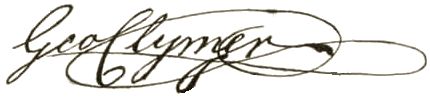
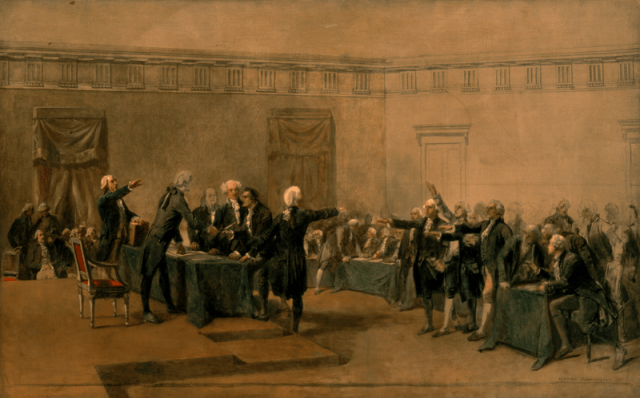
This year, July 4th, which falls on a Monday, and will be celebrated as America’s Independence Day around the country. Americans remember that date, in 1776, as the day that John Hancock, as president of the Second Continental Congress, put quill to ink and then parchment, to affix his signature in a bold stroke at the bottom of the Declaration of Independence. Interestingly, only one other person signed their name to the document that day, secretary to the Second Continental Congress, Charles Thompson.
However, the important date to remember, is today, July 2. On this date in 1776, the Second Continental Congress will adopt Virginia delegate Richard Henry Lee’s resolution to declare independence from Great Britain. This document, crafted by another Virginia, Thomas Jefferson, was originally brought up for debate in June. By June 28th, Jefferson, chosen by a sub-committee to write the declaration, had presented it to Congress assembled in Philadelphia for review.
Artist Charles E. A. Dumaresq’s rendition of the Second Continental Congress signing the Declaration of Independence
“Remember the ladies,” Abigail Adams wrote in a letter to her husband during his service in the Continental Congress. And those words are how we now most often remember her: “Remember the ladies.”
And John did. He pined for her. His long public career—in the Continental Congress, as a minister in Europe, as vice president, as president—kept them apart for long stretches. They spent ten of their fifty-four years of marriage separated by war, by sea, by duty.
So they wrote—some 1200 letters in all. “My dearest friend,” he addressed her, and he meant it.
The lively correspondence between John and Abigail illuminates not only a great American love story but also a great political partnership. Among the company of great Founders, Abigail was the one forced to stay at home—by social convention and family duty—but she refused to be forgotten. Continue reading “Remembering John and Abigail (part two)”→
When Abigail Adams died in late October, 1818, her husband, John, brokenhearted, said, “I wish I could lie down beside her and die, too.”
Today, the two are entombed side by side, along with their son John Quincy and his wife, Louisa Catherine, in a well-lit, whitewashed crypt beneath the United First Parish Church in Quincy, Mass. I’ve come here to pay my respects to the former presidents and first ladies, but mostly I’m here to say thanks to John, and to remember him because he worried he’d be forgotten. Continue reading “Remembering John and Abigail (part one)”→
I sit on a small wooden bench, little more than a plank with legs, really, beneath a tulip poplar whose wide branches umbrella me. The grass around the bench has been worn away by weary travelers come to the bench to rest, revealing the reddish iron-rich soil of Virginia beneath.
A few yards away from me, Thomas Jefferson rests in peace.
A slow stream of visitors comes down the brick walkway from Jefferson’s house to stand outside the black, wrought-iron fence that surrounds his family’s small graveyard, still in use today by descendents. Many visitors have thrown coins onto the president’s grave—not just the Jefferson-faced nickels you’d expect, either, but pennies, dimes, and quarters, too. Considering the rift between Washington and Jefferson in Washington’s last years, I wonder what Jefferson would think about that. Continue reading “Jefferson: America’s Great Contradiction”→
March is Women’s History Month, a time to reflect on the many contributions women have contributed in our country. At George Washington Birthplace National Monument, our social media policy for the month has been to highlight important women to the history of the National Park Service and/or to George Washington’s life.
By writing the history text and developing what images to use for these posts, I thought I would take this example and expand it to include two other women that played integral parts in the American Revolutionary movement.





 Emerging Revolutionary War Era