

Mr. Jefferson’s library: “a necessity of life”

RevWarWednesdays-header

Part three in a four-part series

tjstudy“I cannot live without books,” Thomas Jefferson wrote to John Adams in June of 1815. The former president had just packed his personal library—some 6,700 volumes—into a wagon train and shipped it north to the nation’s capital. He’d sold the collection to Congress for $23,950 to replace the collection burned by the British during the War of 1812.

His collection was, Jefferson rightly believed, “the choicest collection of books in the United States.”

And now he was left virtually bookless. Continue reading “Mr. Jefferson’s library: “a necessity of life””
Jefferson: The Man Who Moved Mountains

RevWarWednesdays-header

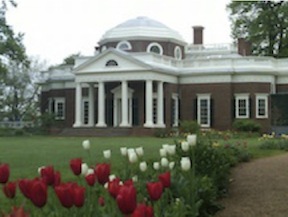
Montecello TulipsThe second in a four-part series

He leveled the top of the mountain with gunpowder.

He began the project in 1768, when he was twenty-five. He had his slaves literally sheer off the tip of the mountaintop, peeling away soil rich in iron and clay, revealing bedrock of a local variety known as Catoctin greenstone.

On the flattened plane, he built his dream home. Over the next fifty-eight years, Thomas Jefferson would significantly remodel the house twice more as his personal tastes evolved. The house has a splash of Cavalier Virginia to it, but it also has touches of the classical and the continental.

Jefferson called it “my essay in architecture.” He named his “essay” Monticello. Continue reading “Jefferson: The Man Who Moved Mountains”

James Monroe at War

RevWarWednesdays-header


Part Two

With an excess of officers in the Continental Army and little prospect of getting a field command, James Monroe resigned his commission in 1779.  He became a Lieutenant-Colonel of Virginia forces, but was unable to recruit enough men to form a new regiment.  In 1780 he went to North Carolina as a military observer for Governor Thomas Jefferson, with whom he had begun the study of law. Continue reading “James Monroe at War”

Jefferson: America’s Great Contradiction

RevWarWednesdays-header

monticellobenchThe first in a four-part series

I sit on a small wooden bench, little more than a plank with legs, really, beneath a tulip poplar whose wide branches umbrella me. The grass around the bench has been worn away by weary travelers come to the bench to rest, revealing the reddish iron-rich soil of Virginia beneath.

A few yards away from me, Thomas Jefferson rests in peace.

A slow stream of visitors comes down the brick walkway from Jefferson’s house to stand outside the black, wrought-iron fence that surrounds his family’s small graveyard, still in use today by descendents. Many visitors have thrown coins onto the president’s grave—not just the Jefferson-faced nickels you’d expect, either, but pennies, dimes, and quarters, too. Considering the rift between Washington and Jefferson in Washington’s last years, I wonder what Jefferson would think about that. Continue reading “Jefferson: America’s Great Contradiction”