

Emerging Revolutionary War welcomes guest historian Al Dickenson
Within the first few pages of his book, Brooklyn College professor Benjamin Carp illustrates all the key points about the 1776 burning of New York City. The points include how vital the city was to the war effort to both the rebels and Loyalists, a discussion on how the fire started (questioning if it was accidental or intentional, and if the latter, whose intention was it?), and furthermore, why has there never been a full investigation into the fire and its causes (Carp’s book is the first full-length work on the topic). In quick succession, readers understand what they will gain by reading this book, why the event in question is important for understanding the American Revolution, and Carp’s own thoughts on the matter.
Carp’s argument in The Great New York Fire of 1776 is that the rebels started the fire, and that the cause of the blaze was indeed arson, which previously had been in question (254). What Carp does not speak to, at least not without some speculation, is who precisely started the fire. While not totally disregarding George Washington’s potential involvement, Carp suggests the more likely culprits would be soldiers in Washington’s army. These men, and in many cases, boys, had yet to receive the disciple so desperately needed from Baron von Stueben’s efforts at Valley Forge, so it seems plausible they could start the inferno, which scorched up to a fifth of the city (244-245). As such, Carp puts his research skills to good use in this volume, sharing his thoughts on the possible origins of the fire and providing readers with a map of more than ten ignition points, illustrating how expansive the blaze was (104). Carp’s thesis is well supported by the primary material, which included letters, sermons, diaries, and other sources from the time.
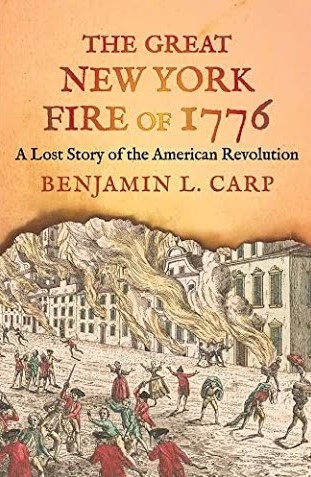
One of the most interesting aspects of this book is its portrayal of the people of New York City. Various interesting characters pop up, but most strikingly, Carp does not shy away from unveiling people for who they are. For instance, without naming particular individuals, the mere thought that the “rebels” could intentionally destroy their own city is a controversial position. It is common today to hear that the men and women who fought in the American Revolution called “patriots,” “Americans,” or even the occasional “freedom fighters.” In many cases, perhaps most, this is true, but does starting a fire which destroyed life, liberty, and the pursuit of happiness really exemplify patriotism? After all, though they were harming the British and their hold of the city, leaving them with a mess and angry crowds, the rebels were also harming those they had vowed to protect. In September 1776, the Declaration of Independence had been signed for a little over two months. In it read that the King, George III, had “burnt our towns” and had deprived people of their right to a trial by jury. In an act of irony, the rebels, if they truly did light the spark of the Great Fire of New York, would have acted similarly to the king the claimed to despise. Not only does this call into question the beliefs surrounding the event of the fire itself, but also the beliefs of the supposed perpetrators. Or, perhaps they could be called “perpetraitors,” at least in some sense. Indeed, through Carp’s questioning of the events, readers learn of more questions regarding the mythology and facts that surround the American Revolutionary War.
While Carp’s book is an incredibly valuable read for any Revolutionary War historian, reader, or enthusiast, like any work, there are several pieces that are either missing or that could have been expanded upon. As noted elsewhere, a map of how the two-tongued fire spread could have been very valuable to readers. Likewise, a more thoughtful explanation of New York City’s geography could have also helped readers understand the fire’s path and implications. It is possible that is issue could be remedied via additional research, but the goal of the writer should be to provide all the tools a reader would need to grasp what is being written. All in all, these are minor points of contention, ones which certainly do not take away much from the reader’s experience.
An additional criticism could be leveled at the rationed contextualization of how this fire impacted the war effort beyond the city limits. Though discussed during the first few chapters (2; 38; 40-42; 150), there is less discussion on how the city’s destruction and war effort implications in the later half of the book. The reason some development of this context could be useful is for those who are not New York historians or residents. While it is important to have detailed, narrow scholarly research and publications written for niche topics, exploring how they impact the rest of the period or boarder context of events can likewise be valuable. Regardless, this is a minor criticism, as Carp’s book was an easy and enjoyable read, the work of an expert historian.
Carp is a master storyteller, waving together many seemingly unrelated or tenuous events, people, and storylines. As an expert in Revolutionary Era urban life, this story seems like the perfect one for him to tell, as Carp wonderfully pulls on the strings of military, urban and political history while also including biography and social commentary. Indeed, Carp undoubtedly completes a more thorough investigation into the fire than the British did in either of their endeavors, in 1776 and 1783. Having nearly two-hundred and fifty years of additional research undoubtedly helped, but nonetheless, the issues of propaganda, terror, and questioning historical perspectives have never been more prevalent than in today’s world and Carp’s book.
Writing about history can be a tedious endeavor. Yet, more often than not, it is incredibly rewarding. Though the majority of previous research went against Carp’s thesis, he persisted, finding evidence that supports his theory beyond a reasonable doubt. In recent years, there have been many incidents of questioning long-held historical beliefs, with some leading to great revisions in how history is taught. It appears The Great New York Fire of 1776 will also fall into that category as well, particularly his thesis regarding rebel arsonists. By devouring this book, readers can hopefully see the value of challenging historical assumptions in a thoughtful manner.
For a biography of Al click here.
 Emerging Revolutionary War Era