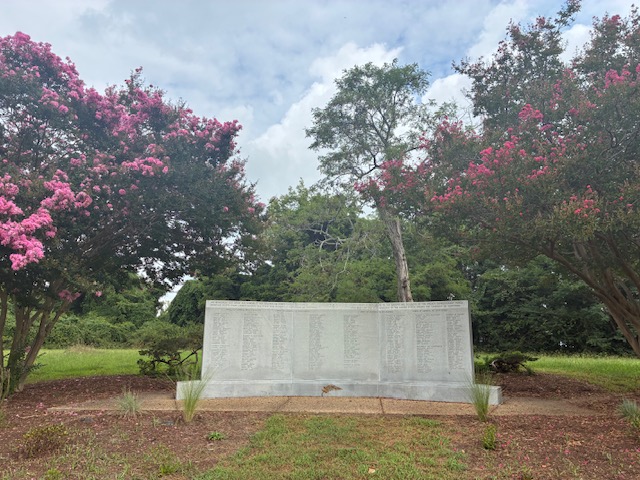
Situated near the York River, across the street from the American Revolution Museum of Yorktown, sits a monument commemorating the French soldiers that fought, bled, and for some, gave their lives during the siege.
A few years ago, or 1421 days ago to be exact, I pulled over into the parking lot for that monument, walked up, and gave a cursory look at the names and the wording. I did not speak or read French–much to the detriment of my French teacher in high school I must say–but determined there that I would. Later that same evening I downloaded the language learning app Duolingo and started a streak, which if you had not guessed already, has reached 1421 straight days.
I recently went back to that monument and could at least interpret enough of the wording to understand the gist. Good start.
The monument in question Author collection
I now take that rudimentary language foundation capability on the road. Where may you ask?
Screenshot to confirm streak
Next week, after deciding approximately a whole 10 days ago, that following the wedding of a cousin in Connecticut, I would drive the remaining 7 hours to Quebec, Canada. Impromptu? Kind of. Just have to remember to pack my passport!
A bucket list item of mine in the history column is to see the famous Plains of Abraham, from one of the climactic battles of the French and Indian (Seven Years’ War), fought 267 years ago this month, on September 13. I also want to walk the last footsteps of General Richard Montgomery as he led an unsuccessful attack by the fledging rebellious American military against the British during the first winter of the American Revolution. I may have missed the anniversary but at least I am within the same year-ish (since the battle was fought on New Year’s Eve 1775).
Side note, Maryland honors Montgomery by a county named in his honor, one of, if not the first, place, county, town, etc. to be named for a person not related to the British monarchy, aristocracy, or gentry. Along with Washington, the two counties in Maryland were siphoned off of Frederick in 1776.
Stay tuned next, week to Emerging Revolutionary War’s Facebook page as I will go live there.
And then I will retreat to a Quebec cafe…or brewery and test out my French…so if you have a suggestion of a can’t miss place, drop a comment below!
Join us this Sunday at 7pm as we ERW authors and historians Dan Welch and Mark Maloy continue their 250th anniversary coverage of the New York Campaign. They’ll chat with us about the events following the Continentals retreat from Long Island, Nathan Hale, the Turtle, the Peace Conference, and of course the fighting at Kip’s Bay and Harlem Heights. Welch and Maloy’s new book, “Conquer or Die” will be available this fall. This Revelry will be LIVE on our Facebook and You Tube pages at 7pm.
This week, during a conference call, someone asked Rob Orrison, Neil Chatelain, and me, “Which figure from the Revolution is ERW most like?”
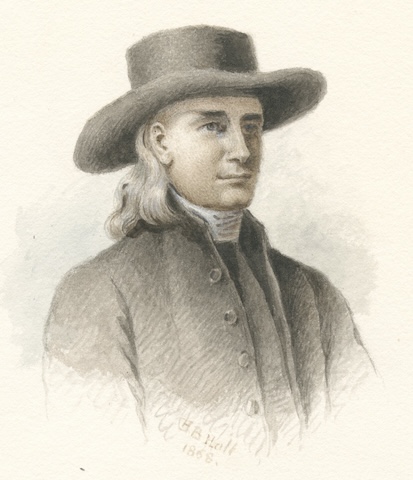
Stephen Hopkins
The first person who jumped to mind was Stephen Hopkins of Rhode Island. Although none of us wears a cool hat like Hopkins does, it was easy to think of ERW as the guy in the back of the room, drinking a mug of rum or beer or grog and offering commentary on events. Hopkins had served several stints as Rhode Island’s colonial governor and served as chief justice of the colonial court during the infamous Gaspée affair. He was good natured and earnest, and John Adams said, “He kept us alive” with his energy. “Hopkins never drank to excess,” Adams said, “but all he drank was immediately not only converted into Wit, Sense, Knowledge and good humor, but inspired Us all with similar qualities.”
Or how about John Adams, as Rob suggested? (He knew I’d love that one!) Not only was Adams a writer, he was also a workhorse, like most of the regular contributors who keep ERW going—a small cadre of folks who each do a lot of work. Adams was also prickly, Rob pointed out, just as many of ERW’s folks are (a bit of self-revealing honesty there!). Adams preferred beer to cider, so I thought we’d have to swap that out, but Rob reminded me that few of us would turn down free cider.
I suggested Ben Franklin. Franklin had a background in printing and writing—something central to ERW—and was also generally good humored. He liked to have a good time—“Perhaps too good of a time,” someone in the conversation piped in—and always situated himself at the social center of any scene. ERW is, if nothing else, social. Rob did point out that Franklin was a genius in many, many areas, while ERW is pretty focused in its work, but personality wise, it’s a good match.
The question put us on the spot, so those were our initial answers. What do YOU think? If ERW was a figure from the Revolution, who would ERW be most like?
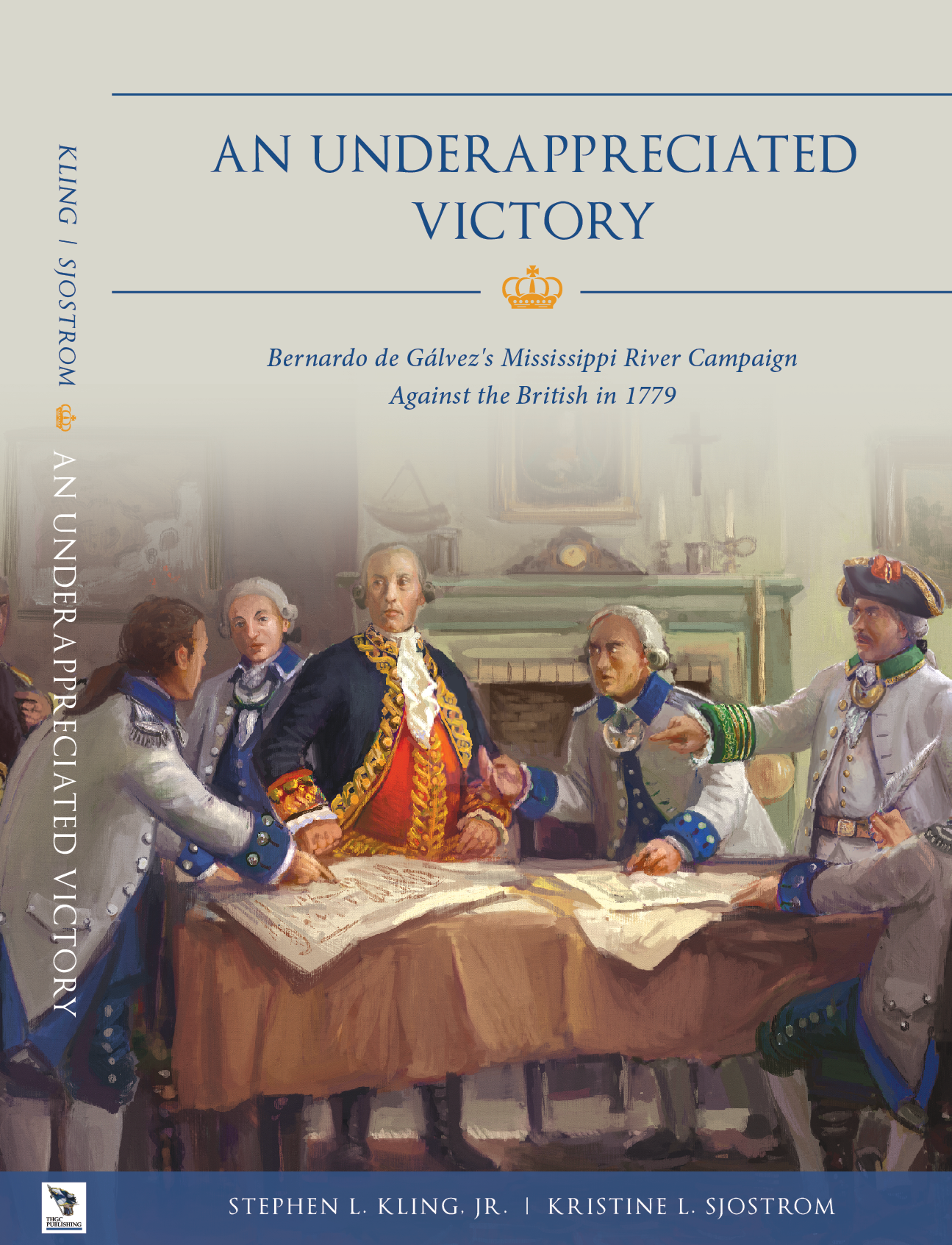
The American Revolution is often remembered through the familiar lens of successful campaigns and their contributing commanders: General George Washington at Yorktown, Virginia, and General Horatio Gates at Saratoga, New York, to name two of the most significant. Yet the Revolution was an international conflict fought across a much wider geographic area than just along the eastern seaboard of North America. In An Underappreciated Victory, Stephen L. Kling, Jr. and Kristine L. Sjostrom seek to restore one of these overlooked campaigns to its proper place in the history of the war. Their study of Bernardo de Gálvez’s 1779 Mississippi River campaign demonstrates how Spain, despite pursuing its own strategic interests, contributed materially to the defeat of Britain and how Gálvez’s leadership produced significant results with remarkably limited resources.
The authors begin by establishing the strategic importance of Spanish Louisiana and the Mississippi River Valley. Following Spain’s entry into the war against Britain in 1779, Louisiana became both a potential target for British operations and a valuable base from which Spain could threaten British possessions. New Orleans was particularly vulnerable. British control of posts along the Mississippi posed a danger to Spanish interests while also threatening communications and commerce throughout the region. Rather than remain on the defensive, Gálvez recognized an opportunity to seize the initiative.
It is in this decision that the authors make one of their strongest arguments about Gálvez’s leadership. His forces were hardly overwhelming, and the campaign presented formidable logistical challenges. Distance, weather, disease, difficult terrain, transportation problems, and uncertain intelligence, all complicated operations. Gálvez nevertheless chose an offensive strategy. His willingness to act before the British could concentrate their forces became one of the campaign’s defining characteristics. The resulting operations against British positions, culminating in the capture of Baton Rouge and other posts, demonstrated the effectiveness of surprise, mobility, intelligence, and decisive leadership.
Kling and Sjostrom are very effective in showing that the campaign cannot be understood solely through its engagements. Logistics and geography receive significant attention, revealing the extent to which environmental conditions shaped military possibilities along the Mississippi River. The campaign’s success therefore becomes more impressive when measured against the obstacles continuing to confront Gálvez. His achievement was not simply that he defeated British forces; it was that he managed to organize and sustain an offensive in an environment that severely restricted the movement and supply of armies.
Another of the book’s greatest strengths is its use of multinational sources. By incorporating Spanish, British, and German accounts, the authors move beyond the predominantly Anglo-American perspective that has traditionally dominated Revolutionary War narratives. These sources allow them to reconstruct events from competing viewpoints and provide greater insight into the decisions made by both sides. Their documentary approach also strengthens the case for reconsidering Gálvez’s campaign as a serious military operation rather than an isolated episode on the margins of the Revolution.
The book’s greatest historiographical contribution, however, lies in its reassessment of Spain’s role in the American Revolution. Spain did not enter the war solely to assist the American colonies; it had territorial, commercial, and geopolitical objectives of its own. Nevertheless, those objectives frequently aligned with the interests of the American revolutionaries. Gálvez’s campaign illustrates how Spanish military operations diverted British attention and resources while weakening British control of the Gulf Coast and Mississippi Valley. The authors therefore broaden the traditional interpretation of the Revolution from an Anglo-American struggle supported by France into a genuinely international conflict.
The study is not without potential limitations. This book is a deep and exhaustive study of a particular subsect of war, designed to be the volume on this aspect. Similarly, the authors’ admiration for Gálvez occasionally raises the question of whether they attribute his successes too heavily to exceptional leadership rather than to a combination of favorable circumstances, British weaknesses, and Spanish strategic interests. Nevertheless, the evidence presented makes a convincing case that Gálvez exercised considerable initiative and understood the advantages of striking quickly against dispersed British positions.
Ultimately, An Underappreciated Victory shows that the importance of a military campaign cannot always be measured by the size of participants or soldiers. Gálvez’s 1779 Mississippi campaign involved relatively modest forces compared with the armies that fought at Saratoga or Yorktown, yet its strategic consequences were considerably greater than its obscurity might suggest. Kling and Sjostrom provide a valuable reconstruction of the campaign while challenging readers to reconsider the geographic and international dimensions of the American Revolution. Their study establishes Gálvez not merely as a peripheral Spanish commander but as an important participant in the broader struggle against Britain. In doing so, An Underappreciated Victory makes a persuasive case that the campaign—and Gálvez himself—deserve a more prominent place in the history of the American Revolution.
THGC Publishing, St. Louis, MO 2026 634 pages, including images $50.00
The New York Campaign had been building for over year by August 1776. In July 1775, previous British commander of forces in America, Thomas Gage, had sent a request to his superiors to be allowed to leave Boston and begin a new campaign in New York. Following Lexington, Concord, and Bunker Hill, Gage’s force remained bottled up and besieged in and around Boston and Charleston. When word of approval of Gage’s plan reached Boston, so too did orders relieving him of command. Before he departed for England in October 1775, he met with his successor, William Howe, and greatly stressed the importance of moving the theater of war to New York. Howe would follow Gage’s preplanning and approval to the letter, including waiting until the spring to began the shift in the army’s base of operations. Howe’s timetable, however, was moved up after the arrival of Henry Knox’s artillery train and the placement of guns on Dorchester Heights. On March 17, 1776, Howe and 11,000 troops and Loyalist citizens sailed for Nova Scotia. Foreshadowing the British departure and the location of the next campaign in a letter written two days before they set sail, Col. Joseph Reed, later George Washington’s adjutant-general, correctly asserted, “If Howe should leave Boston, we expect he will make for New York; and, at all events, we look upon that as one of the scenes of the summer business.”
Meanwhile, George Washington also looked to New York as the next seat of this growing conflict. In January he sent Charles Lee to begin laying out a position for the Continental Army to take once it shifted southward from Boston. Not long after Lee arrived in February 1776 he assured the Committee of Safety that even though he could see no way to make New York into a “tenable fortification” he could make a position strong enough to be “a most advantageous field of battle” that would “cost the enemy many thousands of men to get possession of it.” Just two months later, on April 13, Washington and the Continental Army arrived.
The Continental Army commander had no other choice than to do what he could in New York. There was immense political pressure on Washington not to abandon it, the Congress believing it had high political and psychological value. Many in Congress believed abandoning it would demoralize the Patriot cause and swell the morale of the Loyalist population in the city and colony thereof. Furthermore, it was a central location along the Atlantic coast and a conduit of communication and supplies between New England and the southern colonies via the Hudson River. Furthermore, the Hudson River/Lake Champlain corridor remained a vital passage to Canada and the Great Lakes. New York was also a bustling economic hub, the second largest urban center in the colonies, with a port, shipbuilding, and deep-water harbor had immense naval and trade value. Widely considered as the “key to the continent,” Washington would have a difficult task defend the city, it’s deep water port, and the numerous navigable waterways; all reasons the British wanted to seize the city in their effort cutoff New England from the middle and southern colonies. Writing to his brother, John Augustine Washington, between May 31 and June 4, 1776, he confessed, “We expect a very bloody Summer of it at New York . . . & I am sorry to say that we are not, either in Men, or Arms, prepared for it.”
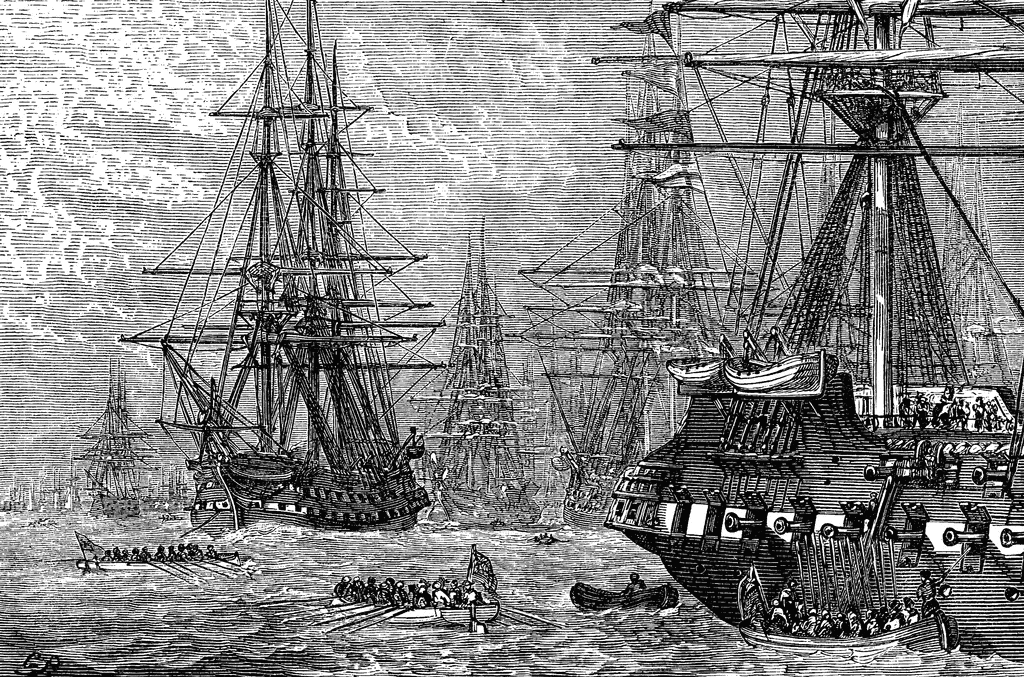
Finally, after several months of resupplying and refitting his army in Nova Scotia, William Howe and his command arrived on Staten Island, unopposed, in June 1776. Pvt. Daniel McCurtin, 1st Company of Maryland Rifles, recorded the British arrival, noting he saw, “the whole Bay was full of shipping as ever it could be. I declare that I thought all London was afloat.”Over the coming weeks he would be joined by his brother, Richard, with large numbers of reinforcements, ships, transports, supplies, and Hessians. Although the two brothers leaned into their role of peace commissioners, attempting to end this growing rebellion through pardons and not bloodshed in July, by August, with no peaceful resolution insight, military preparations moved forward.
On August 20, 1776, British troops began loading onto ships and transports from their Staten Island camps, and 250 years ago today, August 22, 1776, the first British troops landed on Long Island at Denyse’s Ferry. Howe had chosen this site for its richness and crops and plentiful livestock in which to supply his army. Still unsure of Howe’s intentions, and constantly worried about his flank and rear being turned by the British Navy, Washington had spread his army dangerously thin across several islands with waterways separating reinforcements should the need for them arise. Thus, on August 22, Washington only had 3,000 men, John Nixon and Nathaniel Heard’s brigades, and some Long Island militia in which to contest the landing. All they could really do was raise the alarm. By the end of the day 20,000 British troops were on Long Island. Only time would tell, at least for Washington, whether or not this would be Howe’s main push or simply a diversion to another beachhead and main strike.
Learn more about the 1776 New York Campaign with ERW’s forthcoming release, Conquer or Die: The 1776 New York Campaign, by Dan Welch and Mark Maloy. Pre-order here!
From June 28, 1778, until October 1781, there is a gap in major engagements by the main Continental Army under the command of General George Washington. A few minor engagements, at Springfield, Connecticut Farms in New Jersey or Stony Point in New York, occurred. Actions in the Southern Theater occupied much of that period and Newport, Rhode Island became a focal point as well, especially with the French arrival. Historians, especially popular and public historians, tend to quickly cover these approximately three years of war in short order, moving onto the finality.
Yet, these years are important, especially to understand the other facets of warfare, rebellion, and revolution. Diving into the primary sources, from the quill pens of Washington, his fellow generals, staff officers, Continental Congress, and the soldiery that comprised the Continental and militia forces, and one can easily surmise how important those non-major-warfare years were. Luckily for the avid students and enthusiasts of the American Revolutionary War, we now have a concise, richly researched, and impactfully created prose published by Casemate and authored by Jeffrey A. Denman to fill this gap.
A glance at Denman’s biography reveals that he was a public-school teacher and historian who has a resume filled with publications and researched articles. He takes that acquired skill set into this publication, weaving the story, sprinkled with direct quotes and primary source material, for an accurate and compelling overview of the high-stakes of the American Revolution and how success very much so hung in the balance from 1778 – 1781.
At the center is Washington, as the “book tracks…strategic and personal contributions across multiple theaters of war…” (pg. xv). This includes relationships with other military and political leaders, along with the French commander, Rochambeau, in how he “carefully navigated French egos, the paralysis of Congress, and state politics…” (pg. xvii). Yet Denman’s goal is to provide a balanced approach to these years from Monmouth Courthouse in 1778 to Yorktown in 1781, “History proves that Washington was not a great military strategist…committed serious tactical mistakes” but “no man…could match Washington in courage, fearlessness, and devotion to his country.” (pgs. xvi-xvii).
Concluding his introduction, Denman clearly states the purpose of the following pages and why, although no major engagements were fought for over three years under Washington’s command, “this book, focusing on moments and locales rarely chronicled, provides an in-depth and captivating window into how one individual galvanized meager resources to accomplish the extraordinary” (pg. xvii).
Emerging Revolutionary War welcomes guest historian Tom Elmore.
Throughout history many battles have been decided by little things, sometimes even before the battle. This is true of the Battle of Kings Mountain in South Carolina whose outcome was influenced by a little-known battle about thirty miles away on July 26, 1780, at Fort Thicketty in modern-day Cherokee County, S.C.
The fort was built circa 1769 when local farmer David Anderson converted his barn into a blockhouse outpost. Originally called Fort Anderson, it became known as Fort Thicketty (or Thicketty Fort) after a near-by creek that had unusually thick vegetation along its banks. Though the fort was intended to defend the area population from hostile Native Americans, it mainly saw action against outlaw gangs.[i]
In early June 1780, the fort was occupied by Captain Patrick Moore and his Loyalist followers. Moore was born in Virginia in 1750. Since 1768 he had lived about a mile southwest of the fort along Thicketty Creek. He was described as a fierce, intimidating man who stood six foot seven.[ii]
Moore’s men used the fort as a base of operations for raiding Patriot’s homes and farms. One historian described his men as “politically neither British nor American. They were simply robbers…preying upon defenseless women and children.” Another historian noted that “[Fort Thicketty] became a great place of resort and protection for Tory parties. They would sally forth and plunder Whig families in every direction – so that women and children were often left without clothing, shoes, bread, meat, or salt.” [iii]
ERW is pleased to welcome back guest author Marianne Holdzkom.
July 4, 2026, was a big moment for the United States. This day marked the 250th anniversary of the adoption of the Declaration of Independence, what many call the birthday of the United States. As people were making plans, the question was always, “Where do you want to spend this important anniversary?” There were certainly many fantastic choices: New York City, Boston, Philadelphia, and Colonial Williamsburg, just to name a few. Yet I have known for a number of years where I would be. It was a no-brainer. I would spend that day in Quincy, Massachusetts. There is no place else for me. Not only was this 4th the 250th birthday of the Declaration of Independence, but it also marked the 200th anniversary of the deaths of John Adams and Thomas Jefferson—fifty years to the day that the Declaration was adopted by the Continental Congress. It was that anniversary that drew me to Quincy. As a John Adams scholar, I was compelled to be in the town where he lived and where he died. I needed to pay my respects. While others were deciding what fireworks display to see, I was on a mission: Quincy or bust!
Even when Adams was serving abroad, his hometown was never far from his thoughts. “I know not the Reason but there is some Strange Attraction between the North Parish in Braintree [now Quincy] and my Heart,” he wrote to Abigail. “It is a remarkable Spot. It has vomited Forth more Fire than Mount Etna. It has produced three mortals, Hancock and two Adams’s, who have, with the best Intentions in the World, set the World in a blaze.”[1] He was writing from Paris at the time. Now, as the locals will tell you, Quincy is full of history that goes well beyond the Adamses. From the early years of the Massachusetts Bay colony, this region has been one of the historically richest areas of the country. Even in the early colonial period, the South Shore was the center of controversy with the antics of Thomas Morton and some of the Puritan disputes of the 17th century taking place here. The city also honors the history of the Quincy family for which the town was named. In addition, Quincy is the birthplace of both Dunkin’ Donuts and Howard Johnson. There is also a Quincy Quarry and Granite Workers Museum in the city.[2] There is no doubt that the city’s history is fascinating. Yet the attraction for many is always the remarkable Adams family. In this Semiquincentennial year, when Americans are remembering their founding moment, many of us came to Quincy to honor John Adams.
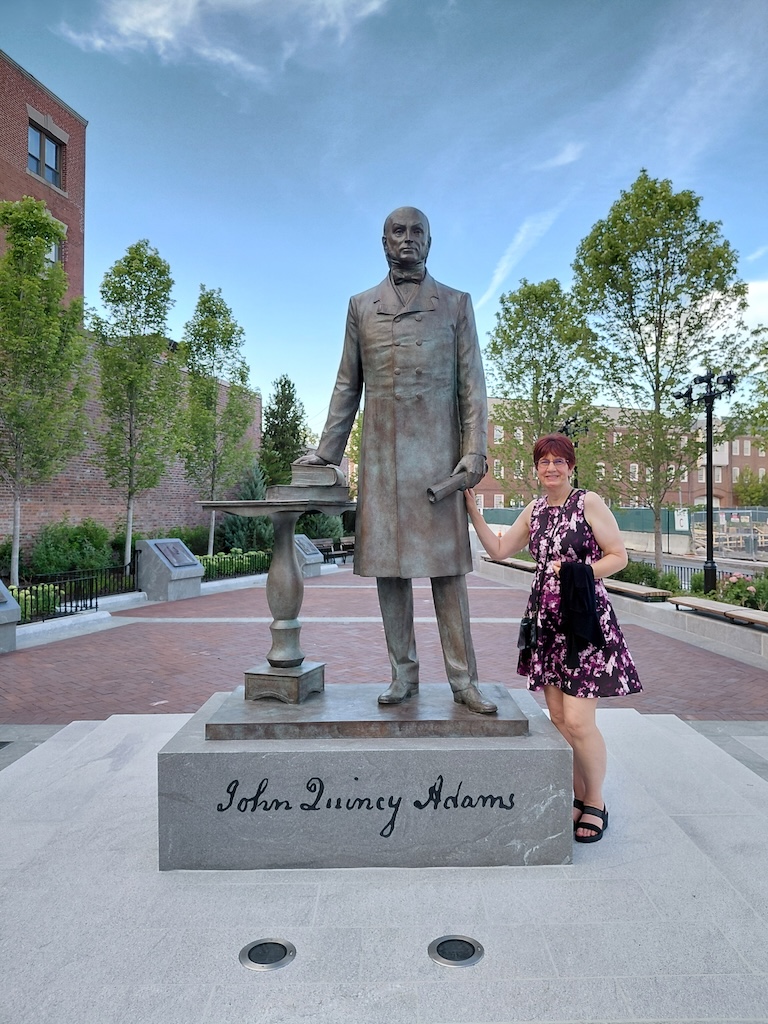
My husband, Dr. Albert J. Churella, ever the good sport about my John Adams fandom, had secured hotel reservations for us in my home from home in Quincy. The hotel is conveniently located across the street from the Quincy North T Station and makes it easy to get around Quincy on the Red Line. On the evening of July 3, after settling into our hotel, we rode the two T stops to Quincy Center. From here, it is a short walk to the Hancock-Adams Common, United First Parish Church, the Adams National Historical Park Visitors Center, and the Quincy Historical Society. As we strolled to dinner, I took the time to pose with the statues of John Adams and Abigail Adams on the Common. We also visited the new John Quincy Adams statue which I had never seen. This statue and the little park surrounding it are nice additions!
The author with Quincy’s new statue of John Quincy Adams
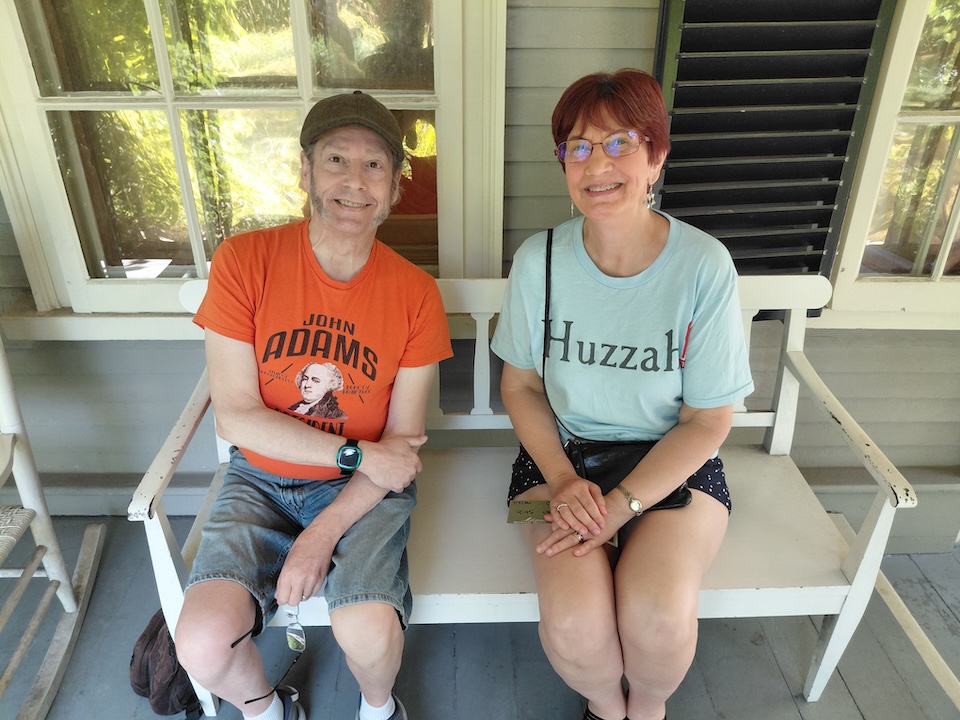
On the morning of July 4, the big day, we arrived early at the Adams National Historical Park. We knew the temperatures would soar, and the earlier we arrived the better chance we had of getting into the historic homes. Here, we met Mr. Scott McKinley, a fellow Adams family fan, and a talented voice actor as well as scholar. It was a delight to meet him and share part of the day with him.
The author (right) with Scott McKinley at Peacefield
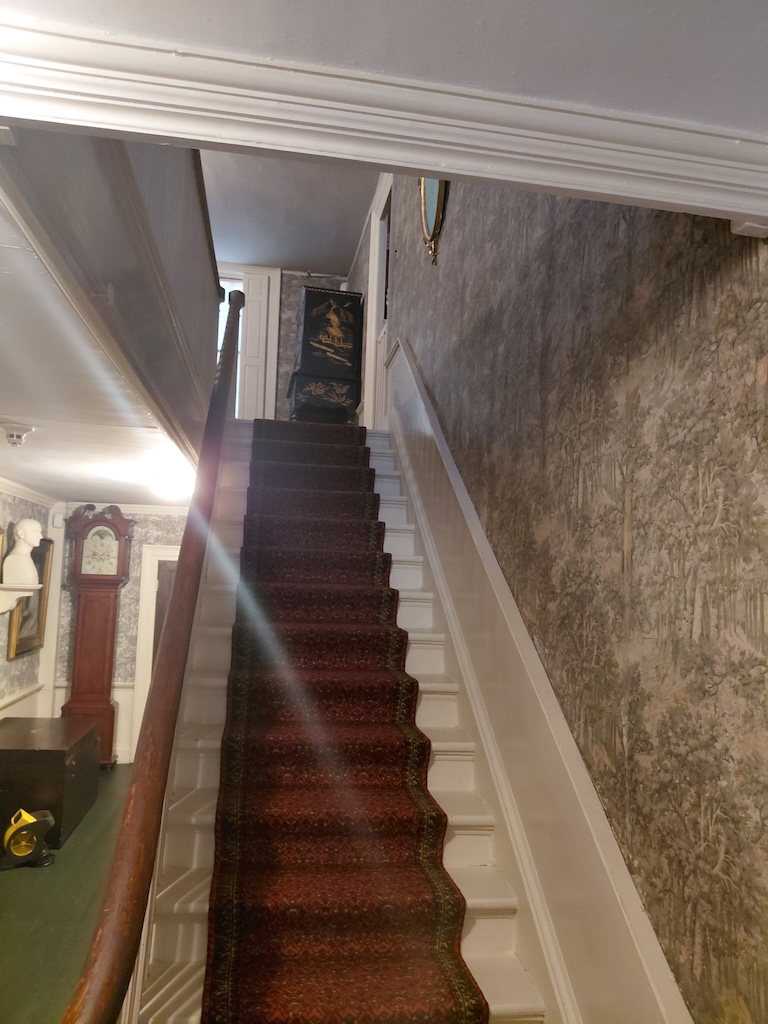
As the Visitors Center opened, we took our place in line with the other people who had decided to spend part of their day with the Adamses. We were fortunate to get a condensed tour of Peacefield in the morning as the temperatures in the house were becoming unbearable. Unfortunately, I could not see the one room that really mattered to me on that day. Reportedly, John Adams died in his upstairs study, and we were not allowed to go there due to the heat. The best thing I could do was take a picture of the staircase. However, according to our guide, one of the staff members at the park is doing some research into the exact place of John Adams’s death. He is not convinced that it happened in the study so stay tuned. I am still grateful that I was able to be in the house, however briefly.
Staircase in Peacefield to the study
One of the special events the park planned for that day was a public reading of the Declaration of Independence. Hilary Miller, Chief of Interpretation at the park, arranged for volunteers from the audience to read portions of the Declaration. Of course, all three of us in our party participated. It was a great way to remind ourselves of the power of those words. While I was disappointed that there was no programming surrounding the death of John Adams on that day (that happened the following weekend), I was happy to be a part of this nod to the Declaration of Independence.
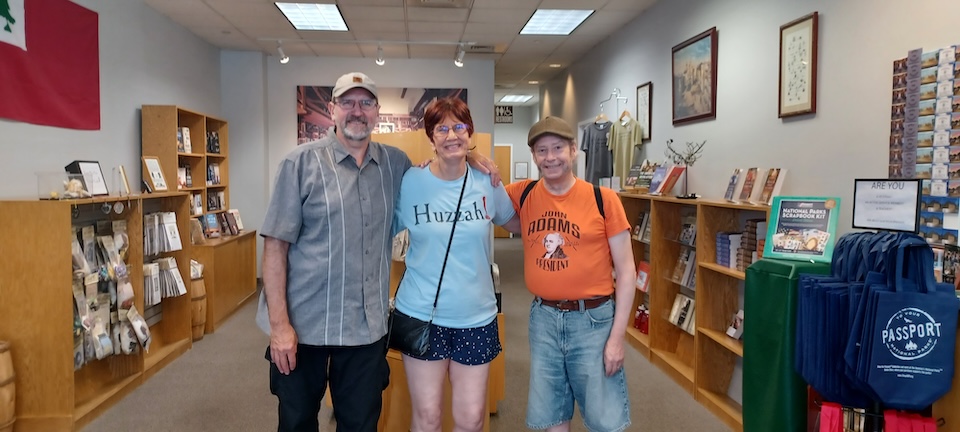
I had several nice moments that day at Adams. I was happy to see, for example, that the park is still selling my book, Remembering John Adams: The Second President in History, Memory and Popular Culture. For an academic author, seeing one’s book on sale is always a win! Yet the nicest gift of all that day came from Hilary Miller. She remembered me from past visits and had something to share with me. Miller had requested a Cameo Video from William Daniels for her team as part of their July 4th celebration. She was kind enough to show it to me! The 99-year-old actor, John Adams to so many of us, recorded a wonderful tribute to the park and thanked them for all they are doing to preserve the legacy of John Adams and his family. I was touched that Hilary wanted to share that with me, knowing how much I would appreciate it.
Albert Churella, the author, and Scott McKinley
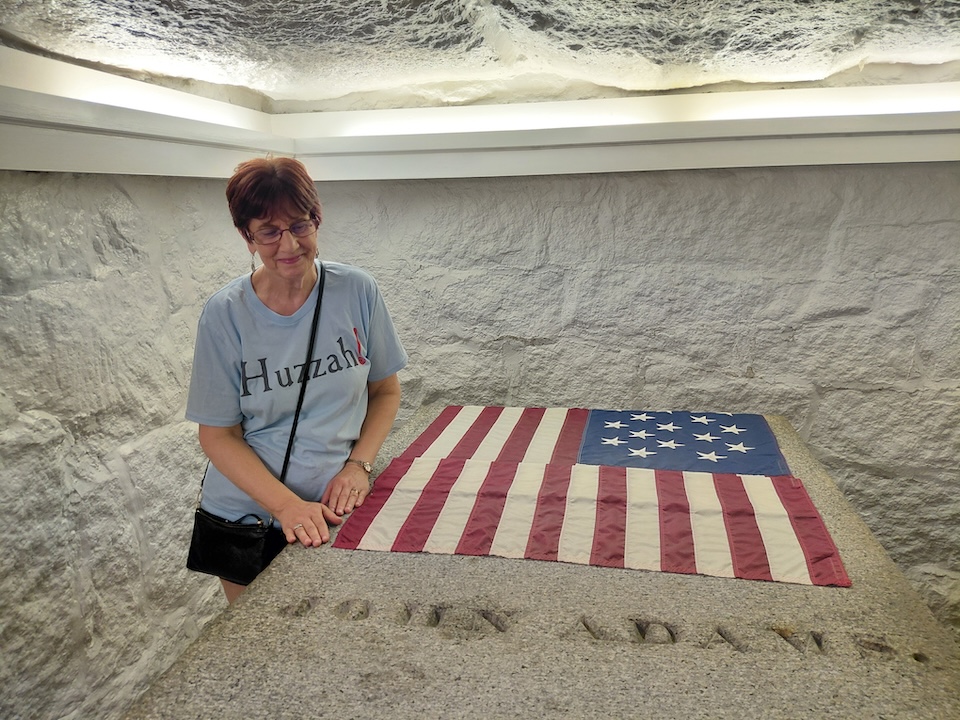
Finally, that afternoon, we arrived at United First Parish Church, or The Church of the Presidents. The church was completed in 1828 and built in part from granite donated by John Adams. He was a life-long member of the congregation here and wished to see a “Stone Temple” built to replace the wooden meeting house in his beloved town. He, along with Abigail, John Quincy Adams, and Louisa Catherine Adams, are buried in the church’s crypt. This is where I had to be, more than any other place that day. As we met up with Bill Westland, the delightful church historian who has been a tremendous help to me in my research, I prepared myself for my visit to John Adams’s grave. I knew that I would not have a moment alone there. That just doesn’t happen although I have never requested it. I was just hoping to be able to shut out everything else and pay my respects. John Adams’s words were swirling around in my brain. “Posterity! You will never know, how much it cost the present Generation, to preserve your Freedom! I hope you will make a good Use of it. If you do not, I shall repent in Heaven, that I ever took half the Pains to preserve it.”[3] “Yet through all the gloom, I can see the rays of Ravishing Light and Glory.”[4] Meanwhile, my husband was taking pictures of me so that I could remember the moment. This was my chance to pay my respects. He understood how important that was to me as did Scott.
As I was standing by John Adams’s tomb, another woman came up and said that she was there to pay her respects and thank him for his service. I was touched by this and didn’t mind sharing the moment with her. Then I had to try and put into words what I was feeling. I looked down at the tomb and asked Mr. Adams, “What do we do now?” The woman standing with me thought that was a very good question. I asked this question because I have been struggling to see those rays of ravishing light and glory lately. I love the optimism and hope in the statement, and I remind myself daily that if John Adams could say this given what he was up against then surely I can, too. Still, I needed his help that day. However, we did not get an answer to my question. Silence.
When you spend as much time studying a historical figure as I have John Adams, you believe that you can know how they would respond to questions or statements in conversation. I know what I wanted to communicate, and I was only getting started. Next, I said to John, “I’ve done the best I can for you and your legacy. Thank you for everything.” It was then that I could imagine a reply. “Thank you, Madam. And I have done the best I can for you. For all of you! What do you do now, you ask? That is up to you. I can do no more but to wish you well!” Fair enough, President Adams. Message received. And thank you!
Communicating with John on July 4, 2026.
Marianne Holdzkom, Professor of History at Kennesaw State University, is the author of Remembering John Adams: The Second President in History, Memory and Popular Culture. She is also an Adams Memorial Foundation Scholar.
[2] For the early history of this region of Massachusetts, see Nina Sankovitch, American Rebels: How the Hancock, Adams and Quincy Families Fanned the Flames of Revolution (New York: St. Martin’s Press, 2020); For exhibits and resources concerning all aspects of Quincy history, visit the Quincy Historical Society and Museum, https://quincyhistory.org/; For more info on Quincy granite, see the Quincy Quarry and Granite Workers Museum, http://www.quincyquarrymuseum.org/
Although the New York Campaign of 1776 was not General Nathanael Greene’s finest moments during the American Revolutionary War, he did rebound and become one of the premier military strategists by the end of the conflict. His views, learned on the field of battle, the bustle of various headquarters, and the countless miles of riding and marching on campaign was summed up when he wrote the following.
“Don’t be surprised if my movements don’t correspond with your Ideas of military propriety. War is an intricate business, and people are often saved by ways and means they least look for or expect.”
Military strategy, tactics, and the war that unfolded will be the topic of discussion on our Facebook page for Sunday, July 26, and the next “Rev War Revelry.” If you miss it, check out our YouTube and podcast channels as the program will be uploaded there next week. This program will also mark the debut of the newest full-time contributor and historian with Emerging Revolutionary War, Ben Powers. Although this “Revelry” will be taped, we wanted to give a bit more background about Ben, what he has written and projects moving forward. That way you can fill the comment section with questions about both military strategy and our newest blog historian. Ben had the following to say.
“I’m honored to share a few exciting milestones in my work with Emerging Revolutionary War.
Over the past several months, I’ve had the privilege of contributing a growing body of research to ERW, including:
• “Nathaniel Greene: Washington’s Strategist or Pioneering Operational Artist” (November 2025) • “The Attack and Defense of the Chew House: British Professionalism at Germantown” (March 2026) • “Brave, Meritorious, Unrewarded Kirkwood”: Unrecognized Valor in the Continental Army (April 2026) • Review of The Wandering Army: The Campaigns That Transformed the British Way of War by Huw J. Davies (April 2026) • “Embattled Farmers or Continentals?” (July 19, 2026)
In June, Emerging Revolutionary War welcomed me as a regular contributor. I am grateful to the editors and readers for the opportunity to participate in the outstanding scholarship and public history the organization produces.
I’m also pleased to be working with the ERW team on an upcoming volume to the Emerging Revolutionary War Series that will center on Race to the Dan/Guilford for the 250th. This is a long-term project, but I am looking forward to the journey.
Whether you’re interested in Revolutionary War history, military leadership, or operational art, I hope you’ll join us for the conversation.
Thank you to everyone who has read, shared, commented on, or challenged my work. As we celebrate America’s 250th anniversary, I look forward to continuing to learn, write, and contribute to the field.”
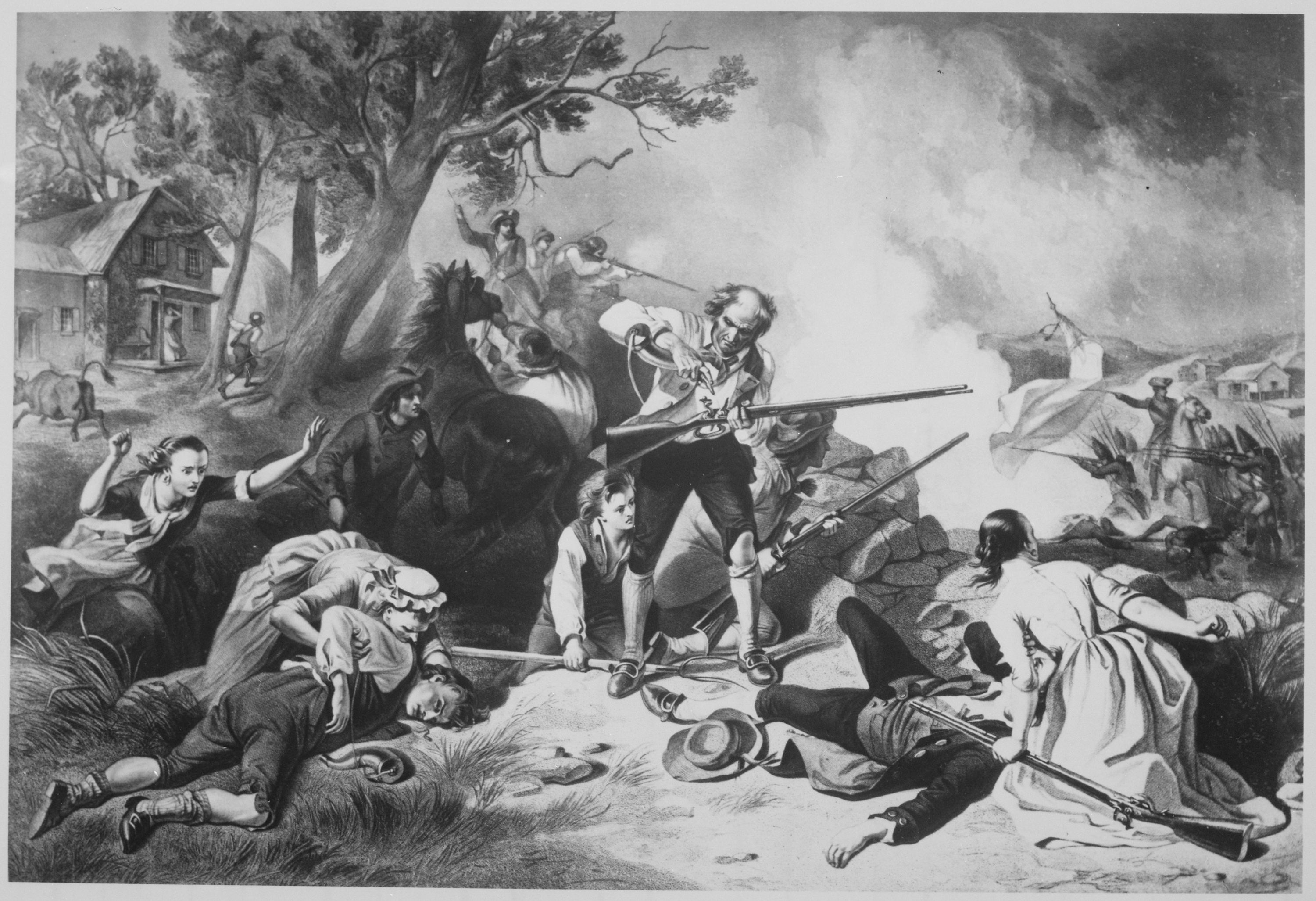
The First Blow for Liberty. Battle of Lexington, April 1775. Copy of print by A. H. Ritchie after F.O.C. Darley (Library of Congress)
There is a sense in the American military tradition that the Republic has relied on citizen-soldiers in times of crisis to bolster its army rather than maintain a large standing force. While the modern American military, post-1945, has increased in size and power to accommodate the global commitments incurred in the wake of World War II, for the bulk of American history, the United States sought to make do with a small professional force, bolstered with militias called to arms and volunteers when war threatened. While this arrangement for national defense was in part driven by fiscal concerns, as a large standing army incurs a cost to the treasury, another aspect concerned how the United States perceived itself. The early Republic, and before its establishment, the thirteen original colonies, inherited from England a distrust of standing armies and a faith in community militias. Historian John Galvin’s The Minutemen posits that the colonial militia, especially in New England, had a long tradition of active training participation, evolving organization, and combat experience prior to the commencement of hostilities on 19 April 1775, and that it was the progenitor of the American citizen-soldier who won the American Revolution.[1] In contrast, James Kirby Martin and Mark Edward Lender argue in A Respectable Army: The Military Origins of the Republic, 1763–1789 that commitment to militia duty was honored largely in the breach in the American colonies prior to the revolution, that the militia performed unevenly during the War for Independence, and that ultimately the Continental Army achieved the victory that cemented America’s freedom.[2] Martin and Lender conclude that the American tradition of a sturdy yeoman militiaman is more legend than fact and used to justify maintaining a small regular army during the early days of the republic.
The notion of the American militiaman responding to an alarm to defend his own appears repeatedly in the literature on the Revolutionary War. John Shy, in his 1962 paper on colonial military systems, described the notion underlying the efficacy of the militia system as “only when free men must themselves fight to maintain their liberty are they likely to remain free.”[3] According to Fred Anderson Berg in his encyclopedia of Continental Army forces, the militia systems of the American colonies evolved from English tradition, and were geographically organized around townships and counties, and were designed to serve for short periods, without pay, and in proximity to their homes. The intent was for them to be an “in extremis” force designed to protect their own neighborhoods. Anderson’s entry on the militia in the American Revolution paints their performance in a favorable light and does nothing to contradict the idea that militia units contributed significantly to securing American Independence.[4] David Hackett Fischer reinforces these points in his analysis of the events of April 1775, providing a brief summary of the martial qualities of the men of Massachusetts Bay Colony, specifically noting that at least once a generation between 1689 and 1763, the militia answered the call to arms in operations against indigenous peoples or French colonial opponents, either separately or in combination.[5] Despite these descriptions of militia origins, motivations, or performance, none of the writers delved into what made militia troops effective, as John Galvin did in his book The Minutemen, The First Fight: Myths and Realities of the American Revolution. Galvin first appears as an unlikely proponent of the militia tradition. He spent his career as a professional soldier, having graduated from the United States Military Academy, served multiple tours in Vietnam, and ultimately retired as a General Officer as the Supreme Commander of Allied Forces in Europe.[6] Upon closer examination, his motivation for doing so becomes apparent. Galvin was a native of Massachusetts and keenly interested in the military history of his home state. He grew up learning the myth that when the King’s troops departed Boston to collect military supplies stored in Concord, every day farmers left their homesteads, banded together against the invaders, and chased them back to whence they came. The take did not make sense to Galvin precisely because of his military training and combat experience. Such a performance in battle suggested organization, command & control, and logistical forethought rather than a spontaneous response to a threat.[7]
Galvin set out to learn the facts behind the myth and discovered that the Massachusetts troops that responded to the alarm of 19 April 1775 enjoyed substantial advantages. He learned, contrary to legend, that the colonists benefited from significant logistical and preparation and training, political support, and a highly organized administrative structure that turned the colony’s country structure into a regimental system capable of rapidly assembling combat power when required. Gavin found that this level of sophistication was the product of an evolving system of alarm companies and other community-based defensive systems dating back to the late 17th century, combined with a renewed emphasis on readiness dating from the fall of 1774, when Massachusetts Committees of Safety began preparing in earnest for what they felt was an inevitable clash with the British troops occupying the colony.[8] This combination of tradition, commitment, and anticipation resulted in a system that could be activated as required, with each participant trained and equipped for action, knowledgeable of their leadership, with an overarching command structure prepared to lead once the men took the field.[9]
Galvin paints a picture of a highly prepared and motivated militia force and documents how the Massachusetts colonists achieved this level of readiness. In contrast, James Kirby Martin and Mark Edward Leander postulate that the militia tradition had to be modified to enable the Americans to field a long-service professional force capable of meeting the British Army in sustained combat.[10]
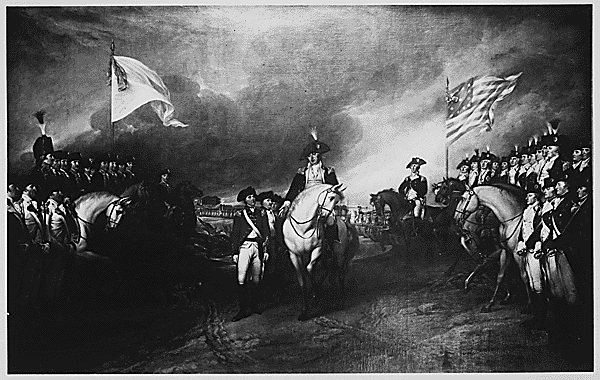
Surrender of Cornwallis. Painting by John Trumbull. (Library of Congress)
In A Respectable Army, The Military Origins of the Republic, 1763-1789, Lender and Martin do not seek to contradict Galvin, but to show that the Massachusetts militia structure was not replicated throughout all thirteen colonies in the spring of 1775, nor were even the Massachusetts militia inclined to remain in the field for prolonged operations.[11] The authors make an effective case that the militia earned an uneven reputation throughout the war, with experienced officers such as Nathaniel Greene arguing that men “coming from home with all the tender feelings of domestic life were not sufficiently fortified with natural courage to withstand the shocking scenes of war.”[12] Greene’s point is that long service in the field, under discipline and consistent training, molded men into effective combat soldiers. Lender and Martin argue that this is precisely the hardening that the Continental Army provided. The authors point out that after the opening battles of the war, the militia’s performance against British regulars was uneven at best. Militia forces provided the bulk of Washington’s troops during the ill-fated battles around New York City in the summer and fall of 1776, in which the British and Hessian troops under Howe forced Washington to evacuate the city and retreat across New Jersey to Pennsylvania by the end of the year. Despite retrieving his fortunes with lightning strikes at Trenton and Princeton in December 1776 and January 1777, Washington’s fortunes were at a low ebb, and he sought to rebuild his Army into a more professional force capable of holding its own in the field. Lender and Martin document that he was able to do just that, relying more on long-service volunteers than short-service militia to achieve his ends. The reality of Continental Army service clashed with the myth of the virtuous citizen-soldier: Washington’s troops were not yeomen protecting home and hearth, but men on the margins of society hoping to improve their fortunes through military service. They were available to serve precisely because they did not have a large stake in the day-to-day running of their home communities.[13]
Galvin presents a contrasting argument to Martin and Lender regarding the militia’s contribution to victory in the American Revolution. While Galvin’s arguments are well-documented, his focus is narrowly oriented toward the Massachusetts colony and the events of April 1775. He does not extrapolate his conclusions to the militia’s overall contribution throughout the war, whereas Martin and Lender demonstrate that militia quality was uneven, combat performance was lacking, and that the military leaders of the United States sought to create a more professional force to achieve military success.
Bibliography
Berg, Fred Anderson. Encyclopedia of Continental Army Units: Battalions, Regiments and Independent Corps. Harrisburg, PA: Stackpole Books, 1972.
Fischer, David Hackett. Paul Revere’s Ride. New York: Oxford University Press, 1994.
Galvin, John R. The Minute Men: A Compact History of the Defenders of the American Colonies, 1645–1775. New York: Hawthorn Books, 1967.
Martin, James Kirby, and Mark Edward Lender. A Respectable Army: The Military Origins of the Republic, 1763–1789. Arlington Heights, IL: Harlan Davidson, 1982.
Shy, John. A People Numerous and Armed: Reflections on the Military Struggle for American Independence. New York: Oxford University Press, 1976.
[1] John R. Galvin, The Minute Men: A Compact History of the Defenders of the American Colonies, 1645–1775 (New York: Hawthorn Books, 1967), 59-67.
[2] James Kirby Martin and Mark Edward Lender, A Respectable Army: The Military Origins of the Republic, 1763–1789 (Arlington Heights, IL: Harlan Davidson, 1982), 45.
[3] John Shy, A People Numerous and Armed: Reflections on the Military Struggle for American Independence (New York: Oxford University Press, 1976), 31.
[4] Fred Anderson Berg, Encyclopedia of Continental Army Units: Battalions, Regiments, and Independent Corps(Harrisburg, PA: Stackpole Books, 1972), 76-77.
[5] David Hackett Fischer, Paul Revere’s Ride (New York: Oxford University Press, 1994), 151.






 Emerging Revolutionary War Era