

EDITOR’S NOTE: Emerging Revolutionary War has been pleased to co-sponsor a series of Monday-evening programs to commemorate the America 250th at St. Bonaventure University, where contributor Chris Mackowski teaches. In March, the line-up of programs featured a student research panel. We are pleased to present today the work of one of the “emerging scholars” from that panel, Alex Payne.
Alex is a junior Theology and Franciscan Studies and History double-major from Shinglehouse, PA, with a minor in classics.
———
Sailor’s ballads in the late 17th and early 18th centuries communicated revolutionary sentiment that influenced the ideological origins of the American Revolution. Sailors’ ballads from revolutionary Atlantic history show how labor culture intersected with protest, emerging revolutionary sentiment, and identity formation. These protest and revolutionary ballads are what I refer to as “records of thought” of oppressed people. By “records of thought,” I mean oral traditions in the form of songs sung by people who were religiously and civilly oppressed that have been written down and transmitted through centuries.
The starting point of the record of thought of oppressed people is with the “Diggers’ Song” attributed to Gerard Winstanley. Winstanley was the leader of the Diggers, similar to but separate from the Leveller movement that emerged during the English Civil Wars between 1641–1659. The Diggers, known to history as radical land reformists, were led by Winstanley. They believed in an agrarian socialism and would “dig up” the land that was unjustly and inhumanly taken from the English commoners. The oppression they endured is found in the record of thought appropriately named “The Diggers’ Song.” This ballad was sung on St. George’s Hill in Surrey around 1649 by 20–30 men. It reads:
Your houses they pull down to fright your men in town,
But the gentry must come down, and the poor shall wear the crown.
Stand up now, Diggers all.
Your freedom to uphold, seeing Cavaliers are bold
To kill you if they could, and rights from you to hold.
Theire self-will is theire law.
The club is all their law to keep men in awe,
Buth they no vision saw to maintain such a law.
Stand up now, Diggers all.
The Digger’s named their oppressor as “the Cavaliers,” which was a party for the king. The line “The club is all their law” highlights a system of violent monarchal authority. The king and the Navy enforced the suppression, violence, and death of tens of thousands of people in England at this time through starvation, war, and Naval impressment into the maritime labor force.[1] Impressment was the forceable or coerced recruitment of seafarers. Men were harried and spirited from towns, off the shores of colonies, and from other Navy and merchant ships.
Maritime workers’ legacy of protest and resistance stemmed from the English Civil wars. These people multiplied and pervaded the Atlantic. They transmitted revolutionary language throughout the world against royalists, the king, and the British Navy from generation to generation, for the next two hundred years through their records of thought as oppression people. The New Model Army, from 1651 on, would become the new tyrannical face of the imperial intruder for sailors and commoners on and offshore, especially through impressment.[2] This direct assault on personal liberty and freedom of movement, not to mention economic control and indirect impoverishment of many families, would fuel the conflict into full-blown revolution.[3]
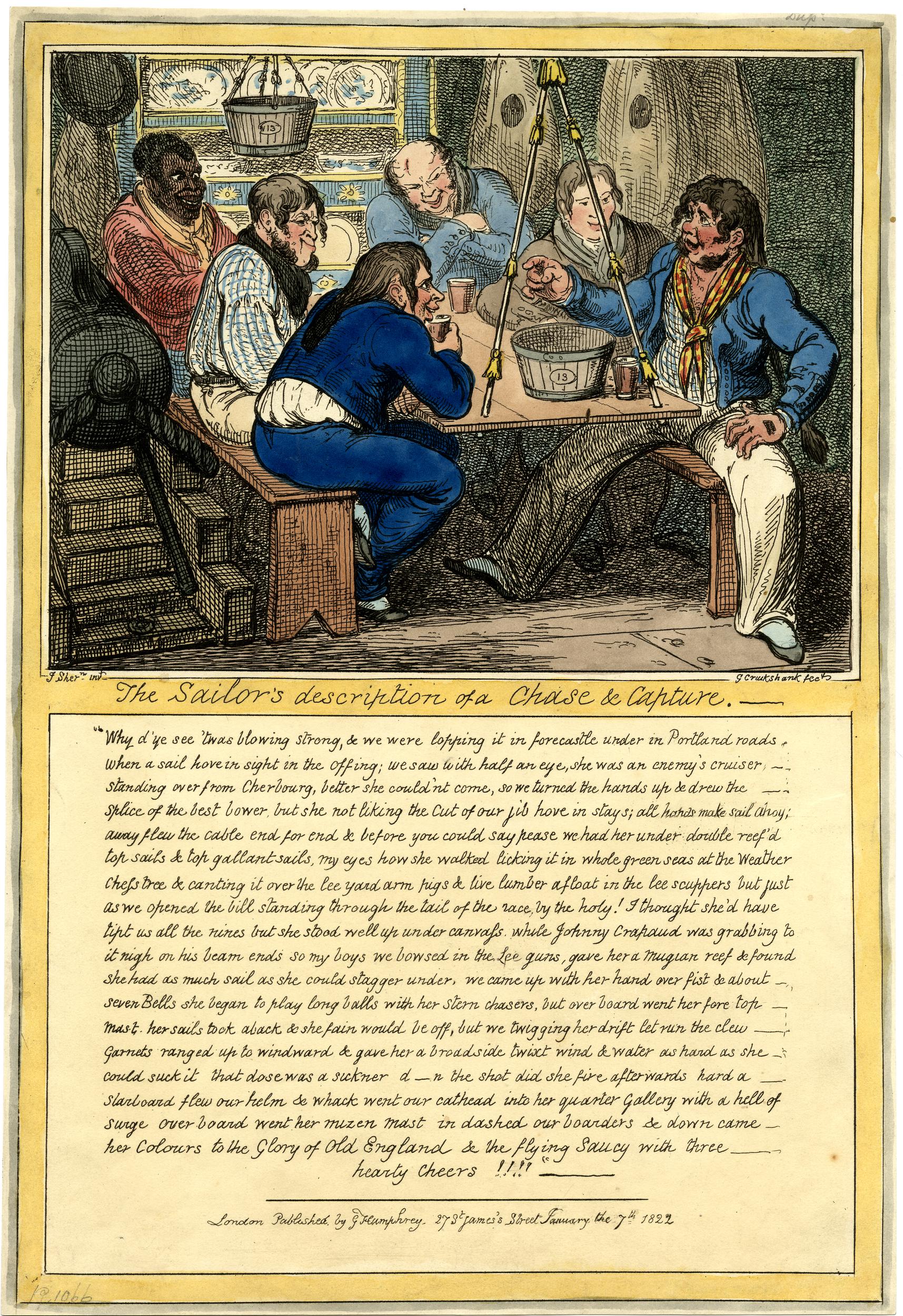
The next record of thought of oppressed people can be traced onto ships, which became a capitalistic prison system. These wooden worlds were filled with victims of impressment, slavery, and blatant human trafficking.[4] Historian Marcus Rediker explains that “work at sea meant virtual incarceration, as the seaman was forcibly assimilated into a severe shipboard regimen of despotic authority, discipline, and control” and was intensely personal.[5] Physical violence, verbal intimidation, and psychological warfare crippled the seamen into submission or into heated vengeance.
Tomas Paine used impressment as a prime example of the “absurdities of subjected hood under monarchy” in future American revolutionary literature.[6] Sailors’ experience of these “absurdities” was a shared experience. Seamen gathered to enjoy one another’s company through collections of songs, poems, and ballads, which “acted to solidify the forecastle community by highlighting cultural priorities” and “shared values of their occupation.”[7]
One of the most important liberties mentioned in ballads that was consistently encroached on was that of pay and “usage,” or treatment. Pay and usage go hand in hand for the seaman in his fight for liberty and freedom.[8]
The seamen’s plight, where they “endured ‘Barbous & Unhumane Usage from their Commander’” is found in a ballad used repeatedly at the gallows by maritime victims.[9] This execution hymn titled “The Sea-Martyrs; Or, The Seamen’s Sad Lamentation for Their Faithful Service, Bad Pay, and Cruel Usage” was a record of revolutionary language against the imperial intruder of land, sea, life, and liberty. It reads,
Thus our new Government does subject serve,
And leaves them this sad choice; to hang or starve.
And when they for their pay did hope
They were rewarded with a rope.
Nay, some did ‘gainst their conscience fight
To do some great ones too much right;
And now, oh, barbarous tyranny!
Like men they fought, like dogs they dye.
These verses contain the reality seamen found themselves in, how they were perceived, and how they perceived themselves. They protested tyranny, liberty of conscience, their “starving families at home” who “expected their slow pay would come,” and against the king and queen themselves who “some mercifull call, but seamen find it not at all.” The ballad continues,
To robbers, thieves, and felons they
Freely grant pardons ev’ry day;
Only poor seamen, who alone
Do keep them on their father’s throne,
Myst have at all no mercy shown
The hymn continues protesting liberty, pay, and property with the sailors begging “us from lawless rule deliver . . . thus they the seamen’s martyrs dye.” They request rebellious action to be taken against the memory of tyrannical injustices and oppression of their rights and self-autonomy. The continual martyrdom of sailors throughout the Atlantic sang various ballads, including “The Seamen’s Sad Lamentation.” These sailors’ future generations who carried this memory would promise that “the more martyrs you make, the more numerous the sons of liberty will become. They will multiply like the hydra, and hurl vengeance upon your heads.” In other words, what goes around comes around.[10]
Admiral Peter Warren warned in 1745 that the sailors of New England were emboldened by a revolutionary heritage: they had “the highest notions of the rights and liberties of Englishmen and indeed are almost Levellers.”[11] The records of thought of oppressed people echoed through the Atlantic as the American colonies broke out in war in 1775.
Throughout the war, ballads and songs of sailors bolstered revolutionary morale in the colonies and made their way across the sea to Forton Prison in England. In 1778, Forton prisons were holding American captives from the Revolution. One sailor, Timothy Conner, wrote down seamen’s poetry and ballads in a journal. This record of thought of oppressed people shows important identity formation. Their cause is not for reformation of a monarch but for a just cause of life and liberty. This cause has been with these sailors since 1640 and now America, this body of universal people, has declared its independence.[12] The songs reads:
In support of the thirteen states
For which we indured captivity
The motto now that cures all fates
For me is Death or Liberty
And let’s be resolute and brave
O see how just our cause appears
For independence we shall have
If we fight for it fifth years.
These narratives of self-identity and self-determination shaped the ideological origins of the American Revolution, evolving from the English civil wars into and after the American Revolution. Ballads constructed and sung collectively by seafarers shaped the revolutionary expression of life, liberty, and the pursuit of happiness. The American Revolution should not be understood simply as a dispute over taxation or elite Enlightenment project. It has a much richer history and longer Atlantic tradition of protest and resistance in which ballads created by sailors preserved these grievances, spread political memory, and shaped revolutionary action.
[1] Peter Linebaugh and Marcus Rediker. The Many-Headed Hydra: Sailors, Slaves, Commoners, and the Hidden History of the Revolutionary Atlantic (Beacon Press, 2000); Marcus Rediker Between the Devil and the Deep Blue Sea: Merchant Seamen, Pirates, and the Anglo‑American Maritime World, 1700–1750 (Cambridge University Press, 1987).
[2] Donoghue, Fire Under the Ashes, 216. See Linebaugh and Rediker, 151, 160. The argument here is the New Model Army propelled impressment via their expansion. The treatment by the army was found worse than by merchant captains.
[3] Christopher Magra, Poseidon’s Curse (Cambridge University Press. 2016). See chapter “Merchants and Mare Liberum on this topic.
[4] The term “wooden world” can be found in various literature. I am citing it from Brunsman, Denver. “Subjects vs. Citizens: Impressment and Identity in the Anglo-American Atlantic.” Journal of the Early Republic, vol. 30, no. 4, 2010, 557–86. For impressment on and off land see, Magra, Poseidon’s Curse, 58.
[5] Rediker, Between the Devil and the Deep Blue Sea, 159, 218.
[6] Thomas Paine, Thomas Paine’s Common Sense: the Call to Independence. Woodbury, N.Y. : Barron’s Educational Series, inc., 1975.
[7] Brian J. Rouleau, “Dead Men Do Tell Tales: Folklore, Fraternity, and the Forecastle.” Early American Studies, vol. 5, no. 1, 2007, 30–62; Linebaugh and Rediker, 159.
[8] Rediker, 130. Rediker looks at the embezzlement by the purser, captain, and supercargoes.
[9] Ibid., 231.
[10] Linebaugh and Rediker, 341.; T. B. Howell, ed., State Trials 25:1099.
[11] Peter Warren to the Duke of Newcastle, June 18, 1745, in Gwyn, Royal Navy and North America, 125–26 (quotation, 126).
[12] George G. Cary, A Sailor’s Songbag: An American Rebel in an English Prison, 177-1779. (University of Massachusetts Pess, Amherst 1976.)


What it would be to feel here today the spirit of that New England, you describe, and see perhaps the Taunton Flag fly over the many pretenders with her older bill of rights Englished and full.
A wonderful read, thank you. Particularly of the Diggers who I knew little of.
LikeLike