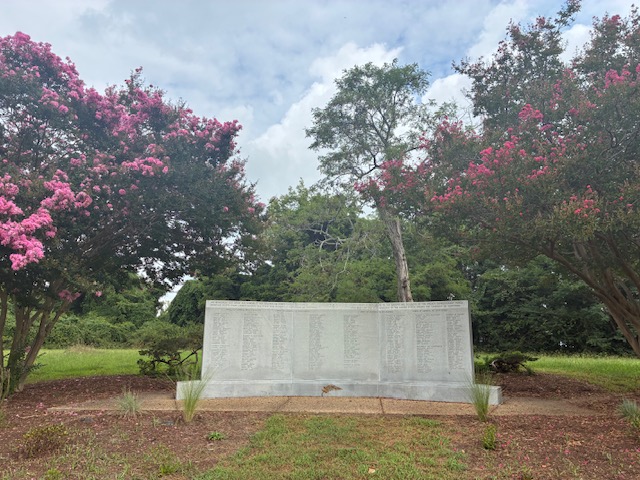
Situated near the York River, across the street from the American Revolution Museum of Yorktown, sits a monument commemorating the French soldiers that fought, bled, and for some, gave their lives during the siege.
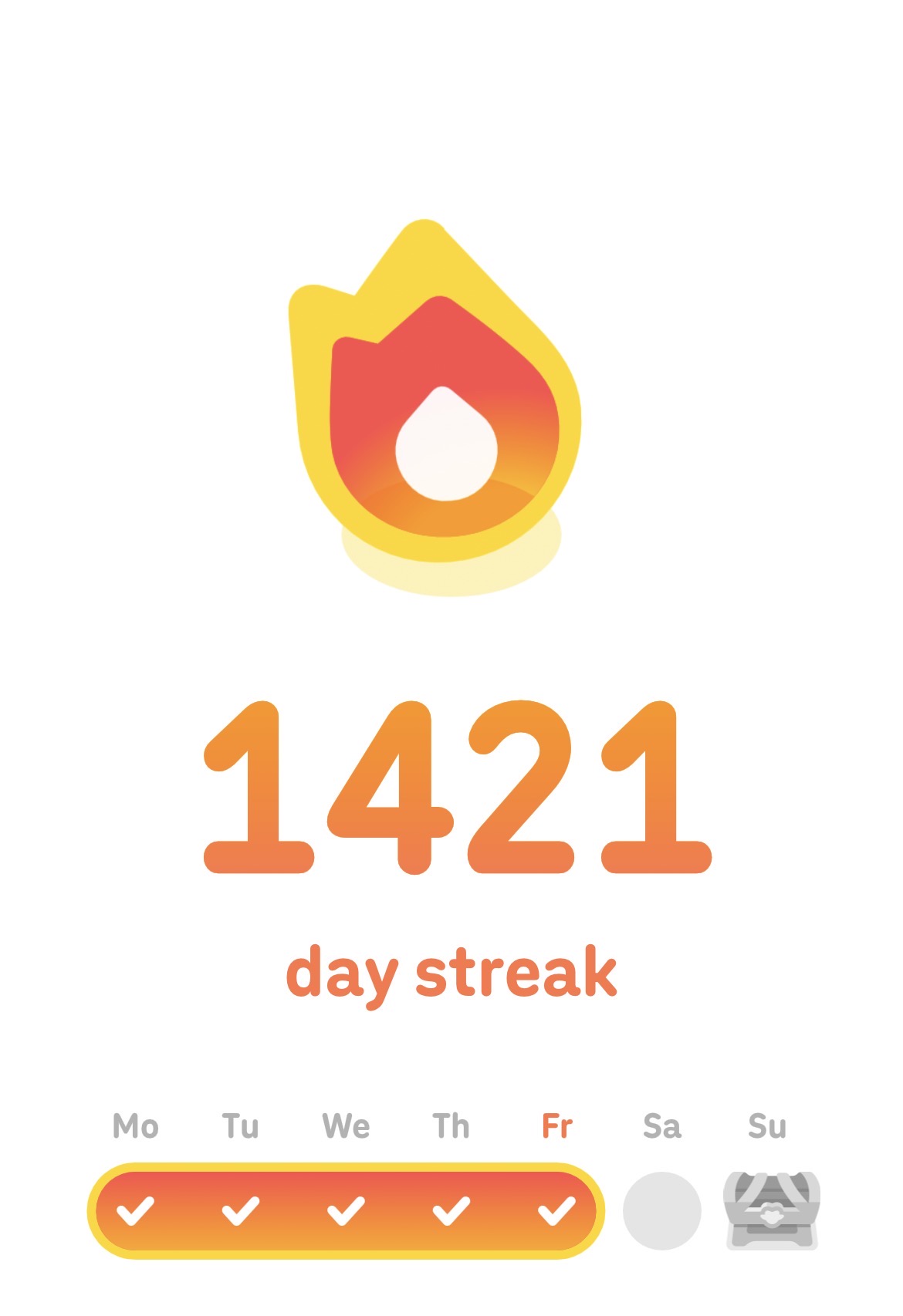
A few years ago, or 1421 days ago to be exact, I pulled over into the parking lot for that monument, walked up, and gave a cursory look at the names and the wording. I did not speak or read French–much to the detriment of my French teacher in high school I must say–but determined there that I would. Later that same evening I downloaded the language learning app Duolingo and started a streak, which if you had not guessed already, has reached 1421 straight days.
I recently went back to that monument and could at least interpret enough of the wording to understand the gist. Good start.
The monument in question Author collection
I now take that rudimentary language foundation capability on the road. Where may you ask?
Screenshot to confirm streak
Next week, after deciding approximately a whole 10 days ago, that following the wedding of a cousin in Connecticut, I would drive the remaining 7 hours to Quebec, Canada. Impromptu? Kind of. Just have to remember to pack my passport!
A bucket list item of mine in the history column is to see the famous Plains of Abraham, from one of the climactic battles of the French and Indian (Seven Years’ War), fought 267 years ago this month, on September 13. I also want to walk the last footsteps of General Richard Montgomery as he led an unsuccessful attack by the fledging rebellious American military against the British during the first winter of the American Revolution. I may have missed the anniversary but at least I am within the same year-ish (since the battle was fought on New Year’s Eve 1775).
Side note, Maryland honors Montgomery by a county named in his honor, one of, if not the first, place, county, town, etc. to be named for a person not related to the British monarchy, aristocracy, or gentry. Along with Washington, the two counties in Maryland were siphoned off of Frederick in 1776.
Stay tuned next, week to Emerging Revolutionary War’s Facebook page as I will go live there.
And then I will retreat to a Quebec cafe…or brewery and test out my French…so if you have a suggestion of a can’t miss place, drop a comment below!
This week, during a conference call, someone asked Rob Orrison, Neil Chatelain, and me, “Which figure from the Revolution is ERW most like?”
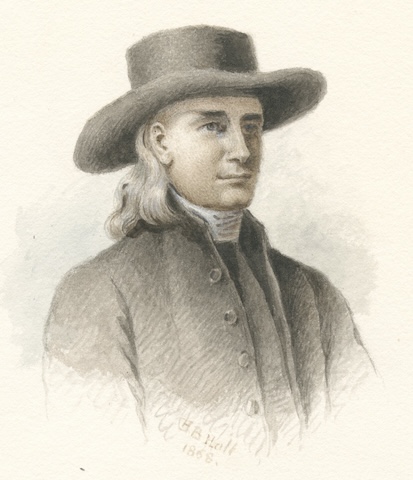
Stephen Hopkins
The first person who jumped to mind was Stephen Hopkins of Rhode Island. Although none of us wears a cool hat like Hopkins does, it was easy to think of ERW as the guy in the back of the room, drinking a mug of rum or beer or grog and offering commentary on events. Hopkins had served several stints as Rhode Island’s colonial governor and served as chief justice of the colonial court during the infamous Gaspée affair. He was good natured and earnest, and John Adams said, “He kept us alive” with his energy. “Hopkins never drank to excess,” Adams said, “but all he drank was immediately not only converted into Wit, Sense, Knowledge and good humor, but inspired Us all with similar qualities.”
Or how about John Adams, as Rob suggested? (He knew I’d love that one!) Not only was Adams a writer, he was also a workhorse, like most of the regular contributors who keep ERW going—a small cadre of folks who each do a lot of work. Adams was also prickly, Rob pointed out, just as many of ERW’s folks are (a bit of self-revealing honesty there!). Adams preferred beer to cider, so I thought we’d have to swap that out, but Rob reminded me that few of us would turn down free cider.
I suggested Ben Franklin. Franklin had a background in printing and writing—something central to ERW—and was also generally good humored. He liked to have a good time—“Perhaps too good of a time,” someone in the conversation piped in—and always situated himself at the social center of any scene. ERW is, if nothing else, social. Rob did point out that Franklin was a genius in many, many areas, while ERW is pretty focused in its work, but personality wise, it’s a good match.
The question put us on the spot, so those were our initial answers. What do YOU think? If ERW was a figure from the Revolution, who would ERW be most like?
Emerging Revolutionary War welcomes guest historian Tom Elmore.
Throughout history many battles have been decided by little things, sometimes even before the battle. This is true of the Battle of Kings Mountain in South Carolina whose outcome was influenced by a little-known battle about thirty miles away on July 26, 1780, at Fort Thicketty in modern-day Cherokee County, S.C.
The fort was built circa 1769 when local farmer David Anderson converted his barn into a blockhouse outpost. Originally called Fort Anderson, it became known as Fort Thicketty (or Thicketty Fort) after a near-by creek that had unusually thick vegetation along its banks. Though the fort was intended to defend the area population from hostile Native Americans, it mainly saw action against outlaw gangs.[i]
In early June 1780, the fort was occupied by Captain Patrick Moore and his Loyalist followers. Moore was born in Virginia in 1750. Since 1768 he had lived about a mile southwest of the fort along Thicketty Creek. He was described as a fierce, intimidating man who stood six foot seven.[ii]
Moore’s men used the fort as a base of operations for raiding Patriot’s homes and farms. One historian described his men as “politically neither British nor American. They were simply robbers…preying upon defenseless women and children.” Another historian noted that “[Fort Thicketty] became a great place of resort and protection for Tory parties. They would sally forth and plunder Whig families in every direction – so that women and children were often left without clothing, shoes, bread, meat, or salt.” [iii]
ERW is pleased to welcome back guest author Marianne Holdzkom.
July 4, 2026, was a big moment for the United States. This day marked the 250th anniversary of the adoption of the Declaration of Independence, what many call the birthday of the United States. As people were making plans, the question was always, “Where do you want to spend this important anniversary?” There were certainly many fantastic choices: New York City, Boston, Philadelphia, and Colonial Williamsburg, just to name a few. Yet I have known for a number of years where I would be. It was a no-brainer. I would spend that day in Quincy, Massachusetts. There is no place else for me. Not only was this 4th the 250th birthday of the Declaration of Independence, but it also marked the 200th anniversary of the deaths of John Adams and Thomas Jefferson—fifty years to the day that the Declaration was adopted by the Continental Congress. It was that anniversary that drew me to Quincy. As a John Adams scholar, I was compelled to be in the town where he lived and where he died. I needed to pay my respects. While others were deciding what fireworks display to see, I was on a mission: Quincy or bust!
Even when Adams was serving abroad, his hometown was never far from his thoughts. “I know not the Reason but there is some Strange Attraction between the North Parish in Braintree [now Quincy] and my Heart,” he wrote to Abigail. “It is a remarkable Spot. It has vomited Forth more Fire than Mount Etna. It has produced three mortals, Hancock and two Adams’s, who have, with the best Intentions in the World, set the World in a blaze.”[1] He was writing from Paris at the time. Now, as the locals will tell you, Quincy is full of history that goes well beyond the Adamses. From the early years of the Massachusetts Bay colony, this region has been one of the historically richest areas of the country. Even in the early colonial period, the South Shore was the center of controversy with the antics of Thomas Morton and some of the Puritan disputes of the 17th century taking place here. The city also honors the history of the Quincy family for which the town was named. In addition, Quincy is the birthplace of both Dunkin’ Donuts and Howard Johnson. There is also a Quincy Quarry and Granite Workers Museum in the city.[2] There is no doubt that the city’s history is fascinating. Yet the attraction for many is always the remarkable Adams family. In this Semiquincentennial year, when Americans are remembering their founding moment, many of us came to Quincy to honor John Adams.
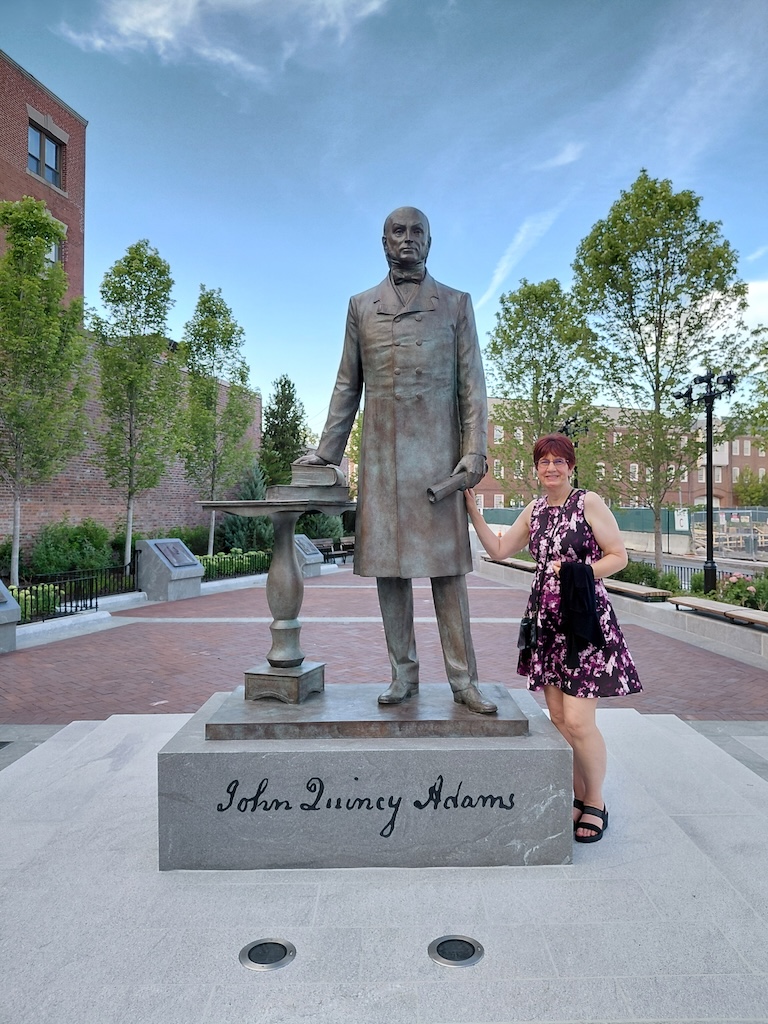
My husband, Dr. Albert J. Churella, ever the good sport about my John Adams fandom, had secured hotel reservations for us in my home from home in Quincy. The hotel is conveniently located across the street from the Quincy North T Station and makes it easy to get around Quincy on the Red Line. On the evening of July 3, after settling into our hotel, we rode the two T stops to Quincy Center. From here, it is a short walk to the Hancock-Adams Common, United First Parish Church, the Adams National Historical Park Visitors Center, and the Quincy Historical Society. As we strolled to dinner, I took the time to pose with the statues of John Adams and Abigail Adams on the Common. We also visited the new John Quincy Adams statue which I had never seen. This statue and the little park surrounding it are nice additions!
The author with Quincy’s new statue of John Quincy Adams
On the morning of July 4, the big day, we arrived early at the Adams National Historical Park. We knew the temperatures would soar, and the earlier we arrived the better chance we had of getting into the historic homes. Here, we met Mr. Scott McKinley, a fellow Adams family fan, and a talented voice actor as well as scholar. It was a delight to meet him and share part of the day with him.
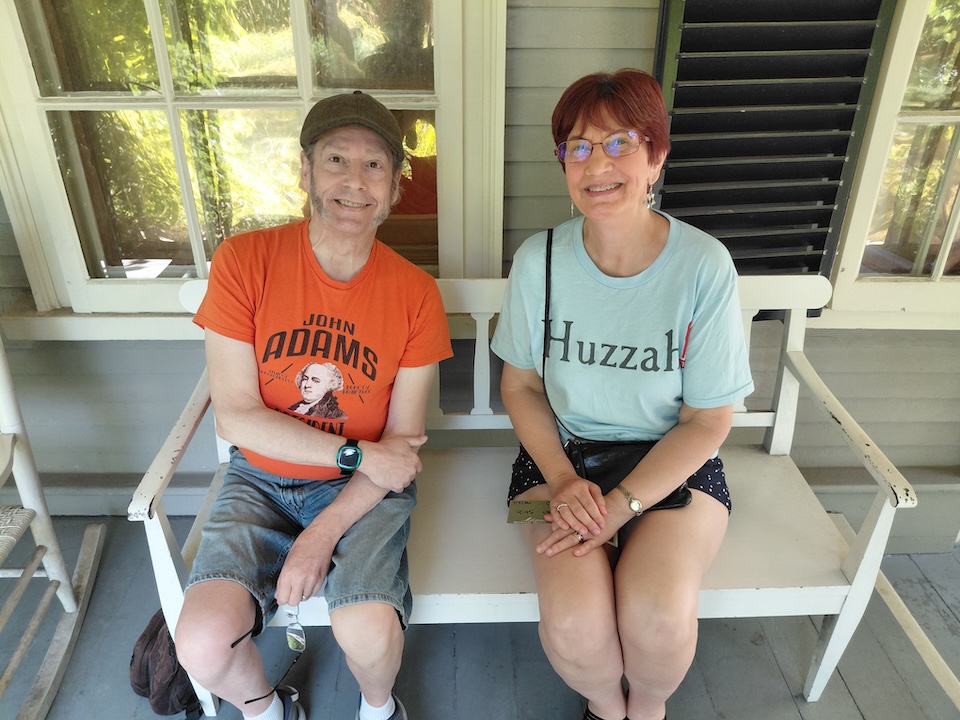
The author (right) with Scott McKinley at Peacefield
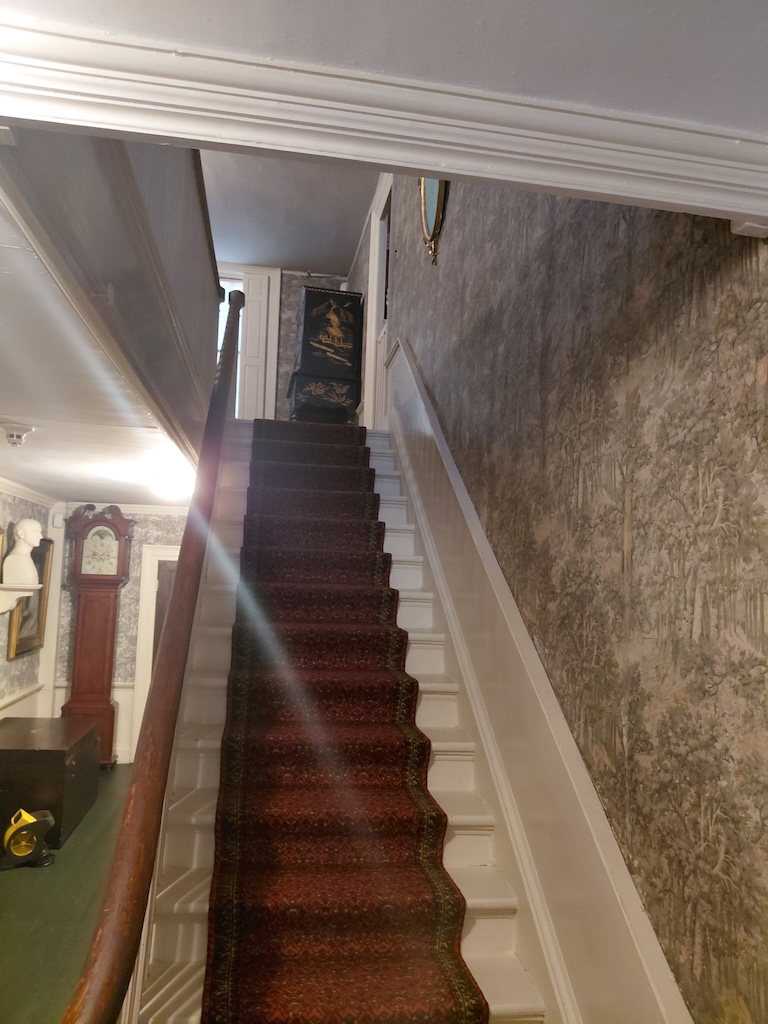
As the Visitors Center opened, we took our place in line with the other people who had decided to spend part of their day with the Adamses. We were fortunate to get a condensed tour of Peacefield in the morning as the temperatures in the house were becoming unbearable. Unfortunately, I could not see the one room that really mattered to me on that day. Reportedly, John Adams died in his upstairs study, and we were not allowed to go there due to the heat. The best thing I could do was take a picture of the staircase. However, according to our guide, one of the staff members at the park is doing some research into the exact place of John Adams’s death. He is not convinced that it happened in the study so stay tuned. I am still grateful that I was able to be in the house, however briefly.
Staircase in Peacefield to the study
One of the special events the park planned for that day was a public reading of the Declaration of Independence. Hilary Miller, Chief of Interpretation at the park, arranged for volunteers from the audience to read portions of the Declaration. Of course, all three of us in our party participated. It was a great way to remind ourselves of the power of those words. While I was disappointed that there was no programming surrounding the death of John Adams on that day (that happened the following weekend), I was happy to be a part of this nod to the Declaration of Independence.
I had several nice moments that day at Adams. I was happy to see, for example, that the park is still selling my book, Remembering John Adams: The Second President in History, Memory and Popular Culture. For an academic author, seeing one’s book on sale is always a win! Yet the nicest gift of all that day came from Hilary Miller. She remembered me from past visits and had something to share with me. Miller had requested a Cameo Video from William Daniels for her team as part of their July 4th celebration. She was kind enough to show it to me! The 99-year-old actor, John Adams to so many of us, recorded a wonderful tribute to the park and thanked them for all they are doing to preserve the legacy of John Adams and his family. I was touched that Hilary wanted to share that with me, knowing how much I would appreciate it.
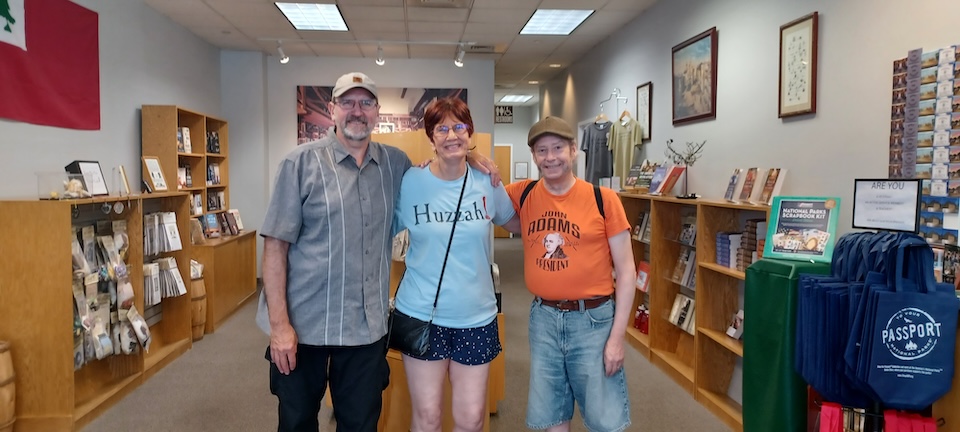
Albert Churella, the author, and Scott McKinley
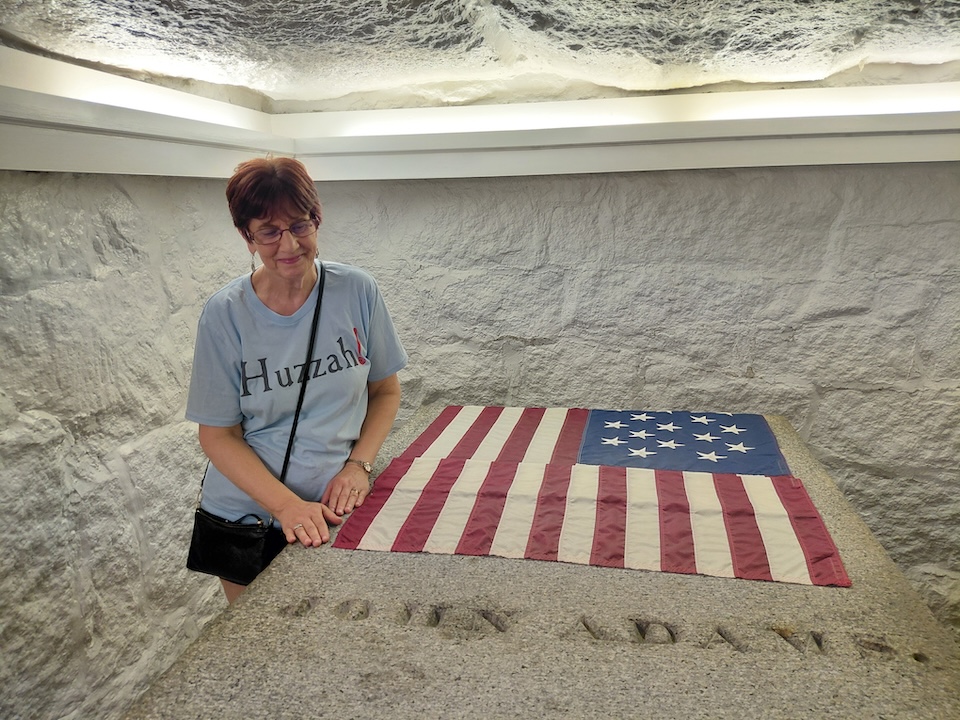
Finally, that afternoon, we arrived at United First Parish Church, or The Church of the Presidents. The church was completed in 1828 and built in part from granite donated by John Adams. He was a life-long member of the congregation here and wished to see a “Stone Temple” built to replace the wooden meeting house in his beloved town. He, along with Abigail, John Quincy Adams, and Louisa Catherine Adams, are buried in the church’s crypt. This is where I had to be, more than any other place that day. As we met up with Bill Westland, the delightful church historian who has been a tremendous help to me in my research, I prepared myself for my visit to John Adams’s grave. I knew that I would not have a moment alone there. That just doesn’t happen although I have never requested it. I was just hoping to be able to shut out everything else and pay my respects. John Adams’s words were swirling around in my brain. “Posterity! You will never know, how much it cost the present Generation, to preserve your Freedom! I hope you will make a good Use of it. If you do not, I shall repent in Heaven, that I ever took half the Pains to preserve it.”[3] “Yet through all the gloom, I can see the rays of Ravishing Light and Glory.”[4] Meanwhile, my husband was taking pictures of me so that I could remember the moment. This was my chance to pay my respects. He understood how important that was to me as did Scott.
As I was standing by John Adams’s tomb, another woman came up and said that she was there to pay her respects and thank him for his service. I was touched by this and didn’t mind sharing the moment with her. Then I had to try and put into words what I was feeling. I looked down at the tomb and asked Mr. Adams, “What do we do now?” The woman standing with me thought that was a very good question. I asked this question because I have been struggling to see those rays of ravishing light and glory lately. I love the optimism and hope in the statement, and I remind myself daily that if John Adams could say this given what he was up against then surely I can, too. Still, I needed his help that day. However, we did not get an answer to my question. Silence.
When you spend as much time studying a historical figure as I have John Adams, you believe that you can know how they would respond to questions or statements in conversation. I know what I wanted to communicate, and I was only getting started. Next, I said to John, “I’ve done the best I can for you and your legacy. Thank you for everything.” It was then that I could imagine a reply. “Thank you, Madam. And I have done the best I can for you. For all of you! What do you do now, you ask? That is up to you. I can do no more but to wish you well!” Fair enough, President Adams. Message received. And thank you!
Communicating with John on July 4, 2026.
Marianne Holdzkom, Professor of History at Kennesaw State University, is the author of Remembering John Adams: The Second President in History, Memory and Popular Culture. She is also an Adams Memorial Foundation Scholar.
[2] For the early history of this region of Massachusetts, see Nina Sankovitch, American Rebels: How the Hancock, Adams and Quincy Families Fanned the Flames of Revolution (New York: St. Martin’s Press, 2020); For exhibits and resources concerning all aspects of Quincy history, visit the Quincy Historical Society and Museum, https://quincyhistory.org/; For more info on Quincy granite, see the Quincy Quarry and Granite Workers Museum, http://www.quincyquarrymuseum.org/
Although the New York Campaign of 1776 was not General Nathanael Greene’s finest moments during the American Revolutionary War, he did rebound and become one of the premier military strategists by the end of the conflict. His views, learned on the field of battle, the bustle of various headquarters, and the countless miles of riding and marching on campaign was summed up when he wrote the following.
“Don’t be surprised if my movements don’t correspond with your Ideas of military propriety. War is an intricate business, and people are often saved by ways and means they least look for or expect.”
Military strategy, tactics, and the war that unfolded will be the topic of discussion on our Facebook page for Sunday, July 26, and the next “Rev War Revelry.” If you miss it, check out our YouTube and podcast channels as the program will be uploaded there next week. This program will also mark the debut of the newest full-time contributor and historian with Emerging Revolutionary War, Ben Powers. Although this “Revelry” will be taped, we wanted to give a bit more background about Ben, what he has written and projects moving forward. That way you can fill the comment section with questions about both military strategy and our newest blog historian. Ben had the following to say.
“I’m honored to share a few exciting milestones in my work with Emerging Revolutionary War.
Over the past several months, I’ve had the privilege of contributing a growing body of research to ERW, including:
• “Nathaniel Greene: Washington’s Strategist or Pioneering Operational Artist” (November 2025) • “The Attack and Defense of the Chew House: British Professionalism at Germantown” (March 2026) • “Brave, Meritorious, Unrewarded Kirkwood”: Unrecognized Valor in the Continental Army (April 2026) • Review of The Wandering Army: The Campaigns That Transformed the British Way of War by Huw J. Davies (April 2026) • “Embattled Farmers or Continentals?” (July 19, 2026)
In June, Emerging Revolutionary War welcomed me as a regular contributor. I am grateful to the editors and readers for the opportunity to participate in the outstanding scholarship and public history the organization produces.
I’m also pleased to be working with the ERW team on an upcoming volume to the Emerging Revolutionary War Series that will center on Race to the Dan/Guilford for the 250th. This is a long-term project, but I am looking forward to the journey.
Whether you’re interested in Revolutionary War history, military leadership, or operational art, I hope you’ll join us for the conversation.
Thank you to everyone who has read, shared, commented on, or challenged my work. As we celebrate America’s 250th anniversary, I look forward to continuing to learn, write, and contribute to the field.”
Emerging Revolutionary War welcomes guest historian Marc Lee.
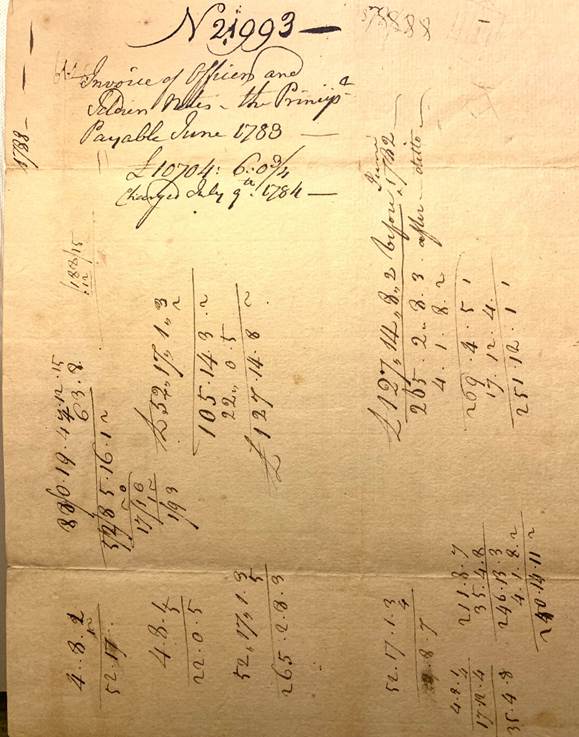
At first glance, it is an unremarkable accounting ledger filled with columns of figures and financial calculations. Yet hidden among its entries is the story of a Revolutionary War soldier whose compensation claim continued to circulate through Connecticut’s bureaucracy years after the fighting had ended. The surviving manuscript, together with wartime muster rolls and treasury records, allows us to follow Edmund Fowler’s claim from military service to a replacement for a lost note, revealing how the Revolution’s paperwork could outlive the war itself.[i]
The document at the center of this story is an Invoice of Officers’ and Soldiers’ Notes, Payable June 1783, a manuscript created as Connecticut settled the financial obligations left by the Revolutionary War. Rather than recording the service of a single soldier, the ledger summarizes military notes issued to officers and enlisted men, listing an aggregate amount exceeding £10,700 and bearing a notation that the account was “charged July 9, 1784.” At first glance, it appears to be little more than a routine accounting record.[ii]
Figure 1.Invoice of Officers’ and Soldiers’ Notes, Payable June 1783, showing the original heading and later accounting calculations.
A closer examination tells a different story. The manuscript remained in active use long after it was first prepared. While the principal heading and endorsements were written in one hand, later calculations were added in a different ink and by a different hand, indicating that officials returned to the account years after the notes first became payable.[iii]
Those physical clues reveal an important reality about the Revolution’s aftermath. Paying veterans was not accomplished through a single transaction. Military service had to be verified, financial obligations reconciled, and documentary evidence maintained as claims moved through the state’s accounting system. What appears to be an ordinary ledger therefore preserves part of the administrative machinery that transformed wartime service into recognized financial compensation.
Among the many entries associated with Connecticut’s officers’ and soldiers’ notes is one that allows this broader process to be examined on a human scale. Through a series of surviving military and treasury records, the documentary trail of Revolutionary War veteran Edmund Fowler can be followed from his wartime muster rolls to the postwar administration of his compensation claim, offering a rare glimpse into how one soldier’s service continued to generate paperwork long after the fighting had ended.[iv]
The ledger identifies many officers and enlisted soldiers, but one name stands out because his surviving records extend well beyond this single document. Edmund Fowler appears in a series of Connecticut military records that preserve different stages of his wartime service, allowing his postwar compensation to be traced across several distinct record groups.[v]
Emerging Revolutionary War welcomes back guest historians Lori Amos Doss & Jarred Marlowe
Part 2: A Veteran in the Southern Campaign and the Road to Yorktown
In early 1781, after years of nearly continuous service, James Johnston finally set out for home on furlough. It must have been a long-awaited journey. Yet before he could reach his destination, events once again pulled him back into the war.
While passing through Prince Edward County, Virginia, Johnston learned of the difficult situation facing General Nathanael Greene in the South. British forces under Lord Cornwallis were pressing hard, and Greene’s army was in poor condition. Supplies were scarce, clothing was inadequate, and many of the soldiers were inexperienced militia. Previous defeats at Charleston and Camden had weakened the Continental presence in the region, leaving Greene with a force that struggled to match the discipline of British regulars.
Johnston understood the danger. Rather than continue home, he took action. Drawing on his experience in the northern campaigns, he recruited twelve veteran soldiers who had completed their terms of service. Together, they traveled south to join Greene. Their arrival was timely. Greene assigned them as adjutants to officers commanding Virginia militia, where their role was to help bring order and discipline to units that often lacked both.
Time was short. Cornwallis was advancing, and a major confrontation was approaching. Johnston worked to train the militia as best he could, instilling in them the habits and expectations of seasoned soldiers. The results became clear at the Battle of Guilford Court House on March 15, 1781.
Greene arranged his army in three lines. The North Carolina militia formed the first, the Virginia militia the second, and Continental regulars the third. When the British advanced, the North Carolina militia broke quickly, some retreating without firing. The Virginia militia, however, held their ground. They fought with determination and inflicted significant casualties on the advancing British.
Although Greene eventually ordered a withdrawal, the battle came at a high cost for Cornwallis. His army suffered heavy losses, weakening his campaign in the South. Later observers noted the steadiness of the Virginia militia, and some accounts credited Johnston and his fellow veterans with helping prepare them for that moment.
After the battle, Johnston returned home at last, reuniting briefly with his family after years away. But the war was not yet finished, and his rest did not last long. Within days, he learned that Lafayette was now operating in Virginia and facing British forces under William Phillips and Benedict Arnold. Once again, Johnston chose to return to service.
Have you ever heard of the popular saying, “No good deed goes unpunished?”
I wonder if there is a reverse to that, especially when it comes to stumbling into history?
Earlier in June, my uncle needed to go out of town and wanted someone to watch his house and two cats. He resides outside of Wilmington, Delaware. Thinking mid-June would be a good time to catch some of the historical sites in Philadelphia on the brink of the 250th in July, and with World Cup soccer games being played in the same city, even better.
I planned to go into the “City of Brotherly Love” one day, but thought the other day I would just drive around Wilmington and New Castle and see what I could discover. A day with no set plans. And that is when I stumbled into “Separation Day” in New Castle.
The United States Army traces its birthday back to June 14, 1775—the date the Second Congressional Congress voted to adopt the New England army then encircling the British in Boston.
Almost a year later to the day—June 12, 1776—the Congress voted to establish the Board of war and Ordnance, the precursor to today’s Department of Defense.[1] One could therefore make the argument that June 12, 2026, is the 250th birthday of the department. At the very least, one could directly trace the department’s ancestry back that far.
Congress voted to establish the board in response to pressure from Gen. George Washington, who desperately needed help managing the logistics of feeding, clothing, arming, equipping, and otherwise supplying the army. He spent at least as much time begging (in a dignified but humble way) various colonies for support as he did planning and executing military strategy and tactics. Supply worries were never far from his mind. “The reflection upon my Situation, & that of this Army, produces many an uneasy hour when all around me are wrapped in Sleep . . .” he wrote a confidant.[2]
But because everything about the Continental government was voluntary, that meant colonies—soon to be states—did not have to comply with Washington’s requests, let alone any Congressional resolutions. Colonies chronically undershot troop quotas and financial contributions.
Naivety ran high in those heady, early days of the war. Colonies believed militia, rather than a trained professional army, could somehow win the war. Their “patriotic spirit” would be enough to overcome the discipline and experience of the British army and its hired mercenaries. Even members of Congress, tied more regularly to military affairs through Washington’s correspondence, bought into the idea.
“You think the present army assisted by the militia is sufficient to oppose the force of Great Britain, formidable as it appears on paper,” one of Washington’s key confidents, Gen. Nathaniel Greene, told Congress in early June. He assured them they were “greatly deceived.”[3]
The creation of the Board of War did much to make the scales fall from Congressional eyes. It did so by bringing key members of Congress more directly into the management of the war.
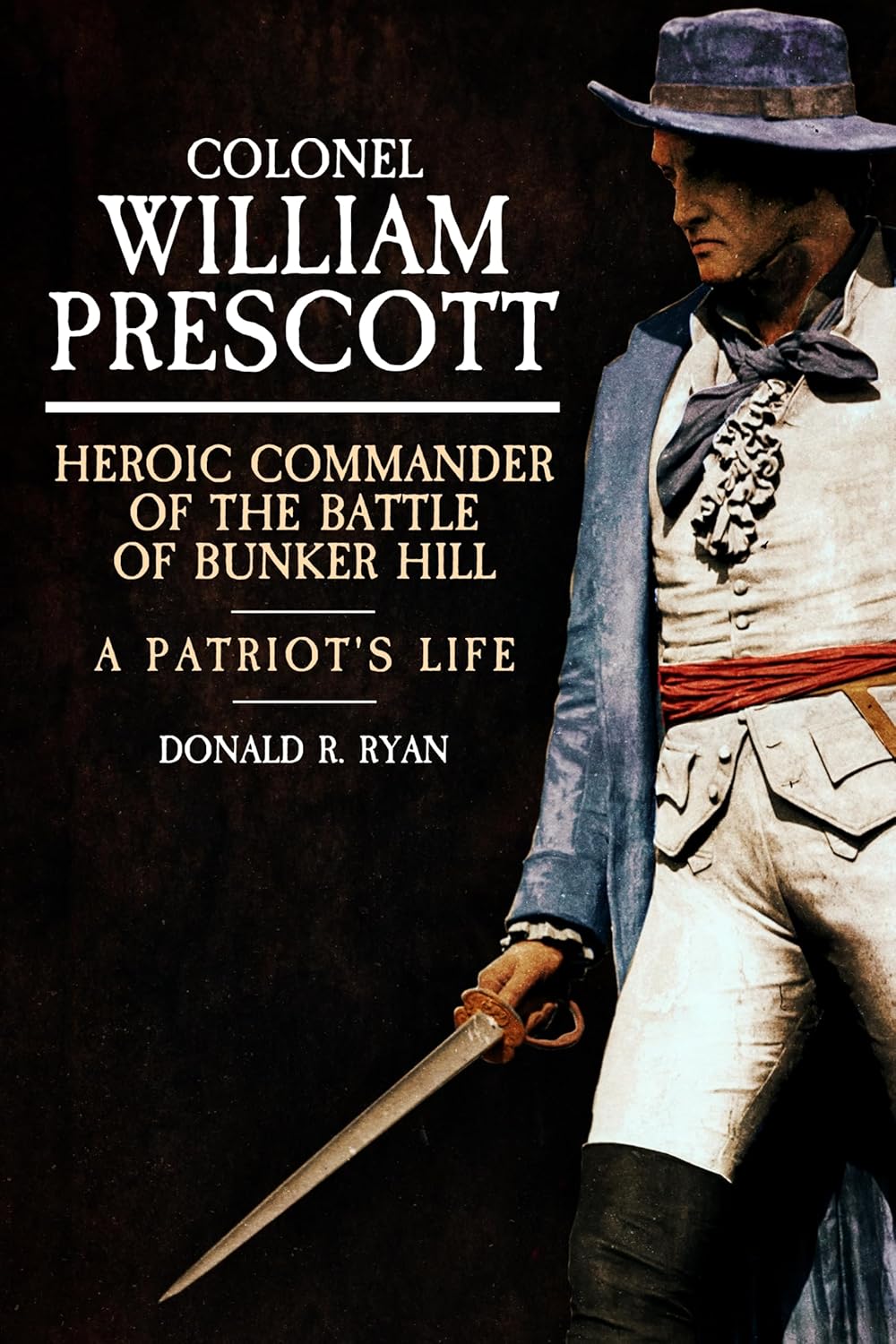
Depicted in various paintings, still standing watch over Breed’s Hill, his name is synonymous with the heroic American defense of the earthen redoubt that graced the aforementioned hill. Although forced to evacuate the work when overwhelmed by the third British advance and out of ammunition, Prescott had shown his value as a competent battlefield leader. Especially of the militia.
Yet, as America approached the 250th anniversary of the country, there had not been a single dedicated biography that covered his entire life. Prescott is mentioned in plenty of great historical works on the battle, the region, and the lives of other patriots who fought that day. But the Massachusetts native deserved more. Entered Donald R. Ryan.
Ryan, a volunteer historian and guide for Boston National Historical Park, took on the task of researching, locating, and even contacting living descendants of Prescott. You can now hold in your hands and read his excellent work on this great military figure, best known for his role in one of the most iconic battles of the American Revolution.
Before you do get your copy and settle in to read, tune in on Sunday evening, as Ryan will appear on our popular “Rev War Revelry” to discuss his book. Emerging Revolutionary War will go live at 7 p.m. EDT. and stream to our Facebook page.
Cannot make the live program on Sunday evening? Don’t fret, the program will be posted to our podcast and YouTube channels in the days after. Either way, hope you tune in to learn about Col. Prescot!


 Emerging Revolutionary War Era