

Emerging Revolutionary War welcomes back guest historian Bjorn Bruckshaw
By the spring of 1776, the people of Rhode Island no longer needed to speculate about their relationship with Great Britain—they were already living in open resistance to it. War had begun the previous year, British naval power remained a constant threat along the coast, and the colony’s long history of defiance toward imperial authority had already brought confrontation to its shores. The destruction of His Majesty’s schooner Gaspee in 1772 had marked a decisive escalation, transforming protest into direct action against the Crown.¹ Now, as members of the Rhode Island General Assembly made their way to Providence in early May 1776, they did so with the reality of war firmly in mind. The question before them was no longer whether they opposed British authority, but whether that authority could continue to exist at all within their government.
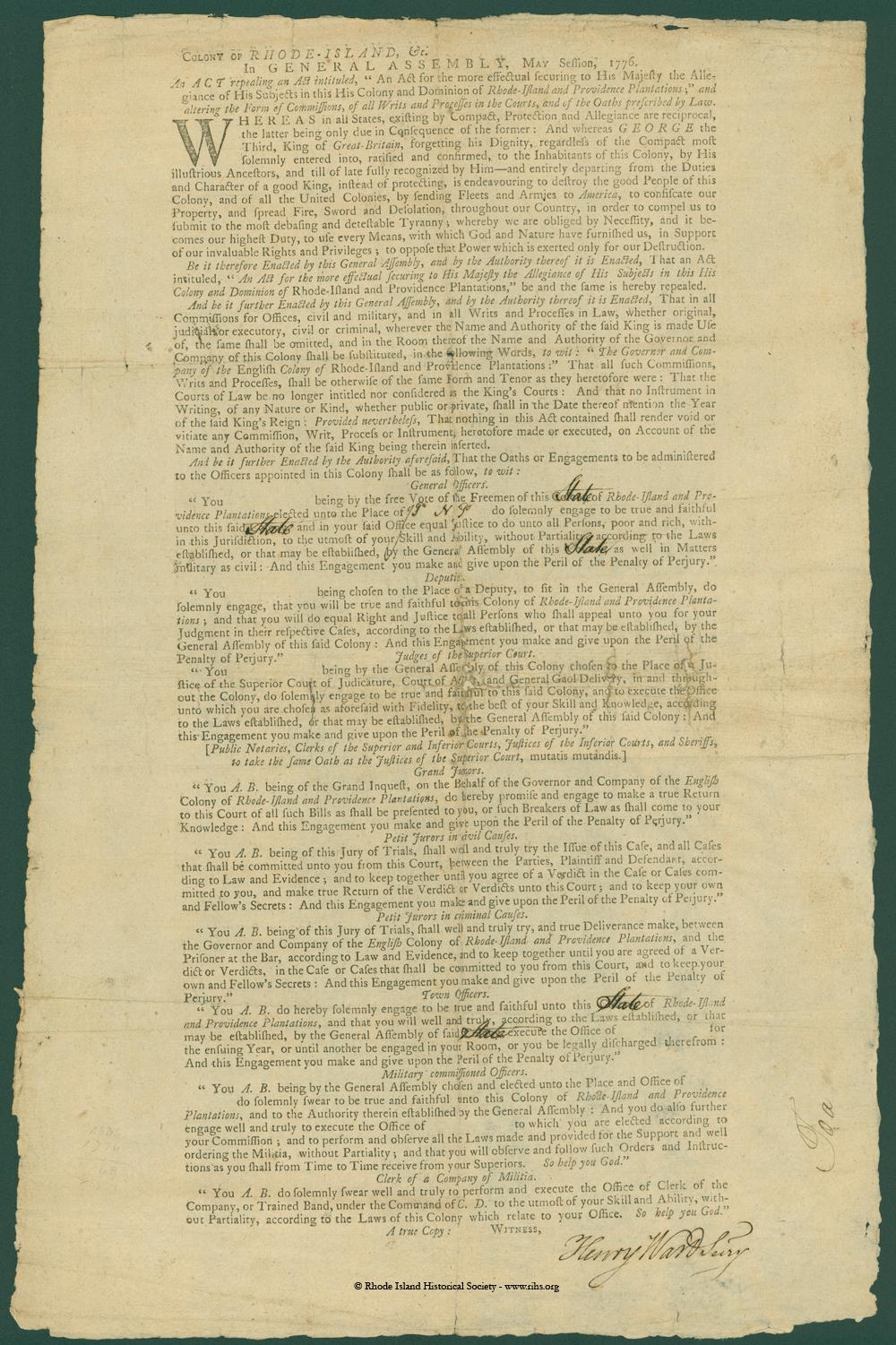
Inside the Assembly chamber on May 4, 1776, that question was answered with clarity and finality. Without issuing a sweeping declaration or engaging in extended philosophical argument, the legislature passed an act that removed King George III from every function of governance within the colony. The law ordered that “in all commissions, writs, and other proceedings in the courts of law,” the name and authority of the king be omitted.² In their place stood the authority of the colony itself. The act further directed that royal authority was to be “totally suppressed.”³ Courts would continue to function, but under a new source of legitimacy. Officials would take new oaths. The government would proceed without reference to the Crown. Rhode Island did not simply declare independence—it enacted it.
This action did not emerge suddenly. For years, Rhode Island had been among the most resistant of the colonies to British imperial control, particularly in matters of trade and enforcement. British officials repeatedly complained of the colony’s defiance, noting the difficulty of imposing authority in a place where regulations were often ignored.⁴ That resistance became unmistakable with the Gaspee affair, and the Crown’s response—threatening to transport suspects to England for trial—provoked widespread alarm. Colonial critics warned that such measures would undermine “that great bulwark of English liberty,” the right to trial by a local jury.⁵ By the time hostilities began in 1775, many Rhode Islanders had already concluded that reconciliation with Britain was increasingly unlikely.
That understanding was reflected not only in legislative action, but in the colonial press. The Providence Gazette soon reported the Assembly’s proceedings, noting that the legislature had taken measures removing the authority of the Crown from government functions, a step consistent with the colony’s wartime posture and political condition.⁶ While not framed in celebratory or rhetorical language, the report treated the change as a matter of governance already in motion. Similarly, the Newport Mercury, writing amid growing military uncertainty, reflected a broader shift in tone, reporting colonial affairs in a way that assumed the imperial relationship was breaking down beyond repair.⁷
These accounts are significant not because they proclaim Rhode Island’s primacy, but because they demonstrate how independence was understood in real time—not as a single dramatic declaration, but as a series of actions already unfolding.
Even as Rhode Island acted, the Continental Congress remained constrained by the instructions of individual colonies. Many delegates believed independence was inevitable but lacked the authority to declare it. Writing in May 1776, John Adams observed that “every post and every day rolls in upon us independence like a torrent,” capturing the speed with which colonial sentiment was shifting.⁸ The movement toward independence was no longer confined to debate—it was being driven by developments within the colonies themselves.
Rhode Island’s action on May 4 must be understood within that broader context. Its legislature addressed not only the question of independence, but the practical problem of governance in a time of revolution. By removing the king from its legal framework, the colony resolved the contradiction between fighting a war against British authority and continuing to operate under it.
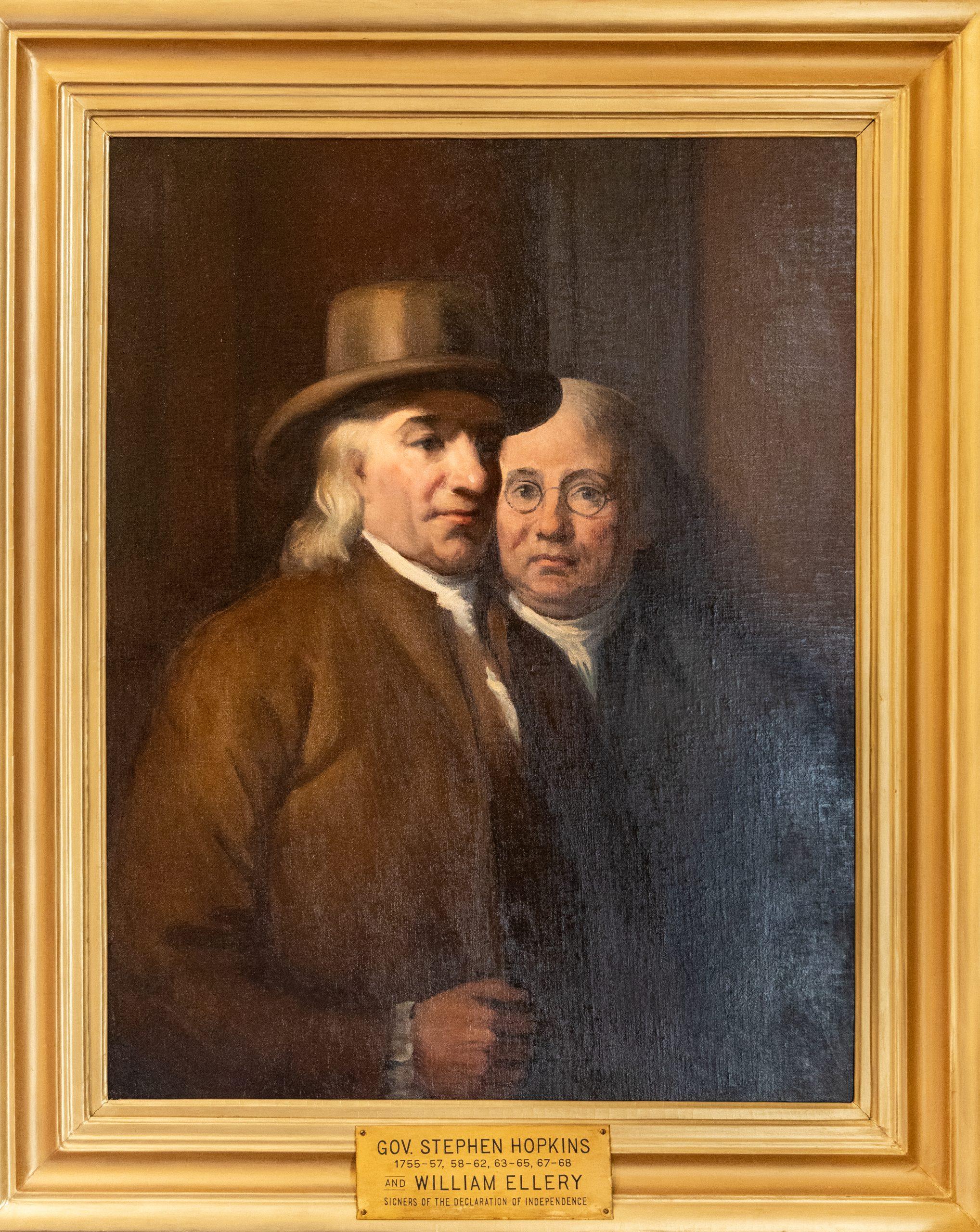
The colony’s leadership had long anticipated such a moment. Stephen Hopkins, a former governor and one of Rhode Island’s delegates to the Continental Congress, had argued years earlier that acceptance of Parliamentary authority would reduce Americans to “a state of absolute slavery.”⁹ Alongside him in Congress was William Ellery, a Newport lawyer who would later sign the Declaration of Independence. Ellery’s diary offers a rare glimpse into the mindset of delegates as independence approached. Reflecting on the moment of decision in 1776, he recorded his close observation of fellow delegates, noting their seriousness and resolve as they committed themselves to separation from Britain.¹⁰ While he did not specifically describe Rhode Island’s May 4 act, his account captures the gravity of a decision that his colony had already implemented in practice.
The timing of Rhode Island’s decision underscores its significance. Just eleven days later, on May 15, 1776, the Continental Congress adopted a resolution urging colonies to establish governments “under the authority of the people.”¹¹ John Adams later described this as “the most important resolution that ever was taken in America.”¹² Rhode Island had already done exactly what Congress was now recommending.
This sequence does not suggest that other colonies explicitly followed Rhode Island’s example, but it does place the colony at the leading edge of a broader transformation. As Adams noted, independence was advancing rapidly, driven by forces beyond Congress itself.¹³ Rhode Island’s action demonstrates how that movement operated in practice—showing that independence could function not just as an idea, but as a system of governance.
Not all observers viewed such developments favorably. Loyalists saw them as unlawful and destabilizing. Joseph Galloway later argued that independence had been the work of “a desperate faction” that had “usurped the powers of government.”¹⁴ British officials similarly viewed Rhode Island’s long-standing defiance as evidence of its unreliability within the empire.
Events later in 1776 would confirm the risks Rhode Island faced. Its exposed coastline made it a target for British operations, and in December of that year British forces occupied Newport.¹⁵ The Assembly’s decision in May did not provoke this occupation; rather, it acknowledged the reality that the colony was already fully engaged in war.
What distinguishes Rhode Island’s May 4 act from the Declaration of Independence that followed is not its significance, but its purpose. The Continental Congress would later produce a document intended to justify independence to a global audience. Rhode Island’s legislation, by contrast, was immediate and internal. It ensured that the government could function without contradiction.
As historian Pauline Maier has observed, independence was not created in a single moment in Philadelphia, but developed through a series of decisions made within the colonies themselves, as authority shifted “from crown to people.”¹⁶ Rhode Island’s action stands as one of the clearest examples of that shift already completed.
In removing the king from its government, Rhode Island did more than anticipate independence—it demonstrated it. There was no dramatic proclamation, no carefully constructed appeal to the world. Instead, there was a legislative act that transformed the foundation of authority within the colony.
If July 1776 provided the language that would define American independence, May 4 provided its structure. Rhode Island did not wait for permission. It acted—and in doing so, it stood at the leading edge of the movement that would soon reshape all thirteen colonies.
- John C. Miller, Origins of the American Revolution (Boston: Little, Brown and Company, 1943), 326–30.
- John Russell Bartlett, ed., Records of the Colony of Rhode Island and Providence Plantations, in New England, vol. 7 (Providence: A. Crawford Greene, 1862), 567.
- Bartlett, Records of the Colony of Rhode Island, 7:567–68.
- Miller, Origins of the American Revolution, 326.
- Peter Force, ed., American Archives, 4th ser., vol. 1 (Washington, DC: M. St. Clair Clarke and Peter Force, 1837), 1098–1102.
- John Adams to Abigail Adams, May 7, 1776, in L. H. Butterfield et al., eds., Adams Family Correspondence, vol. 1 (Cambridge, MA: Harvard University Press, 1963), 382.
- Stephen Hopkins, The Rights of Colonies Examined (Providence: William Goddard, 1764), 18–19.
- William Ellery, diary entry, July 1776, in Paul H. Smith et al., eds., Letters of Delegates to Congress, 1774–1789, vol. 4 (Washington, DC: Library of Congress, 1979), 331–32.
- Journals of the Continental Congress, 1774–1789, vol. 4 (Washington, DC: Government Printing Office, 1906), 342–43 (May 15, 1776 resolution).
- John Adams, “Autobiography,” in Charles Francis Adams, ed., The Works of John Adams, vol. 3 (Boston: Little, Brown and Company, 1851), 392.
- John Adams to Abigail Adams, May 7, 1776, in Adams Family Correspondence, 382.
- Joseph Galloway, Historical and Political Reflections on the Rise and Progress of the American Rebellion (London: G. Wilkie, 1780), 56–60.
- Christian M. McBurney, The Rhode Island Campaign of 1778 (Yardley, PA: Westholme Publishing, 2011), 1–5.
- Pauline Maier, American Scripture: Making the Declaration of Independence (New York: Alfred A. Knopf, 1997), 48–52.
Image Credits
- Stephen Hopkins and William Ellery, Rhode Island delegates to the Continental Congress. Commemorative portrait. Public domain.
- Rhode Island General Assembly Act, May 4, 1776. From Records of the Colony of Rhode Island, vol. 7. Public domain.

