Join us this Sunday at 7pm as we ERW authors and historians Dan Welch and Mark Maloy continue their 250th anniversary coverage of the New York Campaign. They’ll chat with us about the events following the Continentals retreat from Long Island, Nathan Hale, the Turtle, the Peace Conference, and of course the fighting at Kip’s Bay and Harlem Heights. Welch and Maloy’s new book, “Conquer or Die” will be available this fall. This Revelry will be LIVE on our Facebook and You Tube pages at 7pm.
The New York Campaign had been building for over year by August 1776. In July 1775, previous British commander of forces in America, Thomas Gage, had sent a request to his superiors to be allowed to leave Boston and begin a new campaign in New York. Following Lexington, Concord, and Bunker Hill, Gage’s force remained bottled up and besieged in and around Boston and Charleston. When word of approval of Gage’s plan reached Boston, so too did orders relieving him of command. Before he departed for England in October 1775, he met with his successor, William Howe, and greatly stressed the importance of moving the theater of war to New York. Howe would follow Gage’s preplanning and approval to the letter, including waiting until the spring to began the shift in the army’s base of operations. Howe’s timetable, however, was moved up after the arrival of Henry Knox’s artillery train and the placement of guns on Dorchester Heights. On March 17, 1776, Howe and 11,000 troops and Loyalist citizens sailed for Nova Scotia. Foreshadowing the British departure and the location of the next campaign in a letter written two days before they set sail, Col. Joseph Reed, later George Washington’s adjutant-general, correctly asserted, “If Howe should leave Boston, we expect he will make for New York; and, at all events, we look upon that as one of the scenes of the summer business.”
Meanwhile, George Washington also looked to New York as the next seat of this growing conflict. In January he sent Charles Lee to begin laying out a position for the Continental Army to take once it shifted southward from Boston. Not long after Lee arrived in February 1776 he assured the Committee of Safety that even though he could see no way to make New York into a “tenable fortification” he could make a position strong enough to be “a most advantageous field of battle” that would “cost the enemy many thousands of men to get possession of it.” Just two months later, on April 13, Washington and the Continental Army arrived.
The Continental Army commander had no other choice than to do what he could in New York. There was immense political pressure on Washington not to abandon it, the Congress believing it had high political and psychological value. Many in Congress believed abandoning it would demoralize the Patriot cause and swell the morale of the Loyalist population in the city and colony thereof. Furthermore, it was a central location along the Atlantic coast and a conduit of communication and supplies between New England and the southern colonies via the Hudson River. Furthermore, the Hudson River/Lake Champlain corridor remained a vital passage to Canada and the Great Lakes. New York was also a bustling economic hub, the second largest urban center in the colonies, with a port, shipbuilding, and deep-water harbor had immense naval and trade value. Widely considered as the “key to the continent,” Washington would have a difficult task defend the city, it’s deep water port, and the numerous navigable waterways; all reasons the British wanted to seize the city in their effort cutoff New England from the middle and southern colonies. Writing to his brother, John Augustine Washington, between May 31 and June 4, 1776, he confessed, “We expect a very bloody Summer of it at New York . . . & I am sorry to say that we are not, either in Men, or Arms, prepared for it.”
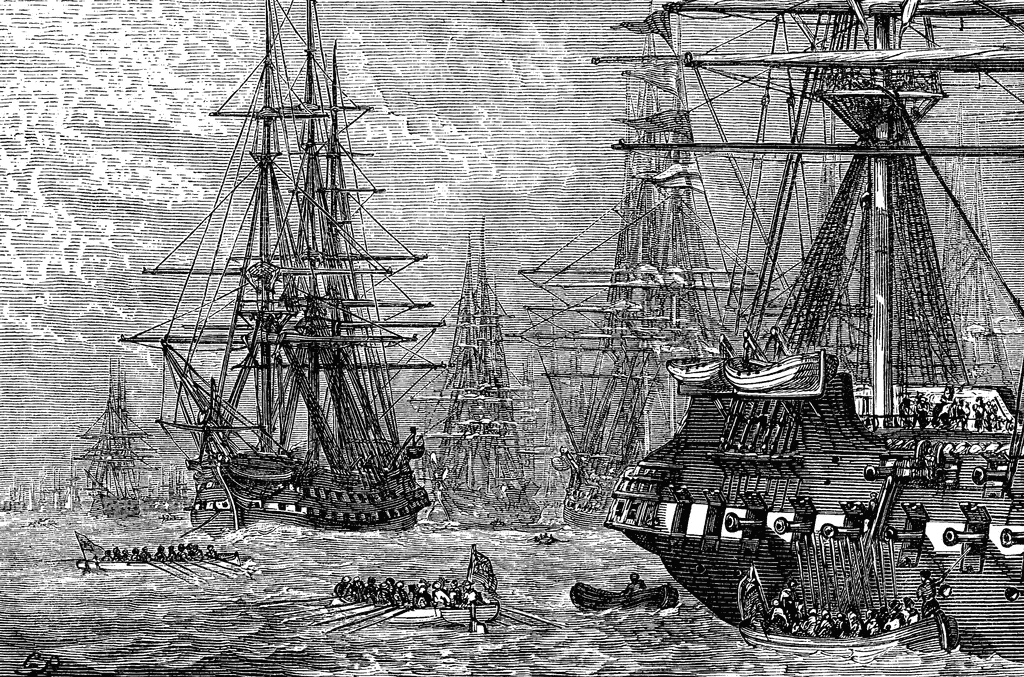
Finally, after several months of resupplying and refitting his army in Nova Scotia, William Howe and his command arrived on Staten Island, unopposed, in June 1776. Pvt. Daniel McCurtin, 1st Company of Maryland Rifles, recorded the British arrival, noting he saw, “the whole Bay was full of shipping as ever it could be. I declare that I thought all London was afloat.”Over the coming weeks he would be joined by his brother, Richard, with large numbers of reinforcements, ships, transports, supplies, and Hessians. Although the two brothers leaned into their role of peace commissioners, attempting to end this growing rebellion through pardons and not bloodshed in July, by August, with no peaceful resolution insight, military preparations moved forward.
On August 20, 1776, British troops began loading onto ships and transports from their Staten Island camps, and 250 years ago today, August 22, 1776, the first British troops landed on Long Island at Denyse’s Ferry. Howe had chosen this site for its richness and crops and plentiful livestock in which to supply his army. Still unsure of Howe’s intentions, and constantly worried about his flank and rear being turned by the British Navy, Washington had spread his army dangerously thin across several islands with waterways separating reinforcements should the need for them arise. Thus, on August 22, Washington only had 3,000 men, John Nixon and Nathaniel Heard’s brigades, and some Long Island militia in which to contest the landing. All they could really do was raise the alarm. By the end of the day 20,000 British troops were on Long Island. Only time would tell, at least for Washington, whether or not this would be Howe’s main push or simply a diversion to another beachhead and main strike.
Learn more about the 1776 New York Campaign with ERW’s forthcoming release, Conquer or Die: The 1776 New York Campaign, by Dan Welch and Mark Maloy. Pre-order here!
ERW welcomes back historian Keith J. Muchowski as he concludes his series.
A new Brooklyn, a new century This all happened at a moment of great economic, political, and demographic transformation in Brooklyn. For many residents of Dutch colonial heritage, life had changed surprisingly little since the seventeenth century. Well into the twentieth century, families like the Lotts, Bergens, Kouwenhovens, and Remsens and others lived comfortably in houses built by their ancestors. Some even continued farming the same fields that their forbears had tilled centuries earlier.1 Besides enjoying a domestic life that would have been recognizable to their ancestors, many worshipped in the same Dutch Reformed Churches those ancestors had built. When the time came, they often buried their loved ones in plots beside family members who had been resting there for centuries.
ERW welcomes back historian Keith J. Muchowski for a two part series in honor of the 250th anniversary of the New York Campaign and the Battle of Long Island.
Although the New York Campaign of 1776 was not General Nathanael Greene’s finest moments during the American Revolutionary War, he did rebound and become one of the premier military strategists by the end of the conflict. His views, learned on the field of battle, the bustle of various headquarters, and the countless miles of riding and marching on campaign was summed up when he wrote the following.
“Don’t be surprised if my movements don’t correspond with your Ideas of military propriety. War is an intricate business, and people are often saved by ways and means they least look for or expect.”
Military strategy, tactics, and the war that unfolded will be the topic of discussion on our Facebook page for Sunday, July 26, and the next “Rev War Revelry.” If you miss it, check out our YouTube and podcast channels as the program will be uploaded there next week. This program will also mark the debut of the newest full-time contributor and historian with Emerging Revolutionary War, Ben Powers. Although this “Revelry” will be taped, we wanted to give a bit more background about Ben, what he has written and projects moving forward. That way you can fill the comment section with questions about both military strategy and our newest blog historian. Ben had the following to say.
“I’m honored to share a few exciting milestones in my work with Emerging Revolutionary War.
Over the past several months, I’ve had the privilege of contributing a growing body of research to ERW, including:
• “Nathaniel Greene: Washington’s Strategist or Pioneering Operational Artist” (November 2025) • “The Attack and Defense of the Chew House: British Professionalism at Germantown” (March 2026) • “Brave, Meritorious, Unrewarded Kirkwood”: Unrecognized Valor in the Continental Army (April 2026) • Review of The Wandering Army: The Campaigns That Transformed the British Way of War by Huw J. Davies (April 2026) • “Embattled Farmers or Continentals?” (July 19, 2026)
In June, Emerging Revolutionary War welcomed me as a regular contributor. I am grateful to the editors and readers for the opportunity to participate in the outstanding scholarship and public history the organization produces.
I’m also pleased to be working with the ERW team on an upcoming volume to the Emerging Revolutionary War Series that will center on Race to the Dan/Guilford for the 250th. This is a long-term project, but I am looking forward to the journey.
Whether you’re interested in Revolutionary War history, military leadership, or operational art, I hope you’ll join us for the conversation.
Thank you to everyone who has read, shared, commented on, or challenged my work. As we celebrate America’s 250th anniversary, I look forward to continuing to learn, write, and contribute to the field.”
Emerging Revolutionary War welcomes guest writer, historian Kenneth Bancroft
Leesburg, Virginia. Tuesday, July 9, 1776. “…News that the Sanhedrim (1) had declared the thirteen united Colonies Free and Independent States. That this was intended by the Northern Colonies from the first, I am well convinced…” (2) These are not the words one expects when talking about the Declaration of Independence, but to a 26-year-old entrepreneurial Englishman caught in a revolution that he neither wanted nor supported, this was the worst news ever. (3)
The Journals of Nicholas Cresswell is an informative source on the Revolutionary War from what could be considered a ‘Tory’ point of view. It is a personal account that shows that the struggle for freedom was not just on the battlefield but also in the streets and homes at the end of the colonial era. Nicholas Cresswell was an outsider from the moment he stepped on American soil in 1774 and heard news of the siege of Boston, noting that the colonists “talk as if they were determined to dispute the matter with the Sword.” (4) For two years, Cresswell observed the American colonies descend into rebellion, “The people here are Liberty mad, nothing but war is thought of.” (5)
When the colonies officially separated, Cresswell felt despair and anger instead of hope. Cresswell’s intention was to set up life as a farmer, but misfortune and bad timing foiled his plans. He blamed the “cursed Rebellion” for turning this “earthly paradise to a Hell upon terra firma.” (6) Constantly under the suspicion of the local committees tasked with enforcing the Continental Association as a suspected ‘Tory’ spy, he grew to despise the Continental Congress as vile and hypocritical. “The Congress under the fallacious pretense of nursing the tender plant, liberty, which was said to thrive so well in American soil, have actually torn it up by the very root.” (7)
Cresswell could not help himself and always got into political discussions in the bars and houses of Virginia. “At Dinner had a long dispute with Doctor Jacson about the origin of the present proceedings…Most of the company agrees that I had the better of the argument. But never so much embarrassed in my whole life.” (8) He even chided General Washington as a yeoman farmer “Negro-driver” (9) and a and was befuddled that he kept evading General Howe. Ultimately, he did decide that he was a decent General.
In the end, Cresswell decided that Virginia, for all of its bounty, was lost and returning to England was his only option. After three years of surviving the storm of a revolution, he made his slip to British lines. While technically not a Loyalist, (10) Cresswell provides critical details on the otherwise missing narrative of Loyalism in the colonies, especially Virginia. His last act dramatically involved him in a plot to free English sailors and soldiers from a jail in Alexandria Virginia. Some of the conspirators were well known merchants in Alexandria. (11) Thankfully Cresswell’s account exists to inform how a revolution hits the home front and the profundity of independence at that time.
July 9-10, 2026 marks the 250th anniversary of the actions at Gwynn’s Island, Virginia. Located in Mathews County, Gwynn’s Island became the last post that Lord Dunmore and his small force of Loyalists and British Regulars could hold in Virginia. The battle marked the end of Lord Dunmore’s military campaign in Virginia and helped secure Patriot control of the colony. Lord Dunmore’s force consisted of Loyalists, British soldiers, and former slaves who had accepted his promise of freedom in exchange for military service.
Thomas Jefferson drew this sketch of Gwynn’s Island in July 1776, Library of Congress
After several raids along Virginia’s coastline, Dunmore established a base on Gwynn’s Island in the Chesapeake Bay. Patriot leaders viewed the island as a threat because it allowed British forces to launch attacks on nearby communities. Brigadier General Andrew Lewis led approximately 1,200 Virginia militia to confront Dunmore’s forces. Lewis positioned artillery on the mainland opposite the island and began a bombardment on July 9, 1776. The Patriot cannon fire damaged British defenses, destroyed supplies, and caused significant casualties.
Disease also weakened Dunmore’s camp. Smallpox had spread among his soldiers and supporters, reducing their ability to defend the island effectively. Facing continuous artillery fire and the effects of illness, Dunmore decided to abandon Gwynn’s Island. During the night of July 9–10, British ships evacuated the remaining troops, leaving the Patriots in control. Dunmore’s force suffered minimal casualties during the battle (including Lord Dunmore suffering a minor injury when his ship was struck), but they were decimated by the diseases that plagued his force. About 400 to 500 former slaves people in the Ethiopian Regiment and roughly 150 white loyalists died of disease. Many dying were left behind when Dunmore left the island. The reported conditions on the island were horrible.
The victory at Gwynn’s Island effectively ended organized British and Loyalist efforts to regain control of Virginia during the early years of the Revolution. Although British naval raids continued along the coast, Dunmore never returned to lead another campaign in the colony. The battle strengthened Patriot confidence, protected Virginia from an immediate British threat, and allowed the colony to focus on supporting the broader struggle for American independence. Today, the island is still a rural recreational retreat for many, recently interpretation about the battle and its history have been installed to tell the important story of what took place there in July 1776.
Join us this Sunday at 7pm on our Facebook page to view the American Revolution and the Declaration of Independence through the eyes of an English traveler who visited Virginia from 1774-1777. Nicholas Cresswell’s daily diary is a researchers dream into daily life during the American Revolution and understanding an Englishmen’s point of view. We welcome historian and blogger Ken Bancroft as he talks about Cresswell’s life and his reaction to hearing about the Declaration of Independence. Ken Bancroft manages the website “The Journals of Nicholas Cresswell – Celebrating the 250th Anniversary Every Day” found at: https://nicholascresswell.wordpress.com/ . This Revelry is pre-recorded and will be posted to our Facebook page on Sunday, July 12th at 7pm and then to our You Tube Channel.
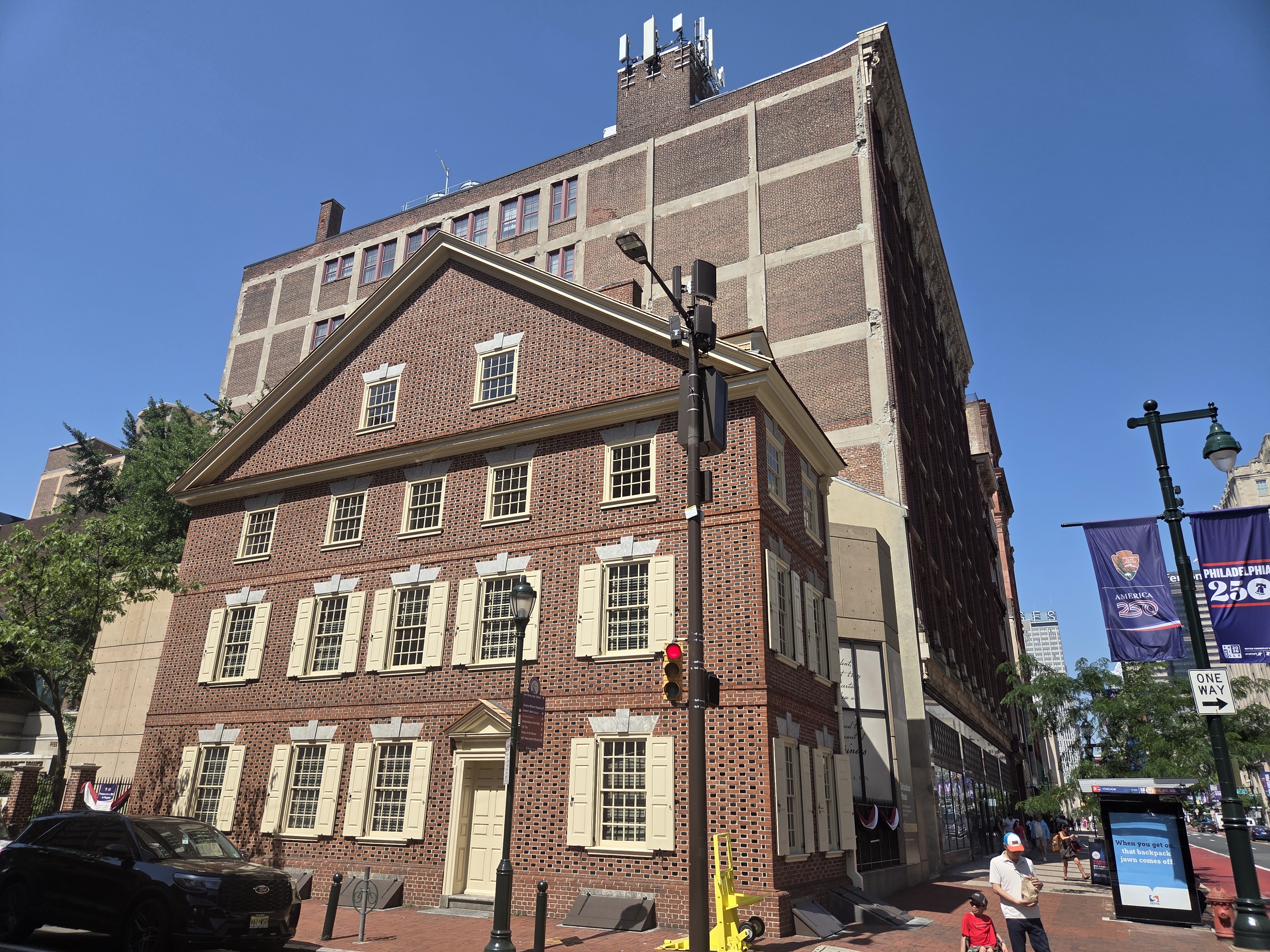
July 4, 1776 was not an unusual day when it began for Thomas Jefferson. It started off as any normal Thursday. Jefferson documented that he woke up around at dawn on the second floor of the Jacob Graff House at the corner of Market and 7th Streets. He spent the morning shopping in nearby Philadelphia stores. He documented the temperature that day at an ironic high of 76 degrees (much cooler than the expected 100+ degree heat on July 4, 2026). As he perused the stores on Philadelphia that morning, he purchased seven thermometers as well as women’s gloves. Jefferson also noted donating one shilling six pence to charity.
Jefferson was on hand as the Second Continental Congress convened at 9:00am in the Assembly Room of the Pennsylvania State House. The day before, Jefferson sat through discussion on editing his draft of the Declaration of Independence. He would also spend this morning listening to others editing down his document by one-third. Jefferson took great offense to the edits and preserved his original draft for posterity.
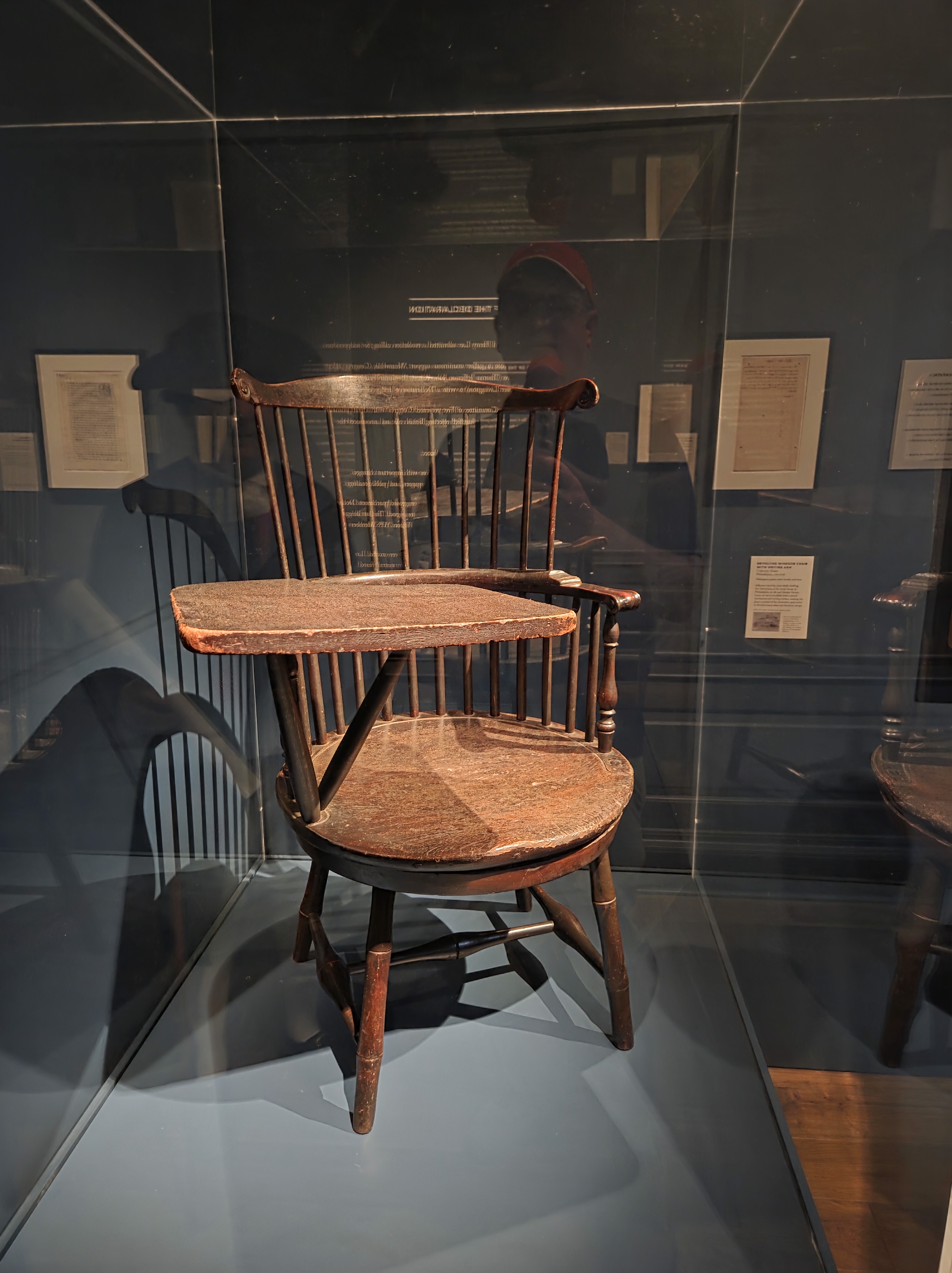
Jefferson used this chair in the Graff House to write the declaration. Today the chair is on display at the American Philosophical Society
After some time spent finishing the edits to Jefferson’s Declaration, the Congress approved the document later that morning. Congress then ordered local printer John Dunlap to print 200 copies of the Declaration now known as the “Dunlap Broadsides.” Dunlap worked quickly to set his printer’s type and began printing the copies the night of July 4th. For Jefferson and the other members of Congress, the rest of the day was spent on various items around defense, relations with native tribes and other committee work. No noted celebration of the occasion of passing the Declaration. Congress also directed John Adams, Benjamin Franklin and Thomas Jefferson to design a new “Great Seal” for the new nation. [2]
It was not until later in life did men such as Adams and Jefferson give the day its prominence in American ethos. Though Adams called on Americans to celebrate July 2, today we celebrate the day that the Declaration was adopted. Both days are surely worth their own celebrations.
[1] – Jefferson the Virginian by Dumas Malone, pg. 229.
[2] – Letters of Delegate of the First and Second Continental Congresses,1774-1789. edited by Edmund C. Burnett
At 11 a.m. on July 2, 1776, Second Continental Congress Secretary Charles Thomson called the roll of the colonies in the vote for independence from Great Britain. The debates were over (they lasted most of the legislative session on July 1). Now was the time to formalize Richard Henry Lee’s resolution, first introduced to the Congress on June 7, 1776, “That these United Colonies, are, and of right ought to be, free and Independent States …”
It only took perhaps a few minutes for Thomson to query each colony and record their vote. Before noon, 12 colonies unanimously voted for independence while New York abstained. They were no longer colonies, but states. All the men in the Pennsylvania State House knew the importance of the occasion. Abraham Clark, one of New Jersey’s delegates, wrote, “We are now … embarked on a most Tempestuous Sea. Life very uncertain. Seeming dangers Scattered thick around us …. Let us prepare for the worst, we can Die here but once. May all our Business, all our purposes & pursuits tend to fit us for that important event.”
John Adams, one of the champions of the independence movement, reflected on the importance of July 2 the next day in a letter to his wife Abigail:
The Second Day of July 1776, will be the most memorable Epocha, in the History of America.
I am apt to believe that it will be celebrated, by succeeding Generations, as the great anniversary Festival. It ought to be commemorated, as the Day of Deliverance by solemn Acts of Devotion to God Almighty. It ought to be solemnized with Pomp and Parade, with Shews, Games, Sports, Guns, Bells, Bonfires and Illuminations from one End of this Continent to the other from this Time forward forever more.
You will think me transported with Enthusiasm but I am not. — I am well aware of the Toil and Blood and Treasure, that it will cost Us to maintain this Declaration, and support and defend these States. — Yet through all the Gloom I can see the Rays of ravishing Light and Glory. I can see that the End is more than worth all the Means. And that Posterity will tryumph in that Days Transaction, even altho We should rue it, which I trust in God We shall not.
While the Declaration of Independence would still not be signed for several weeks, July 2, 1776, and the vote for independence marked a point of no return for the members of the Continental Congress.






 Emerging Revolutionary War Era