

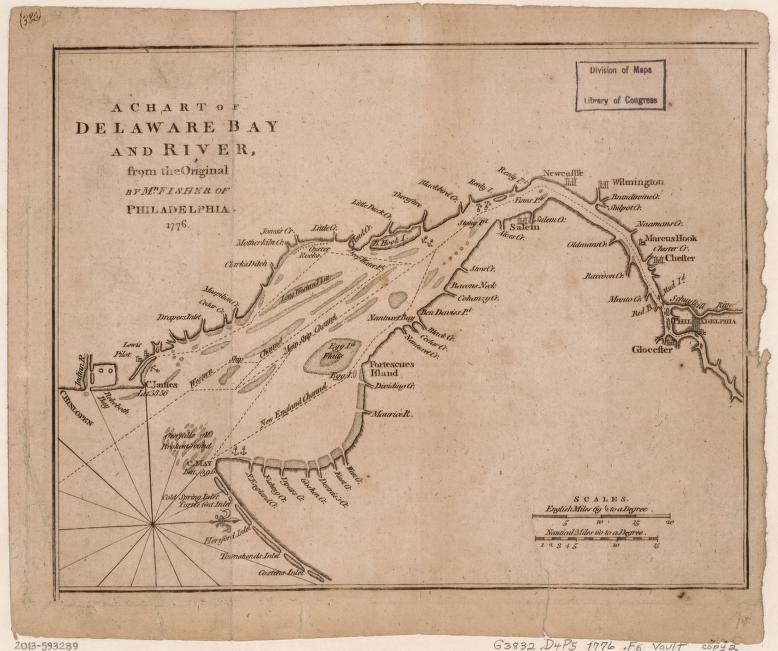
While the Americans recovered their strength and restocked their vessels upstream after the fighting on May 8, Hamond and his sailors worked to refloat the Roebuck. With a higher tide and deeper water sometime between 2 and 4 am, Roebuck finally floated free.[i] When the sun rose on Thursday the 9th fog blanketed the river and neither side could see one another. The American ships were already on the move, though, falling back down the river under a light breeze and oars to reengage the British vessels, probably in the hope that Roebuck was still grounded.[ii] In the fog, though, they paused to wait.
The mist finally burned off enough to see and around 8 o’clock that morning, Wallace and Liverpool spied the American galleys some two miles upriver.[iii] Hamond made the signal to weigh anchor and pursue them upstream. Even at full sail, though, the British couldn’t catch the Americans as “they industriously plied their Oars and Sails to avoid us.”[iv] They eventually found a point of land on the western shore Hamond could not reach, particularly in the face of an ebbing tide. Both sides anchored and waited. The prospect of continuing to advance up the Delaware, which grew ever narrower and more shallow did not appeal to Hamond. He and Captain Bellew held a quick conference and decided to drop back down the river, hoping to draw the galleys after them toward water more favorable to the British.
Around 2 pm, Hamond detected the Americans getting underway. So, Roebuck and Liverpool raised their anchors and clapped on more sail, still hoping to entice them to chase the British into deeper water. The small squadrons began exchanging long range fire around 4 pm, lasting through afternoon all while slowly moving down the Delaware. The cannon were heavy enough to be heard in Philadelphia.[v] The winds were generally moderate, but an occasional shower passed through.[vi] As they had through most of the day, the Americans stuck to the shallows closer to shore. Throughout, the two sides kept their distance. The Americans were satisfied chasing the British away and Hamond could not tempt them into a close-in fight. Finally, with darkness deepening, the firing ceased. The Americans preferred not to descend below New Castle.
Two American vessels, Hornet and Montgomery, remained farther upriver, closer to the river’s fixed underwater obstacles. It was just as well. Hornet’s captain had no orders and Captain Thomas Read of the Montgomery had no means of refilling cartridges with the powder he had received.[vii] The afternoon of the 9th, Read advised the Pennsylvania Committee of Safety that under the circumstances, “our Best station is above, to guard the pass,” and to drop farther down the river towards the fort when the tide was favorable. Consequently, the vessels would remain out of the fight. (Charles Biddle recalled things differently. In his telling, after watching the fighting on the 8th with Mrs. Gibbs and Colonel Francis, he and others volunteered for the crew and went aboard Montgomery on the night of the 8th. They eventually set off from a Philadelphia wharf, intending to attack a grounded Roebuck, though the Montgomery was poorly armed and crewed. When intelligence arrived that Roebuck was floating again on May 9, Read abandoned the mission and dismissed the crew, suggesting he had given up joining the fight rather than consciously choosing to remain above it.)[viii]
May 10 found Roebuck and its little flotilla anchored off Reedy Island, back near Port Penn. Hamond counted his losses: one man killed with many shots through the sails and rigging, even a few into the hull. Thunderstorms passed through in the morning, but Hamond and Bellew spent the afternoon conducting repairs.[ix] Roebuck and Liverpool continued in this part of the river another two days, posting guard boats and, at some point, refilling water casks. Finally, on Monday, May 13, Liverpool and Roebuck began their journey back down the river in some earnestness.[x] By May 15, they were back on station at the mouth of the Delaware Bay, their foray up the Delaware done for the moment. For his part, Hamond concluded, “that nothing could be done in the River Delaware without more Ships, a Bomb vessel, and a body of Troops to act with them,” he turned his thoughts elsewhere.[xi] In Philadelphia, much the same attitude prevailed. A correspondent wrote the Pennsylvania Evening Post, “This engagement…sufficiently establishes the reputation of the Row-Galleis, as being the best mode of defence practicable in a river.”[xii] In Delaware, Congressman George Read summed his take on the episode, “I am well satisfied they have produced a very happy effect upon the multitudes of spectators on each side of the river; and in that part of the Colonies where the relation shall be known, British ships of war will not be thought so formidable. A few long boats drove, and apparently injured, those sized ships that seemed best calculated to distress us.”[xiii]
[i] “Narrative of Captain Andrew Snape Hamond,” NDAR, 5, 15; “Journal of H.M.S. Liverpool, Captain Henry Bellew,” NDAR, 5, 19,
[ii] “Autobiography of Joshua Barney, May 9, 1776,” NDAR, 5, 17. Barney’s recollection of the naval skirmish on May 9 differs considerably from the contemporaneous journals of Roebuck and Liverpool.
[iii] The journals of Roebuck and Liverpool consistently differ by an hour or two, with the Liverpool’s time record running behind.
[iv] “Journal of H.M.S. Roebuck, Captain Andrew Snape Hamond,” NDAR, 5, 18.
[v] “Diary of Christopher Marshall, May 9, 1775,” NDAR, 5, 14.
[vi] “Journal of H.M.S. Roebuck, Captain Andrew Snape Hamond,” NDAR, 5, 18 and “Journal of H.M.S. Liverpool, Captain Henry Bellew,” NDAR, 5, 19.
[vii] “Captain Thomas Read to the Pennsylvania Committee of Safety, May 9, 1776,” NDAR, 5, 16-17.
[viii] Autobiography of Charles Biddle, 83-84.
[ix] “Journal of H.M.S. Roebuck, Captain Andrew Snape Hamond,” and “Journal of H.M.S. Liverpool, Captain Henry Bellew,” NDAR, 5, 37-38.
[x] “Journal of H.M.S. Liverpool,” NDAR, 5, 78.
[xi] “Narrative of Captain Andrew Snape Hamond,” NDAR, 5, 108-109.
[xii] “Pennsylvania Evening Post, Saturday, May 11, 1776, NDAR, 5, 53-54.
[xiii] “George read to Caesar Rodney and Thomas McKean, May 10th 1776,” NDAR, 5, 36-37.


Pingback: Captain Andrew Snape Hamond, R.N. and Roebuck in the Summer of 1776 – Emerging Revolutionary War Era