A Naval Battle off Wilmington, DE: May 9, 1776

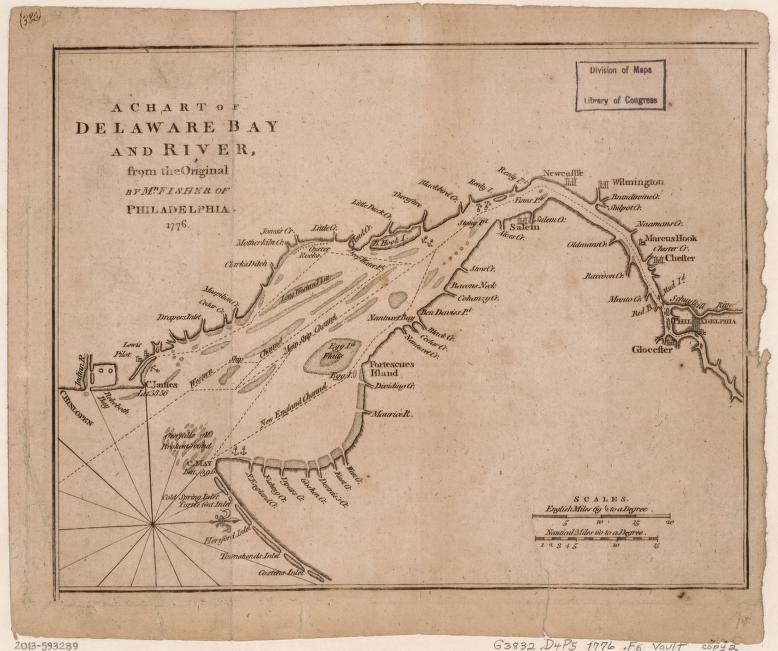
A Chart of the Delaware Bay and River, 1776 (LOC).

While the Americans recovered their strength and restocked their vessels upstream after the fighting on May 8, Hamond and his sailors worked to refloat the Roebuck.  With a higher tide and deeper water sometime between 2 and 4 am, Roebuck finally floated free.[i]  When the sun rose on Thursday the 9th fog blanketed the river and neither side could see one another.  The American ships were already on the move, though, falling back down the river under a light breeze and oars to reengage the British vessels, probably in the hope that Roebuck was still grounded.[ii]  In the fog, though, they paused to wait.

                  The mist finally burned off enough to see and around 8 o’clock that morning, Wallace and Liverpool spied the American galleys some two miles upriver.[iii]  Hamond made the signal to weigh anchor and pursue them upstream.  Even at full sail, though, the British couldn’t catch the Americans as “they industriously plied their Oars and Sails to avoid us.”[iv]  They eventually found a point of land on the western shore Hamond could not reach, particularly in the face of an ebbing tide.  Both sides anchored and waited.  The prospect of continuing to advance up the Delaware, which grew ever narrower and more shallow did not appeal to Hamond.  He and Captain Bellew held a quick conference and decided to drop back down the river, hoping to draw the galleys after them toward water more favorable to the British.

                  Around 2 pm, Hamond detected the Americans getting underway.  So, Roebuck and Liverpool raised their anchors and clapped on more sail, still hoping to entice them to chase the British into deeper water.  The small squadrons began exchanging long range fire around 4 pm, lasting through afternoon all while slowly moving down the Delaware.  The cannon were heavy enough to be heard in Philadelphia.[v]  The winds were generally moderate, but an occasional shower passed through.[vi]  As they had through most of the day, the Americans stuck to the shallows closer to shore.  Throughout, the two sides kept their distance.  The Americans were satisfied chasing the British away and Hamond could not tempt them into a close-in fight.  Finally, with darkness deepening, the firing ceased.  The Americans preferred not to descend below New Castle.

Continue reading “A Naval Battle off Wilmington, DE: May 9, 1776”

A Naval Battle off Wilmington, DE: May 8, 1776

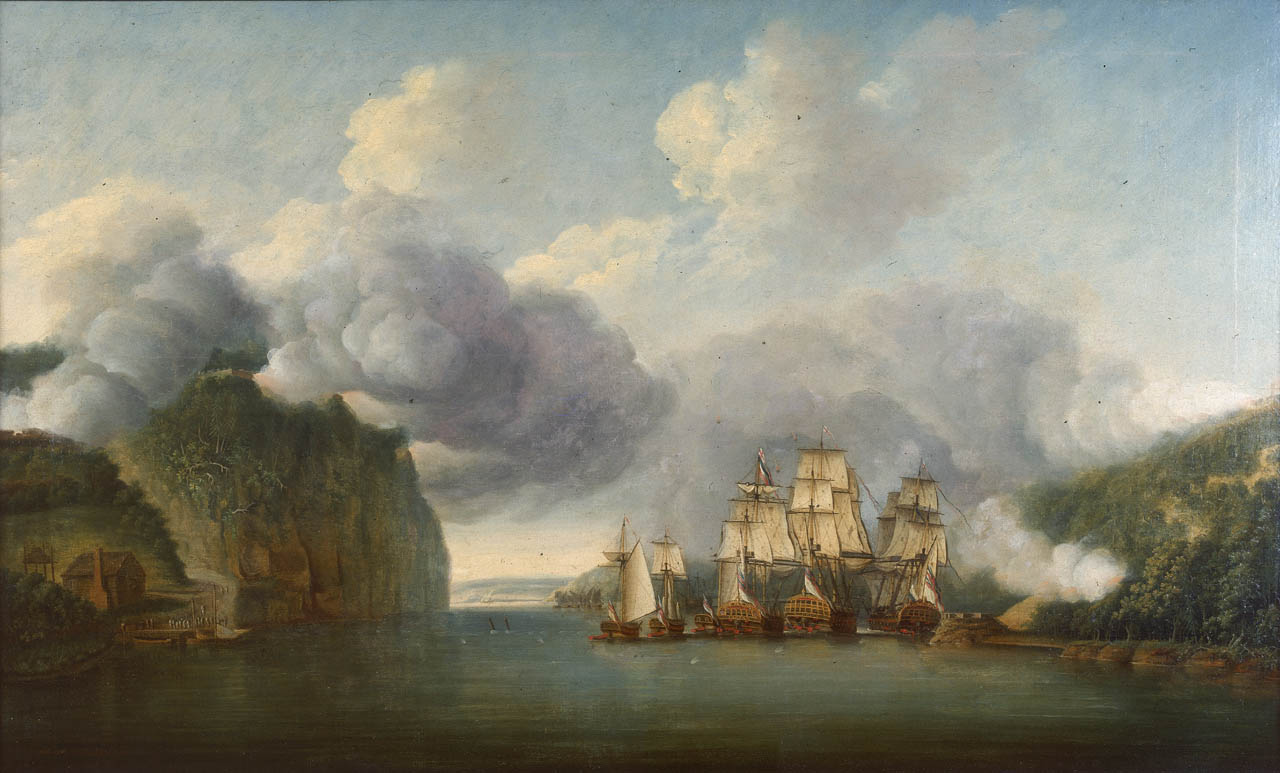
Action off Mud Fort by William Elliott circa 1787 (Wikimedia Commons). This image portrays a subsequent battle in the Delaware in the Autumn of 1777, during the naval campaign to open the Delaware River. Roebuck was a major combatant in those engagements as well.

The beginning of May 1776 found Captain Andrew Snape Hamond of the Royal Navy’s Roebuck, a fifth rate of forty-four guns, operating off the Delaware capes.  His job was to control traffic in and out of the bay and maintain a de facto British blockade while seizing any supplies that might be of use to the rebel Americans and instead secure them for British forces.  On Saturday, May 4, Hamond began moving up the bay and into the Delaware river in company with Liverpool, 28 guns, the brig Betsey and several tenders.   He was short of water and needed to refill empty casks at a fresh source.  It was also an opportunity to take a look at rebel defenses on the critical waterway.[i]  The British enjoyed only light winds and cloudy skies as they sailed upstream for the next two days, periodically anchoring and frequently taking soundings to avoid the muddy shallows.  Operating at some distance, on May 6 the Liverpool spotted a grounded sloop and sent a boat to recover it.  But, it was stuck fast and Captain Henry Bellew’s crew burned the ship instead.[ii]

Between 6 and 7 am on Tuesday, May 7, Hamond signaled his little squadron to raise anchor and continue moving up the Delaware River in the direction of Wilmington.  Off New Castle, they spied an armed schooner and several boats and gave chase in the afternoon, just as the weather broke and began pelting the ships in strong winds and heavy rain.  The schooner ran for the shallows under fire from the British ships.  She grounded and Hamond sent boats to seize her around 3 pm.  Unable to refloat her, they settled on taking off her cargo: bread and flour.[iii]  At the end of a productive day, around 7 pm, Hamond anchored his ships near the Christina River and Wilmington.

Ashore, word spread quickly of Roebuck’s advance up the river.  At Dover on May 6, Colonel John Haslet of the Delaware Regiment received word that the British were off Port Penn in the area of Reedy’s Island and the local militia expected an attack.  The British were already upstream from Haslet.  As Roebuck alternately sailed and anchored, the troops ashore had time to assemble, although they were often chasing dated intelligence about the British position.  One hundred thirty men assembled in Cantwells Bridge about 4 am on the 7th, but by then Roebuck had already moved up to New Castle.[iv]  Word of the British anchoring off New Castle reached Philadelphia in the afternoon, about the same time that American gondolas at Fort Island left to drop down the river and attack the British at their anchorage.  Robert Morris, Vice President of the Continental Congress Marine Committee, ordered Continental Navy Captain John Barry to assemble as many Continental Navy crew as possible and dispatch them to the Pennsylvania ship Reprisal and a floating battery, which were both also to drop down the river and join in the attack on the British.[v]  Men from Captain Proctor’s Company of Artillery in the fort even joined the slapdash crews, serving aboard the American vessel Hornet.[vi]  It was an all hands moment for Philadelphia’s naval defenders.

Continue reading “A Naval Battle off Wilmington, DE: May 8, 1776”

A Coastal Skirmish in Delaware

Thomas Mitchell, Forcing a Passage on the Hudson. From left to right, Phoenix, Roebuck, and Tartar run forts on the Hudson River later in the war. The smaller vessel on the far left is a tender. Maria or the Lord Howe may have looked like that.

In the spring of 1776, the Sussex County Delaware Committee of Safety sent the schooner Farmer under the command of Nehemiah Field to St. Eustatius for gunpowder, always in short supply in the rebelling colonies.  By then, the little Dutch island in the Caribbean was a well known haven for smugglers to sell and buy embargoed goods.  Indeed, leaders of the rebellion in America had been cruising Caribbean waters for months, always looking to acquire armaments from neutral colonies from under the nose of the Royal Navy, which lacked a sufficient number of ships to stop the practice.  Inevitably, the American smugglers found willing partners, some simply looking to earn a quick profit on high-value goods, others recognizing that islands throughout the area relied on the Americans for bulk foodstuffs.  If the Americans could not trade, some Caribbean colonies might go hungry.

Field successfully acquired a cargo and evaded British patrols between the Caribbean and his destination in the Delaware Bay, but his greatest test would come as he sought to enter the bay and unload his cargo in the lee of Cape Henlopen, near the town of Lewes.  The British fifth-rate Roebuck (44) under Captain Andrew Snape Hamond patrolled the lower bay with various attached small boats.  His chief task was to prevent smuggling, particularly of the kind Field and Farmer represented.  Delaware Bay is a large body of water shaped a bit like a rounded arrowhead.  It narrows at the top where the Delaware River enters and has a wider bottom, closer to the Atlantic Ocean.  But, that wide part starts to curve back on itself, and the mouth of the bay, between Cape Henlopen and Cape May, New Jersey is roughly 17 miles wide with shallows that constrain its navigability for deep-draft ships.  Those shallows limited Roebuck’s mobility and increased the demands on its smaller supporting ships and boats.  So, Captain Hamond relied heavily on his tender, Maria, and boats to intercept smugglers.  

At daybreak on Sunday, April 7, on a clear day, Hamond spied a schooner coming into the bay and already close to the Henlopen light house.  Roebuck set a course to the south in pursuit and dispatched the Maria and two armed boats to venture into the shallower waters.  Hamond was accustomed to chasing ships, but he didn’t know how lucky he was to stumble across the Farmer, originally sent to obtain gunpowder from the Caribbean.  When his prey seemingly ran aground, Hamond must have been delighted.

Read more: A Coastal Skirmish in Delaware

Ashore, guards at the lighthouse sent word to the village of Lewes that a schooner had arrived and was being chased into the bay.  Men were needed to help unload it.  Captain Charles Pope, of the Delaware Continental Battalion, quickly assembled his men and the local militia.  He needed boats to cross a creek, which the townspeople soon produced.  As Pope moved the town militia toward the beaches, the lighthouse guard descended on the Farmer, seven or eight miles south of the cape.  They quickly began unloading cargo: coarse linens.  If Pope was surprised or disappointed, he didn’t mention it.

As the militia arrived, they could see Roebuck’s tender bearing down on the schooner and hear the retort as it loosed a broadside of swivels and muskets at the Farmer and men unloading her.  The Farmer’screw responded by running right up on shore.  The guard returned the tender’s fire with muskets, which Pope’s men quickly augmented as they arrived on the scene.  A gunfight ensued as the militia and crew aboard the tender exchanged shots without doing much damage.  At one point, militiamen even began picking up many of the tender’s musket balls as they rolled on the ground, spent of all energy. But the distance was too great for small arms and eventually the militia laid off firing in order to expedite unloading.  According to Pope, the tender, still standing offshore, dispatched a boat back to the Roebuck, presumably for assistance.  

By the time the frigate rounded the cape, Pope and his men had managed to load two swivels on the Farmer and engage the Maria, which had moved closer and anchored.  As he reported, the exchange of fire between Pope’s men and the tender lasted a solid two hours.  The militia kept up a close fire on the tender to keep her from raising her anchor, probably because they thought they were getting the better of the fight. Pope thought he saw men fall, although Hamond didn’t note any casualties in his log.  Eventually, the Mariasuccessfully hoisted her anchor out of the sand and mud, but then a swivel on the Farmer shot away her halyards and the sail came down, forcing the tender to drop anchor again.  For her part, Roebuck remained in deeper water, visible, but largely out of the fight.  Eventually, she sent over a boat to tow off the Maria.   The boat drew militia fire and Pope thought they inflicted wounds on her crew too, but the boat and Maria eventually drew off, concluding the shoreline skirmish. There were no American casualties and Hamond did not report any from the affair.

Early in the afternoon, Hamond spied another schooner approaching the bay and hauled off to chase her.  He fired one shot at her before identifying her as the Lord Howe, another of his tenders, just arriving from Virginia.  Just another day for the Royal Navy on the American coast.