

The beginning of May 1776 found Captain Andrew Snape Hamond of the Royal Navy’s Roebuck, a fifth rate of forty-four guns, operating off the Delaware capes. His job was to control traffic in and out of the bay and maintain a de facto British blockade while seizing any supplies that might be of use to the rebel Americans and instead secure them for British forces. On Saturday, May 4, Hamond began moving up the bay and into the Delaware river in company with Liverpool, 28 guns, the brig Betsey and several tenders. He was short of water and needed to refill empty casks at a fresh source. It was also an opportunity to take a look at rebel defenses on the critical waterway.[i] The British enjoyed only light winds and cloudy skies as they sailed upstream for the next two days, periodically anchoring and frequently taking soundings to avoid the muddy shallows. Operating at some distance, on May 6 the Liverpool spotted a grounded sloop and sent a boat to recover it. But, it was stuck fast and Captain Henry Bellew’s crew burned the ship instead.[ii]
Between 6 and 7 am on Tuesday, May 7, Hamond signaled his little squadron to raise anchor and continue moving up the Delaware River in the direction of Wilmington. Off New Castle, they spied an armed schooner and several boats and gave chase in the afternoon, just as the weather broke and began pelting the ships in strong winds and heavy rain. The schooner ran for the shallows under fire from the British ships. She grounded and Hamond sent boats to seize her around 3 pm. Unable to refloat her, they settled on taking off her cargo: bread and flour.[iii] At the end of a productive day, around 7 pm, Hamond anchored his ships near the Christina River and Wilmington.
Ashore, word spread quickly of Roebuck’s advance up the river. At Dover on May 6, Colonel John Haslet of the Delaware Regiment received word that the British were off Port Penn in the area of Reedy’s Island and the local militia expected an attack. The British were already upstream from Haslet. As Roebuck alternately sailed and anchored, the troops ashore had time to assemble, although they were often chasing dated intelligence about the British position. One hundred thirty men assembled in Cantwells Bridge about 4 am on the 7th, but by then Roebuck had already moved up to New Castle.[iv] Word of the British anchoring off New Castle reached Philadelphia in the afternoon, about the same time that American gondolas at Fort Island left to drop down the river and attack the British at their anchorage. Robert Morris, Vice President of the Continental Congress Marine Committee, ordered Continental Navy Captain John Barry to assemble as many Continental Navy crew as possible and dispatch them to the Pennsylvania ship Reprisal and a floating battery, which were both also to drop down the river and join in the attack on the British.[v] Men from Captain Proctor’s Company of Artillery in the fort even joined the slapdash crews, serving aboard the American vessel Hornet.[vi] It was an all hands moment for Philadelphia’s naval defenders.
Anticipation and proximity bought out the spectators on Wednesday, May 8. Merchant sea captain Charles Biddle, newly arrived in Philadelphia after running the British blockade, set off early in the morning for the home of a Mrs. Gibbs, a widow-friend who inclined toward the British. Keeping his purpose from her, Biddle convinced her to go with him to Marcus Hook, just above Wilmington, in her carriage. Perhaps he was driving too fast, perhaps the carriage was poorly maintained, or perhaps it was dumb luck, but three miles from their destination the axle broke. Neither Biddle or Mrs. Gibbs were injured, but he wasted no time heading to Marcus Hook “as fast as my feet could carry me.”[vii] He thought he might be able to join the crew of one of the row galleys defending Philadelphia, but arrived too late and had to walk back to Mrs. Gibbs. By the time he returned to her, passersby had helped Mrs. Gibbs improvise an axel. Confessing his desires, she chided Biddle on his mission and forgave him his foolishness. Perhaps intrigued by the prospects of a battle, Mrs. Gibbs joined him and they continued on their way.
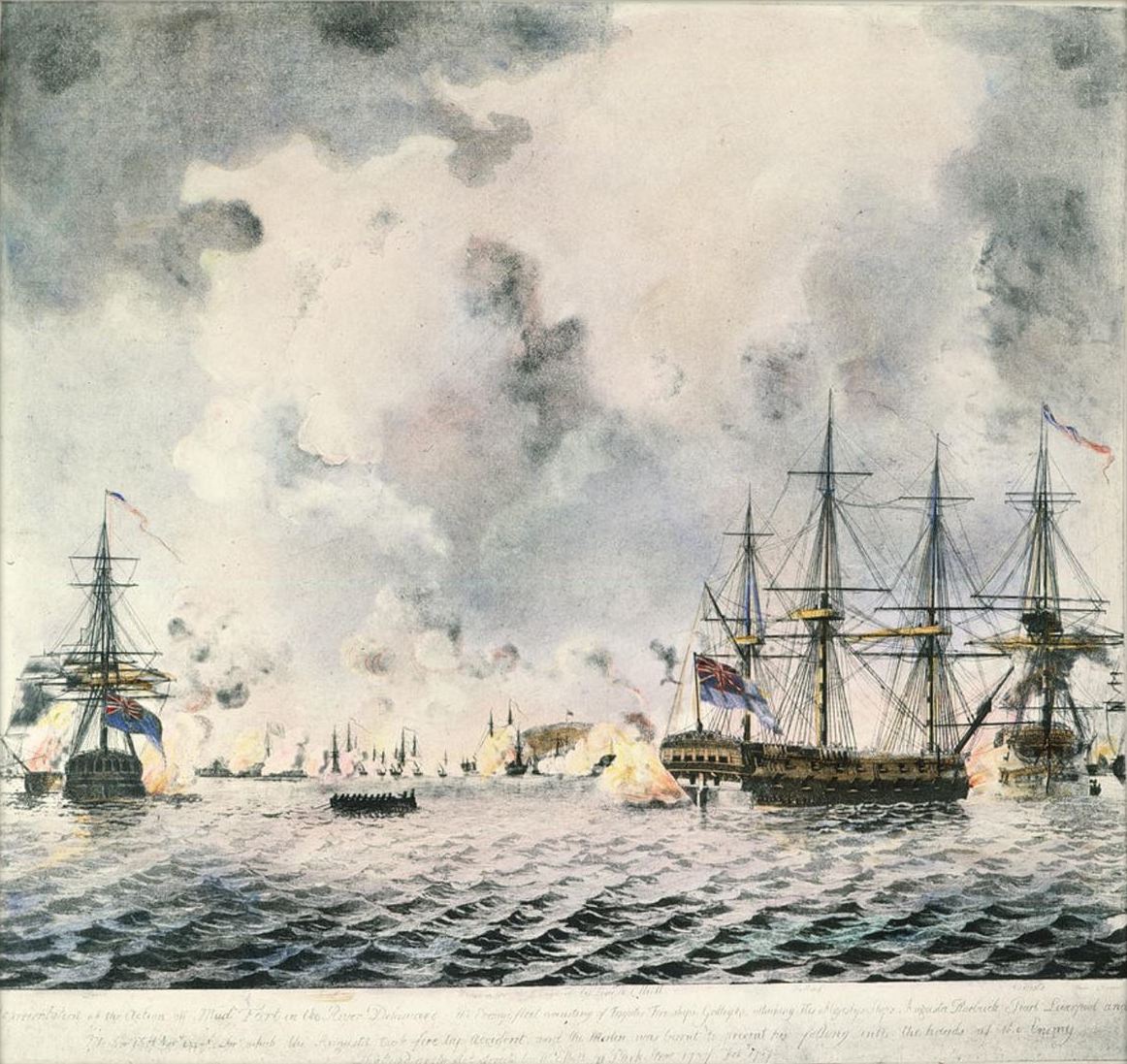
The American flotilla drew within sight of Roebuck around 1 pm. They may have been as far upriver as Chester, Pennsylvania.[viii] Due to the river’s narrow confines, Hamond would have preferred to drop anchor and maneuver the ship on springs and cable, a means of turning the ship while relatively stationary. But, the current and running tide were too much for that, so Hamond met the approaching Americans under sail.[ix] He spotted 13 row galleys, each carrying one gun. While the weight varied, they were all substantial. He also detected a floating battery (Arnold) and a sloop that appeared to be a fire ship. Coming downstream under oar power, the galleys had an advantage in choosing the point of engagement. Worse, from Hamond’s point of view, the range was “scarcely within point blank Shot: and being such low objects on the water, it was with some difficulty that we could strike them.” Firing commenced around 2 pm and lasted a solid two hours. Sometime during the fight, the American sloop Wasp slipped out of the Christina River and captured the Betsey, one of Roebuck’s smaller escorts.[x] In the afternoon, the row galleys drew off and Roebuck ran aground close to the Jersey shore. Liverpool took up station off her stern.
Captain Biddle, Mrs. Gibbs, and a former British colonel, Turbutt Francis, had watched the battle from the shoreline, joining crowds that lined the shore. Colonel Francis, suffering from gout, had a chair placed close to the water’s edge as he could not walk. The shots sometimes passed over him. Despite Biddle’s entreaties to seek safety, Francis remained seated, insisting there was no danger. Biddle remembered, “he sat with great composure, observing the engagement.”[xi] There would be more to come on May 9.
[i] “Narrative of Captain Andrew Snape Hamond,” NDAR, 5, 15.
[ii] “Journal of H.M.S. Roebuck, Captain Andrew Snape Hammond,” and “Journal of H.M.S. Liverpool, Captain Henry Bellew,” NDAR, 4, 1446-1447.
[iii] Ibid and “Narrative of Captain Andrew Snape Hammond,” NDAR, 4, 1447.
[iv] Colonel John Haslet to Caesar Rodney, May 7, 1776,” and “Henry Fisher to the Pennsylvania Committee of Safety, May the 7 1776,” NDAR, 4, 1448; “Extract of a Letter from Philadelphia, Dated Thursday Morning 10 O’Clock, May 9,” NDAR, 5, 13.
[v] “Caesar Rodney to Captain Thomas Rodney,” and “Marine Committee of the Continental Congress to Captain John Barry,” NDAR, 4, 1462-1463.
[vi] “Captain William Hallock to the Marine Committee of the Continental Congress, 10th May 1776,” NDAR, 5, 36.
[vii] Autobiography of Charles Biddle, Vice President of the Supreme Executive Council of Pennsylvania, 1745-1821(Philadelphia: E. Claxton and Company, Privately Printed, 1883) 84-84.
[viii] “John Hancock to George Washington, May 10, 1776,” NDAR, 5, 34-35.
[ix] “Narrative of Captain Andrew Snape Hamond,” NDAR, 5, 15.
[x] “Extract of a Letter from Philadelphia, Dated Thursday Morning, 10 o’clock, May 9,” NDAR, 5, 13-14. Hamond had transferred his empty water casks to Betsey for refilling and he thought very little of the loss.
[xi] Autobiography of Charles Biddle, 85-86.


Pingback: Captain Andrew Snape Hamond, R.N. and Roebuck in the Summer of 1776 – Emerging Revolutionary War Era