Reflecting on ERW’s 250th Lexington and Concorgasm One Year Later

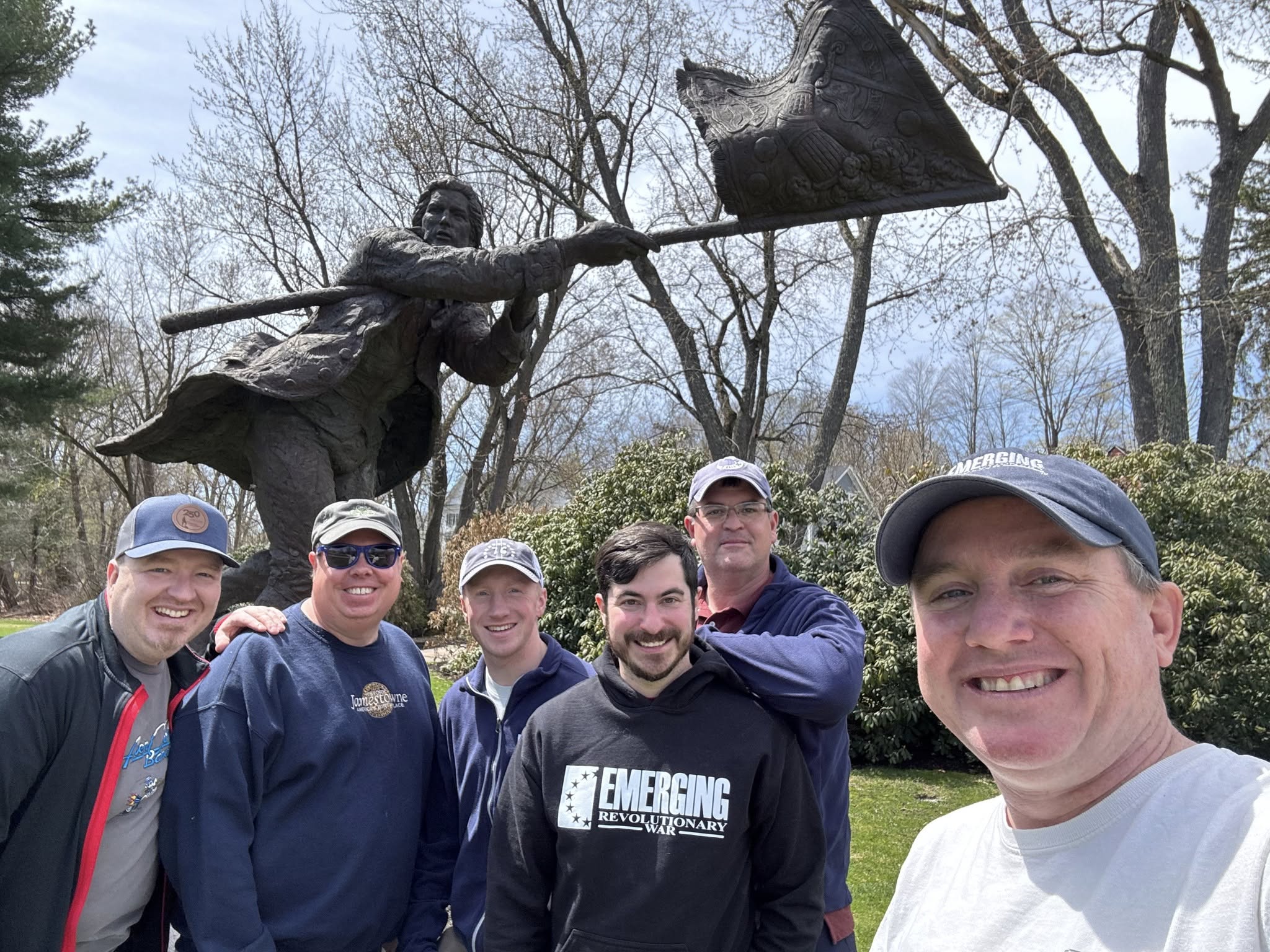
Being present at the 250th anniversary of the beginning of the Revolutionary War in Boston, Lexington, and Concord was truly a once-in-a-lifetime experience. Once because there will never be another 250th anniversary ever (and maybe never another such commemoration on this scale in my lifetime) but also once because many of the ERW historians who attended the events did something none of us will likely be fit to do in 25, 50, or more years for the next large commemorative events. We spent 32 hours in the saddle (longer than Paul Revere but with better amenities) visiting countless sites related to the Lexington Alarm of 1775. By the end of April 19, 2025, I had been awake for 40 straight hours. However, I was still on a history high from the experiences of those anniversary events.

Our 250th events began by visiting the graves of some of the first fallen Americans in the Revolution in Acton. We followed that up with a trip to Bedford, another community whose men answered the calls of Paul Revere, William Dawes, and the network of colonial riders. While in Bedford, stop into the Bedford Free Public Library to see the oldest known flag in the United States. Then, onto Lexington we went for the first time this trip to visit the Scottish Rite Masonic Museum & Library which housed a new exhibit displaying artifacts from the start of the Revolutionary War.

Continue reading “Reflecting on ERW’s 250th Lexington and Concorgasm One Year Later”

250th Anniversary of the Release of Common Sense

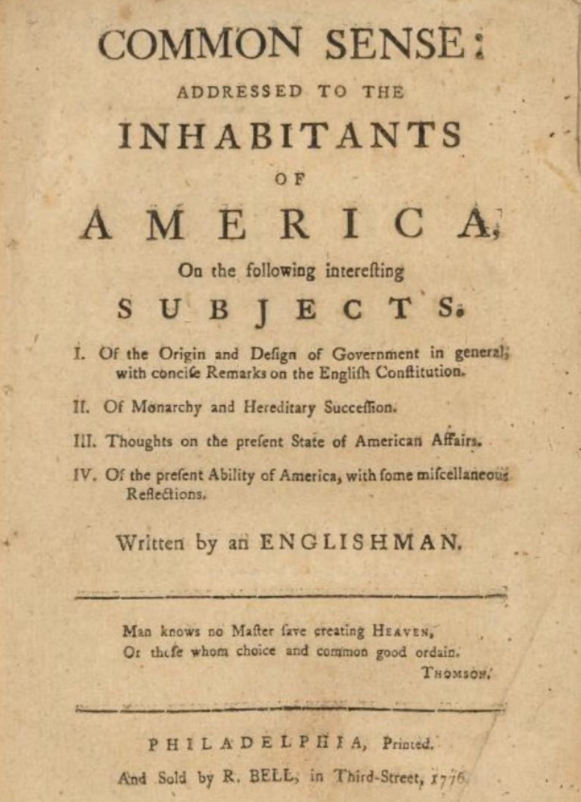
Virginian Landon Carter was vocal about the latest pamphlet sweeping through the American colonies in 1776. In several diary entries from the first four months of that momentous year, he commented on Common Sense, written anonymously “by an Englishman.” Carter described its contents in February as “rascally and nonsensical as possible, for it was only a sophisticated attempt to throw all men out of principles.” By April, as he continued to criticize the work, he reached a conclusion about its author: “I begin now more and more to see that the pamphlet called Common Sense, supporting independency, is written by a member of the Congress …” Carter could not have been further from the truth.

“An Englishman” was, in fact, an apt description for the author of Common Sense, first advertised to the American public on January 9, 1776, and first released on January 10. Thomas Paine was an Englishman—born there and, by most measures, matured there as a failure. He failed at his corset-making business. Teaching, collecting taxes, privateering, and working as a grocer—none of these occupations suited him either. He married twice (his first wife died in childbirth), and his second marriage collapsed. Amid this string of failures, Paine found success with the written word, which caught Benjamin Franklin’s attention in England in 1774. With little left for him in England, Paine embarked for America, arriving later that year. There, he scraped by as a writer, publishing essays in Philadelphia newspapers.

Continue reading “250th Anniversary of the Release of Common Sense”

Congress Creates the Marine Corps, November 10, 1775

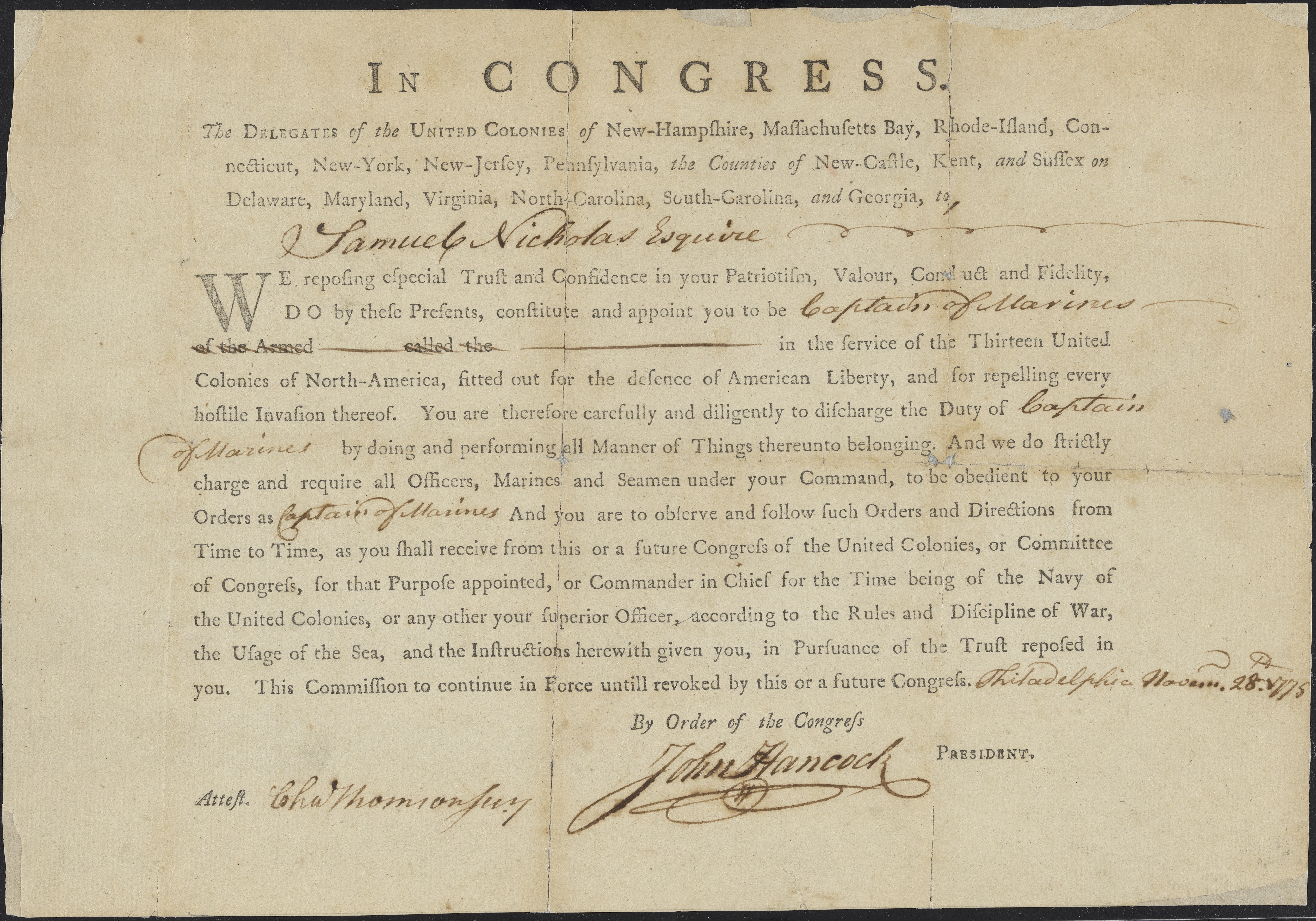
The Commission of Captain Samuel Nicholas, the first American Marine. (USMC)

Today marks the 250th birthday of the Marine Corps. November 10, 1775 was a milestone in the creation of American naval power, but the birthday story is a little more complicated.

The Continental Congress resolved to create a navy under its auspices on October 13, 1775, but much work remained to build American naval power to a point where it might serve a strategic purpose.  Individual colonies had already begun creating naval forces and George Washington had leased ships under the army’s authority.  Thus, the resolution served as more of milestone on a long road, rather than a fresh beginning.  

On October 30, the Continental Congress considered the reports of its naval committee and confirmed recommendations for two vessels of 14 and 10 guns.  Moreover, it resolved to add two more ships to its burgeoning navy, one of 20 guns and one carrying up to 36 guns.  It also added four new members to the naval committee, bringing it to a total of seven.  Stephen Hopkins (RI), Joseph Hewes (NC), Richard Henry Lee (VA), and John Adams (MA) joined John Langdon (NH), Silas Deane (CT), and Christopher Gadsden (SC).[1]  On November 2, Congress gave the naval committee authority to call on the treasury for up to $100,000 to acquire a navy and delegated to the committee the authority to recruit officers and seamen, offering them prize money in the amount of one-half the value of all warships and one-third the value of transports made prizes.[2]  It also took up a petition from a Committee of Safety in Passamaquoddy, Nova Scotia to join the association represented by the Continental Congress.  Naturally, Congress appointed a committee—Silas Deane, John Jay, Stephen Hopkins, John Langdon, and John Adams to consider the matter.  The naval expansion and Passamaquoddy petition sparked a new round of thinking about American naval power.