Being present at the 250th anniversary of the beginning of the Revolutionary War in Boston, Lexington, and Concord was truly a once-in-a-lifetime experience. Once because there will never be another 250th anniversary ever (and maybe never another such commemoration on this scale in my lifetime) but also once because many of the ERW historians who attended the events did something none of us will likely be fit to do in 25, 50, or more years for the next large commemorative events. We spent 32 hours in the saddle (longer than Paul Revere but with better amenities) visiting countless sites related to the Lexington Alarm of 1775. By the end of April 19, 2025, I had been awake for 40 straight hours. However, I was still on a history high from the experiences of those anniversary events.
Our 250th events began by visiting the graves of some of the first fallen Americans in the Revolution in Acton. We followed that up with a trip to Bedford, another community whose men answered the calls of Paul Revere, William Dawes, and the network of colonial riders. While in Bedford, stop into the Bedford Free Public Library to see the oldest known flag in the United States. Then, onto Lexington we went for the first time this trip to visit the Scottish Rite Masonic Museum & Library which housed a new exhibit displaying artifacts from the start of the Revolutionary War.
After checking into our hotel, we made our way to the historic Warren Tavern in Charlestown across the Charles River from Boston, where we raised a glass to Paul Revere. Then, we strolled across the river into Boston proper, where we found a growing crowd standing outside in the streets around the Old North Church, where Robert Newman was instructed by Paul Revere to hang one lantern if the British marched out of Boston by land, two if by sea. At 8:15 pm (2025 time), as we stood in the streets filming one of our many live ERW videos, two modern lights lit up the Old North Church steeple. Like Paul Revere, our cadre of history enthusiasts rushed to the banks of the Charles River to witness a reenactor portraying Revere row across the Charles River under an impressive police escort.
While the interested Massachusetts crowd lined the streets of Charlestown to witness Revere ride out to warn “The Regulars are out,” we walked to a secluded spot near the USS Constitution to get as close to the actual spot we could of Revere’s landing on the north bank of the river.
Now it was time, after a brief meal to energize our own midnight ride, to trace the steps of the British column destined for Lexington and Concord, Paul Revere, and William Dawes 250 years to the moment when those momentous steps were taken by the soldiers, civilians, and militiamen about to be at the forefront of history.
Our first post-meal stop took us to the historic location of Lechmere Point, now located several blocks from the Charles River, where the British column landed across the waterway from Boston. Only a small stone marker locates this historic landmark today. At that time of night, there were no other interested souls at the marker, though we did spot a few British reenactors preparing to make their own march to Lexington. It provided an eerie and surreal beginning to the westward march out of Boston.
Over the course of the next four hours, we traveled with considerably more horsepower than Dawes, Revere, and the mounted British officers to multiple sites related to the events of the night of April 18, 1775. Check out our YouTube channel playlist for greater details. Certainly, though, one of the highlights was playfully jeering with a British column marching in the dead of night through the streets of Menotomy (modern day Arlington), or teenage bikers encouraging us to overthrow King George III while filming a live video in front of a modern gas station well after midnight.
Finally, by about 2 am, we pulled our caravan of cars into a large school parking lot outside of Lexington, where we hopped on a bus blasting Revolutionary Era music for a ride to Lexington Green. By the time we reached historic Lexington, a charming town even when running on no sleep in the dead of night, it was still several hours until the Regulars showed up on the green and faced off against Captain John Parker’s Lexington militia. To kill time and to keep us awake, we visited the Hancock-Clarke House and Buckman Tavern. In the early morning, those sites were mostly quiet, no doubt a stark contrast to the activity that would have been going on at those sites 250 years before.
After visiting these two sites, it was time to rest our feet on the cold, damp grass of Lexington Green. While the setting provided comfort for our feet, it was not cozy enough to sleep in the predawn hours of April 19. We waited for a couple of hours for the reenactment of the opening shots on Lexington Green to play out before us. But to be standing there on Lexington Green 250 years to the minute when those momentous events occurred there was well worth the wait.
The shining sun on that beautiful New England spring day rejuvenated our tired souls. We departed Lexington and boarded a bus for Concord. The objective of the British expedition still retains much of its Revolutionary War “feel” with many buildings witness to the events of April 19, 1775. Our already tired feet carried us out to the North Bridge, where we watched among throngs of people the arrival of the Acton Militia, who were notably more numerous 250 years later. Concord, like many Massachusetts towns that weekend, were not only commemorating the 250th anniversary but Patriots Day also, a big deal in Massachusetts. We fought crowds to get around the historic town and into the Concord Museum. Check out their collection of artifacts from the Revolutionary War, including one of the two lanterns hung in the steeple of the Old North Church on April 18, 1775.
Just like the British when they departed Concord, our day was still far from over. As they marched back to Boston, growing numbers of Massachusetts militia and minutemen harassed the British column along the Battle Road, a large stretch of which is preserved by the National Park Service between Concord and Lexington. That afternoon, the National Park Service presented a battle demonstration on the road at the site of Parker’s Revenge, where the rejuvenated Lexington militia again met the British on April 19.
We finally made it back to Lexington that afternoon. However, we still had more to see and do. We had come this far and waited this long to commemorate the 250th anniversary of these events and we were not going to skimp out early. The tired gang of ERW historians loaded back up into the car and continued heading back toward Boston, stopping at sites between there and Lexington where some of the bloodiest fighting of the day occurred. Many of these sites are preserved less or not at all, but armed with countless battlefield guidebooks and knowledgeable historians, our afternoon stops included Foot of Rocks, the Jason Russell House, and the site of 78 year old Samuel Whittemore’s stand. There, a simple stone marker commemorates one of the most memorable stories from the events of April 19: Whittemore, after killing three British soldiers, was shot and bayoneted multiple times and left for dead, but he was determined to live and carried on for another 18 years!
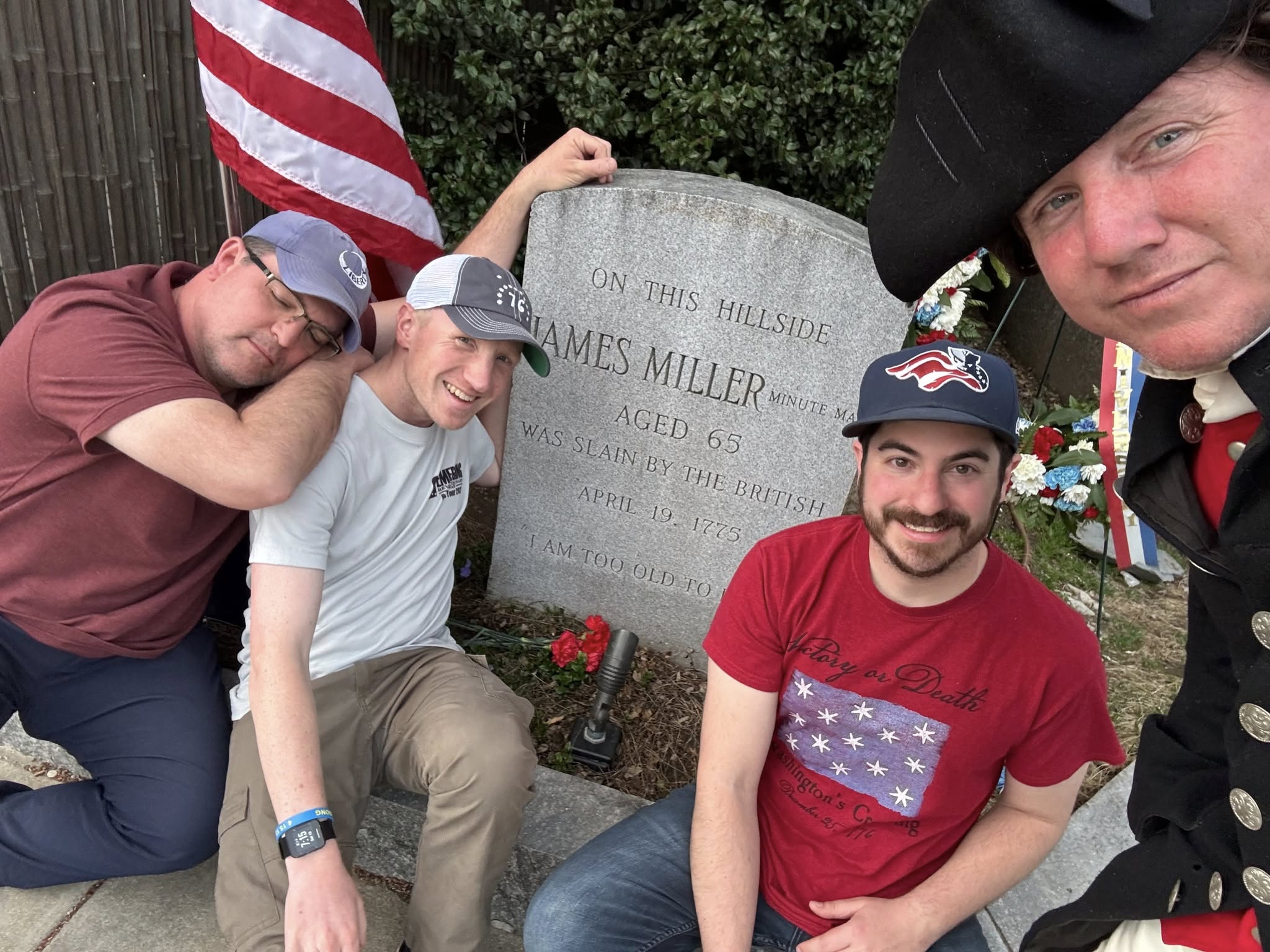
Finally, the day was winding down. We had one more marker to find in Somerville. There, 65 year old James Miller fell at the hands of the British. “I am too old to run,” he said as they neared him. Miller died as one of the first martyrs of Massachusetts, and one of the last on that day.
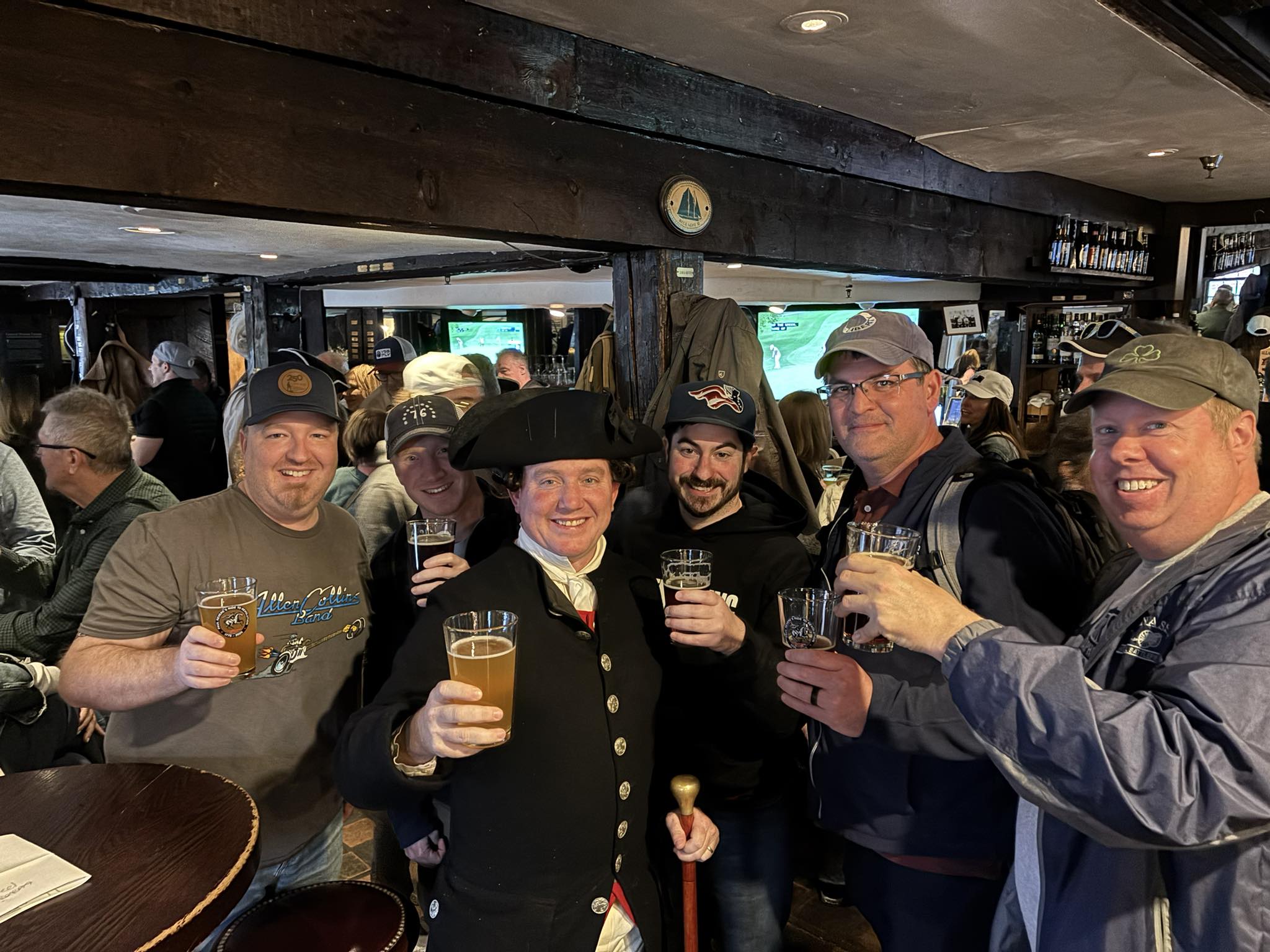
By the end of the day, we were all too tired to run anymore. We reached the end of our rope, a long 32 hours after our ERW extravaganza began. As you can imagine, we worked up quite an appetite. There was no better place to end it than at the Menotomy Grill to raise a glass of flip, the same drink Jason Winship and Jabez Wyman were consuming when British soldiers killed them at Cooper’s Tavern. Thankfully, our drinks were consumed under much less hostile conditions, but perhaps in as tired of a state as the participants in the first clash of the Revolutionary War.
To view all of our videos from the 250th anniversary of the Battles of Lexington and Concord, visit our YouTube channel here.