

For weeks, colleagues in the Continental Congress had been asking John Adams for advice. If the colonies were to break away from Great Britain and established governments of their own, what should those governments look like?
The first request came from North Carolinians William Hooper and John Penn in late March. The duo had been recalled from Philadelphia so they could join in conversations about a new government for their home state. Before departing, they each asked Adams for his thoughts. Adams “wrote with his own Hand, a Sketch,” and gave copies to both delegates.[1] The ensuing discussions in North Carolina led to the April 12, 1776 passage of the Halifax Resolves, which authorized the colony’s Congressional delegation to vote in favor of independence—the first colony to formally grant such authorization.
Next came a request from George Wythe of Virginia and then one from John Dickinson Sergeant of New Jersey. Finally, Richard Henry Lee of Virginia asked for a copy.
Adams had already given the topic considerable thought. He had touched on it in early 1775 in a series of newspaper articles that he’d signed “Novanglus,” and during a trip home in late 1775, he had addressed it for the Massachusetts colonial assembly. “The Happiness of the People is the sole End of Government, so the Consent of the People is the only Foundation of it,” he had written.[2] “Happiness,” in Adams’s vocabulary, meant “ease, comfort, security.”[3]
As Adams sketched out his ideas for his colleagues, he took the same approach, and each letter allowed him to develop and refine his ideas even further. By the time he wrote out his thoughts for Wythe, those ideas had become so clear and well articulated that the impressed Lee asked if he could have the letter published. Adams agreed. Using Wythe’s letter as the basis, Lee threw it into shape and “put it under the Types.”[4]
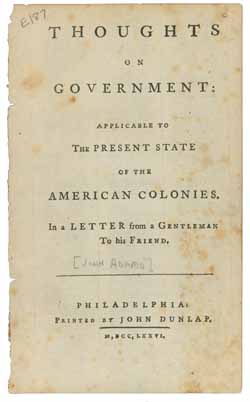
The result was Thoughts on Government, published anonymously because, of course, advocating an independent government was treason. John Dunlap—the same Philadelphia printer who had initially published Thomas Paine’s Common Sense—advertised the pamphlet for sale on April 22, 1776.
Adams’s treatise advocated three separate but equal branches of government: an executive branch with departments charged with carrying out laws; a two-chamber legislative branch charged with making those laws; and an independent judiciary. Militia would fall under civilian control.
If that all sounds a lot like the arrangement that later found its way into the constitution, that’s because it was. Adams’s pamphlet would strongly influence the state constitutions in nine of the new states and profoundly influence the eventual Constitution of the United States.
“Of all the millions of words that Adams wrote and published, none came close to rivaling the impact or the enduring influence of this pamphlet,” judged historian John Ferling.[5]
Adams had no way of knowing at that moment just how influential Thoughts on Government would be, but he would have been delighted. One of his main motivations for publishing the pamphlet was to counter ideas set for months earlier in Common Sense. Payne had coupled his brilliant argument in favor of independence with a plan for a post-independence government. “The Arguments in favour of Independence I liked very well,” Adams said, but he found Payne’s sketch for a replacement government to be “so foolish a plan.”[6] He “determined to do all in my Power, to counter Act the Effect of it” and so consented to Thoughts’s publication.[7]
Word of Adams’s authorship eventually leaked, and soon thereafter, Paine sought him out. Paine worried Thoughts “would do hurt, and that it was repugnant to the plan he had proposed in his Common Sense.” That was precisely the point, Adam’s cheerfully admitted; he had “consented to the publication of it: for I was as much afraid of his Work as he was of mine.”[8]
“This Conversation passed in good humour, without any harshness on either Side,” as Adams recalled, although they came to no resolution. That satisfied Adams just fine.[9]
Today, Thoughts is often forgotten, overshadowed by Common Sense in public memory in the same way James Madison overshadows John Adams’s contributions to the structure of the Constitution. Fewer documents, however, have had a more important, lasting impact on America than John Adams’s Thoughts.
[1] Adams to James Warren, 20 April 1776. https://www.masshist.org/publications/adams-papers/index.php/view/PJA04d062
[2] By the Great and General Court of the Colony of Massachusetts-Bay. A Proclamation. Broadside. (Watertown, Mass.: printed by Benjamin Edes, 1776).
[3] “III. Thoughts on Government, April 1776,” Founders Online, National Archives, https://founders.archives.gov/documents/Adams/06-04-02-0026-0004. [Original source: The Adams Papers, Papers of John Adams, vol. 4, February–August 1776, ed. Robert J. Taylor. Cambridge, MA: Harvard University Press, 1979, pp. 86–93.]
[4] Adams to James Warren, 20 April 1776. https://www.masshist.org/publications/adams-papers/index.php/view/PJA04d062
[5] Ferling, 155.
[6] John Adams, Diary of John Adams, Vol. 3, “In Congress, Fall 1775–Spring 1776.” https://www.masshist.org/publications/adams-papers/index.php/view/ADMS-01-03-02-pb-0330
[7] Ibid.
[8] Ibid.
[9] John Adams, Diary of John Adams, Vol. 3, “In Congress, Fall 1775–Spring 1776.” https://www.masshist.org/publications/adams-papers/index.php/view/ADMS-01-03-02-pb-0330

