

For weeks, colleagues in the Continental Congress had been asking John Adams for advice. If the colonies were to break away from Great Britain and established governments of their own, what should those governments look like?
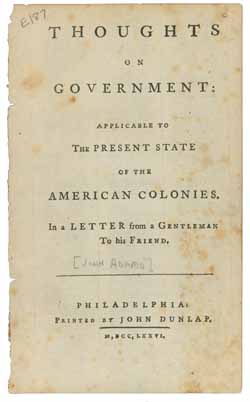
The first request came from North Carolinians William Hooper and John Penn in late March. The duo had been recalled from Philadelphia so they could join in conversations about a new government for their home state. Before departing, they each asked Adams for his thoughts. Adams “wrote with his own Hand, a Sketch,” and gave copies to both delegates.[1] The ensuing discussions in North Carolina led to the April 12, 1776 passage of the Halifax Resolves, which authorized the colony’s Congressional delegation to vote in favor of independence—the first colony to formally grant such authorization.
Next came a request from George Wythe of Virginia and then one from John Dickinson Sergeant of New Jersey. Finally, Richard Henry Lee of Virginia asked for a copy.
Adams had already given the topic considerable thought. He had touched on it in early 1775 in a series of newspaper articles that he’d signed “Novanglus,” and during a trip home in late 1775, he had addressed it for the Massachusetts colonial assembly. “The Happiness of the People is the sole End of Government, so the Consent of the People is the only Foundation of it,” he had written.[2] “Happiness,” in Adams’s vocabulary, meant “ease, comfort, security.”[3]
As Adams sketched out his ideas for his colleagues, he took the same approach, and each letter allowed him to develop and refine his ideas even further. By the time he wrote out his thoughts for Wythe, those ideas had become so clear and well articulated that the impressed Lee asked if he could have the letter published. Adams agreed. Using Wythe’s letter as the basis, Lee threw it into shape and “put it under the Types.”[4]
Continue reading “Thoughts on “Thoughts on Government””
