Before July 1776, There Was Rhode Island

Emerging Revolutionary War welcomes back guest historian Bjorn Bruckshaw

By the spring of 1776, the people of Rhode Island no longer needed to speculate about their relationship with Great Britain—they were already living in open resistance to it. War had begun the previous year, British naval power remained a constant threat along the coast, and the colony’s long history of defiance toward imperial authority had already brought confrontation to its shores. The destruction of His Majesty’s schooner Gaspee in 1772 had marked a decisive escalation, transforming protest into direct action against the Crown.¹ Now, as members of the Rhode Island General Assembly made their way to Providence in early May 1776, they did so with the reality of war firmly in mind. The question before them was no longer whether they opposed British authority, but whether that authority could continue to exist at all within their government.
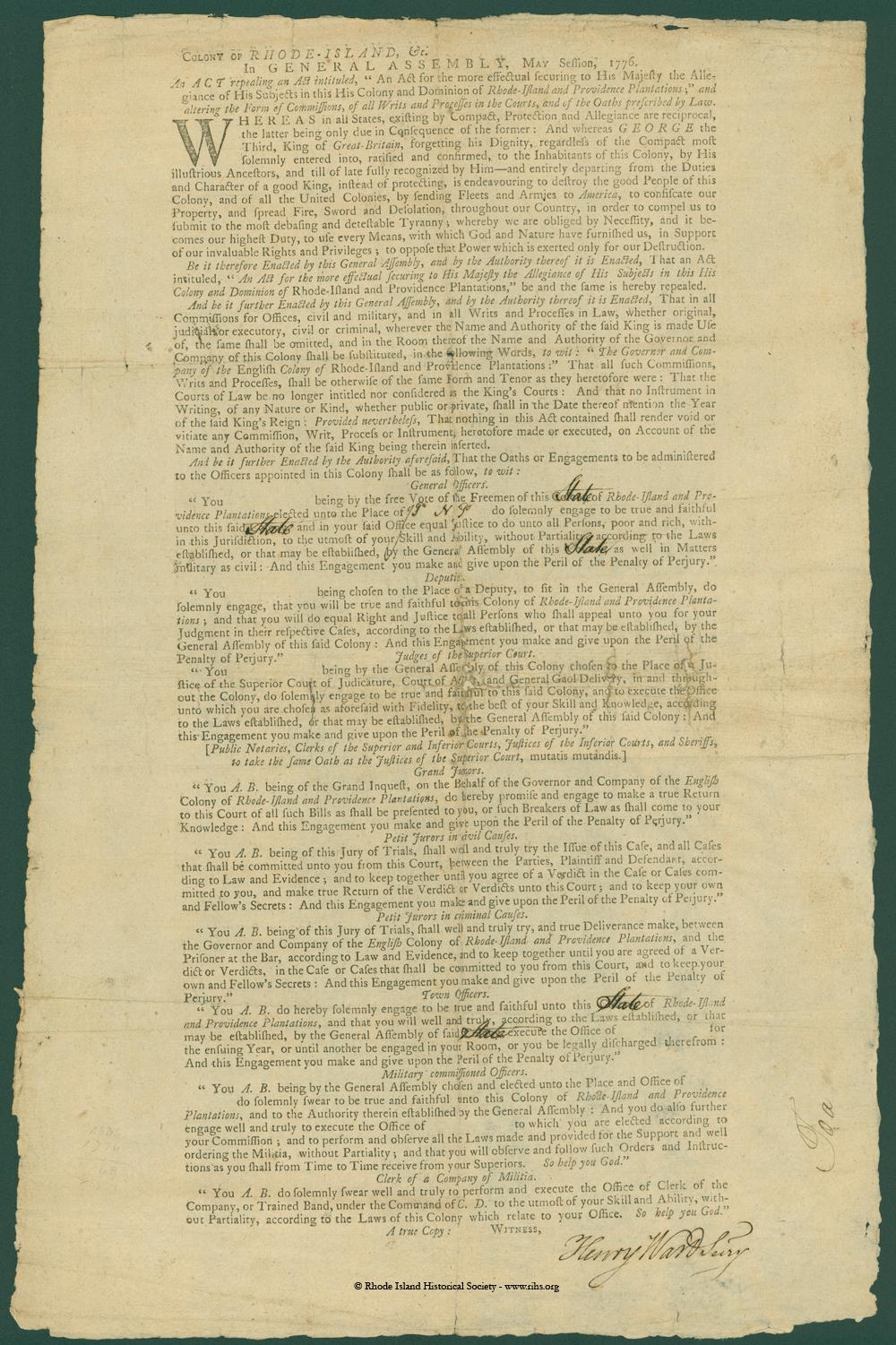
Rhode Island Independence Document

Inside the Assembly chamber on May 4, 1776, that question was answered with clarity and finality. Without issuing a sweeping declaration or engaging in extended philosophical argument, the legislature passed an act that removed King George III from every function of governance within the colony. The law ordered that “in all commissions, writs, and other proceedings in the courts of law,” the name and authority of the king be omitted.² In their place stood the authority of the colony itself. The act further directed that royal authority was to be “totally suppressed.”³ Courts would continue to function, but under a new source of legitimacy. Officials would take new oaths. The government would proceed without reference to the Crown. Rhode Island did not simply declare independence—it enacted it.

This action did not emerge suddenly. For years, Rhode Island had been among the most resistant of the colonies to British imperial control, particularly in matters of trade and enforcement. British officials repeatedly complained of the colony’s defiance, noting the difficulty of imposing authority in a place where regulations were often ignored.⁴ That resistance became unmistakable with the Gaspee affair, and the Crown’s response—threatening to transport suspects to England for trial—provoked widespread alarm. Colonial critics warned that such measures would undermine “that great bulwark of English liberty,” the right to trial by a local jury.⁵ By the time hostilities began in 1775, many Rhode Islanders had already concluded that reconciliation with Britain was increasingly unlikely.

That understanding was reflected not only in legislative action, but in the colonial press. The Providence Gazette soon reported the Assembly’s proceedings, noting that the legislature had taken measures removing the authority of the Crown from government functions, a step consistent with the colony’s wartime posture and political condition.⁶ While not framed in celebratory or rhetorical language, the report treated the change as a matter of governance already in motion. Similarly, the Newport Mercury, writing amid growing military uncertainty, reflected a broader shift in tone, reporting colonial affairs in a way that assumed the imperial relationship was breaking down beyond repair.⁷

These accounts are significant not because they proclaim Rhode Island’s primacy, but because they demonstrate how independence was understood in real time—not as a single dramatic declaration, but as a series of actions already unfolding.

Continue reading “Before July 1776, There Was Rhode Island”
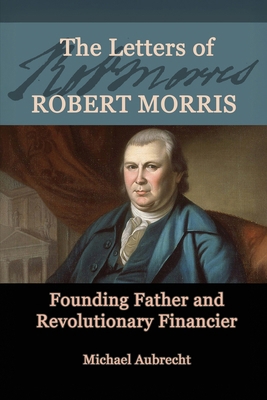
Book Review: The Letters of Robert Morris: Founding Father and Revolutionary Financier. By Michael Aubrecht

Emerging Revolutionary War welcomes back guest historian Evan Portman for this review.

Among the pantheon of America’s Founding Fathers, Robert Morris is a name rarely mentioned beyond circles of historians. However, Michael Aubrecht sheds light on this phantom revolutionary figure with his book The Letters of Robert Morris: Founding Father and Revolutionary Financier. His work represents the first time the primary sources of Robert Morris have been compiled in print.

The Letters of Robert Morris spans the financier’s political life from his time in the Continental Congress to his time in debtors’ prison at the turn of the eighteenth century. Morris’s correspondence provides a fascinating window into his public life. His recipients often include the likes of George Washington, Thomas Jefferson, Benjamin Franklin, and Alexander Hamilton. Some of Morris’s most fascinating correspondence comes from late 1776 and early 1777, during which the financier provided Washington’s army with much needed supplies. His letters to Washington during the Ten Crucial Days reveal the anxiety and trepidation that pervaded the fledgling United States at that time.

Also compelling is Morris’s role in establishing the Bank of North America and a new national currency, which he outlined to a letter to John Hanson, the president of Congress, in 1782. His frequent exchanges with individuals like Hamilton and Franklin about the bank and its expenditures highlight Morris’s financial acumen but also how much of his own personal wealth he was willing to pledge to the American revolutionary cause.

Overall, Aubrecht’s editorial approach is sound and tactful. He adapts hundreds of Morris’s letters the National Archives’ online repository. While many of these letters are accessible on the internet, there is particular value in assembling them in print as Aubrecht has. While an online repository can sometimes feel disjointed, a printed volume can help readers to make connections and allow the editor to exert a bit more influence over the narrative.  

However, Aubrecht places Morris’s voice at the center of this volume, intruding little on the language and meaning of the original texts. Aubrecht occasionally inserts a missing word or clarifies a misspelling, but his methodology essentially allows Morris to speak for himself. Aubrecht also provides useful biographical information on his subject in the introduction as well as advocates for his importance as one of the Revolution’s most prominent financiers.

The collection could, however, benefit from a bit more contextual information, particularly in between substantial time gaps between letters. While most readers need no introduction to many of Morris’s illustrious correspondents, a brief paragraph providing the context of a set of letters could prove useful in providing a more detailed picture of Morris’s life. The collection could also make more liberal use of footnotes in defining key terms and antiquated language, as well as elaborating on some of the lesser-known people Morris mentions in his correspondence.

Regardless, The Letters of Robert Morris is a welcome contribution to the existing literature on one of America’s underappreciated Founding Fathers. Aubrecht’s selection proves to be a key asset to researchers and history buffs alike.

Information:

The Letters of Robert Morris: Founding Father and Revolutionary Financier. By Michael Aubrecht. Berwyn Heights, MD: Heritage Books, 2025. Softcover, 431 pp. $43.00.

The Gerrymander: A Gift from the Founding Fathers

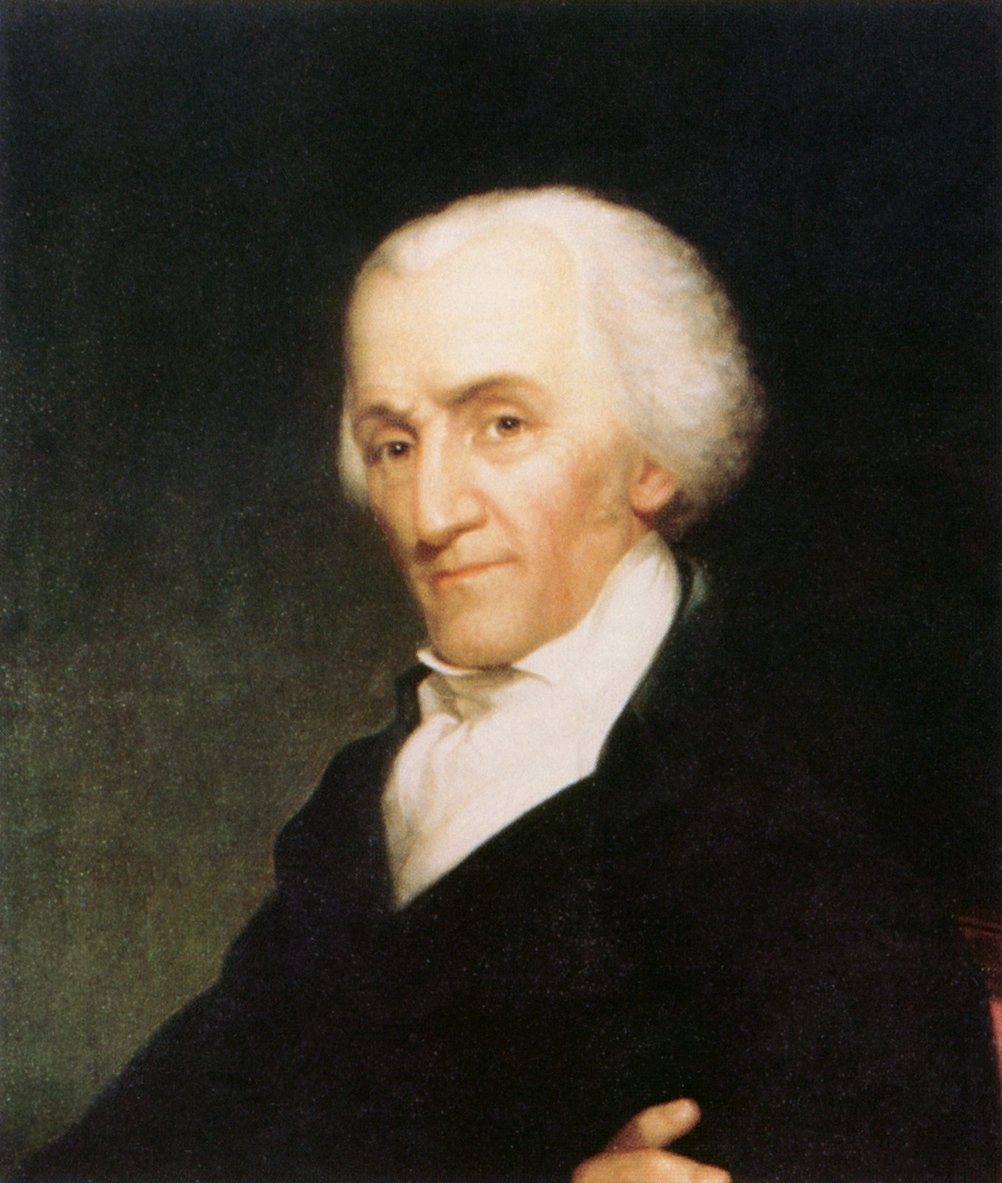
Elbridge-gerry-painting
Massachusetts Governor and U.S. Vice President Elbridge Gerry

Lately, the term “gerrymandering” is getting thrown around as some sort of new illness that afflicts the republic.  The process essentially involves drawing electoral district boundaries in ways that benefit one political party or the other and dates back to 1812 Massachusetts, when Governor Elbridge Gerry, a member in good standing of the founding generation, signed legislation radically redrawing electoral districts in the state to favor the Democratic-Republican Party.

Born in 1744, Gerry was a Massachusetts merchant and vocal opponent of British policy in the colonies who served in the Second Continental Congress, signed the Declaration of Independence, the Articles of Confederation, and attended the Constitutional Convention.   Like a few of his contemporaries, notably George Mason and Patrick Henry of Virginia, he refused to sign the Constitution due to its lack of an explicit Bill of Rights. Nonetheless, he went on to serve as an envoy to France in the Adams administration, then was elected to the U.S. House of Representatives, as Governor of Massachusetts, and then was Vice President under James Madison.  Only a few men had a better claim on the term “founding father.”

Continue reading “The Gerrymander: A Gift from the Founding Fathers”

Northwest Territory: Setting a Precedent

A precedent was set in early July for the young and aspiring American republic. A date other than July 4th and in fact, nine days and eleven years later.

July 13, 1787.

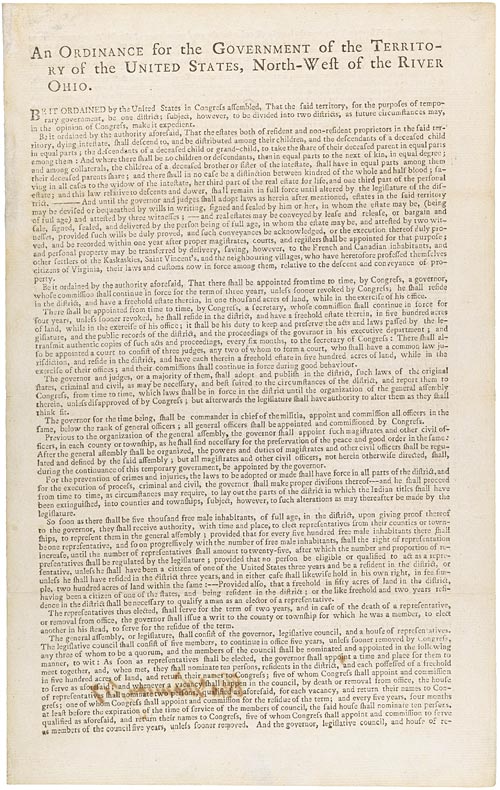
doc_008_big
Northwest Ordinance (courtesy of OurDocuments.gov)

On that date, the United States Congress enacted the Northwest Ordinance which set in motion the precedent for how new states would enter the burgeoning United States of America. In 1784 the groundwork for the Northwest Ordinance was laid, rejecting a proposal that new territories, carved from ceded land of current states, would enter as colonies. Congress set up the following parameters.  Continue reading “Northwest Territory: Setting a Precedent”