

Emerging Revolutionary War welcomes guest historian Mike Busovicki
If the majority of American Colonists were from the British Isles, Africa, and Germanic States, why was Spanish currency so prevalent and how did it get here?
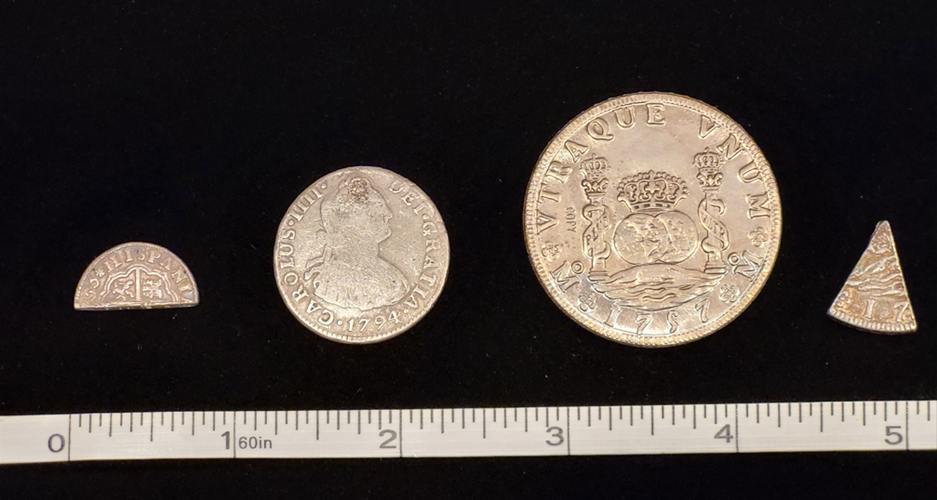
L-R: Silver half of a 1-reales coin, silver 2 reales, copy of an 8-reales (“piece of eight”) and copy of 1/8 (piece, or “bit”) of the 8-reales. Like cutting a pizza in half and cutting the halves again twice, it was easier to create a system based on “eighths” rather than a decimal one. (Photo by Mike Busovicki)
By the late 1400s, The Spanish had joined the kingdoms of Aragon and Castile through the marriage of Ferdinand and Isabela, wrested control of the Iberian Peninsula from the Islamic Moors and utilized the Catholic Church to enforce royal authority and justify brutal domestic and foreign policies.But these endeavors were expensive. Though successful in removing political opponents, it drove out or suppressed long standing medical, financial, and trade centers, especially in population hubs like Granada, Seville, and Toledo. Heavily in debt, the Spanish crown had to generate income from outside of Spain. Consolidating wealth and power into the hands of a few was expedient, but it excluded large segments of the population and resulted in domestic economic stagnation.
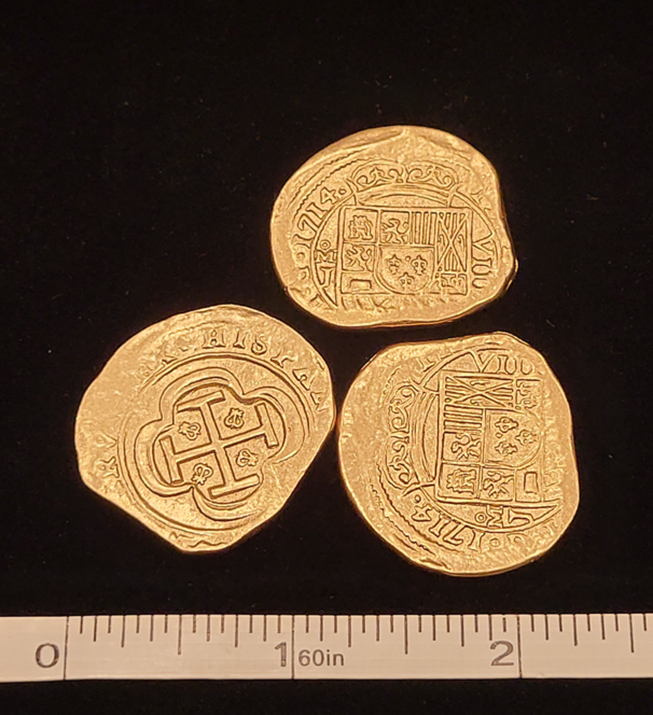
Copies of 4-Escudo coins. Escudo, meaning shield, referred to the coat of arms that validated coins. New world mines accounted for over 80% of the world’s silver and 70% of the world’s gold – it also funded conquest by the Ming, Qing, Mugul, Ottoman, and Safavid empires. (Photo by Mike Busovicki)
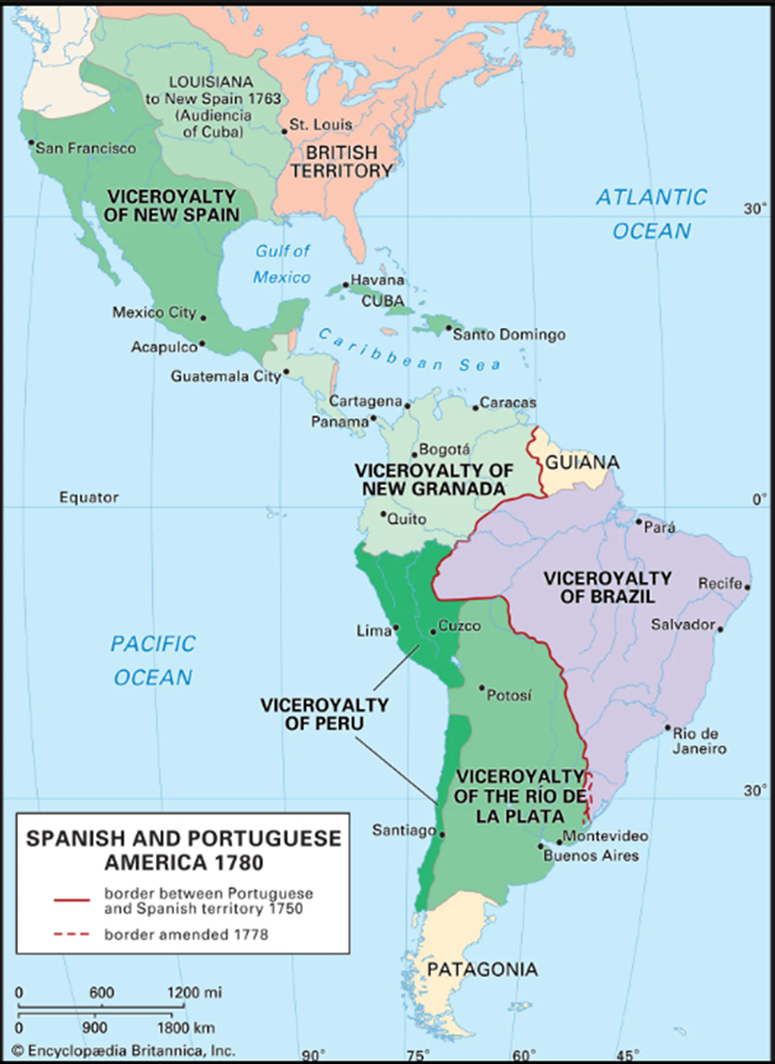
While French intervention, British politics, and German mercenaries constitute most discussions regarding European power during the Revolution, centuries of Spanish control of vast areas cannot be overstated. By courtesy of Encyclopædia Britannica, Inc., copyright 2016; used with permission.
Spanish conquistadors initially sought gold, but by the mid 1500’s large silver deposits quickly became the focus. The decisive factor was an amalgamation process where mercury helps separate silver from impurities in the ore. This streamlined process improved consistency, especially after mercury was discovered in Peru in 1568. The largest mine, at Potosí in present-day Bolivia, increased production 7-fold between 1572 and 1585, never yielding less than 7.6 million pesos every year for the next 70 years. Put another way, between 1550 and 1700, Spain produced 50,000 tons of silver – doubling the amount of the precious metal in all of Europe in only 150 years.[i]
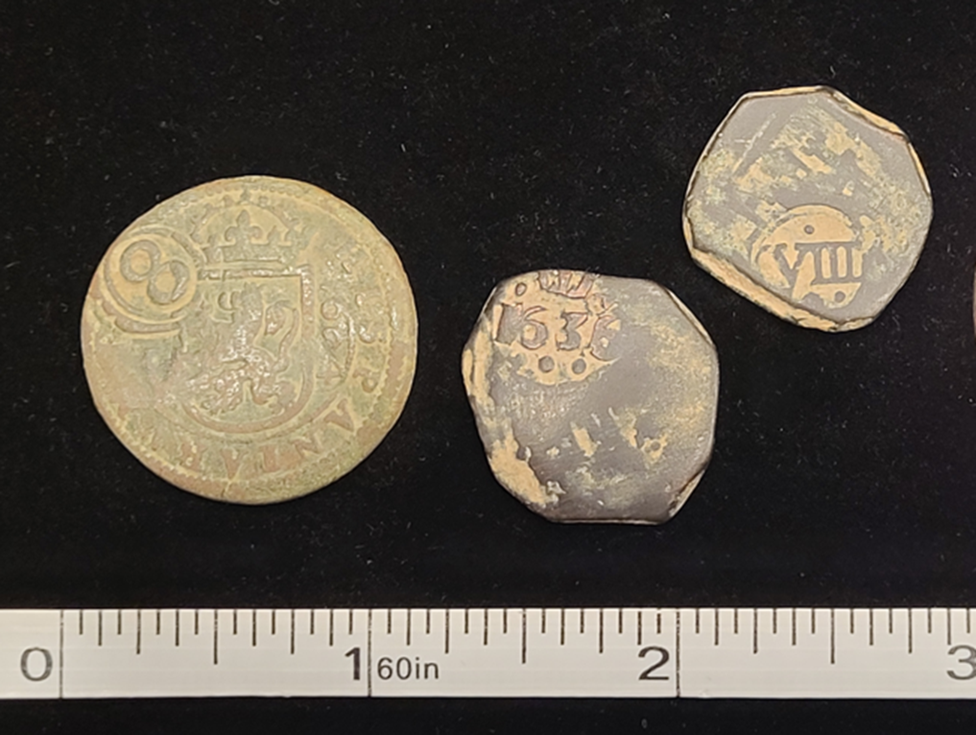
An early machined Spanish and “cob” copper coins. Various types of counter stamping verified their content or that it was accepted in other realms. “Chop” marks cut into the coin revealed whether it was pure throughout or a counterfeit, perhaps silver or gold plate over other metal. (Photo by Mike Busovicki)
The term “milled” comes from the milling process that created coins of a standard shape, size, and weight. Earlier coins were simple stamped chunks of metal chopped off a rough bar or ingot. They were called “cobs” from the Spanish word, cabo, meaning bar. Prior to milling machines, rough irregular coins were common because the weight and purity – not the shape or aesthetics – were the focus. But with the milling process, Spanish “milled” coins became easier to recognize, harder to counterfeit, and projected quality.
The Spanish system relied on non-Spaniards in every regard. Native workers extracted the metal while agents of the crown sent a percentage sent back to Madrid. Silver was eagerly sought by the Chinese, who were doing business with Europeans in the Philippines and Indonesia. Chinese goods were cheaper vis-a-vis the price of silver, inextricably drawing Spain into Asian markets. While Madrid was to receive one-fifth of the wealth produced in the new world, it was either mismanaged, paid debts, financed military operations and mercenaries, or left via a series of dynastic marriages throughout Europe.
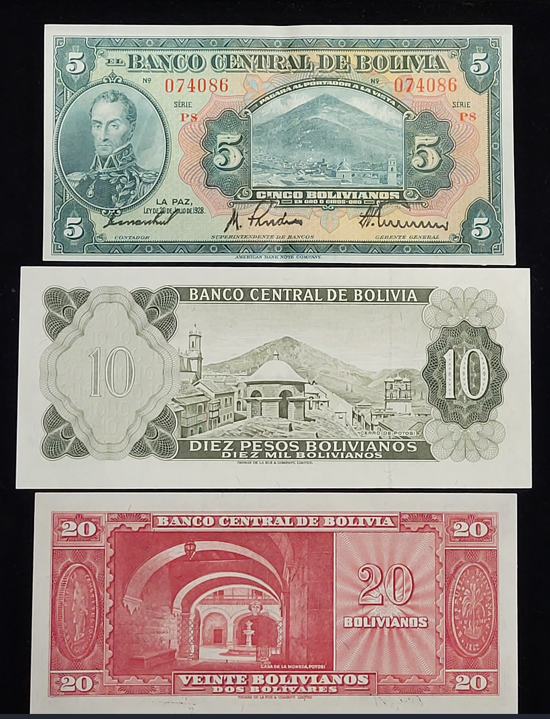
(To the Right) Once silver was discovered in Potosí (now Bolivia) in 1545 and Zacatecas (now Mexico) in 1548, the Spanish Empire ran on silver. 70% came from Potosí, proudly displayed alongside their liberator, Simón Bolívar. Today, the Spanish word “plata” literally means “silver” but remains Latin American slang for “cash.” (Photo by Mike Busovicki)
By the turn of the 17th Century, an estimated 5 million pesos annually sailed to Asia, confirming it as the de facto currency of a new global economy. More still left on Portuguese, Dutch, Flemish, French, English, and German ships who were getting a better price for silver than from the Spanish. Very little reached the average Spaniard who still relied heavily on credit. If the Spanish crown truly controlled global finance, the great international banking houses like Antwerp and Genoa would have relocated to Madrid. They never did.
By the mid-17th Century, Spain’s Armada had not recovered from its defeat at the hands of the British, there had been silver devaluation following scandal over purty at Potosí, and Portugal had gained independence from Spain. Dutch fleets controlling the spice trade, British preeminence in the Caribbean, and perennial conflict with the French helped spell the downfall of the Spanish Empire.[ii] Between 1640 and 1763, almost all Spanish bullion was re-exported. Spain remained the center of international trade, but only because its treasure constituted the common coin of that system.[iii]
The British also wanted to engage in Asian markets, but luxury goods like silk, tea, and porcelain had to be purchased with silver because there were so few European products in demand.[iv] Attempts to offset the resulting trade deficit were the currency acts of 1751 and 1764, ensuring raw materials were sent to Britain but little coinage returned.[v] American ports now relied on payments in hard currency from foreign ships resupplying there rather than their mother country.[vi]
From 1761 until 1771, no new copper coins were struck by the British mint, meaning even less reached the colonies. British silver coin production reached a standstill around the same time because the mint was paying less for bullion than its value on the open market.[vii] Therefore, only small denominations were circulating, like shillings and sixpence, and many of those were so old and worn they were no better than cob coins.[viii] Eventually, tokens made of copper or alloys were created but they contained less metal than face value.[ix]
Spanish Silver Dollars were the first major loans that propped up the first American Dollar, and they remained in circulation for years.[x] In 1776, the Continental Congress accepted no less than 25 different foreign coins for transactions.[xi] It wasn’t unusual to use coins of various origin; the metal content was the important thing, not the monarch on it.[xii] Scales and international exchange rates became so inextricably linked with finance that even today, verbiage like the pound, the mark, and the peso can describe either measurements or financial denominations.
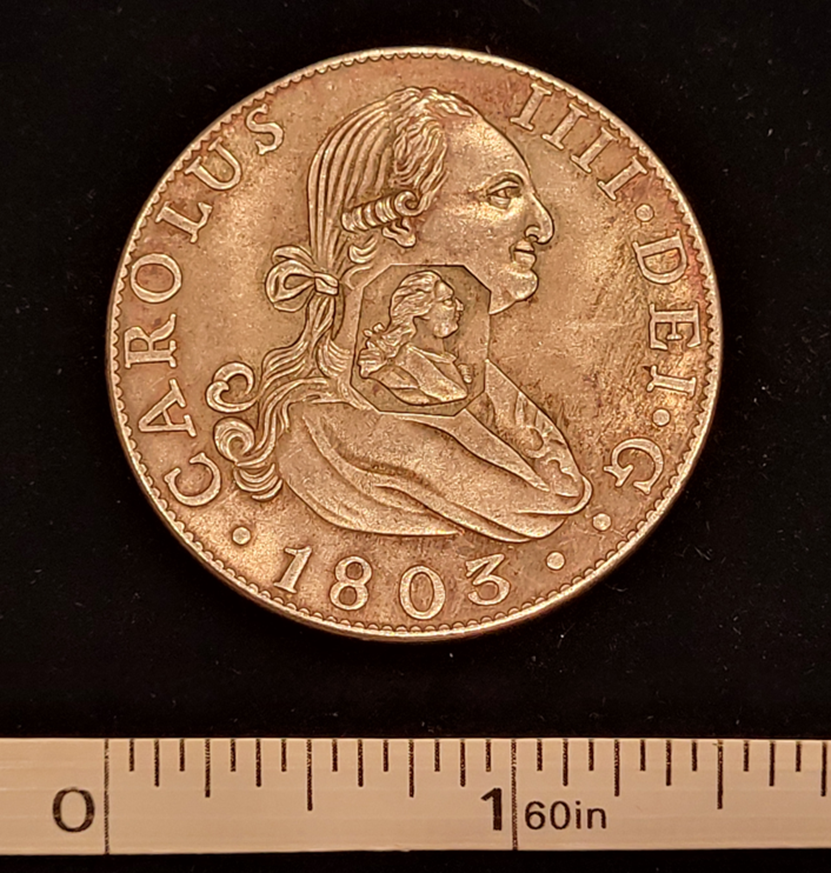
Copy of the 8-reales King George III repurposed for use during shortages. The octagonal stamp made counterfeits easier to detect but were ridiculed by the public. (Photo by Mike Busovicki)
The Spanish Milled Dollar had a long legacy wherever it landed. Demand for coin was so acute that the British bought and counter-stamped them with King George III’s bust in the 1790’s so they could legally circulate in the realm. The small oval stamp was easily faked, and the practice was eventually halted but counter-stamping resumed in 1804 during the Napoleonic Wars. British national debt, due in large part to wars on multiple continents led to higher taxes. That debt didn’t cause coin shortages per se, but supply was reduced because payments were made in physical gold and silver – arms and troops weren’t going to materialize on credit, goodwill, or token payments.
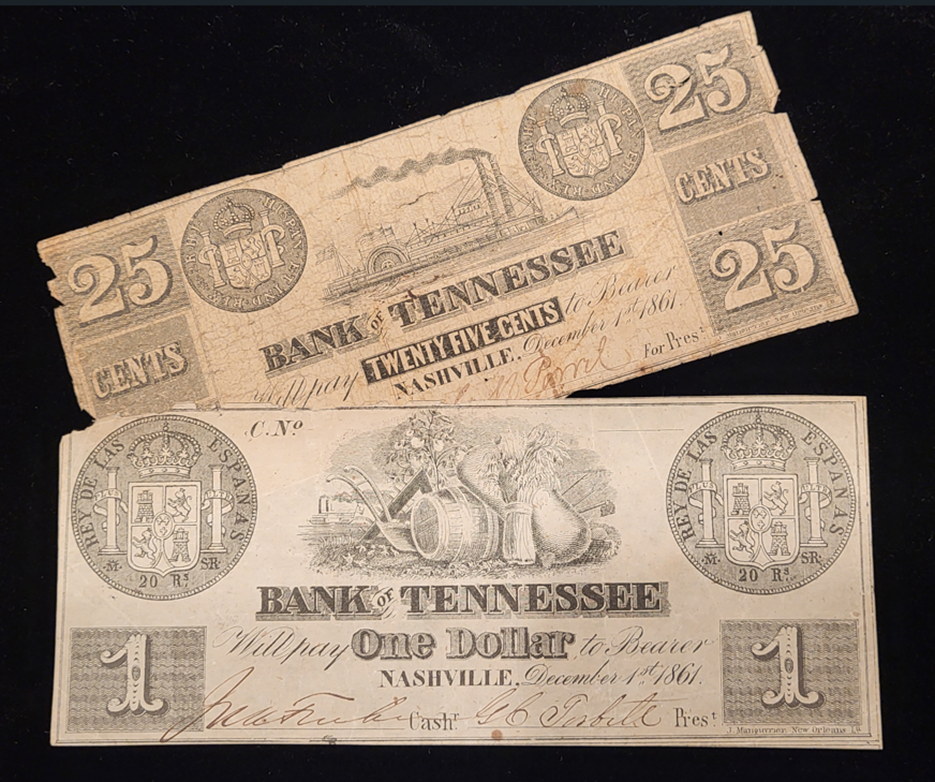
In times of economic uncertainty, American banks still relied on the reputation of Spanish silver to project quality and stability. (Photo by Mike Busovicki)
Several economic depressions and hard times marked the first decades of American independence. Precious metal of any origin was still hoarded, meaning Milled Dollars remained in demand long into the 19th century. The coinage act of 1857 formally removed foreign currency from circulation in the United States, but those old enough to fight in the civil war had living memory of using silver sought by the conquistadors.
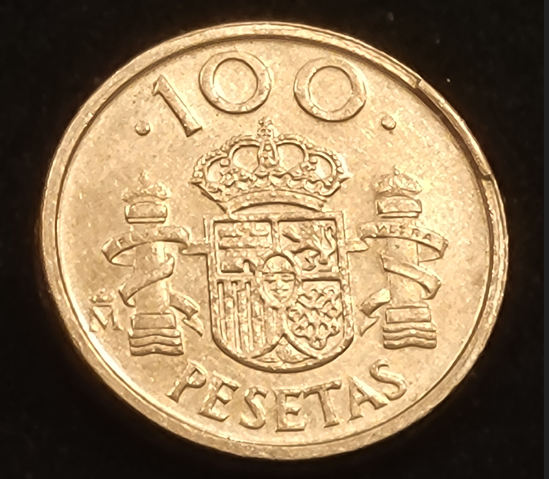
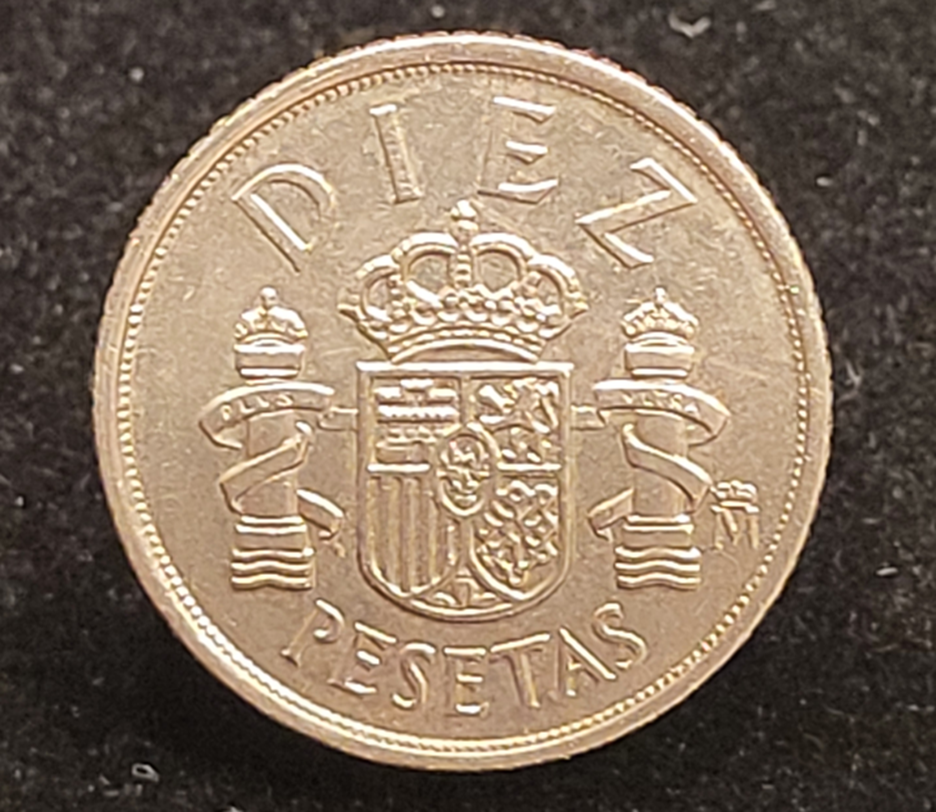
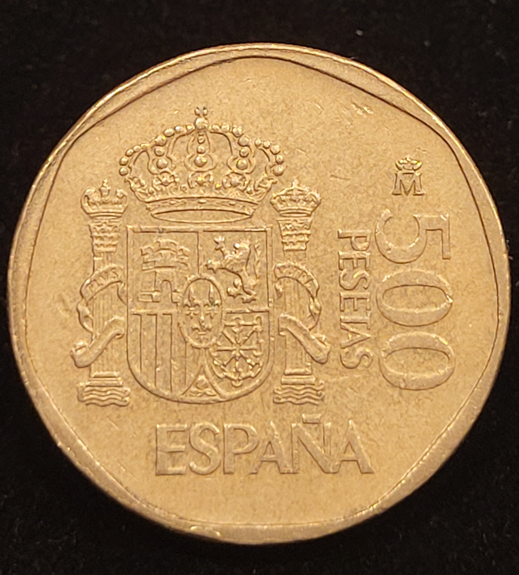
Plus Ultra: Latin for “More lies beyond.” The banners around the Pillars of Hercules form the familiar $ sign we use today. The pillars represent the straits of Gibraltar that lead from the Mediterranean to trade routes full of riches. Copied from the 8-reales, the Pillars remained a feature on Spanish coins until they adopted the Euro in 1999. (Photo by Mike Busovicki)
[i] Kamen, Henry. Empire: How Spain Became a World Power (Harper Collins, 2003). 285-292
[ii] The Beginnings of Globalization: The Spanish Silver Trade Routes. Defense.info: https://share.google/NwyWqSSxrkBYDMog8
[iii] Kamen, pp. 449-450.
[iv] The National Archives (UK): “Howe did Hong Kong become Part of the British Empire? https://www.nationalarchives.gov.uk/education/resources/hong-kong-and-the-opium-wars/
[v] “The Currency Act” American History Central. https://www.americanhistorycentral.com/entries/currency-act/
[vi] Lasser, Joseph R. et al. The Coins of Colonial America: World Trade Coins of the Seventeenth and Eighteenth Centuries (The Colonial Williamsburg Foundation, 1997)
[vii] National Archives (UK).
[viii] The Royal Mint Museum: “George III.” https://www.royalmintmuseum.org.uk/journal/british-monarchs/george-iii/#:~:text=The%20shortage%20of%20silver%20by,the%20end%20of%20October%201797.
[ix] @Townsends. “The Strange History of Money in America.” You Tube: https://youtu.be/I5INCV7AQTI?si=yPJKPe3weJkxrc75
[x] “Spain’s Involvement in the American Revolution” American Revolution.org. https://www.americanrevolution.org/spains-role-in-the-american-revolution/
[xi] Lasser, pp. 5
[xii] Lasser, pp. 4

