

Emerging Revolutionary War welcomes back guest historian Ben Powers
Huw Davies’s work The Wandering Army: The Campaigns That Transformed the British Way of War posits that the British Army underwent a period of enlightenment during the late eighteenth century, inspired by its poor showing in the War of the Austrian Succession. Officers turned to continental Europe to study military art in the same spirit that enlightenment scholars studied moral philosophy. This period of military change, innovation, and adaptation encompassed what Davies refers to as “the interconnected relationship of these three areas: military thought, experience, and knowledge exchange, which together drove Britain’s accidental military enlightenment.”
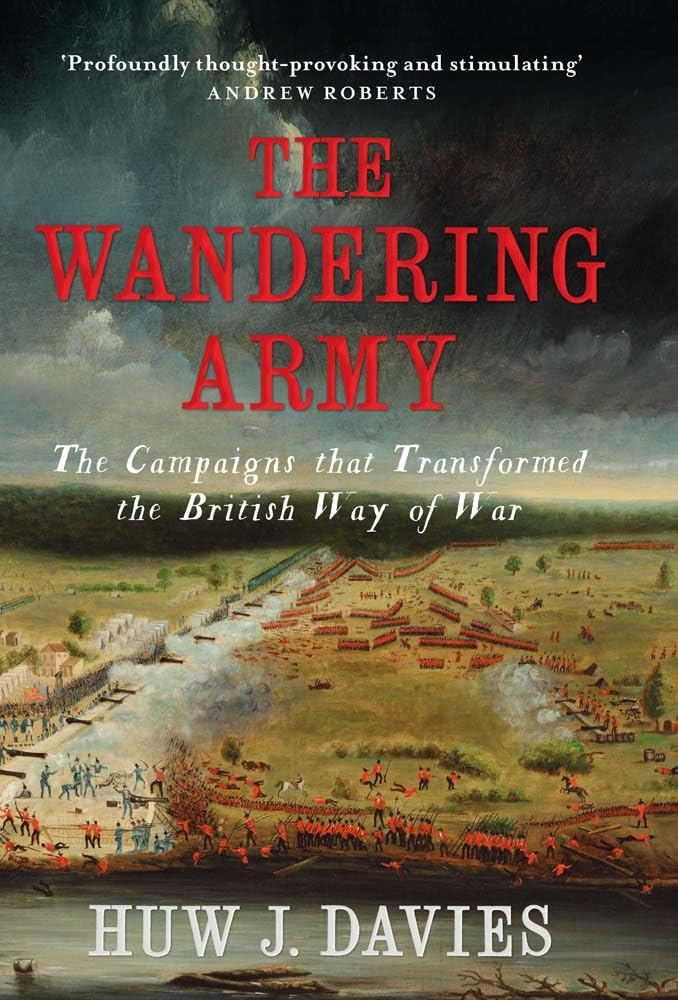
Davies documents that the British Army in the 1700s entered a doldrums of intellectual and tactical stagnation in the early decades of the century, following its successful participation in the War of the Spanish Succession. Victory bred complacency, leading to a poor showing at Fontenoy in 1745. He goes on to demonstrate that defeat galvanized officers to undertake self-directed study of military theory and share lessons learned with other officers, forming a community of practice. Officers later combined these efforts with practical experience gained through active campaigns and peacetime training, resulting in cycles of learning throughout the latter half of the eighteenth century. Davies’s work contributes to the historiography of the British Army by demonstrating that officers actively sought to synthesize the latest military theories, their own combat experiences, and the ideas of their peers into innovative systems to address challenges across multiple theatres of war.
Davies uses a variety of evidence, including historical analysis, accounts of officer practices, and descriptions of training reforms. The bibliography of The Wandering Army contains almost 600 entries, ranging from period treatises, manuals, and official correspondence such as orderly books and military returns, to contemporary newspapers, to historical manuscripts. Davies traces a paper trail of British study of military art from 1745 to 1815, showing that officers studied war, applied what they learned, and discussed war in public forums and personal correspondence. He cites examples of General Henry Clinton walking and studying old battlefields in 1774 to prepare himself for future challenges (Davies, 82–83); Lord Charles Cornwallis’ establishment of a standardized system of drill and equipage for his troops in India, based on lessons he had learned during the War for American Independence (Davies, 204); and the establishment of a camp for the training of light troops at Shorncliffe, England, to teach innovative tactics to light infantry, developed by Sir John Moore (Davies, 287–315).
Davies does not claim that these developments guaranteed victory, but rather that they resulted in a better-prepared officer corps. This argument is convincing and well-supported, presenting a balanced view of the British Army’s advancements. This use of evidence is a primary strength of Davies’s argument. The main weakness may be a lack of discussion of precisely why improvements that led to battlefield success consistently atrophied during periods of peace. Davies’s nuanced interpretation attempts to address this; however, the cycle of defeat-innovation-victory-atrophy, while well documented, is never fully explained.
The Wandering Army has received positive reviews. Professor Lawrence D. Freedman found the book compelling and that it proved its thesis, while Dr. James D. Scudieri praises the depth of research. Stephen Brumwell considers Davies’s argument convincing, but questions whether he proved the British Army maintained communities of practice over time.[1]
Davies presents a thoughtful examination of the evolution of the British Army’s knowledge and preparedness between the War of the Austrian Succession and the end of the Napoleonic Wars. He proves his point that, although it experienced uneven progress, losing ground during periods of peace, the late eighteenth-century British Army proved remarkably innovative and adaptable.
Bibliography
Brumwell, Stephen. “No End of a Lesson: Did the Redcoats Ever Learn from Their Mistakes?” Review of The Wandering Army: The Campaigns That Transformed the British Way of War, by Huw J. Davies. Times Literary Supplement. 2023. https://www.the-tls.com/history/the-wandering-army-huw-j-davies-book-review-stephen-brumwell.
Freedman, Lawrence D. Review of The Wandering Army: The Campaigns That Transformed the British Way of War, by Huw J. Davies. Foreign Affairs 102, no. 3 (May/June 2023). Published April 18, 2023. https://www.foreignaffairs.com/reviews/wandering-army-campaigns-transformed-british-way-war.
Scudieri, James D. Review of The Wandering Army: The Campaigns That Transformed the British Way of War, by Huw J. Davies. Parameters 54, no. 2 (Summer 2024). US Army War College
[1] Brumwell, Stephen. “No End of a Lesson: Did the Redcoats Ever Learn from Their Mistakes?” Review of The Wandering Army: The Campaigns That Transformed the British Way of War, by Huw J. Davies. Times Literary Supplement. 2023. https://www.the-tls.com/history/the-wandering-army-huw-j-davies-book-review-stephen-brumwell.
Freedman, Lawrence D. Review of The Wandering Army: The Campaigns That Transformed the British Way of War, by Huw J. Davies. Foreign Affairs 102, no. 3 (May/June 2023). https://www.foreignaffairs.com/reviews/wandering-army-campaigns-transformed-british-way-war.
Scudieri, James D. Review of The Wandering Army: The Campaigns That Transformed the British Way of War, by Huw J. Davies. Parameters 54, no. 2 (Summer 2024). US Army War College Press. https://press.armywarcollege.edu/cgi/viewcontent.cgi?article=1049&context=parameters_bookshelf.
Book Details:
Yale University Press, 2022, 384 pages

