

By the summer of 1775, North Carolina’s royal governor, Josiah Martin, was an outcast among the land he presided over. Forced to flee the mainland by Patriot sympathizers, Martin believed his colony was not lost to rebels. His prompting initiated a British expedition to North Carolina and excited the loyalists present there enough to rise up. Descendants of Scottish Highlanders who settled large areas of North Carolina put on their kilts and broadswords and marched for King George III toward Wilmington to the tune of bagpipes.
Patriot regulars from North Carolina stood in their way about 15 miles northeast of Wilmington. On February 27, 1776, the Scots and Tories attacked the North Carolinians behind Moore’s Creek. The brief fight turned out to be another victory for the Patriot cause in the south (preceded by the Battle of Great Bridge). Though small by later standards of the Revolutionary War, the battle received widespread coverage throughout the American colonies. Below is a transcript of one of the earliest newspaper accounts of the Battle of Moore’s Creek Bridge, published on March 15, 1776, in Williamsburg’s Virginia Gazette.
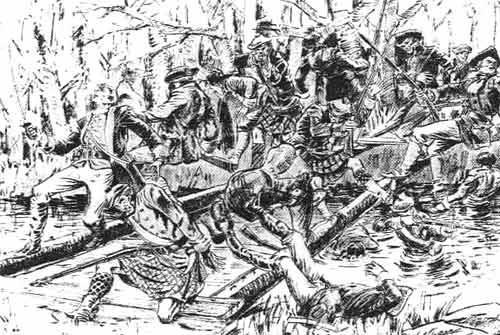
“By letters from North Carolina, we have the pleasure to communicate the following important intelligence, giving an account of the total defeat of the Scotch Highlanders, Regulators, &c. who had lately become very formidable, and threatened much mischief to the southern colonies, as well as to the glorious cause wherein all America is engaged, in support of her invaded rights, and to oppose ministerial tyranny; so that we may now safely congratulate the publick on the utter demolition of the Tory interest in that province, which puts a finishing stroke to the farther machinations of master Martin, their wicked and unprincipled governour.—-Col. Moore, with a body of 2000 men, having got within about six miles of the Tory army, before they thought we were apprised of their scheme to join governour Martin and the succours he expected from Boston and England, they, to amuse him, sent a flag of truce, summoning him and his followers to lay down their arms, deliver up their ammunition and stores, and repair to the king’s standard and take the oath of allegiance; and in the meanwhile, in order to avoid him, they crossed the river, not knowing that col. Caswell was on his way up, on the same side, to join col. Moore, with about 700 men. The colonel, being made acquainted with this manœuvre of the Tories, immediately despatched an express to col. Caswell, who made a forced march, and got near five miles ahead of them, taking post between them and the governour, at a bridge over Moore’s creek, where he knew they must pass, or fall in with col. Moore’s main body. Col. Caswell, making use of his advantageous situation, threw up a Small intrenchment on the oppoſite side of the creek, where he determined to wait for col. Moore, then between 40 and 50 miles distant, or, should the Tories incline to attack him, to give them battle, although they were upwards of 2000 strong. In the meanwhile, however, to decoy them, he made a final breastwork on the other side of the creek, and began to treat with the Tories, who had sent in a flag of truce, with the like requisition they made to col. Moore, to lay down their arms, &c. in which case they should receive mercy, and be treated with gentleness. Col. Caswell’s reply was, that he and his people were resolved to use their arms in the service of their country, and should not lay them down unless they were compelled to it. During this negotiation, he took care to let the officers who came with the flag of truce see his encampment, and the breastwork he had thrown up; and immediately on their departure caused it to be levelled, and crossed to his main post, leaving only a small guard behind, whom he ordered to keep up large fires, as if his whole army was there encamped. He did not fail to leave behind him all the marks of a precipitate retreat, taking up the planks of the bridge for about 30 feet, but suffered the sleepers to remain, that the enemy might have it in their power to come over, though but slowly, and then made dispositions to prevent his army from being discovered by them. Next morning, a good while before day, the whole Tory army marched down to attack him, leaving only a small party behind to guard their baggage. Their disposition was a very good one, the main body being supported on each side by a column of flankers; the van led by col. Macleod, second in command, and the rear of the army brought up by brigadier-general Macdonald, both of whom were at the battle of Lexington, and afterwards sent by general Gage, at governour Martin’s request, to head the North Carolina insurgents. Upon their arrival, finding that col. Caswell had abandoned his camp, they determined to cross the bridge in pursuit of him; but as soon as they got upon it, his advanced guard challenged them, who were answered by Macleod with a discharge of his piece, which a sentinel returned. The enemy then began a heavy firing, although without being able to do the least execution; for col. Caswell lay still, till he thought a sufficient number of them had crossed to play upon with four field-pieces, which he caused to be loaded with musket balls, and were so disposed on the intrenchment (in the form of a half-moon) as to rake the bridge on all sides. About 100 of the enemy having crossed the bridge, there ensued a most dreadful carnage, and they never fired a shot after the first discharge from the artillery, but, being seized with a panick, betook themselves to flight, in the most precipitate manner, notwithstanding every exertion of col. Macleod, who fell soon afterwards, and when found had 23 balls and two buck shot in him and through him. It is supposed that scarcely one of those returned who got over the bridge, about 30 being killed on the spot, between 50 and 60 wounded, and the rest fell over the bridge and were drowned, owing to the planks and sleepers being greased, which served to trip up their hells in their tumultuous flight, as was expected, and intended. A party of horsemen were sent in pursuit of general McDonald, who took him; and the Granville and Orange militia, who were likewise ordered to pursue the enemy, took about 400 prisoners, 30 of them officers, whom they delivered to col. Alexander Martin, then on his march from the western parts of the province to join col. Moore with 4000 men. The private men he disarmed, and set at liberty; but the leaders are to be sent to Halifax, where the Provincial Congress meets the second of April … Providence, which hitherto has so remarkably interposed in our behalf, was upon this occasion equally favourable to our glorious cause; for, during the whole engagement, there was not a single man killed, and only three were wounded, but not badly.”
 Emerging Revolutionary War Era