

Since the besieged British soldiers in Boston under General William Howe’s command awoke on the morning of March 5, 1776, and saw American cannon overlooking the city from Dorchester Heights, Howe prepared to evacuate Boston. Orders to prepare the embarkation of the troops and military stores and depart Boston went out to his command of 9,000 soldiers on March 7. It took days to organize the large-scale movement, and the British Navy did not have enough space on their ships to carry everything the army had. Decisions had to be made, supplies had to be destroyed or left behind. The military had to make room for loyalists wanting to depart the city as well.
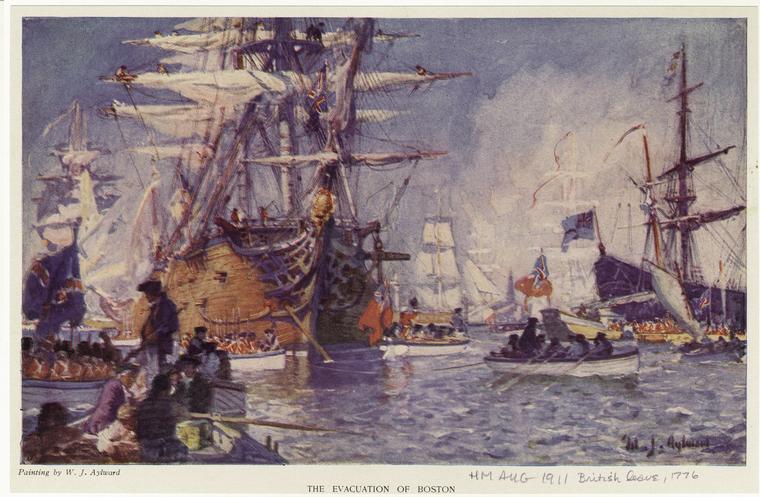
After unfavorable winds delayed the original departure date of March 13, British troops formed into marching columns at 4 a.m. on March 17. Four hours later, General Howe’s army rocked aboard boats in Boston Harbor, abandoning their hold on the American seaport city. General George Washington’s Continental Army did not interfere with the British evacuation, honoring an agreement trading a pause in military action for a promise that British troops would not harm the city as they departed.
While morale sagged on the British boats, Patriots in Boston were jubilant that their city was free from British army. Boston selectman Timothy Newell recorded in his journal the momentous day of Boston’s freedom from British occupation:
This morning at 3 o’clock, the troops began to move–guards, chevaux de freze, crow feet strewed in the streets to prevent being pursued. They all embarked at about 9 oclock and the whole fleet came to sail. Every vessel which they did not carry off, they rendered unfit for use. Not even a boat left to cross the river.
Thus was this unhappy distressed town (through a manifest interposition of divine providence) relieved from a set of men whose unparralleled wickedness, profanity, debauchery and cruelty is inexpressible, enduring a siege from the 19th April 1775 to the 17th March 1776. Immediately upon the fleet’s sailing the Select Men set off through the lines to Roxbury to acquaint General Washington of the evacuation of the town. After sending a message Major Ward, aid to General Ward, came to us at the lines and soon after the General himself, who received us in the most polite and affectionate manner, and permitted us to pass to Watertown to acquaint the Council of this happy event. The General immediately ordered a detachment of 2000 troops to take possession of the town under the command of General Putnam who the next day began their works in fortifying Forthill, etc., for the better security of the town. A number of loaded shells with trains of powder covered with straw were found in houses left by the Regulars near the fortifycation.
 Emerging Revolutionary War Era