“…to the Liberty Peace and Safety of America: Cut the Gordian knot…”

On this date in 1776, Major Joseph Ward, serving as a staff officer for Major General Artemas Ward, second in command of the Continental Army that had just evicted the British from Boston, sat down at his desk to pen the following letter. The recipient was John Adams, a fellow Massachusettsan then serving in the Second Continental Congress in Philadelphia, Pennsylvania. Ward continued his correspondence of keeping Adams apprised of military affairs around Boston. In this letter, however, he makes the case for the colonies to “cut the Gordian knot” and declare independence, months before Richard Henry Lee’s proposal to call for independence in late June 1776.

Boston 23 March 1776

Sir,

The 17th Instant the Pirates all abandoned their Works in Boston and Charlestown and went on board their Ships, and on the 20th they burnt and destroyed the works on Castle Island. They now lye in Nantasket Road waiting for a fair wind; we keep a vigilant eye over them lest they should make an attack on some unexpected quarter. The particulars with regard to the Seige, the Stores taken, &c. you will receive from better authority, therefore it is unnecessary for me to mention them. Our Troops behaved well, and I think the flight of the British Fleet and Army before the American Arms, must have a happy and very important effect upon the great Cause we engaged in, and greatly facilitate our future operations. I wish it may stimulate the Congress to form an American Government immediately. If, after all our exertions and successes, while Providence offers us Freedom and Independence, we should receive the gloven cloven foot of George to rule here again what will posterity, what will the wise and virtuous through the World say of us? Will they not say, (and jusly) that we were fools who had an inestimable prize put into our hands but had no heart to improve it! Heaven seems now to offer us the glorious privilege, the bright preeminence above all other people, of being the Guardians of the Rights of Mankind and the Patrons of the World. It is the fault of the United Colonies (a rare fault among men) they do not sufficiently know and feel their own strength and importance. Independence would have a great effect upon the Army, some now begin to fear that after all their fatigue and hazards in the Cause of Freedom, a compromise will take place whereby Britain may still exercise a power injurious to the Liberty Peace and Safety of America: Cut the Gordian knot, and the timid and wavering will have new feelings, trimming will be at an end, and the determined faithful friends of their Country will kindle with new ardour, and the United Colonies increase in strength and glory every hour.

Yesterday I saw your Brother, who informed that Mrs. Adams and your Children were well.

General Ward, on account of his declining health, has wrote his Resignation to the President of the Congress. I expect the greatest part of the Army will march for New York, or the Southern Colonies as soon as the Fleet is gone to Sea; and the Troops that remain here will be employed in fortifying the most advantageous Posts to defend the Town and harbour. I do not much expect the Enemy will make any attempts to regain possession of Boston, for I think they are sufficiently convinced that they cannot penetrate the Country in this part of America; ’tis probable they will try their fortune to the Southward and if they fail there the game will be up with them. We hear many accounts about Commissioners coming from Britain to treat with the Colonies separately, or with the Congress. Many fear we shall be duped by them, but I trust the congress is too wise to be awed by the splendor or deceived by the cunning of British Courtiers.

I know not of one discouraging circumstance attending either our civil or military affairs in this part of the Continent. I have lately heard with pleasure that the Farmer is become an advocate for Independence.Wishing the Congress that Wisdom which is from above, I am Sir with much Respect Your most Humble Servant,Joseph Ward

________________________________________________________________________________________________________

To learn more background about the letter, click here. Courtesy of the Massachusetts Historical Society.
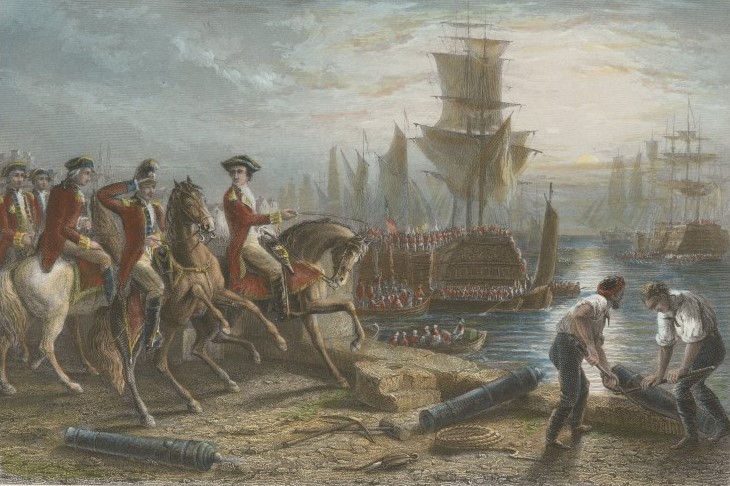
The British Evacuation of Boston, 250 Years Ago

Since the besieged British soldiers in Boston under General William Howe’s command awoke on the morning of March 5, 1776, and saw American cannon overlooking the city from Dorchester Heights, Howe prepared to evacuate Boston. Orders to prepare the embarkation of the troops and military stores and depart Boston went out to his command of 9,000 soldiers on March 7. It took days to organize the large-scale movement, and the British Navy did not have enough space on their ships to carry everything the army had. Decisions had to be made, supplies had to be destroyed or left behind. The military had to make room for loyalists wanting to depart the city as well.

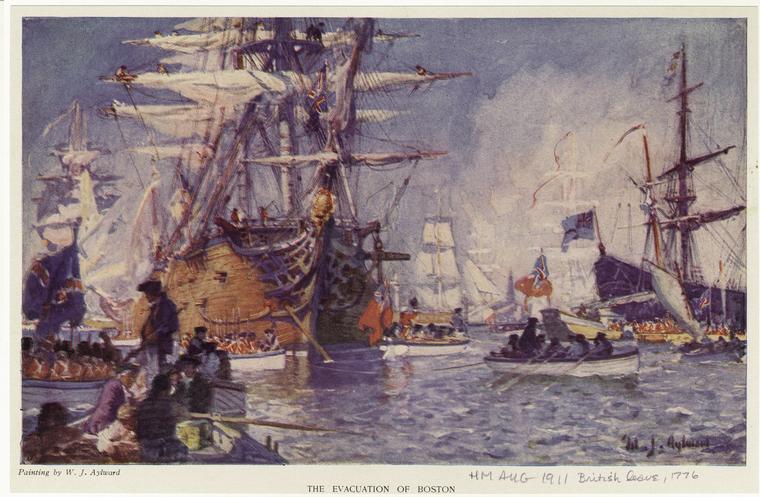
After unfavorable winds delayed the original departure date of March 13, British troops formed into marching columns at 4 a.m. on March 17. Four hours later, General Howe’s army rocked aboard boats in Boston Harbor, abandoning their hold on the American seaport city. General George Washington’s Continental Army did not interfere with the British evacuation, honoring an agreement trading a pause in military action for a promise that British troops would not harm the city as they departed.

While morale sagged on the British boats, Patriots in Boston were jubilant that their city was free from British army. Boston selectman Timothy Newell recorded in his journal the momentous day of Boston’s freedom from British occupation:

This morning at 3 o’clock, the troops began to move–guards, chevaux de freze, crow feet strewed in the streets to prevent being pursued. They all embarked at about 9 oclock and the whole fleet came to sail. Every vessel which they did not carry off, they rendered unfit for use. Not even a boat left to cross the river.

Thus was this unhappy distressed town (through a manifest interposition of divine providence) relieved from a set of men whose unparralleled wickedness, profanity, debauchery and cruelty is inexpressible, enduring a siege from the 19th April 1775 to the 17th March 1776. Immediately upon the fleet’s sailing the Select Men set off through the lines to Roxbury to acquaint General Washington of the evacuation of the town. After sending a message Major Ward, aid to General Ward, came to us at the lines and soon after the General himself, who received us in the most polite and affectionate manner, and permitted us to pass to Watertown to acquaint the Council of this happy event. The General immediately ordered a detachment of 2000 troops to take possession of the town under the command of General Putnam who the next day began their works in fortifying Forthill, etc., for the better security of the town. A number of loaded shells with trains of powder covered with straw were found in houses left by the Regulars near the fortifycation.

To the Commanding Officer at Roxbury…

Timothy Newell kept a very vivid diary of life in Boston in 1775 and 1776. He started the entry below on this date, 250 years ago, by copying the “sundry papers lent me…relative to the Siege and Evacuation of Boston in 1775…”

To the Commanding Officer at Roxbury

March 8, 1776

As His Excellency Gen Howe is determined to leave the Town with the troops under his command, a number of the respectable Inhabitants, being very anxious for its preservation and safety, have applied to General Robertson for this purpose, who at their request have communicated the same to his Excellency Gen Howe, who has assurred him, that he has no intention of destroying the Town, unless the Troops under his command are molested, during their embarkation, or at their departure by the armed force without; which declaration he gave General Robertson leave to communicate to the Inhabitants. If such an opposition should take place, we have the greatest reason to expect the Town will be exposed to entire destruction. As our fears are quieted, with regard to General Howe’s intentions, we beg we may have some assurances, that so dreadful a calamity may not be brought on by any measures without. As a testimony of the truth above we have signed our names to this Paper, carried out by Mess Thomas and Jonathan Amory, and Peter Johonnet, who have at the earnest entreaties of the Inhabitants, through the Lieu Governor solicited a flag of truce for this purpose.

  1. John Scollay 2. Timothy Newell 3. Thomas Marshall 4. Samuel Austin

*The General Robertson mentioned above was Brigadier General James Robertson, who commanded the 4th Brigade during the Siege of Boston

________________________________________________________________________________________________________

Sources:

“Newell‘s Journal” https://babel.hathitrust.org/cgi/pt?id=uc1.b3496228&seq=301

 “Remember, it is the fifth of March, a day ever to be forgotten; avenge the death of your brethren,”

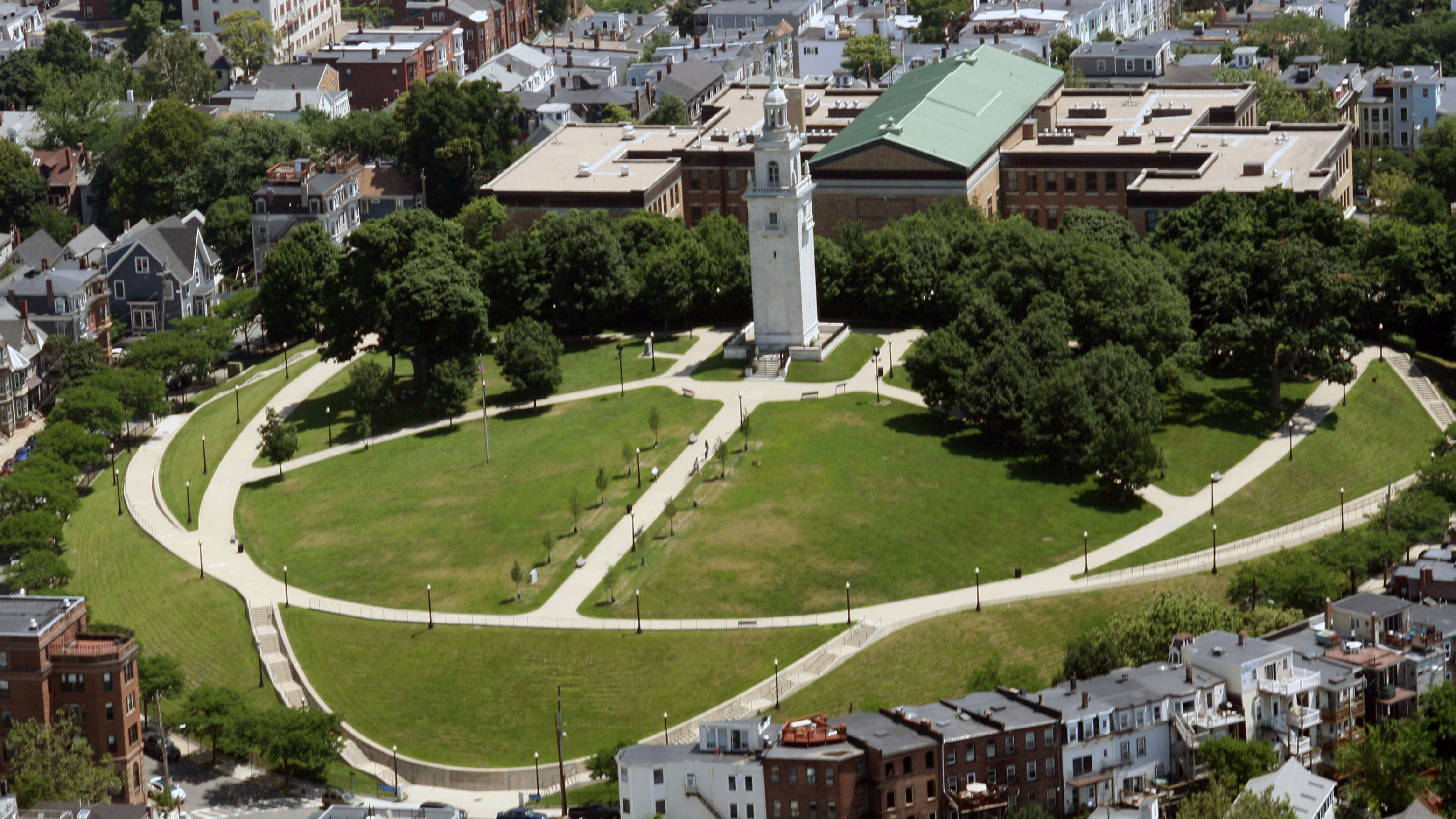
In March 1776, a quiet hill overlooking Boston Harbor became one of the first turning points of the American Revolutionary War. Dorchester Heights, rising above the southern approaches to Boston in what is now South Boston, played a decisive role in forcing the British Army to evacuate the city. The dramatic occupation and fortification of the Heights by American forces under General George Washington transformed a long, grinding siege into a strategic victory that reshaped the war’s momentum.

After the battles of Lexington and Concord in April 1775 and the bloody clash at Bunker Hill in June, British forces under General Thomas Gage and then William Howe found themselves effectively trapped in Boston. Surrounding militia units from Massachusetts and neighboring colonies formed a loose ring around the city, beginning what became known as the Siege of Boston. When George Washington arrived in July 1775 to take command of the newly formed Continental Army, he inherited a force that was determined but poorly supplied and short on artillery.

Throughout the fall and winter of 1775–1776, Washington searched for a way to break the stalemate. A direct assault on Boston would have been costly and risky. Instead, he looked to geography. Dorchester Heights, commanding sweeping views of the harbor and the city, offered a strategic advantage. If American forces could fortify the Heights with cannon, they would threaten both the British fleet and the troops stationed in Boston. Control of this high ground would make the British position untenable. The British Navy had encouraged British General Howe (now commanding the British forces in Boston) to take the position due to the Navy’s vulnerability if the Americans were able to command the heights with artillery. Howe underestimated the importance of the heights and also believed the Americans lacked the proper artillery and strength to hold it.

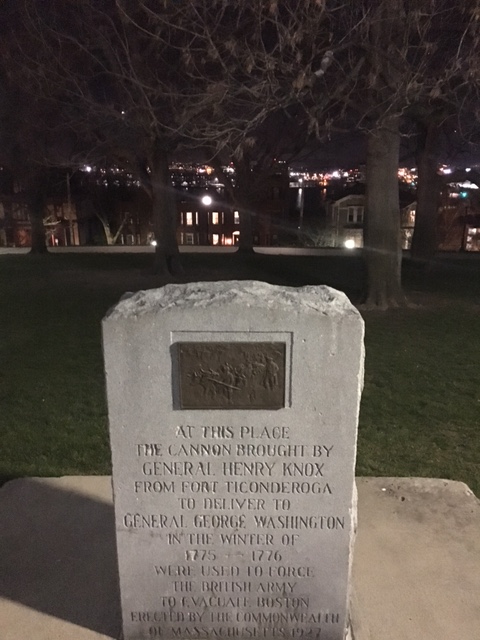
Knox marker on Dorchester Heights

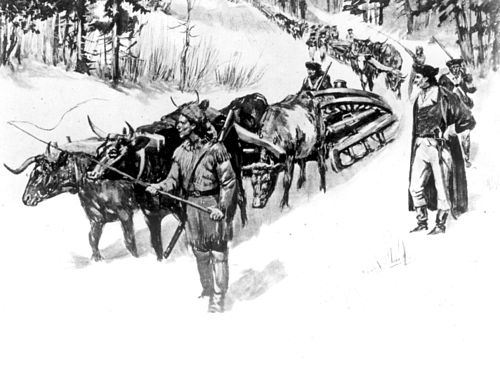
The key to Washington’s plan lay in artillery. In late 1775, Colonel Henry Knox undertook an audacious mission to transport heavy cannons captured from the British at Fort Ticonderoga in upstate New York. Over the winter, Knox and his men hauled approximately 60 tons of artillery—an operation later dubbed the “Noble Train of Artillery”—over 300 miles of frozen rivers and snow-covered terrain to Cambridge, Massachusetts.

These cannons provided Washington with the firepower necessary to implement his strategy. By early March 1776, conditions were ripe. The ground was still frozen, making it easier to move heavy equipment and but would challenge their skills at building fortifications.

On the night of March 4, American troops moved silently toward Dorchester Heights. Under the cover of darkness and diversionary bombardments from other positions, they began constructing fortifications with remarkable speed. Using pre-prepared materials—fascines (bundles of sticks), chandeliers (wooden frames filled with earth), and hay bales—they built defensive works capable of withstanding British cannon fire.

By dawn on March 5, the anniversary of the Boston Massacre, British sentries were stunned to see formidable American fortifications atop the Heights, bristling with cannon aimed at the city and harbor. General Howe reportedly exclaimed that the rebels had accomplished more in one night than his army could have done in months. The strategic implications were clear. From Dorchester Heights, American artillery could rain fire down on British ships and troop positions. The Royal Navy, essential to British supply and mobility, was now vulnerable. Remaining in Boston was a risk that Admiral Molyneux Shuldham was not willing to take and pushed Howe to respond quickly.

General Howe initially planned a counterattack to dislodge the Americans. However, a fierce storm on March 6 disrupted preparations and made an amphibious assault difficult. Also, Washington got word of the planned British assault and increased his manpower on Dorchester Heights to nearly 6,000. The memory of heavy British casualties at Bunker Hill also weighed heavily. Dorchester Heights were even stronger and more defensible than Breed’s Hill had been the previous year.

Howe evacuating Boston, courtesy New York Public Library

Facing the prospect of severe losses and an increasingly precarious situation, Howe reconsidered. Negotiations—informal and indirect—suggested that if the British evacuated Boston without destroying the town, American forces would not attack during the withdrawal.

On March 17, 1776, British troops and Loyalists began evacuating the city. More than 11,000 soldiers and nearly 1,000 Loyalists boarded ships and sailed to Halifax, Nova Scotia. The Siege of Boston was over, and the city was firmly in American hands for the remainder of the war.

The occupation of Dorchester Heights marked the first major strategic victory for the Continental Army under Washington’s leadership. It demonstrated the effectiveness of coordinated planning, logistical ingenuity, and the intelligent use of terrain. Rather than launching a costly frontal assault, Washington had leveraged geography and artillery to compel the enemy’s withdrawal.

This victory also boosted American morale at a critical time. The war was far from won—indeed, it would intensify dramatically later in 1776 with British campaigns in New York—but the successful eviction of British forces from Boston showed that the Continental Army could achieve meaningful results.

Moreover, Dorchester Heights solidified Washington’s reputation as a capable commander. His cautious but decisive approach, combined with Knox’s logistical triumph, set a pattern for future operations. The event underscored the importance of high ground in military strategy, a lesson that had already been evident at Bunker Hill but was applied with even greater effect in March 1776.

Dorchester Heights and the 1902 monument today, part of the Boston National Historical Park, courtesy of NPS

Rev War Revelry: Henry Knox and the Noble Train

In December 1775, Henry Knox wrote to General George Washington, “I hope in 16 or 17 days to be able to present your Excellency a noble train of artillery”. However, the train of artillery would not arrive until the end of January 1776. Still an impressive feat, as Knox with his team moved 60 tons (119,000 pounds) of artillery over 300 miles from upstate New York to the environs of Boston in 70 days in the midst of winter.

This impressive feat enabled Washington to evict the British from Boston, winning the siege and giving the fledgling rebellion a victory to build momentum from.

To discuss this amazing feat and part of American military history, Emerging Revolutionary War welcomes Dr. Phillip Hamilton, a professor of history at Christopher Newport University. A historian of the American Revolutionary and Early Republican periods, he has edited and written “The Revolutionary War Lives and Letters of Lucy and Henry Knox.”

Although the program is pre-recorded, Emerging Revolutionary War hopes you still tune in on Sunday, February 22 at 7 p.m. EDT. We promise the revelry will be enlightening. If you have any questions, please drop them in the chat during the program, and we will ensure Dr. Hamilton receives them.

Tidbits of Research…

For those that write and research it can be a personal albeit lonely endeavor. Hours spent in libraries or archives, humped over your computer or pad and pencil taking copious notes. Eyes going bleary or cross-eyed trying to decipher 18th century handwriting or microfilmed pieces of primary data. But, at the same time, it is such a rewarding experience, is it not? Uncovering the past, shedding light on the personalities that comprise the fabric of American history. Maybe even finding overlooked accounts or information that changes the narrative or promotes a fuller picture?

For me, I enjoy finding quotes or descriptions that creates a better understanding of the world in which the soldiers and civilians of the American Revolutionary or American Civil War periods lived. Anything that humanizes them more I feel makes them relatable. Breathes life into who they were, instead of just what comes through in official dispatches, reports, or polished accounts they left behind. One way is to read the accounts of fellow officers or compatriots as they discuss or describe their fellow comrades-in-arms.

Or there is just Israel Putnam. The patriot general who on April 19, 1775 when hearing of the British march to Lexington and Concord famously left his plow in a half plowed farm field to rush from Connecticut to Massachusetts. In the process he rallied his militia and stuck around for the siege that followed the first shots of what would become the American Revolution.

Israel Putnam

That is where I picked up his tale. Researching an upcoming volume of the Emerging Revolutionary War Series. (Stay tuned for what that will be in the upcoming months. Yes, “vague booking” and self-promotion happening!) During the siege of Boston he was asked in a meeting of general officers about the “expediency of intrenching” as a few of the gathered were doubtful of its efficacy on the psyche of the volunteer militia.

Putnam’s response fit the mold mentioned above, of providing a human touch to the notes of that meeting and a bit of 18th century humor for added measure.

The general responded, “earnest in his advocacy of the measure” that,

“The Americans are not at all afraid of their heads, though very much afraid of their legs: if you cover these, they will fight for ever.”

Time and defensive tactics would uncover the truth of that statement.

In closing, what is a favorite line, anecdote that is not well known from the American Revolutionary period that resonates with you?

ERW Weekender: Bunker Hill Monument & Museum

Emerging Revolutionary War welcomes back guest historian Katie Turner Getty. 

Towering over Charlestown, Massachusetts, its foundation set in sacred battleground soil, the Bunker Hill Monument is a 221 foot obelisk commemorating the Battle of Bunker Hill. The cornerstone of the monument was laid by the Marquis De Lafayette in 1825, fifty years after the battle was fought on June 17, 1775.

BunkerHillMon-KTGetty
Bunker Hill Monument (author collection)

Although the land surrounding the monument has been greatly developed since the battle, visitors today can get still get a sense of the 18th-century landscape just by walking through Charlestown and climbing the hill to reach Monument Square. Approaching visitors are greeted by the statue of Colonel William Prescott, the gray granite of the monument serving as an impressive backdrop behind him. Continue reading “ERW Weekender: Bunker Hill Monument & Museum”