

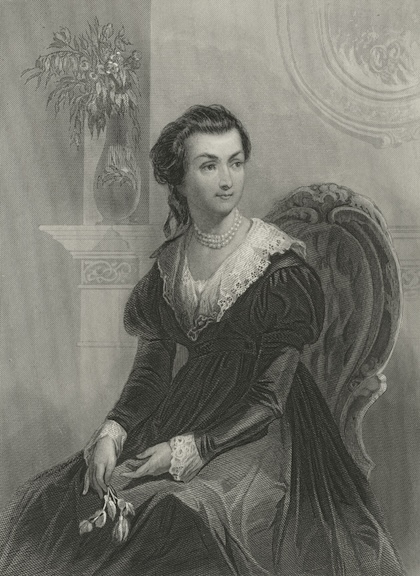
“Remember the ladies.” Of all the words Abigail Adams wrote to her husband John over a correspondence than spanned 1,160 letters and nearly 40 years, those three stand as the most famous. They come from a letter written on March 31, 1776—250 years ago today.
At the time, events in the colonies were moving at a quickening pace. Common Sense in January 1776 had not only leveraged a major public shift toward American independence, it also sparked debate about what might come after. Sentiment in the Continental Congress lagged public opinion, despite John’s best efforts to spur that sentiment along, but conversation still bubbled among the delegates about that possible future.
It was in this context that Abigail, as astute a politician as any Congressional delegate, wrote to her husband. If independence loomed, and America had the chance to jump-start a new system of its own, then why not take advantage of the winds of change and establish independence not only from Great Britian but from the old social order altogether.
[I]n the new Code of Laws which I suppose it will be necessary for you to make I desire you would Remember the Ladies, and be more generous and favourable to them than your ancestors. Do not put such unlimited power into the hands of the Husbands. Remember all Men would be tyrants if they could. If perticuliar care and attention is not paid to the Laidies we are determined to foment a Rebelion, and will not hold ourselves bound by any Laws in which we have no voice, or Representation.
That your Sex are Naturally Tyrannical is a Truth so thoroughly established as to admit of no dispute, but such of you as wish to be happy willingly give up the harsh title of Master for the more tender and endearing one of Friend. Why then, not put it out of the power of the vicious and the Lawless to use us with cruelty and indignity with impunity. Men of Sense in all Ages abhor those customs which treat us only as the vassals of your Sex. Regard us then as Beings placed by providence under your protection and in immitation of the Supreem Being, make use of that power only for our happiness.[1]
Abigail’s request comes as a literal “by the way” at the end of an 837-word letter—the last paragraph and a half, in fact. She didn’t get to send the letter right away, so on April 5, she added another 368 words but “with a heart so gay.” These are both context clues to help us better understand John’s reply, which has often drawn criticism from modern scholars. His response came on April 14:
As to your extraordinary Code of Laws, I cannot but laugh. We have been told that our Struggle has loosened the bands of Government every where. That Children and Apprentices were disobedient—that schools and Colledges were grown turbulent—that Indians slighted their Guardians and Negroes grew insolent to their Masters. But your Letter was the first Intimation that another Tribe more numerous and powerfull than all the rest were grown discontented.—This is rather too coarse a Compliment but you are so saucy, I wont blot it out.
Depend upon it: We know better than to repeal our Masculine systems. Altho they are in full Force, you know they are little more than Theory. We dare not exert our Power in its full Latitude. We are obliged to go fair, and softly, and in Practice you know We are the subjects. We have only the Name of Masters, and rather than give up this, which would compleatly subject Us to the Despotism of the Peticoat, I hope General Washington, and all our brave Heroes would fight.[2]
At first glance, John’s reply seems dismissive and even patronizing. However, that interpretation fails to look at the letter in the context of their full correspondence or their relationship in general. John and Abigail looked at each other as full partners and intellectual equals. He invited her to advise him on everything, and even if he didn’t always agree with her, he took her opinions seriously.
They also knew how to banter and joke around. They both possessed sharp wits and, to use John’s word, “saucy” attitudes. If he detected a note of good humor in her letter—indeed, the gay heart she wrote with—he was bound to respond in kind.
On April 27, Abigail wrote to her friend Mercy Otis Warren about her exchange with John. “He is very sausy to me in return for a List of Female Grievances which I transmitted to him,” she confessed. (There’s that “saucy” word again, btw.) She continued:
I thought it was very probable our wise Statesmen would erect a New Goverment and form a new code of Laws. I ventured to speak a word in behalf of our Sex, who are rather hardly dealt with by the Laws of England which gives such unlimitted power to the Husband to use his wife Ill.
I requested that our Legislators would consider our case and as all Men of Delicacy and Sentiment are averse to Excercising the power they possess, yet as there is a natural propensity in Humane Nature to domination, I thought the most generous plan was to put it out of the power of the Arbitary and tyranick to injure us with impunity by Establishing some Laws in our favour upon just and Liberal principals.[3]
Abigail suggested that maybe she and Mercy send a petition directly to Congress, although, if such effort happened, no record of it survives. (For more on Abigail’s exchange with Mercy on this topic, see Phill Greenwalt’s post from 2015, “Remember the Ladies.”)
Abigail did revisit the subject with her husband, though, and her May 7 reply conveyed a friendly word to the wise that stated her feelings plainly:
I can not say that I think you very generous to the Ladies, for whilst you are proclaiming peace and good will to Men . . . you insist upon retaining an absolute power over Wives.
But you must remember that Arbitary power is like most other things which are very hard, very liable to be broken—and notwithstanding all your wise Laws and Maxims we have it in our power not only to free ourselves but to subdue our Masters, and without violence throw both your natural and legal authority at our feet—[4]
And so, Abigail got the last word, and John, for his part, seemed delighted with her response. It was just kind of intellectual jousting he loved. “Your Sentiments of the Duties We owe to our Country, are such as become the best of Women, and the best of Men,” he wrote on May 22. “Among all the Disappointments, and Perplexities, which have fallen to my share in Life, nothing has contributed so much to support my Mind, as the choice Blessing of a Wife. . . .”[5]
In the end, Congress did not “remember the ladies,” and neither did John—although he didn’t quite forget them, either. To “remember the ladies” meant following a train of logic—as his tongue-in-cheek reply to her suggested—that could descend into messy populism. For John, that was just one step too close to a mob. For all his reputation today as a radical, he was too much of a conservative to embrace an overthrow of the entire social system. He preferred, instead, slow, deliberate change managed by checks and balances. (On May 26, John laid out his argument in a letter to James Sullivan, justice of the Massachusetts Superior Court. You can read that letter here.)[6]
As recent Abigail biographer John L. Smith, Jr., has noted, “Not only was Congress negotiating treaties with foreign countries but it was also trying to deal with the crashing economy, supplying the army, establishing the courts, conducting and winning the war, and handling dozens of other critical issues.”[7] While that explanation might be interpreted as letting Congress off the hook too readily, it is also true. It might also be true that, because John saw his marriage with Abigail as an ideal balance, he didn’t fully appreciate how uneven the balance could be in other households.
Whatever the reason, the issue of women’s rights did not seem to be a sticking point between John and Abigail in their later correspondence. It’s reasonable to assume that, as candid as Abigail was with her husband, if the issue nagged at her, she would have brought it up again.
Soon after the “remember the ladies” exchange, the pace of events quickened to lightning speed, culminating in independence even as British troops landed on Staten Island to test its very viability. The stakes of the entire Revolution jumped exponentially. John toiled in Philadelphia and Abigail advised him from afar. He couldn’t help but “remember the ladies,” or at least his own lady, because his homesickness ensured she was never far from his thoughts.
[1] “Abigail Adams to John Adams, 31 March 1776,” Founders Online, National Archives, https://founders.archives.gov/documents/Adams/04-01-02-0241. [Original source: The Adams Papers, Adams Family Correspondence, vol. 1, December 1761 – May 1776, ed. Lyman H. Butterfield. Cambridge, MA: Harvard University Press, 1963, pp. 369–371.]
[2] “John Adams to Abigail Adams, 14 April 1776,” Founders Online, National Archives, https://founders.archives.gov/documents/Adams/04-01-02-0248. [Original source: The Adams Papers, Adams Family Correspondence, vol. 1, December 1761 – May 1776, ed. Lyman H. Butterfield. Cambridge, MA: Harvard University Press, 1963, pp. 381–383.]
[3] “Abigail Adams to Mercy Otis Warren, 27 April 1776,” Founders Online, National Archives, https://founders.archives.gov/documents/Adams/04-01-02-0257. [Original source: The Adams Papers, Adams Family Correspondence, vol. 1, December 1761 – May 1776, ed. Lyman H. Butterfield. Cambridge, MA: Harvard University Press, 1963, pp. 396–398.]
[4] “Abigail Adams to John Adams, 7 May 1776,” Founders Online, National Archives, https://founders.archives.gov/documents/Adams/04-01-02-0259. [Original source: The Adams Papers, Adams Family Correspondence, vol. 1, December 1761 – May 1776, ed. Lyman H. Butterfield. Cambridge, MA: Harvard University Press, 1963, pp. 401–403.]
[5] “John Adams to Abigail Adams, 22 May 1776,” Founders Online, National Archives, https://founders.archives.gov/documents/Adams/04-01-02-0267. [Original source: The Adams Papers, Adams Family Correspondence, vol. 1, December 1761 – May 1776, ed. Lyman H. Butterfield. Cambridge, MA: Harvard University Press, 1963, pp. 412–413.]
[6] “John Adams to James Sullivan, 26 May 1776,” Founders Online, National Archives, https://founders.archives.gov/documents/Adams/06-04-02-0091. [Original source: The Adams Papers, Papers of John Adams, vol. 4, February–August 1776, ed. Robert J. Taylor. Cambridge, MA: Harvard University Press, 1979, pp. 208–213.]
[7] John L. Smith, Jr. The Unexpected Abigail Adams: A Woman “Not Apt to Be Intimidated” (Yardley, PA: Westholme, 2024), 86–7.
 Emerging Revolutionary War Era