

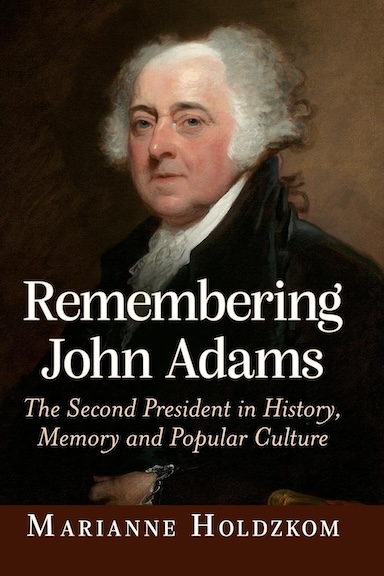
Emerging Revolutionary War is pleased to welcome guest author Marianne Holdzkom, author of Remembering John Adams: The Second President in History, Memory and Popular Culture.
Several years ago, I set out to write a comprehensive history and memory study of John Adams. I did not want to write a straight biography of him. Other scholars have done this, and I could not add anything to their work. What I wanted to do instead is examine how historians and creative artists have represented him. I also wanted to discuss how he has been memorialized—or not as in the case of Washington, D.C.
The result of my efforts was Remembering John Adams: The Second President in History, Memory and Popular Culture (McFarland, 2023). I finished the manuscript knowing that I had covered all my bases, proud of what I had accomplished. I had even done my best to wade through the difficult poetry of Ezra Pound for the project!
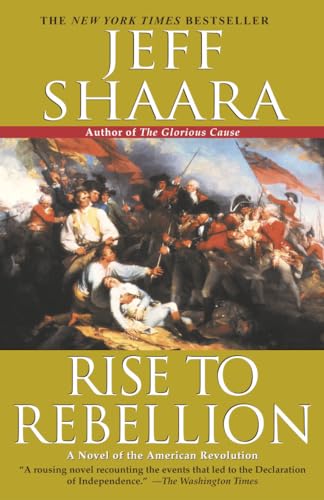
Yet, I missed something. I believed I had found all the literature references to John Adams, but one book escaped my attention. I am not sure how that happened because I am familiar with the author and his other works. Still, Jeff Shaara’s Rise to Rebellion (2001) in which John Adams plays a significant role, escaped my attention. This is an oversight that I regret, and I would like to rectify it now.
Rise to Rebellion isa novel about the beginning of the American Revolution. In it, Shaara followed a formula designed to humanize the history he covered by focusing on key players and centering the narrative around their perspectives. Understanding that the Revolution was not just the war, Shaara traced developments on both sides of the Atlantic through the eyes of Benjamin Franklin, General Thomas Gage, George Washington, and John Adams. In reflecting on his character choices for this novel, Shaara made a keen observation about the world of 2001:
It has become fashionable in our modern, more cynical time to reexamine our history, to throw a supposedly new light on those who are famous for their accomplishments, to instead expose their faults, to topple the statue of the hero, to replace the honor and respect with the sensational and the shameful, as though it were the only meaningful way these characters can be relevant to today’s world. I most adamantly disagree.[1]
Shaara continued by arguing that these people are “so very much like us.” [2] It is this understanding that leads Shaara to the humanity of all his characters, including John Adams. While the writer does not put Adams on a pedestal, he also avoids the more popular portrayals of the founder. The “obnoxious and disliked” trope so often attached to John Adams robs him of his three-dimensionality. In this novel, as in other works of literature, Adams is more than the impatient, shrill annoyance that the public often sees in popular culture. In Shaara’s book, the reader sees his journey from successful lawyer to reluctant yet passionate revolutionary. This is, in part, because of the period the book covers.
Shaara focused this novel on a timeframe from March 1770 through the summer of 1776. The so-called Boston Massacre of 1770 marked a turning point in the relationship between England and Massachusetts, but it also brought John Adams to the forefront of the conflict. Adams played a key role in the Boston Massacre trials, not as an advocate for the five victims of the shootings, but as the defense attorney for the soldiers accused of murder. Shaara began his narrative by recreating the events of March 5, 1770, through the eyes of these soldiers. We first meet John Adams as he is responding to the shooting. In these early scenes, Shaara revealed several layers of Adams’s personality. We see the citizen of Boston, confused over what has happened and desperately seeking answers, but we also see the husband and father, concerned for the safety of his family. We meet his remarkable wife, Abigail, for the first time, pregnant and amazingly calm given the circumstances. Shaara took this opportunity to recount the grief John and Abigail were still feeling over the death of their baby daughter, Suzanna. This is part of their storyline that is rarely covered in popular culture.[3] Adding this to his narrative adds a dimension to Adams that is refreshing.
One of Shaara’s talents as a writer is to depict introspection. To know the characters of this novel, the reader must see their thought processes. For John Adams, Shaara placed him where he was most happy: his farm in Braintree. In a remarkable section of chapter five, we see Adams enjoying a summer day, walking his land and thinking about how the crisis with England had evolved. We witness John’s perspective, his struggle to understand what had changed and why the English were reacting in the way they were. At the same time, Shaara provided the reader with needed exposition. As Adams traces the events since 1765 to the moment of the Boston Massacre, the reader is led through the history to that point. Yet this is also personal for Adams. We see him understand the English perspective, but we also witness his anger at them and his dark thoughts about where the crisis would end both for the colonies and for him. This brooding is quintessential John Adams and Shaara captured it brilliantly. Yet Shaara also examines why John’s introspection did not consume him. That was thanks to Abigail.
As with other artists and historians, Shaara could not ignore the relationship between John and Abigail. We have a keen understanding of the bond between them thanks to their correspondence. Some 1100 letters between them exist. Using this source, Shaara gives his reader a glimpse into their marriage. As a result, he further humanizes John.
John confides to Abigail his concerns about his own ambition but also predicts to her that unless things change in London, there will be a revolution in America. He laments not being present for his children, but vows to be a father of whom they can be proud. She reassures him every step of the way, but she also shares her own concerns.
In one scene, Shaara creates a moment between John and Abigail, the conversation born from Abigail’s most famous letter to John. John is home in December 1775 and lamenting all that she has to do while he is away. She, in turn, is telling him about all that she has learned to do out of necessity. As she is wondering about independence and government, she asks, “when you speak of the people just whom are you referring to? In your new code of laws can it be hoped that you will perhaps remember the ladies? Can it be within your male spirit to allow some authority to flow our way?”[4] Recreating this exchange in this way, we witness Abigail making John squirm. He responds awkwardly, explaining the complexities of suffrage. She does not let him off the hook, but laughs and says, “All those fancy words and they may as well fall in a jumble over a cliff.”[5] This is one of my favorite scenes in the entire novel for in it, we see the remarkable relationship between these two complicated people.
As events move toward the vote for independence in the congress, John, once again in Philadelphia, has embraced his leadership role. Like other creative artists, Shaara, out of necessity, invents the speech that John gives in favor of independence. We don’t know exactly what Adams said during the final debate on July 1st; his words were not recorded. Adams never recollected what he said. Perhaps this is because he had said it all before. In a letter to fellow delegate, Samual Chase, he lamented, “That Debate took up the most of the day, but it was an idle Mispence of Time for nothing was Said, but what had been repeated and hackneyed in that Room before an hundred Times for Six Months past.”[6]
At the end of the created speech Adams gives in the novel, Shaara set up a wonderful moment between Adams and Franklin. “We are a people who have shown the world we can help ourselves, that we have the God-given strength to stand for our liberty. God help us? No, sir. May God bless us.” After the vote for independence, Adams then asks Benjamin Franklin, “Was I right, Doctor? Will God bless us?” Franklin responds, “He already has, Mr. Adams.”[7]
Throughout Rise to Rebellion, John Adams emerges as a man centered in the law and his farm but conflicted about the changing world around him. We see a warm relationship with Abigail and his children while, at the same time, we witness the leader he became. Jeff Shaara has presented his readers with a three-dimensional human being, not perfect by any means. He is driven by passion, his love for his family, and the law, yet he is not always secure in his own abilities. The historical John Adams would approve.
Marianne Holdzkom, Professor of History at Kennesaw State University, is the author of Remembering John Adams: The Second President in History, Memory and Popular Culture. She is also an Adams Memorial Foundation Scholar.
[1] Jeff Shaara, Rise to Rebellion: A Novel of the American Revolution (New York: The Random House Publishing Group, 2001;2002), x.
[2] Ibid.
[3] One of the few exceptions is the PBS series The Adams Chronicles.
[4] Shaara, 448.
[5] Shaara, 449.
[6] John Adams to Samuel Chase, 1 July 1776,” Founders Online, National Archives, https://founders.archives.gov/documents/Adams/06-04-02-0142.
[7] Shaara, 523; 527.


Marianne, rather than overlooking a source, your experience with the memory of John Adams demonstrates that authors continue to explore their books well after they are published. And you have inspired me to read Jeff’s novel!
LikeLiked by 2 people
Thank you so much, Gene!
LikeLike
Marianne, rather than overlooking a source, your experience with the memory of John Adams demonstrates that authors continue to explore their books well after they are published. And you have inspired me to read Jeff’s novel!
LikeLike
Marianne, rather than overlooking a source, your experience with the memory of John Adams demonstrates that authors continue to explore their books well after they are published. And you have inspired me to read Jeff’s novel!
LikeLike
After having “Rise To Rebellion” on my shelf for about 20 years, and never having read it, I recently decided to do so and have about 2 chapters left. I’ve enjoyed it immensely. After previously reading several of Shaara’s other novels, I think this is one of his best.
LikeLiked by 1 person
I absolutely agree!
LikeLike