War in the Mississippi Valley: Part II

Previously I wrote about the fighting in the Mississippi Valley and Gulf coast during the Revolution.  Below is a brief overview of the modern states in the Mississippi Valley and a summary of their colonial origins and events there during the Revolution:

Alabama

The French colonized the area that is now Alabama in the early 1700s.   They constructed a fort at what is now Mobile, and this was the capital of La Louisiane- not New Orleans.  The French presence was never very strong or deep, and they had few settlements in the region.

The French established trade network with Native Americans in the interior.  The English were also interested in the region, and trades and explorers penetrated the northern area of modern-day Alabama.

The 1763 Treaty of Paris, which ended the Seven Years’ War after France’s defeat by Britain, resulted in France ceding its territories east of the Mississippi to Britain.  Great Britain came into undisputed control of the region between the Chattahoochee and the Mississippi rivers. The portion of Alabama below the 31st parallel became a part of British West Florida.  Today this is the long section of the Alabama-Florida state line.

The portion north of this line became a part of the “Illinois Country,” established by the British Crown for use by Indians.  At the conclusion of the Revolution, The British ceded West Florida to Spain, and the land to the north to the United States.  Yet there was disagreement about where the division between Spanish and American territory was, laying the foundation for a long boundary dispute between the two nations.

P1010793

Continue reading “War in the Mississippi Valley: Part II”

War in the Mississippi Valley: Part I


While the majority of Revolutionary War action occurred on the Atlantic coast, important events occurred farther west as well.  This article takes a look at this lesser known part of the conflict.

It is well known that France was an eager ally of the fledgling United States, secretly making loans and selling supplies to the Revolutionaries.  When the French felt the Americans had proved themselves at Saratoga, France officially entered the war, and became the first foreign nation to recognize the United States.  On February 6, 1778 both nations signed the Treaty of Alliance, in which France declared war on Great Britain and recognized American Independence.

Spain was also on the sidelines, watching events closely.  Unlike France, when Spain declared war on Great Britain, they did not recognize American independence.  By the Treaty of Aranjuez on April 12, 1779, Spain entered the war as an ally of France, and agreed to attack British forts in the Mississippi Valley and Gulf Coast.   Spain’s King Charles III would assist his first cousin, Louis XV of France in the conflict with the British.  The Spanish hoped to recover territory lost from the British, and take advantage of Britain’s preoccupation with the rebellious colonies.

The British were already realigning their military for a worldwide conflict: facing France, Spain, and the Netherlands in India, Gibraltar, Europe, and the high seas.  The Gulf of Mexico and Mississippi Valley was yet another front, one that was poorly defended by the British.

In the first action of this vast theater, American marines raided Fort Bute, a British fort located at Bayou Manchac, about 115 miles from New Orleans.  The attack on the far western border of British West Florida took place in February, 1778. Continue reading “War in the Mississippi Valley: Part I”

A new park and museum for Great Bridge

Most of us who study the Revolution know of the battle of Great Bridge, fought December 9, 1775. While short and small, it was extremely significant, resulting in British evacuation of Virginia and allowing the colony to move forward with independence and unhindered support of the war effort.

Until recently, the site of this important local landmark, and significant battle, were unpreserved. Nearby, thousands of vehicles drive on the Chesapeake Expressway, largely unaware that they are whizzing past the site of a significant Revolutionary War site. Area preservationists intend to change that.

Local citizens began the effort in 1999. Realizing that the site was unmarked, residents of Chesapeake began working with the city and the Army Corps of Engineers. The result was the Great Bridge Battlefield and Waterways History Foundation.

Thus far they have created a public park with an interpretive trail, historic markers, monuments, and are building a museum/visitor center on the site. Future plans include another monument and interpretive signage and public access at the rest of the battlefield.

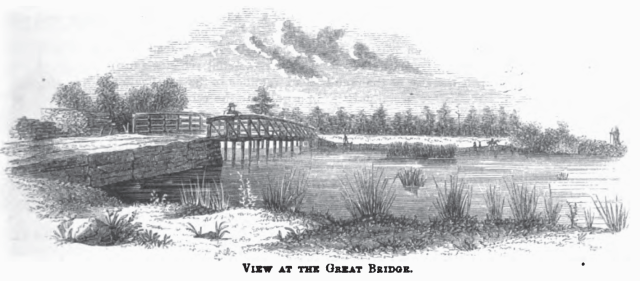
The area south of Norfolk, the Great Dismal Swamp, was largely inaccessible in the Eighteenth Century. A solitary road ran south from Norfolk, crossing the Southern Branch of the Elizabeth River at Great Bridge. Here local citizens were responsible for maintaining the bridge for public use. The road continued on into North Carolina.

Great_Bridge_view_LossingSketch by artist Benson Lossing, 1850s. Continue reading “A new park and museum for Great Bridge”