

250 Years Ago Today: The Battle of Great Bridge

On the cold morning of December 9, 1775, a British force of redcoats marched out of their wooden stockade and advanced towards the rebel earthworks on the southern end of the Great Bridge.  For days both sides were expecting an action, and now it was about to happen.  Royal Governor Dunmore, believing that Patriot cannon from North Carolina were on their way to drive the British from Great Bridge, sent Captain Samuel Leslie with 120 men of the 14th Regiment of Foot to drive the Patriots out with a straight frontal assault.
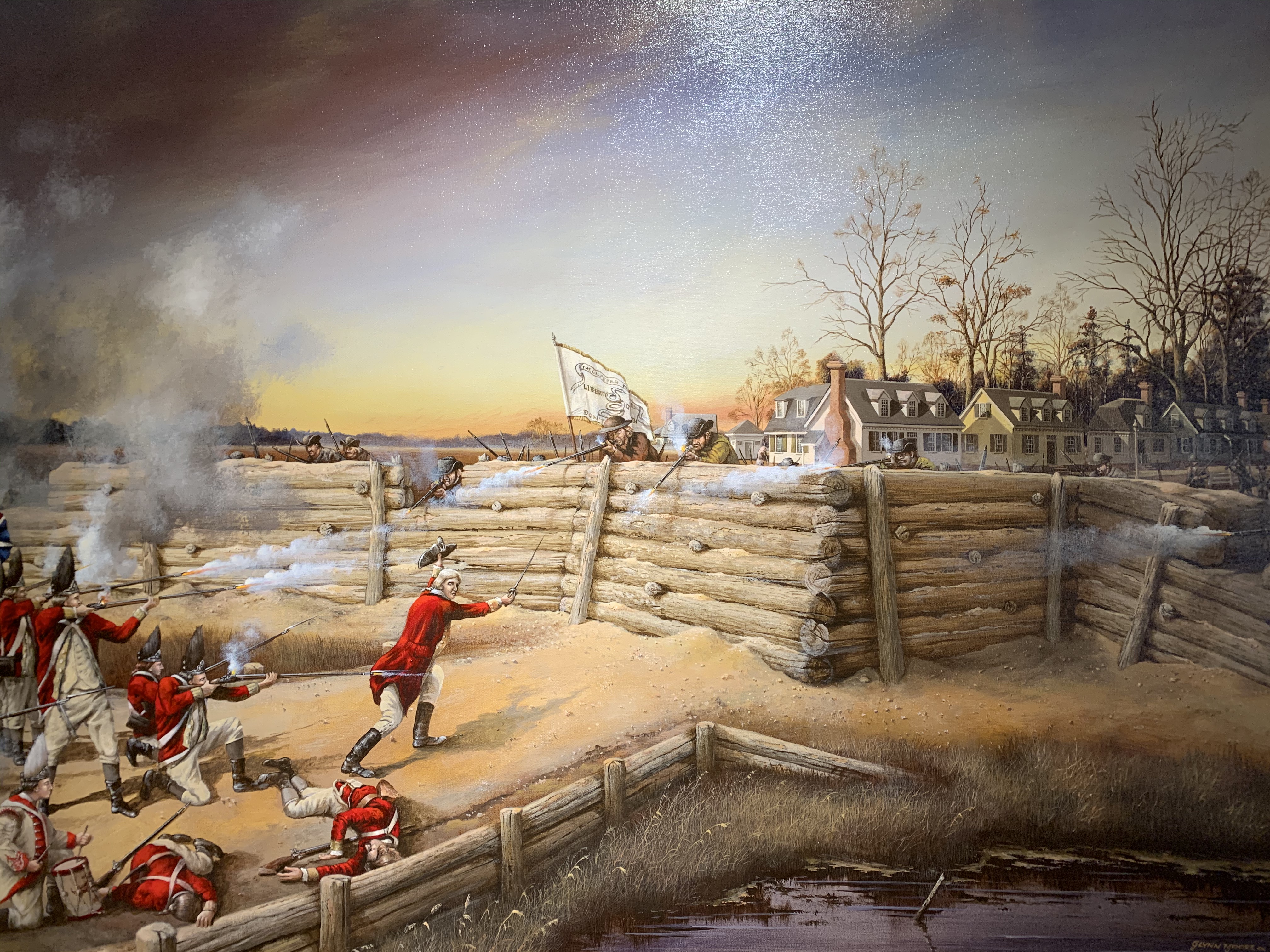
Leading the attack were about 60 grenadiers of the 14th Regiment of Foot under the command of Captain Charles Fordyce.  Behind them were some other British regulars, some Loyalist militia and some of Royal Governor Dunmore’s Ethiopian Regiment.  Across the Great Bridge was a long causeway with swamp on either side.  Any attack by the British would be across this this causeway with no other way to maneuver.  At the southern end of the causeway were Patriot earthworks manned by Col. William Woodford’s 2nd Virginia Regiment.  To their left were positioned some riflemen of the Culpeper Minute Men.  Out on the causeway were some Patriot pickets, including the free African American Billy Flora.

As the British advanced across the bridge, they began to engage the American pickets.  The pickets after firing for a few minutes began to pull back into the main American lines.  Fordyce and the grenadiers continued to push forward despite receiving fire from the pickets as well as the extremely accurate Culpeper riflemen.

With the American fire alerting everyone, American reinforcements advanced into the main American lines.  Lieutenant Edward Travis of the 2nd Virginia had his men hold their fire until the British advanced to point blank range.

The British grenadiers, marching forward six men abreast, hoped to rush the American position at the point of the bayonet.  When they were just 50 yards from the American line, the 2nd Virginians aimed at the British soldiers and poured a heavy fire into them.  Now the grenadiers were being hit from the flank by the American riflemen as well as from the front by the muskets of the 2nd Virginia.  The fire was galling.  Fordyce removed his hat and waved it enjoining his men to follow him into the American works.  Fifteen paces from the American lines, Fordyce fell at the head of the column with 14 musket balls in his body.

Colonel Woodford remembered that “perhaps a hotter fire never happened or a greater carnage.”  The British continued to engage for a little, but as more Patriot troops filled the American earthworks, and as the British sustained heavy fire the from the front and the right, they decided to pull back across the Great Bridge.  They left behind a grisly scene, as the British suffered 17 men killed and 44 wounded or captured, about 50% of the attacking force.  The Americans only had one man wounded in the hand.

The day had been an important Patriot victory.  Dunmore was forced to cede the ground.  William Woodford wrote to Patrick Henry that “the victory was complete . . . This was a second Bunker’s Hill affair, in miniature, with this difference, that we kept our post and had only one man wounded in the hand.”

To learn more about this significant, though often overlooked battle of the Revolutionary War, be sure to visit our Facebook page today, as historians from Emerging Revolutionary War will be filming videos in real time from the battlefield.  Also, check out our Rev War Revelry with historian Patrick Hannum where we discuss in more depth the battle.

AN APPEAL TO HEAVEN: The history behind the flag

Where do our rights come from?  The answer to this question is at the heart of the pine tree flag that was flown by soldiers and sailors during the Revolutionary War. The Founding Fathers were very clear about where they believed rights came from. In the Declaration of Independence, the Founders say that their “unalienable rights” were “endowed by their Creator”.  This was a distillation of hundreds of years of religious and enlightenment thought and writing. Because their rights came from God, the role of government was not to provide rights, but to protect their natural rights from people or governments that would infringe them. 

If a government were to attempt to subvert a people’s natural rights, who could the people appeal to for justice? At that point, the only recourse is an appeal to God or Heaven to protect their natural rights.

The actual phrase comes from a passage in John Locke’s Second Treatise of Government (1689): “And where the body of the people, or any single man, is deprived of their right, or is under the exercise of a power without right, and have no appeal on earth, then they have a liberty to appeal to heaven, whenever they judge the cause of sufficient moment . . . And therefore, though the people cannot be judge, so as to have, by the constitution of that society, any superior power, to determine and give effective sentence in the case; yet they have, by a law antecedent and paramount to all positive laws of men, reserved that ultimate determination to themselves which belongs to all mankind, where there lies no appeal on earth, viz. to judge, whether they have just cause to make their appeal to heaven.” [emphasis added]

As war between American colonists and British regulars began in 1775, the colonists stressed that the need for war was to defend their natural rights, or the “rights of Englishmen.”  Supporters of the patriot cause developed numerous flags and banners that highlighted the cause for which they were fighting.  These banners which flew from ships, forts, and carried into battle often included symbols and motifs as well as words and phrases.  There were rattlesnake flags with the words “Don’t Tread on Me”.  There were regimental flags with Latin phrases.  Many included stars and stripes, though a standard American national flag was not developed by the Congress until 1777.  Among the banners and flags created in the early days of the conflict that demonstrated the justice of their cause, was an “Appeal to Heaven” flag.

This popular flag that was flown by the colonists was a white flag with a green pine tree in the center and the words “An Appeal to Heaven” (sometimes it would say “An Appeal to God”) scrawled across it. No version of this flag still exists today, but descriptions from the time tell us what it looked like. This flag had much symbolism beyond the important phrase.

The pine tree symbolized the New England colonists’ home. The pine tree had long been used as a symbol of Massachusetts during the colonial period.  The eastern white pine was very common to the area and New Englanders adopted the tree as a symbol of their land as early as the 17th century. As the colonies went to war with Great Britain in 1775, many Massachusetts troops carried flags with pine trees on them.  New England Continental army units used pine tree flags in battle, such as at Bunker Hill.  The colonial leader Dr. Jospeh Warren used the phrase “appeal to Heaven” in a letter he penned to the people of Great Britain after the first battles at Lexington and Concord in which he noted that “to the persecution and tyranny of his cruel Ministry we will not tamely submit; appealing to Heaven for the justice of our cause, we determine to die or be free.” He lived up to his words.  In one account, at the Battle of Bunker Hill, just before being shot in the head, Dr. Jospeh Warren pointed to one of the “Appeal to Heaven” flags and asked his men to remember what they were fighting for.

Following the incredibly bloody Battle of Bunker Hill, and following George Washington’s arrival as commander-in-chief of the Continental Army, the Continental Congress published a declaration of “the Causes and Necessity of their taking up Arms.” In this declaration the Congress asserts that they had no “ambitious Designs of separating from Great Britain, and establishing Independent States”, but that they were “resolved to die Freemen rather than to live Slaves.”

This declaration reached the army encamped outside Boston in mid-July. General Israel Putnam had his division paraded at Prospect Hill on July 18, 1775 where the declaration was read to the troops.  A flag had been sent to Putnam from Connecticut and it was unfurled after reading the declaration and a prayer.  As the flag was raised, the wind caught it and unfurled it. On one side was emblazoned “An Appeal to Heaven” and on the other side “Qui Transtulit Sustinet” which is Latin for “He Who Transplanted Still Sustains.”  Included on this banner was the Connecticut armorial bearings.

By October of 1775, not just army units were using this banner, but also American floating batteries and ships were flying it. Col. Joseph Reed wrote to two other officers: “Please to fix upon some particular colour for a flag, and a signal by which our vessels may know one another. What do you think of a flag with a white ground, a tree in the middle, the motto “Appeal to Heaven”? This is the flag of our floating batteries.”  By January of 1776, British newspapers were reporting the flag flying from American privateers.  In April of 1776, the Massachusetts government directed that their naval forces use the banner.

Ultimately, the Patriots’ appeal was answered, and the United States won its freedom from British rule.  Today, the flag symbolizes a central aspect our Revolution: that our rights come from God and when tyrannical governments attempt to deny those rights, we have a right and a duty to appeal to the highest level.

Rev War Revelry: George Washington’s Momentous Year Volume 2: Valley Forge to Monmouth, January to July 1778

Join us this Sunday at 7 p.m. on our Facebook page as we welcome back historian and author Gary Ecelbarger to discuss his latest book, George Washington’s Momentous Year: Twelve Months that Transformed the Revolution―Vol. 2: Valley Forge to Monmouth, January to July 1778. Volume 2 picks up where Volume 1 concluded, in the wake of the Battle of Whitemarsh in early December 1777, with the British army returning to Philadelphia and French officials opening formal negotiations with American diplomats. Check out our discussion with him last year for Volume 1: https://www.youtube.com/watch?v=rFFTklzSDmI

Ecelbarger’s original research revises the history of this crucial period, presenting for the first time Washington’s aggressive plan to attack Philadelphia soon after arriving at Valley Forge and the fact that the encamped army was much larger than previously understood.

This video will be posted on our Facebook page and then later go up on our YouTube page and audio podcast.

250 Years Ago Today: The Bloodiest Day of the Revolutionary War

On June 17, 1775, exactly 250 years ago today, American colonists and British troops clashed in one of the most brutal and iconic battles of the Revolutionary War: the Battle of Bunker Hill. Though commonly named after Bunker Hill, most of the fighting actually took place on nearby Breed’s Hill, just outside of Boston. This early engagement proved to be the bloodiest single day of the entire war and signaled that the conflict would be far more deadly and drawn out than many on either side had anticipated.

Following the skirmishes at Lexington and Concord in April 1775, thousands of colonial militia surrounded Boston, trapping British forces inside the city. To break the siege, British commanders planned to seize the heights around the city to gain a strategic advantage. On the night of June 16, colonial forces under Colonel William Prescott stealthily fortified Breed’s Hill, constructing earthworks that overlooked Boston and its harbor.

By dawn on June 17, British General Thomas Gage recognized the threat posed by the colonial position and ordered a frontal assault to dislodge the rebels. British troops, led by General William Howe, launched multiple attacks up the hill and against a rail fence line near the Mystic River under intense colonial fire. The colonists, although poorly supplied and lacking bayonets, held their ground and inflicted staggering casualties on the British ranks.

The first two British assaults were repelled with heavy losses. Only on the third attempt, when the colonists had largely run out of ammunition, were the British able to overrun the position. In the retreat, Jospeh Warren, one of main leaders of the Patriots was shot in the head and killed instantly.

The human cost was enormous. British forces suffered over 1,000 casualties. More than 200 had been killed and more than 800 wounded. The American losses were around 400, with over 100 killed and about 300 wounded. Though technically a British victory because they captured the ground, the Battle of Bunker Hill was a strategic and psychological triumph for the American cause. It showed that colonial forces, mostly farmers, tradesmen, and volunteers, could stand and fight against the professional British army.

For many in the colonies, the blood spilled on Breed’s Hill made reconciliation with Britain increasingly unlikely. The battle hardened public opinion and spurred the Continental Congress to intensify preparations for a long war. Just days before the battle, Congress had appointed George Washington as Commander in Chief. News of the battle reached him as he was traveling north to take command, and it confirmed the scale of the challenge ahead.

Looking back 250 years later, the Battle of Bunker Hill stands as a defining moment in the struggle for American independence. It was not only the bloodiest single day of the war but also the moment when the Revolution became real, marked by sacrifice, courage, and a growing commitment to liberty. The legacy of that day continues to echo across the centuries as a symbol of resistance and the high cost of freedom. While there would be hundreds more battles and skirmishes over the following eight years, no day would see as many casualties in one day as June 17, 1775.

Be sure to check out our Facebook page and YouTube channel later today to see videos from Emerging Revolutionary War historians guiding you on the battlefield today.

250 Years Ago Today George Washington Accepts Command

On June 16, 1775, George Washington stood before the Continental Congress in Philadelphia and accepted his commission as Commander in Chief of the Continental Army. Washington’s election was not just a military decision; it was a deliberate political and symbolic act, one that helped unify the colonies and provided the revolution with a face of leadership, dignity, and resolve.

On June 14, 1775, the Congress established the Continental Army, and the next day (June 15), delegates unanimously chose George Washington to lead it.

Why Washington? He was a Virginian, which brought balance to a cause that, up to that point, had been largely centered in New England. He was also widely respected as a man of integrity, with military experience gained during the French and Indian War. Just as important, Washington had been an early and vocal critic of British policy. His commitment to liberty, combined with a calm and dignified demeanor, made him the ideal figure to rally support across the colonies.

On June 16, Washington formally accepted the command. In a modest speech, he thanked Congress for their confidence but expressed sincere doubts about his own abilities. “I do not think myself equal to the command I am honored with,” he told them. He went on to pledge that he would accept no salary, only reimbursement for expenses. It was a powerful gesture, signaling that he was not seeking personal gain but was instead answering a call to duty.

On June 19, Washington received his commission in writing. It read, in part: “We, reposing special trust and confidence in the patriotism, valor, conduct, and fidelity of George Washington, do hereby constitute and appoint him General and Commander in chief of the Army of the United Colonies.”

Washington departed Philadelphia shortly thereafter and traveled north to take command of the troops besieging Boston. His arrival at Cambridge on July 3 marked the beginning of a long and arduous campaign. Throughout the war, Washington would lead with patience, resilience, and an unwavering sense of purpose.

The choice of George Washington as commander of the Continental Army would turn out to be one of the most important decisions made in American history. The wisdom of their choice was apparent on December 23, 1783, when Washington, at his zenith following the American victory in the war, he resigned and returned the every same commission to the Congress.

250 Years Ago Today the Continental Army is Created

On June 14, 1775, the Continental Congress met in what we call today Independence Hall in Philadelphia. While the delegates met, Massachusetts soldiers under General Artemas Ward were laying siege to the British army in Boston. They were just a few days away from fighting the bloody battle of Bunker Hill. At this point, the thirteen American colonies were carrying on their resistance to British tyranny individually. But with war underway in Massachusetts, an important event occurred on June 14, 1775. That day, the Continental Congress voted to adopt the Massachusetts army and add to it soldiers from Pennsylvania, Maryland, and Virginia. This was the beginning of the Continental Army. The Continental Army would become the unifying force between the various colonies, and would ultimately secure American independence on the battlefield. Today, the United States Army claims June 14, 1775 as its birthday.

The journal of the Continental Congress recorded this for the day:

“Resolved, That six companies of expert riflemen, be immediately raised in Pennsylvania, two in Maryland, and two in Virginia; that each company consist of a captain, three lieutenants, four sergeants, four corporals, a drummer or trumpeter, and sixty-eight privates.

That each company, as soon as completed, shall march and join the army near Boston, to be there employed as light infantry, under the command of the chief Officer in that army.”

Of course, the chief officer of the army had not been selected yet. John Adams rose and nominated Colonel George Washington from Virginia. Washington immediately left the room as the Congress debated choice. While the Congress would not vote on Washington’s nomination until the following day, they had taken a momentous step in creating an army, even while they hoped for an ultimate reconciliation with Great Britain with their English rights preserved.

The Continental Congress prescribed the oath for enlisting Continental troops:

“I have, this day, voluntarily enlisted myself, as a soldier, in the American continental army, for one year, unless sooner discharged: And I do bind myself to conform, in all instances, to such rules and regulations, as are, or shall be, established for the government of the said Army.”

By mid-July the Virginia Continentals would already start marching towards Boston.

This year the United States Army will be doing numerous events to celebrate the momentous event. The National Museum of the US Army in Fairfax County, Virginia also has a special exhibit on display to mark the 250th. Remember the tens of thousands of men who fought in the Continental Army over the eight year war, and the thousands who died in its ranks for our freedom.

Freedom is a Light for Which Many Men Have Died in Darkness

Remember this Memorial Day the approximately 25,000 Patriots who died to secure the independence and liberty of the United States between 1775 – 1783. They died all across the continent in battle, in prisons, and in hospitals. In Philadelphia stands a monument to the Tomb of the Unknown Revolutionary War Soldier. The memorial stands in Washington Square, just a few blocks from Independence Hall. Washington Square was an 18th-century burying ground for the destitute, a Potter’s Field. During the Revolutionary War, it was used as a burying ground for both American and British soldiers who died of disease or were killed in nearby battles.

Not as famous as the Tomb of the Unknowns in Arlington Cemetery, this one was completed in 1957. The year before, archaeologists found the remains of a soldier who had a musket ball wound in his skull. They took these remains and placed them in a sarcophagus with the words: “Beneath this stone rests a soldier of Washington’s army who died to give you liberty.” He lies as a representative of the thousands of men who gave their lives during the brutal war. In front of the tomb, an eternal flame flickers in remembrance of the dead. A statue of the soldier’s commander George Washington looks over him. Behind Washington are the words: “Freedom is a light for which many men have died in darkness.” On one side is a quote from Washington’s Farewell Address: “The independence and liberty you possess are the work of joint councils and joint efforts of common dangers, suffering and success.” On the other, an explanation of the significance of the site: “In unmarked graves within this square lie thousands of unknown soldiers of Washington’s Army who died of wounds and sickness during the Revolutionary War.”

In the plaza of the square are multiple Revolutionary War era flags. The site is somber and inspiring. It was a place of somber reflection even while the war was being fought. On April 13, 1777, John Adams walked through the burying ground and wrote to his wife Abigail what he saw:

“I have spent an Hour, this Morning, in the Congregation of the dead. I took a Walk into the Potters Field, a burying Ground between the new stone Prison, and the Hospital, and I never in my whole Life was affected with so much Melancholly. The Graves of the soldiers, who have been buryed, in this Ground, from the Hospital and bettering House, during the Course of the last Summer, Fall, and Winter, dead of the small Pox, and Camp Diseases, are enough to make the Heart of stone to melt away. The Sexton told me, that upwards of two Thousand soldiers had been buried there, and by the Appearance, of the Graves, and Trenches, it is most probable to me, he speaks within Bounds.”

Two weeks later he wrote to the unborn millions who became the beneficiaries of these mens’ ultimate sacrifice: “Posterity! You will never know, how much it cost the present Generation, to preserve your Freedom! I hope you will make a good Use of it. If you do not, I shall repent in Heaven, that I ever took half the Pains to preserve it.”

Remember them this Memorial Day!

250 Years Ago Today? The Myth and Mystery of the Mecklenburg Declaration

In the early days of American independence, few tales are as intriguing—or as controversial—as the story of the Mecklenburg Declaration of Independence. Allegedly signed on May 20, 1775, over a year before the more famous Declaration in Philadelphia, this document claimed that citizens of Mecklenburg County, North Carolina, boldly severed ties with the British crown. It’s a story of early patriotism, defiance, and pride—but also one mired in historical uncertainty.

According to legend, upon hearing news of the battles at Lexington and Concord, local leaders in Mecklenburg County convened an emergency meeting and drafted a declaration proclaiming themselves “free and independent.” The idea that North Carolina may have led the way in declaring independence is a point of pride for many in the state. In fact, May 20, 1775, the supposed date of the declaration, is emblazoned on the North Carolina state flag and seal.

Yet for all its emotional and symbolic power, the Mecklenburg Declaration has a major problem: there’s no evidence it ever existed.

No original copy has survived. In fact, the first known reference to the document didn’t surface until 1819, more than 40 years after the supposed event. That version was reconstructed from memory by elderly men who claimed to have seen or signed it in their youth. These recollections were written down decades after the fact, raising serious doubts about their reliability.

Most historians today believe the Mecklenburg Declaration is a misremembered version of the “Mecklenburg Resolves,” a very real and much better-documented set of statements issued on May 31, 1775. These resolves denounced British authority and called for local governance, but they stopped short of declaring full independence.

Despite the lack of hard evidence, the legend of the Mecklenburg Declaration persisted, particularly in North Carolina. Even Thomas Jefferson, the principal author of the national Declaration of Independence, was drawn into the controversy when some accused him of borrowing from the Mecklenburg document—an accusation he vigorously denied.

Today, the Mecklenburg Declaration stands as a symbol, if not a historical document: a reminder of the spirit of independence, the complexities of memory, and the way legends can shape our understanding of the past. Whether or not it was truly the first declaration of independence, it remains a proud part of North Carolina’s revolutionary heritage.

The Patriot Martyrs of April 19, 1775

Yesterday marked the 250th anniversary of the first battles of the American Revolution.  The Battles of Lexington and Concord were brutal and vicious.  More than 40 American colonists were killed in the fighting.  These were the first martyrs in the cause for American liberty.  Here are the stories of some of those men who shed their blood on that fateful day for our freedom.

Jonathan Harrington was one of the few dozen men in the Lexington militia who stood on the Lexington Green when the first British troops arrived at sunrise on April 19, 1775.  He lived with his wife and child in a home that was located on the Green.  After a shot was fired, the British soldiers opened fire on the American militiamen.  As they were dispersing, Harrington was shot through the chest.  He crawled towards his house and died within sight of his home.  Local legend says he crawled to his own doorstep and died at the feet of his wife and child.

Sign on the Harrington house which still stands in Lexington, MA today.

Isaac Davis was the captain of the Acton minutemen. The Acton minutemen marched more than 5 miles to Concord in the early morning hours of April 19.  After seeing smoke from the town, the minutemen marched down towards the North Bridge and the British soldiers guarding the opposite side fired a volley at the minutemen.  This volley was high and may have been a warning shot.  The next volley was fired into the minutemen.  Private Abner Hosmer was shot through the head and killed.  Davis was shot through the chest, his blood splattering the men around him.  Seconds later the American colonists were given the command to fire on British soldiers for the very first time.

The Acton Monument stands over the graves of Isaac Davis, Abner Hosmer, and James Hayward.

James Hayward was part of the Acton company that joined in the running battle back towards Boston.  During the battle soldiers from both sides stopped to get water at local wells.  At one point a British soldier went to the well by the Fiske house to get a drink of water.  At the same time, Hayward was heading there too.  The two saw each other and raised their muskets.  The British soldier said, “You are a dead man!” Hayward replied, “So are you.” They both fired at the same time. The British soldier was killed instantly.  Hayward was hit, with splinters of his powder horn going into his side.  He died not long after.

The site of the Fiske well, where James Hayward and a British soldier died.

Jason Russell was a 58-year-old man living in the village of Metonomy (present day Arlington, Massachusetts) and was preparing to defend his home on the road back to Boston. People were telling him to leave the area, but Russell refused and exclaimed “An Englishman’s home is his castle!” As the British column came down the road, Russell and a dozen militiamen began to fire into redcoats.  Unfortunately for Russell and the other militiamen, the British had deployed flankers to clear out many of the houses along the road.  The colonists were taken by surprise and retreated into the house.  Russell was unable to run and was bayonetted to death by the British troops on his front doorstep.  The British entered the house and hand to hand fighting occurred inside the house.  Two British soldiers and eleven militiamen were killed.

A painting depicting the death of Jason Russell at the Jason Russell House (Arlington Historical Society)

Jason Winship and Jabez Wyman decided to sit in the Cooper Tavern and have a drink.  The fighting in Metonomy became extremely brutal.  Even unarmed civilians got caught up in the carnage.  As British arrived at the Cooper Tavern, the tavern owners fled into a cellar.  Winship and Wyman did not stand a chance. The owners noted that: “the King’s regular troops under the command of General Gage, upon their return from blood and slaughter, which they had made at Lexington and Concord, fired more than one hundred bullets into the house where we dwell, through doors, and windows,…The two aged gentlemen [Winship and Wyman] were immediately most barbarously and inhumanly murdered by them, being stabbed through in many places, their heads mangled, skulls broke, and their brains out on the floor and walls of the house.”

Samuel Whittemore was a 78-year-old man who lived in Menotomy.  He prepared to fight the British troops marching along the road.  He carried a musket, two pistols and a sword.  As some British soldiers moved to get Whittemore, he shot one with his musket, then killed two with his pistols and then drew his sword to fight them.  The British soldiers shot off part of his face off, clubbed him and bayoneted him fourteen times, leaving him for dead. Amazingly, he survived and live for another eighteen years, dying at the ripe age of 96.

A monument for Smauel Whittemore in Arlington, MA.

One of the last people to die that day was 65-year-old militiaman James Miller.  As the British were making it back to Charlestown, James Miller and some men fired into the retreating soldiers.  British soldiers ran towards the militia.  Miller’s compatriots fled and entreated him to do the same.  Miller replied, “I am too old to run.”  The British opened fire and killed Miller.

These stories are only a few of the dozens who died that day.  You can find these and many other stories (and where they happened!) in “A Single Blow” by Robert Orrison and Phill Greenwalt, one of seven books that are part of the Emerging Revolutionary War book series published by Savas Beatie.

Today the remains of the men who were killed on Lexington Green now lie there under a monument that was erected in 1799, not long after the successful conclusion of the Revolutionary War.  The epitaph on that monument still speaks to the heroism and valor of these first Americans to fall in the Revolutionary War:

“The Blood of these Martyrs,
In the cause of God & their Country,
Was the Cement of the Union of these States, then
Colonies; & gave the spring to the spirit. Firmness
And resolution of their Fellow Citizens.
They rose as one man to revenge their brethren’s
Blood and at the point of the sword to assert &
Defend their native Rights.
They nobly dar’d to be free!!”

William Washington, Hero of the Revolution

Stafford County, Virginia was the boyhood home to the most famous person in the Revolutionary War, George Washington. However, it was also the boyhood home for another, often overlooked, Washington.  This was George Washington’s second cousin once removed, William Washington.  William Washington was born and spent his early life in northern Stafford County and went on to become a war hero.  He fought in many of the most important battles of the Revolutionary War and was wounded multiple times.  For his valor in combat, he received a medal from the Continental Congress.  After the war, he married and settled in Charleston, South Carolina where he became a planter and prominent state politician.

William Washington by Rembrandt Peale. He is wearing the uniform of a Lieutenant Colonel in the 3rd Continental Light Dragoons.

William Washington was born on February 28, 1752 at Windsor Forest plantation in Stafford County, Virginia.  The 1200-acre plantation, no longer extant, is now part of the US Marine Corps Quantico Base, about a mile and a half north of present day Garrisonville Road.  He was the second son of Bailey and Catherine Washington. The Washingtons were very active in the church and young William initially attended services at St. Paul’s in King George County and later attended services at Aquia Church in Stafford County.  He was tutored by Rev. Dr. William Stuart and was preparing to enter the ministry. When not studying, Washington played, hunted, and rode horses throughout Stafford County. He was described by Henry Lee III as “possessed [of] a stout frame, being six feet high, broad, strong and corpulent.”

In the spring of 1775, William Washington left his studies to join in the Revolutionary War.  He initially joined the Stafford minutemen and became the captain of that unit.  In February 1776, William Washington was commissioned as one of ten company captains in the 3rd Virginia Regiment of the Continental Line.  He was 23 years old.  For the first part of 1776 the 3rd Virginia was stationed mostly around Williamsburg.  By the end of July, they were ordered to march north and join George Washington’s main Continental Army outside of New York City.  They marched north through Stafford County and stopped at the nearby James Hunter’s Iron Works to resupply.

Continue reading “William Washington, Hero of the Revolution”