Was it Murder in Virginia?

“You slander my family.  With God’s help I’ll dance in your blood you course, Presbyterian fellow!”  Shortly after these angry words were shouted, a man lay dead on the floor of an out-of-the-way tavern in what was then Cumberland County, Virginia.  Now a mere footnote in our local history, to be sure, but at the time this event and what would follow was one of the most talked-about sensations of the day.Sign

It was June 1766 and the dead man was a transplanted Scotsman; a merchant and landowner by the name of Robert Routledge.  He had lived in Virginia for only a short time.  It was rumored he’d ridden with Charles Stuart, “Bonnie Prince Charlie” in Scotland in 1745.  By the 1760’s he seemed to be making his way in the world of Virginia but apparently to the chagrin of some of the more established men of the colony who saw him as nothing more than a common upstart.  One man in particular would play an important role in this tale.  His name was Colonel John Chiswell and it would be at the point of his own sword that Robert Routledge would meet his violent end.

Chiswell was born at Scotchtown in Hanover County.  A member of the Virginia elite from birth, by 1766 he was living in a beautiful home in the capital city of Williamsburg.  Due to a string of poor investments, though, Col. Chiswell found himself deeply in debt.  He did, however, own an interest in a lead mine venture in the New River Valley, in the western portion of the colony.  By all accounts, Chiswell was a rather arrogant man and accustomed to giving orders.  In June 1766, he and some companions were riding east from the mines, heading for Williamsburg and home.

Mosby Tavern Far
Mosby Tavern

While slowly meandering through Cumberland County along what was then called the Middle Road (now US Route 60) the party decided to stop for the night at a road-side establishment, Mosby Tavern.  Built by Benjamin Mosby in 1740, the tavern was well-known to westward bound travelers of the day.  In the 19th Century the place would also be familiar to Benjamin Mosby’s kinsman, the Confederate guerrilla chieftain John Singleton Mosby.  Privately owned, the old tavern still stands along Route 60 in what is now Powhatan County.

The story goes that Mr. Routledge and Col. Chiswell knew one another.  Not companions by any stretch but they certainly were acquainted.  Later that evening in Mosby’s taproom both men dined separately with friends and downed numerous tankards of Rum.  And, as is normally the case, the alcohol soon began to take effect as the evening wore on.  From the eyewitness accounts we know that Col. Chiswell, in his jubilance regarding the hoped-for success of his lead mine enterprise, became a little loud and boisterous.  He began to swear or to “utter certain oaths”, happy in the prospects of his impending wealth.

Apparently Robert Routledge took umbrage at the remarks and took the colonel to task for “swearing and talking as you do among such good company”.   To Col. Chiswell, Routledge was certainly not a member of the Virginia gentry.  He was a commoner, an upstart and certainly no one to correct his speech or instruct him on the proper discourse of a gentleman.  Tempers began to flare and soon the men were standing in the middle of the taproom, on legs made wobbly from the drink.  Routledge suddenly raised his tankard and threw liquor onto the face and clothes of Chiswell.  The Virginian exploded in a rage and called for his sword.  He ordered Routledge to depart from the room!  “You are not worthy to appear in such company.  If you do not get out immediately I’ll kill you!

What happened next is a bit murky and accounts from those present that evening tend to differ.  Some say that Routledge, in a spirit of friendship, attempted to assuage the anger of the man standing before him.  He moved forward, his arms raised in hopes of placating Chiswell.  In response, they say Col. Chiswell ran Routledge through with his sword, murdering the Scotsman in cold blood.Sword3
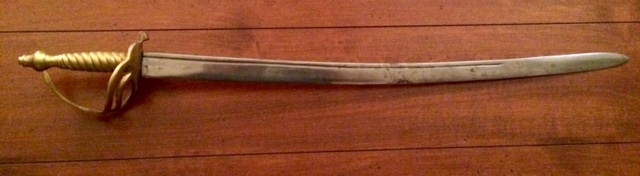
But John Chiswell would tell a different tale.  It was his claim that Routledge was drunk, which he most likely was, and in moving towards him apparently stumbled over his own feet.  Stumbling forward, according to Chiswell, Routledge accidently fell onto the colonel’s sword!  It was not murder, he claimed, but purely a tragic accident.

John Chiswell was arrested and later remanded to the General Court in Williamsburg for trial.  In cases of possible homicide, it was not the court’s custom to grant bond (bail).  However, three of the court’s justices took an interest in the question of bond.  After questioning Colonel Chiswell and the Cumberland bailiff who escorted him to Williamsburg, and discussing the matter with the eminent legal minds of the colony, including George Wythe, the justices determined that bond should be granted and Col. John Chiswell was allowed to await his day in court in the comfort of his own home.

This case promised to be the “Trial of the Century”.  It was known and discussed throughout the colony and especially so in Williamsburg.  Many residents there considered the episode to be scandalous.  They believed a wealthy man was getting away with murder.  It was so scandalous that for months local newspapers printed stories accusing the justices of showing partiality to an arrogant, wealthy man due only to his social status.  Chiswell was under de facto house arrest as crowds gathered daily in front of his home in protest.  The fact that the justices in this case, William Byrd, III, Presley Thornton, and John Blair, were all companions and even business associates of the accused, only made matters worse.

Chiswell House
Chiswell-Bucktrout House

Mysteriously in October 1766, before the case could come to trial, Col. John Chiswell was found dead in his home.  It was suspected that, not having the strength to endure the scandal and the scrutiny of his fellow citizens, Chiswell took his own life.  The coroner’s report, however, simply stated that John Chiswell died from “nervous fits, owing to a constant uneasiness of the mind.”  It should be noted that the Coroner was also a companion of Col. Chiswell.

With suicide suspected, the Chiswell family was not allowed to bury the deceased colonel in the graveyard at Bruton Parish Church in Williamsburg.  Instead, the body was taken by cart to the place of his birth, back to Scotchtown in Hanover County.  The colonel’s daughter was abiding there at the time.  But John Chiswell would not rest in peace even after arriving at the beautiful home he knew as a child, or not yet anyway.  Fearing that he had possibly posed his own death as a means of avoiding trial and the gallows, the family and friends of Robert Routledge gathered in the yard of Scotchtown and awaited the arrival of the body. They insisted the coffin be opened, much to the heart-felt agony of the widow, so that the body could be positively identified as that of Col. Chiswell.  It was so identified; as a matter of fact, one of the men there that day and who recognized the visage of Chiswell was the future owner of Scotchtown himself, Patrick Henry.  Mr. Henry noted afterwards that the skin on the face of Chiswell had turned black, a sure sign of arsenic.
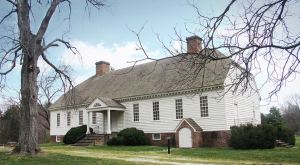
Scotchtown
Scotchtown

It was a scandalous and sensational story and certainly the “OJ Simpson Case” of its day.  Most people of colonial Virginia knew of it and yet, today, the story is not very well known at all.  How many other stories like this one are out there, waiting to be discovered?

The Signal

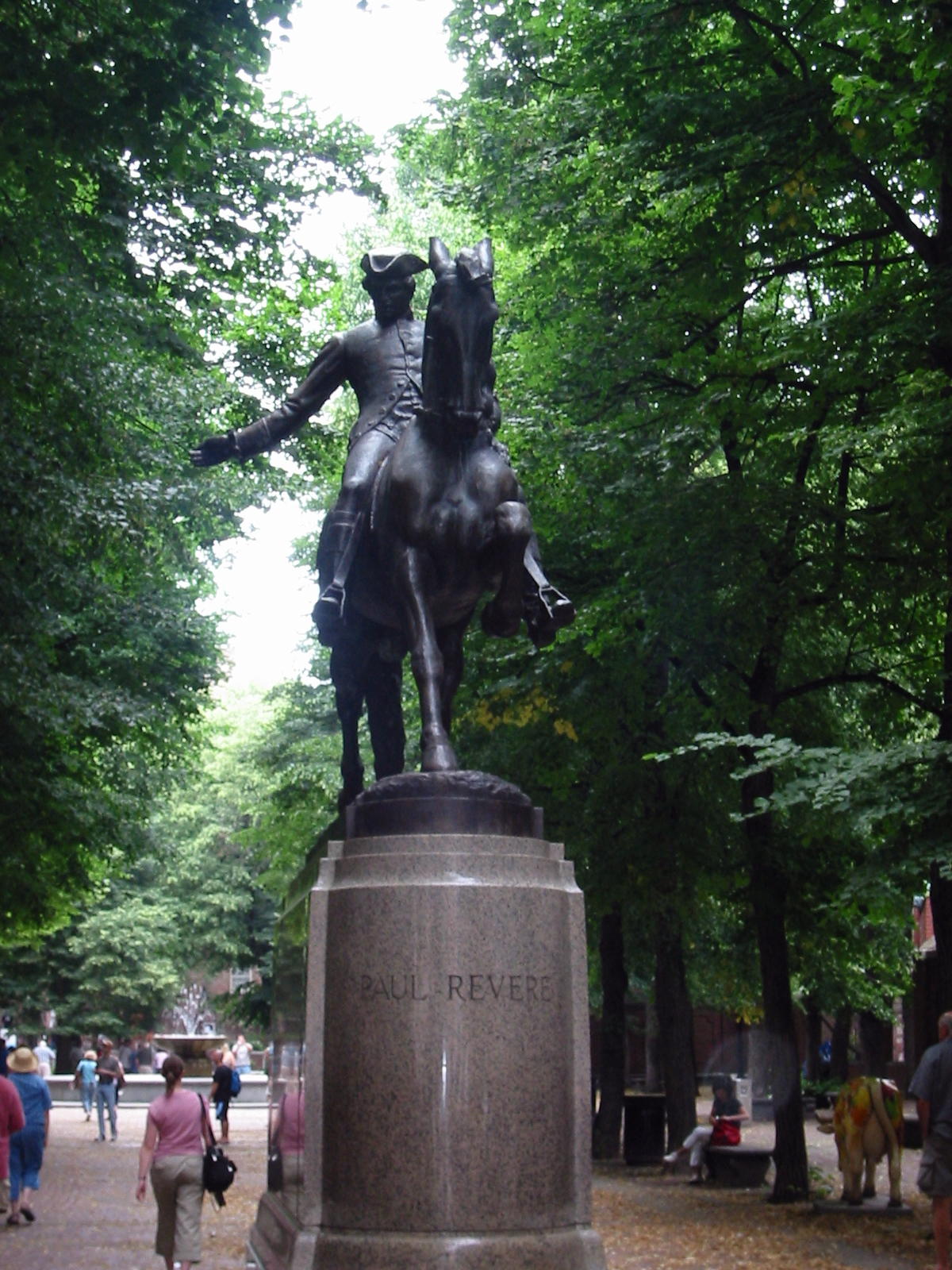
“One if by land, two if by sea; and I on the opposite shore will be, ready to ride and spread the alarm through every Middlesex village and farm, for the country folk to be up and to alarm.”  When I was a boy, these words from Henry Wadsworth Longfellow’s poem “The Midnight Ride of Paul Revere” truly stirred within me an excitement that I don’t think has ever really left me.  I hadn’t visited Boston mind you, but I could still envision the outline of that brave horseman as he paced along the shore of the Charles River, “booted and spurred” and wearing his cocked hat and long riding cloak.  He waited and he watched.  He was waiting for the signal in the belfry of the Old North Church that would tell him which direction the Lobsterbacks would be taking that night on their march to Concord.

Paul Revere
Paul Revere

Yes sir, Paul Revere was a hero of mine early on.  Right up there with Daniel Boone and Davy Crockett.  It would be years, though, before I would learn the real story of what happened that night, April 18, 1775.  During my first visit to Boston a few years ago, I crossed the bridge that spans the Charles River, near where the USS Constitution is now moored.  Longfellow’s poem has fooled many since its publication in 1861.  It’s true, Paul Revere, Boston silversmith, member of the Sons of Liberty, and Messenger of the Revolution, crossed the river near that spot.  He met up with local militia leaders on the Charlestown side.  The steeple of Christ Church in Boston’s North End, the Old North Church it was also called, did indeed shine forth with the light of two lanterns, hung there by its young sexton Robert Newman.  It was a message alright but Longfellow got it backwards.  It wasn’t a message to Paul Revere but, rather, it was a message from Paul Revere!

One of the Lanterns
One of the Lanterns

The North End of Boston is still what we would today call a blue collar place.  Its streets are narrow and the buildings are close-packed.  The Paul Revere House, at 19 North Square, is surrounded by modern buildings and businesses.  Didn’t matter to me though as I strolled through the house on a self-guided tour.  I found myself struck as I exited from the back door and walked down the back steps; probably the same exit route taken by Revere himself that night as he left home and headed down to the water to retrieve the small boat he kept hidden there.  Like a lot of historic areas, you sometimes have to use your “mind’s eye” to envision what things were really like.  As I looked around North Square, I envisioned how Mr. Revere’s world would have looked.  At last, on that first trip to Boston, I was following in the footsteps of Paul Revere!

Paul Revere House
Paul Revere House

Over on Salem Street stands Christ Church; the Old North Church from history.  The sanctuary is still beautiful.  If it were allowed, I surely would’ve climbed to the top of the steeple as Robert Newman did on April 18th.  Revere and may other members of the Sons of Liberty had already learned, through mysterious sources, of the secret plans of British General Thomas Gage to march a hand-picked force of light infantry troops and a handful of Royal Marines to the village of Concord, some 20 miles west of Boston to seize the colony’s powder stores.   By all accounts, General Gage was a good and virtuous man; a veteran of the fight on Braddock’s Field in 1755.  He arranged his plans to secretly snatch up the colony’s stores of powder and shot in order to help stop any further bloodshed should tensions continue to boil over into violence.  But it was not to be.

Old North Church
Old North Church

Many of the troops who would be making the march later that evening were quartered in buildings near the Old North Church.  In fact, Mr. Newman’s signal lights were actually seen by the regulars.  As an officer banged hard on the wooden doors in the front of the church, wanting to know what was going on; Robert Newman stole silently through a rear window to make his escape.  As he was known to carry about his person a set of keys to the church he would later be arrested and detained.

Back Window of the Old North Church
Back Window of the
Old North Church

By the same token, Revere knew the risks he himself would be taking in having friends row him across the Charles River after the hour when no further civilian traffic was allowed.  They would pass under the guns of the HMS Somerset, the man-of-war that was posted in the river to block all nocturnal travel between Boston and Charlestown.  Hence, the signal.  In case Revere was stopped, he had arranged for Robert Newman to make the signal of two lanterns in the belfry, to communicate to the Patriots in Charlestown that the regulars would be crossing Boston’s Back Bay, near Cambridge, on their march.  “Two if by sea.”

The signal was sent and Revere made it to Charlestown.  He borrowed a horse, Brown Beauty, and galloped off but not to Concord; he was heading for Lexington.  Down to the south, along Boston Neck, passed another rider, by the name of William Dawes.  The mission for both men was the same: reach Lexington in time to warn patriots Sam Adams and John Hancock that the regulars were out!  Both men made it to Lexington, with Revere arriving first.  They delivered their message.

As for Concord, well…that’s another story.

Revere Statue
Revere Statue
Steeple of Christ Church

Where An Army Was Born

When most Americans think of Valley Forge the image of a cold, harsh and bleak winter landscape tends to spring to mind.  They remember from their history books that this was the place where Gen. George Washington’s rag-tag Continental Army suffered greatly from the harsh elements.  While Pennsylvania winters are rarely mild, the winter of 1777-1778 was not as harsh as what the army would later endure at Morristown, NJ.  What truly plagued Washington’s army that winter at the Forge was a want of supplies:  food, medicine, blankets, shoes, clothing, etc…  If there was ever a time in the life of this army when the boys could have called it quits, when they could have disbanded and just gone home…..then Valley Forge would have been the place for it.

National Memorial Arch

I took my family to visit Valley Forge National Historical Park near the Schuylkill River, west of Philadelphia not long ago.  Out of season, of course.  It was a warm day in July when the five of us meandered through the little visitor’s center and museum and then drove along the park roads trying to take in everything this immense site had to offer.  Entertaining three teenagers packed in a minivan isn’t always the easiest thing to do on a history tour but they seemed impressed with the National Memorial Arch, standing majestically alone on its green hilltop.

My attention, not surprisingly, was drawn to the restored cabins where the soldiers spent their winter days and nights and by the beautiful stone Potts House in which Washington lived and, along with his military “family”, used as headquarters.  But this trip would prove to be an eye-opener for me.

Restored Cabins
Restored Cabins

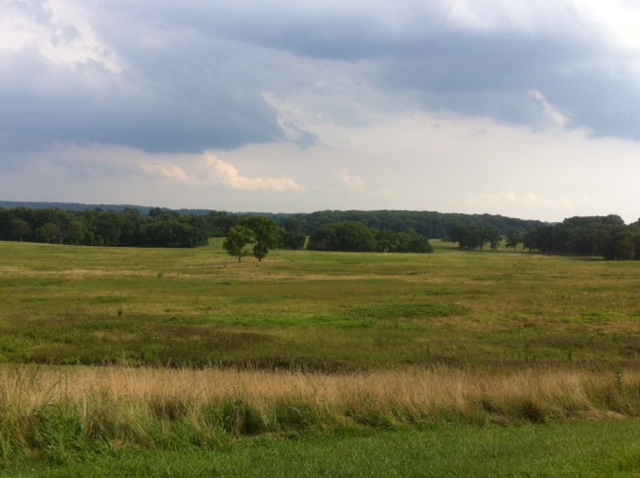
As we cruised along the park roads, through beautiful rolling hills, we came upon what is called The Grand Parade.  It’s a large, grassy, open field bordered by trees that stands nearly in the center of the park.  At first glance it appears no different than any other large, grassy, open field bordered by trees, but there is something extra special about this one.  For this was the scene where, some 238 years ago, Washington’s regiments and battalions marched and drilled during that long winter.

Baron Von Steuben
Baron Von Steuben

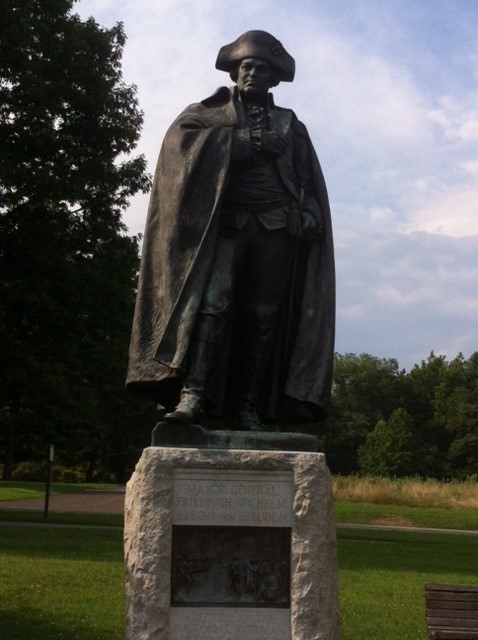
Standing on one side of the field is a statue; the man who’s responsibility it would become to train these men in the European military fashion.  Friedrich Wilhelm August Heinrich Ferdinand Steuben, known as Baron von Steuben, came to America on the recommendation of none other than Benjamin Franklin.  He was a veteran of the Prussian Army, he said; had attained the rank of Lieutenant General and served directly under the military genius Frederick the Great.  At Valley Forge that winter, he would serve as a volunteer and would be appointed temporary Inspector General.  As the historical record would later show, Steuben did serve as aide-de-camp to Frederick the Great but never attained a rank higher than that of captain.  While his claim to rank and privilege was questionable at best and downright false at worst, Baron van Steuben would nonetheless prove invaluable to the United States.  As an officer of the Prussian Army, he had the knowledge and skill necessary for training men in the art of war.  He was the right man, for the right job, at just the right time.

The Baron spoke not a word of English; his orders had to be translated, but the manual of training he would compose was such that it turned a hungry, tattered, exhausted mass of farm boys and mechanics into a well-disciplined fighting force.  He would mold them into an army.

Potts House
Potts House

Unlike his British counterparts, George Washington  was never to have a fully veteran army.   Indeed, there were some men who served for the duration of the war but, by and large, enlistments expired and men returned to their homes, farms and families.  But because of the training provided by this somewhat eccentric European who spoke and swore in German, the soldiers of the Army of the United States would go on to match the best in the world.  On the field at Monmouth Courthouse in 1780, these men would prove their mettle.  While the initial attack stalled, due mainly to poor leadership, the defensive position they would establish, under the watchful eye of their Commander-In-Chief, would prove the worth of their training.  These lads stood off the best army in the world.  And it all came together right here, on The Grand Parade at Valley Forge.

The Grand Parade
The Grand Parade

As I stood beside that statue on a warm day in July and gazed out on this wide open space, in my mind’s eye I could see those boys drilling; first by squad, then by company, then by regiment.  I could see it all unfolding before me on this unassuming field.  It looks like any other field you may pass on a drive in the country, but this field is where the war would change for the United States.  This field, by God, was the birthplace of the American Army.