

PART TWO OF FOUR
The Battle of Point Pleasant, October 10, 1774
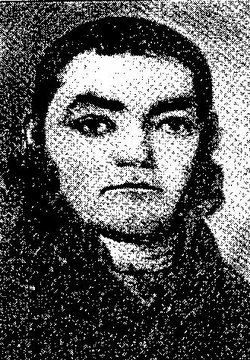
Andrew Lewis, another Scot, whose family had founded the town of Staunton, Virginia, led a command of the same Scots-Irish ruffians who later fought and won the 1781 Battle of Kings Mountain during the Revolutionary War. These men were fiercely independent and were known to be hard, determined fighters. They were the right men to pursue the mission laid out by Lord Dunmore.

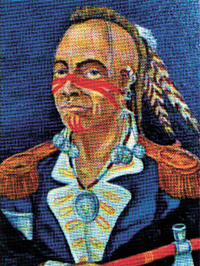
Chief Cornstalk, the Shawnee leader, led a force to intercept Lewis’ force to prevent Lewis from completing his rendezvous with Dunmore’s army. The Shawnee chief led somewhere between 300-500 warriors, including the future Shawnee war chief, Blue Jacket. If they attacked Lewis’ command, they would do so with less than half the manpower. Cornstalk intended to attack Camp Pleasant, hoping to trap Lewis’ force on a bluff overlooking the Ohio River.
The Indians crossed the river on rafts about three miles upriver from the confluence of the rivers on the night of October 9. They expected to take Lewis’ camp by surprise, and they nearly succeeded. However, half an hour or so before sunrise, two men of Capt. William Russell’s company spotted the Indian war party about a mile from Camp Pleasant. The Indians shot down one of the two men, but the other escaped and brought in the intelligence that an Indian attack was imminent. A few minutes later, two men of Capt. Evan Shelby’s company brought in a similar report.
Lewis immediately ordered his brother, Col. Charles Lewis, to take command of a division of 150 men, while Col. William Fleming assumed command of another division of 100 or so men. The following is a contemporaneous account of the battle, written a week later:
Col. Charles Lewis’ division marched to the right, some distance from the Ohio, and Col. Fleming, with his division on the bank of the Ohio, to the left.
Col. Charles Lewis’ division had not marched quite half a mile from the camp when, about sunrise, an attack was made on the front of his division, in a most vigorous manner, by the united tribes of Indians—Shawnees, Delawares, Mingoes, Tawas, and of several other nations—in number not less than eight hundred, and by many thought to be one thousand.
In this heavy attack, Col. Charles Lewis received a wound which, in a few hours caused his death, and several of his men fell on the spot; in fact, Augusta division was obliged to give way to the heavy fire of the enemy. In about a second of a minute after the attack on Col. Lewis’ division, the enemy engaged the front of Col. Fleming’s division, on the Ohio, and in a short time the Colonel received two balls through his left arm, and one through his breast, and, after animating the officers and soldiers in a most calm manner to the pursuit of victory, retired to the camp.
The loss in the field was sensibly felt by the officers in particular; but the Augusta troops, being shortly after reinforced from the camp by Col. Field, with his company, together with Capt. McDowell, Capt. Mathews and Capt. Stewart, from Augusta; Capt. Paulin, Capt. Arbuckle and Capt. McClannahan, from Botetourt, the enemy no longer able to maintain their ground, was forced to give way till they were in a line with the troops, Col. Fleming being left in action on the bank of the Ohio.
In this precipitate retreat. Col. Field was killed. During this time, which was till after twelve, the action in a small degree abated, but continued, except at short intervals, sharp enough till after 1 o’clock. Their long retreat gave them a most advantageous spot of ground, from whence it appeared to the officers so difficult to dislodge them that it was thought most advisable to stand as the line was then formed, which was about a mile and a quarter in length, and had sustained till then a constant and equal weight of the action, from wing to wing.
It was till about half an hour till sunset they continued firing on us scattering shots, which we returned to their disadvantage. At length, the night coming on, they found a safe retreat.
They had not the satisfaction of carrying off any of our men’s scalps, save one or two stragglers whom they killed before the engagement. Many of their dead they scalped, rather than we should have them, but our troops scalped upwards of twenty of their men that were first killed.
It is beyond doubt their loss, in number, far exceeded ours, which is considerable;
The return of the killed and wounded in the above battle, same as our last, as follows:—Killed—Colonels Charles Lewis and John Field, Captains John Murray, R. McClannahan, Samuel Wilson, James Ward, Lieut. Hugh Allen, ensigns Cantiff and Bracken, and forty-four privates. Total killed, fifty -three.
Wounded—Col. William Fleming, Captains John Dickinson, Thomas Buford and I. Skidman Lieutenants Goldman, Robinson, Lard and Vance, and seventy-nine privates. Total wounded, eighty-seven; killed and wounded one hundred and forty.
Steven T. Mitchell, who fought at Point Pleasant, left this 1827 account of the fighting:
We landed about a mile on the left-hand shore of Kanawha, and climbing a large hill, we were saluted by a hundred Indians, encamped upon the top. Our captors told their adventures, no doubt, with every aggravation; for, after the most frantic expressions of grief and rage, I was bound to a tree, a large pine tree, which stands to this day upon the brow of the hill, and the fire was kindled around me. I said my prayers; my time was come; my body felt the scorching heat: but, by a miraculous interposition of Providence, the clouds which had been lowering all day, now burst out in showers, and quenched the flames. The Indians thought the Great Spirit looked over me, and directed the shower for my safety. My bonds were loosened, and I was allowed a little jirk and hommony for my refreshment. The next day I could perceive some great expedition on foot; the Indians were running to and fro in every direction; some grinding paint and some cleaning up their arms; and even the squaws and little boys were providing themselves with hatchets and scalping knives, and strewing themselves from the Ohio river all along the cliffs of Kanawha.
Late in the evening, I saw an uncommon anxiety on the faces of the savages; councils, grand and petty, were held in various places, and so completely were my guards absorbed in the undertaking which was at hand, that they became entirely remiss in their attentions to me. I resolved to seize the propitious moment, and make my escape. I sprang: on my feet and ran as fast as my legs would carry me. A loud whoop proclaimed the event, and in a moment, I could perceive myself closely pursued by half a dozen athletic young fellows, with uplifted tomahawks. Fear added to my limbs the agility of the deer. With my head turned back over one shoulder, I bounded through the pine-trees until my speed had carried me unawares to the brink of a precipice. I tried to stop; it was too late; I gave a piercing shriek and bounded over. A rushing sound in my ears like the roaring of a mill-dam, then the crashing of branches and limbs recalled me to my recollection, and I found myself to my inexpressible delight, breaking my way through the thick branches of a buck-eye tree. I alighted without injury, and looking back upon the cliff above, could see my savage pursuers gaping over the precipice in amazement. I gave not a second look, but darted off towards the point with a heart swelling with praise to the great Creator, who had thus twice rescued me so miraculously from my enemies. Arriving at the mouth of the Kanawha, I shouted aloud for assistance. But, the whites had too often been decoyed by their own people to the savages, to be easily imposed upon. They answered me they could give no assistance. I could not swim, but my ingenuity, never fertile in expedients, befriended me now for the first time in my life. I rolled down a dry log from the bank into the water, and getting astride of it, I managed by great exertion of hands and feet, to row it across the stream, which at that time, from the great height of the Ohio, was as still as a mill-pond I was received by General Lewis, the commandant of the fort, with great cordiality and affection; and, being naked and necessitous, I enrolled myself as a regular in the corps; and, being dressed in militaire, with a tremendous rifle in my hand and a thick breast work before me, I felt as brave as Julius Caesar.
I was in hopes that I might enjoy, within the walls of a fort, some respite from the fears, toils and anxieties which had, for the last two weeks, worn me out both body and mind. But he who undertakes to settle in a new and savage country, must look out for no such respite, until, by hardihood and perseverance, he has leveled the forest, with its inhabitants, to the earth.
On the 10th of October, 1774, about sun-rise, the hunters came in at fall speed, and gave the appalling information that a large body of Indians had spread themselves from river to river, and were advancing by slow degrees, towards the fort; at the same instant, we could observe the women and boys skulking up and down the opposite banks of the Ohio and Kanawha. The position of the fort was peculiarly favourable to a surprise. As I have above mentioned, it was situated at a right angular point formed by the confluence of the Kanawha and Ohio rivers. The country above the fort was covered with a heavy forest and impervious growth of underwood, through which an invading force might penetrate completely undiscovered, to the very walls of the fort. The garrison was composed of about twelve hundred men entirely Virginians, from the counties of Botetourt and Augusta. The Indians consisted of about the same number, the flower of the Shawnee, Wyandotte and Mingoe tribes, who were commanded by the celebrated “Chieftain, Cornstalk.”
From the large force which he had collected for this expedition, and from the secrecy of his movements, it was evident that the Indian Chief, in this desperate attempt to recover the country east of the Ohio river, meditated nothing less than an entire extermination of the garrison. General Lewis ordered out about seven hundred of his rangers, under the command of his nephew, Colonel Charles Lewis; with the remaining part of his troops, about five hundred in number, he determined to act as a reserve and defend the fort to extremities.
I happened to be among those who were ordered out, very much against my will; but it was neck or nothing; we advanced about three hundred yards in front of the fort, toward a deep ravine which intersected the valley at the right angles with the Kanawha. All was still as death; one moment more and a yell mingled with the roar of a thousand rifles, rung from river to river, and at the same moment every bush and tree seemed alive with armed savages. Col. Lewis was killed at the first fire, but the rangers maintained their ground, and a contest commenced more desperate and more rapidly fatal than any which had ever, been fought with the Aborigines, excepting that of Talledaga. The Indian Chief, with that promptness for seizing an advantage, and that peculiar military tact for which he was so much renowned, extended his line from the Ohio as far as it would stretch across to the Kanawha bank, for the purpose of out flanking the opposing forces. But, in the execution of this manoeuvre, he was completely foiled by the superior address and boldness of the whites who, animated with revenge for the loss of their leader and a consciousness of their desperate situation, fought with a fury that supplied the inequality of numbers, and set at defiance every stratagem of the savages.
Finding that his method of outflanking would not succeed, the Indian Chief concentrated his forces, and furiously attacked the centre of the Virginia line. The savages, animated by their warlike and noble Chieftain, Cornstalk, forgot the craftiness of their nature, and rushing from their coverts, engaged hand to hand with their stout and hardy adversaries, until the contest resembled more a circus of gladiators than a field of battle. I became desperate; hide where I would, the muzzle of some rifle was gaping in my face, and the wild, distorted, countenance of a savage, rendered more frightful by paint, was rushing towards me with uplifted tomahawk One fellow in particular, seemed to mark me as his victim; I levelled my rifle at him as he came yelling and leaping towards me, and fired. The ball missed my aim. He rose upon his toes with exultation, and whirling his tomahawk round his head, slung it at me with all his powers. I fell upon my face, and it whizzed harmless over my head and stuck into a sapling. I bounded up and forced it from the tree, but the Indian was on me and rescued the hatchet from my hands. I seized him round the waist, enclosing both his arms at the same time and tripping up his heels, we rolled together upon the ground. I at last grew furious, gouged him with my thumbs in both eyes, and seizing him with my teeth by the nose, I bit the whole of it from his face; he yelled out with pain and rage, and letting loose the hatchet to disengage my teeth, I grasped the handle and buried the sharp point into his brains. He gave one convulsive leap which bounced me from his body, and in a moment after expired. I immediately rose, and gaining a secure position behind a tree, remained there till the close of the fight, and made a thousand resolutions, if I survived this engagement, never to be caught in such a scrape again. I kept my word; for, I have never since encountered the savages, and if Heaven forgives me, I never will. There is no fun in it.
But, to return to the history of this ever memorable battle. There was a peninsula extending from a high range of bills running parallel with the Ohio river, which jutted close to the Kanawha bank, about a half a mile from its mouth. Knowing the importance of securing the narrow pass which ran between its base and the river, the Indian Chief dispatched a picked body of his troops to take possession of it. They entered the dry bed of a small creek which skirted the foot of the hills, and pursued their route unnoticed till they were about to enter the important pass, when a shower of rifle bullets pierced their body and swept down the foremost ranks. A chosen band of rangers at’ the same moment made their appearance, with whom General Lewis in anticipation had guarded the pass. A yell of surprise and rage burst from the savage line, and they seconded their returning fire by an unanimous and desperate charge with the hunting-knife. The contest now assumed all the wild and terrific cast which a personal struggle, conducted with the deadly feelings of hate and revenge then existing between the whites and Indians, could inspire. The air was filled with the screams of the savages and the deep imprecations of the riflemen; every blow brought death, and the ground was soon heaped with the corpses of the combatants. But the disappointed efforts of savage desperation were ineffectual against the unbroken and impenetrable column which was maintained by the whites; and the Indians were driven, with the loss of half their force, back upon the main body. Here, the fight still raged in the extremity of opposition, every inch of ground was contested, from behind every bush and decayed log the murderous flash arose, and the continued roar of a thousand rifles vibrated through the forest.
The savage Chieftain discovered that the chances against him were desperate, yet, by his own personal example of courage and address, was the fight long1 sustained, even after his line had been driven, step by step, from their original position. His voice could at intervals be heard, rising above the din of the fight like the shrill blast of a bugle; at one moment, his dusky form and glittering ornaments could be seen flitting through the trees upon the Ohio bank, and his war cry in the next would fill the echoes of the hill at the farthest extremity of the line. A sheering ejaculation of triumph would one moment escape him, as an advantage was gained by the de voted gallantry of some Shawnee warrior; an imprecation upon some skulking Mingoe, in a short time afterwards, would be recognized in his voice. “Charge high and aim low” was his command incessantly throughout the day; and, it is one of the circumstances remarked of that fatal fight, that most of the bullet wounds received by the whites proved mortal; but few of the wounded ever recovered. Yet, all the efforts of the old warrior were vain; defeated and discouraged, the savage army almost abandoned the fight in the latter part of the day, and it was reduced to a mere straggling fire between individuals of the contending parties.
Night closed upon the scene, yet the ground was still occupied by the two armies. Although victorious, the Virginians could neither press their advantage nor retire to rest. An ambuscade or a night attack was expected from the savages, and their behaviour warranted the latter supposition. For, behind a long line of watch-fires, they could be discovered as if cautiously examining the points most open to attack. The wild scream of a savage warrior, apparently advancing to the fight, would at intervals break upon the death-like stillness of the night, and cause my heart to leap almost out of my mouth. I confidently calculated that every moment was the time for their attack, and fancied divers times could hear them stealing through the bushes upon us. The gleams of the morning sun, however, at length illumined the scene, but not a vestige of the Indian army remained; the living and the dead had alike disappeared, and it was not until then, it was ascertained or even suspected, that the savages had secure themselves from interruption, under pretense of a night attack, had thrown their dead, with weights attached to them, in the river, and retreated across it under cover of darkness.
The next morning, Colonel William Christian marched his men over the battlefield, finding 21 dead Indians in the open, and another 12 hidden by brush and old logs. The dead included Pucksinwah, the father of the great Shawnee war chief, Tecumseh. Christian’s men also captured 40 guns, many tomahawks and other plunder.
So ended the brutal Battle of Point Pleasant. Lewis’ men held the battlefield after repulsing Cornstalk’s determined attacks, but the toll had been frightful. Lewis lost 75 killed and 140 wounded, including his brother, Col. John Lewis. Capt. Thomas Buford of Bedford County was mortally wounded and died several days later. Buford, a veteran of the Braddock Expedition during the French & Indian War, was the older brother of Col. Abraham Buford, who found infamy during the 1781 Battle of Waxhaws during the Revolutionary War. Abraham Buford and his younger brother Simeon both served in the Culpeper Minutemen, and helped to depose Lord Dunmore the next year. Simeon Buford was the grandfather of the great Civil War cavalryman, Maj. Gen. John Buford.
Indian casualties are unknown, since Cornstalk either buried the bulk of his dead, or threw them into the river. His losses had to have been similar to those sustained by Lewis. More importantly, Cornstalk’s bloody defeat at Point Pleasant brought a quick end to what became known as Lord Dunmore’s War.

 Emerging Revolutionary War Era