Arnold’s Treason: 240 Years Later – The Capture of Major Andre (September 23, 1780)

Major Andre cautiously rode his horse through unfamiliar territory between American and British lines. It was a neutral zone wreathing with unforgiving bands of Cowboys and Skinners, but ground that Andre, garbed in civilian clothing, needed to cross in order to return to New York City. He had experienced several close brushes with American posts, and his guide, Joshua Smith, rather than risking any run-ins with Tories, had decided to turn around when they were some twenty miles from British lines. Andre was on his own for the final leg of the journey. All seemed to be going well until he arrived just outside of Tarrytown and three men with leveled muskets emerged from the bushes astride the path.

The capture of Major Andre during the morning of September 23, 1780 was the moment that Benedict Arnold’s plot to surrender West Point to the British officially unraveled, saving the garrison, the Hudson River, and potentially the revolutionary cause for the Americans. It was a moment that was entirely avoidable had Smith agreed to carry Andre back to the Vulture downriver rather than insisting on taking the overland route and subsequently abandoning the officer to the mercy of whatever lay between the opposing lines. Unfortunately, for Andre, his fate would be determined by a group of “volunteer militiamen,” but most likely crooked highwaymen.

The meeting exchange that occurred between the British intelligence chief and the armed men blocking his path proved to be the most costly of the latter’s short life. Seeing that one of the militiamen was dressed in the green jacket of a Hessian jaeger, Andre incorrectly assumed that they belonged to his side, or the “lower party,” as he had asked them. The man, John Paulding, duped Andre, and answered in the affirmative. Relieved, the major revealed to them that he was in fact a British officer. Paulding then informed him that they were Americans, and after Andre handed him a pass written by Arnold, he threw it aside and began searching the rider, taking the valuables he carried with him. All this could have been ignored by Andre if they had then let him continue on to New York City, but the greedy militiamen then proceeded to remove the fine boots of a British officer he was wearing, and then his socks. What he was hiding underneath would be the evidence eventually needed to incriminate him and Arnold: documents relating to West Point and its defenses. The ragtag party of Americans had just nabbed themselves a spy.
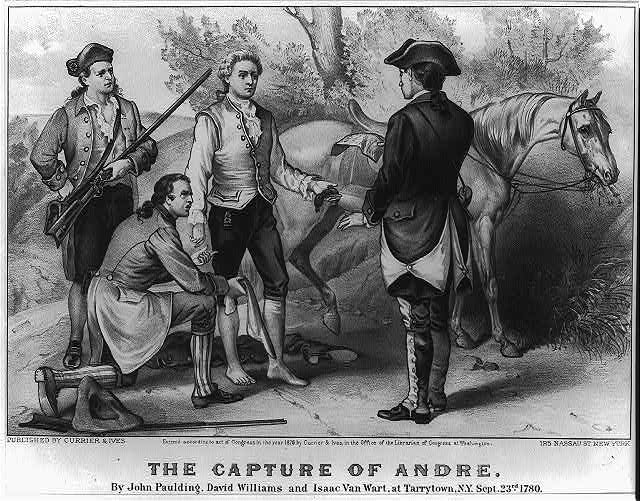
A 19th century depiction of Andre’s capture. Library of Congress.

Following his capture, Andre was taken to the Continental camp at North Castle and turned over to Lt. Col. John Jameson of the 3rd Continental Dragoons, who examined the dispatches. Seeing Arnold’s name on the papers, Jameson was not about to accuse an American hero of conspiring with the enemy. Instead, he sent Andre with an escort back to Arnold’s camp and scribbled off a message to the general: “I have sent Lieutenant Allen with a certain John Anderson [Andre’s moniker] taken going to New York. He had a pass signed with your name. He had a parcel of papers taken from under his stockings, which I think of a very dangerous tendency … The papers I have sent to General Washington.”[1] It was only a matter of time before Arnold realized that his plot was about to be discovered.

Andre, however, would never make it back to Arnold’s headquarters. Later that day, Maj. Benjamin Tallmadge, Washington’s chief intelligence officer and famed leader of the “Culper Ring,” arrived in Jameson’s camp and after learning of the man carrying suspicious documents, convinced the lieutenant colonel to return the suspect to camp.

Riding back to Arnold with Lt. Allen, Andre must have felt relieved that he had dodged another bullet. Much to his dismay, the next day he would be turned around and delivered to Maj. Tallmadge, where his fate as a spy would be decided.


[1] Quoted in Stephen Brumwell, Turncoat: Benedict Arnold and the Crisis of American Liberty (New Haven, CT: Yale University Press, 2018), 269.  
Arnold’s Treason: 240 Years Later – “The Tempter and the Traitor” (September 22, 1780)

It was a meeting that decided the fates of Benedict Arnold and John Andre. Not necessarily because of what had been discussed, but because of the unraveling circumstances surrounding it. Within several days, Arnold would be fleeing his once beloved country’s cause to the safety of the British lines in New York City, and in less than two weeks, Andre, not as lucky, would be dead.

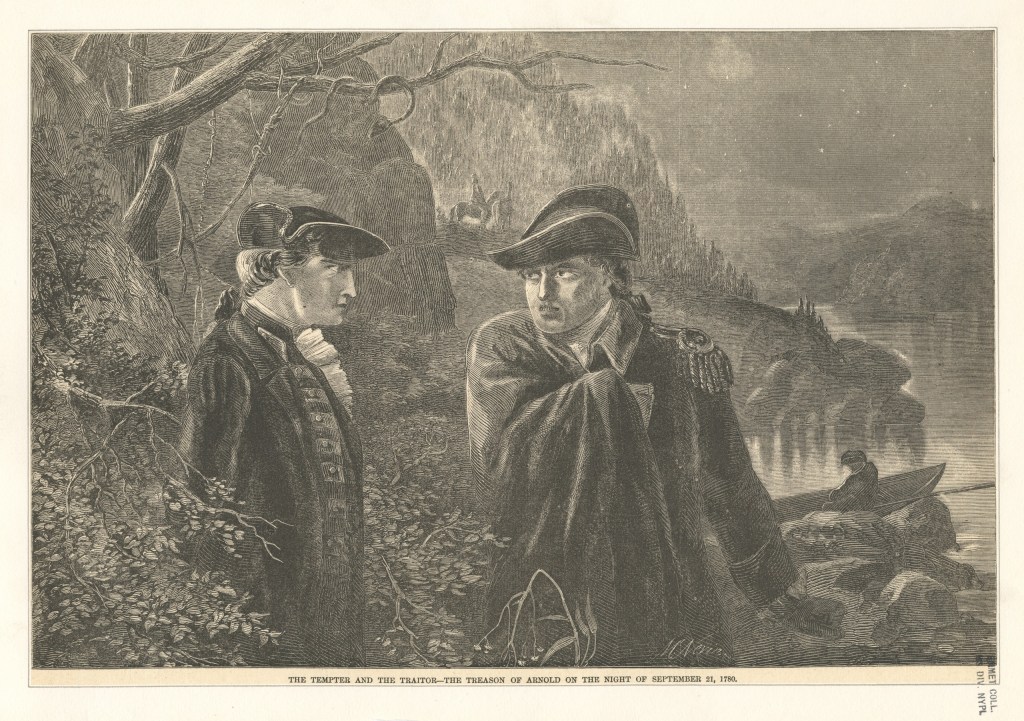
Not long after 1 a.m., September 22, 1780, Major Andre was rowed ashore near Haverstraw, New York, less than twenty miles below West Point. There, for several hours in the dark woods aside the Hudson River, he conversed with Arnold in a rendezvous that had been over a year in the making. His orders from Sir Henry Clinton stipulated that he was to confirm with Arnold “the manner in which he was to surrender himself, the forts, and troops…,” so the operation against West Point could be “conducted under a concerted plan between us … that the King’s troops sent upon this expedition should be under no risk of surprise or counter-plot.”[1] The British would attack the fortifications, and overwhelmed by superior numbers, Arnold would surrender the garrison and the river defenses.

“The Tempter and the Traitor.” Arnold and Andre’s Meeting near Haverstraw, NY. New York Public Library.

It is possible that another prize was discussed between the two men: the capture of George Washington. The American commander in chief was due to arrive to inspect the post on September 25 after meeting with the French high command at Hartford, Connecticut. Capturing West Point, as well as bagging Washington could spell an end to the rebellion once and for all.

After several hours, the meeting came to an end as daylight loomed. Waiting to procure some men to row Andre back to the Vulture, the vessel that was to return him to his own side, Arnold took the major to a house within the American lines. Everything seemed to be in order for the operation to be successfully executed now. That was until Continental artillery on the shore was directed by Col. James Livingston to open fire on the Vulture, forcing the craft to flee several miles downriver. Andre’s transportation back to New York City had been compromised. Though they did not know it yet, the plot to surrender West Point officially began to unravel. Arnold was now forced to send Andre back to British lines via an overland route through hostile territory.


[1] Quoted in Stephen Brumwell, Turncoat: Benedict Arnold and the Crisis of American Liberty (Yale University Press, New Haven, CT, 2018), 264.

Arnold’s Treason: 240 Years Later – August 30, 1780

On August 30, 1780, Benedict Arnold fully committed to treason by accepting the final terms presented by Sir Henry Clinton regarding the plot to turn over the fortifications at West Point to the British. Arnold’s reply to a letter written on July 24 by Clinton’s adjutant-general and chief intelligence officer, Major John Andre, was the result of over a year’s worth of on and off negotiations between the two parties. At times it had appeared to Clinton and Andre that Arnold’s defection would not be as useful as they had hoped. The American general could not obtain a field command and could only offer intelligence that was of little value or already known. However, when Arnold assumed command of the fortifications in the Hudson Highlands, including West Point, in early August, the possibility of using his services to strike a crushing blow to the American cause became a reality.

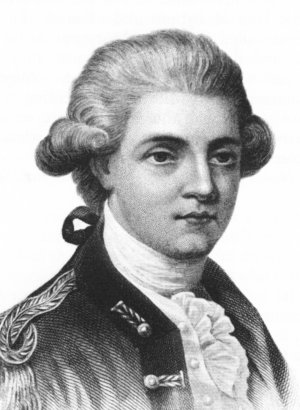
Andre
Maj. John Andre. http://www.westminster-abbey.org

The first mention of West Point in the correspondence between Arnold and Andre appeared in a letter written by the latter in late July 1779. Andre had inquired about the “procuring of an accurate plan,” of the post. Arnold, still serving as military governor of Philadelphia and away from Continental Army headquarters, was unable to answer this request. The following month, discussions began to stall and it would not be until the next year when the prospect of Arnold obtaining command of the Hudson Highland forts reinvigorated negotiations. By this time, it was far too late for Arnold to back out. The British high command had enough correspondence and gathered intelligence from the “American Hannibal” to expose him as a traitor. Arnold knew this as well, which is why his terms for defecting and surrendering a large body of American troops and/or West Point hinged on Clinton promising him financial and personal security for himself and his new family (Peggy had given birth to their first son, Edward, in March 1780).

On July 24, 1780, Maj. Andre penned a letter to Arnold informing him that Gen. Clinton had agreed to his terms of a payment of £20,000 in exchange for the surrender of 3,000 men and the West Point fortifications. If he should be unable to accomplish this task, £10,000 was still offered for his efforts. The message did not arrive until a month later, but Arnold responded six days later under the alias “Gustavus,” and requested to set up a meeting in the near future with Andre. The dispatch never made it to the British. The courier tasked with delivering it grew suspicious of its content and instead carried it to Maj. Gen. Samuel Parsons, his neighbor, on September 10. Parsons did not believe that the letter was anything to be concerned with, since it referred only to a Mr. Moore (Arnold) and Anderson (Andre) and such topics as market goods and speculators. The message was, of course, coded. Arnold had unknowingly dodged a major bullet.

Although his August 30 correspondence did not reach the British in New York City, Arnold scribbled out another message on September 3. This time, the letter was successfully delivered by Mary McCarthy, the wife of an escaped, but recaptured member of Saratoga’s “Convention Army,” Private Charles McCarthy, 9th Regiment of Foot.

Benedict Arnold, at one point the most famous hero of America’s revolutionary war, had officially entered his treasonous plot to turn over West Point and its garrison and defect to the British into its final stage. A little over three weeks later he would meet with Maj. Andre fifteen miles south of West Point near Haverstraw, New York.


Arnold’s Treason: 240 Years Later

This is the first part of what will be a running series that will highlight the 240th anniversary of the events surrounding Benedict Arnold’s treason.

The story of Benedict Arnold’s treason during the Revolutionary War is one of the most infamous, yet tragic, in our nation’s history. He was the “American Hannibal,” the most brilliant battlefield commander during the conflict’s early stages. His patriotism, sacrifice, and commitment to the cause of independence were matched by few in the American high command, so too were his battle honors. Fort Ticonderoga, Quebec, Valcour Island, Ridgefield, the relief of Fort Stanwix, and the battles of Saratoga—he was always in the thick of things.

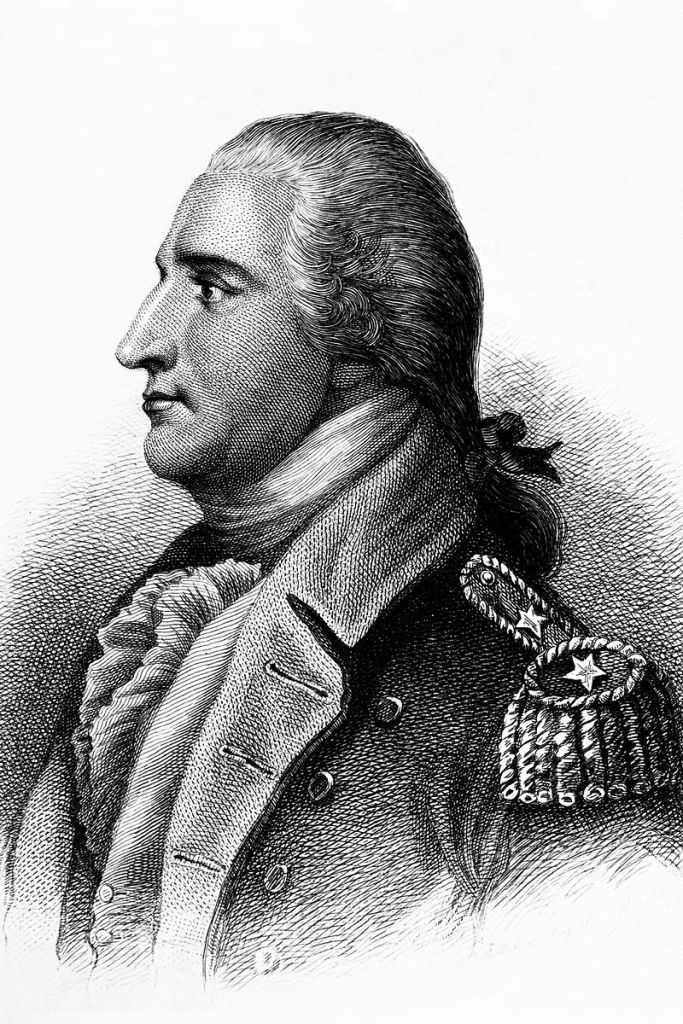
Benedict Arnold
Maj. Gen. Benedict Arnold. Wikimedia.

Arnold’s treason was not something that was pre-determined. His ultimate defection to the British in 1780 was a result of many factors that continued to pile up as the war progressed, but it can be rooted in a long-running feeling of being underappreciated and a growing distrust in America’s political leaders.

Following his grievous leg wound at Saratoga on October 7, 1777, Arnold was appointed military governor of Philadelphia, never to command American troops on the battlefield again. While stationed there, his downward spiral towards treason began to accelerate. An open feud with Joseph Reed and Pennsylvania’s Supreme Executive Council led to a court martial and reprimand from George Washington, something beyond correction for a man with the personal honor of Benedict Arnold. The slippery slope became even more slippery. Continue reading “Arnold’s Treason: 240 Years Later”

“A damned old rebel, with one foot in the grave”: The Deposition of Elizabeth Covenhoven, Monmouth County, New Jersey, July 30, 1778

The lead elements of Sir Henry Clinton’s army trudged into the village of Monmouth Court House, New Jersey throughout the day on June 26, 1778. There, the British force remained until the morning of the 28th, when it continued onward toward the safety of New York City.

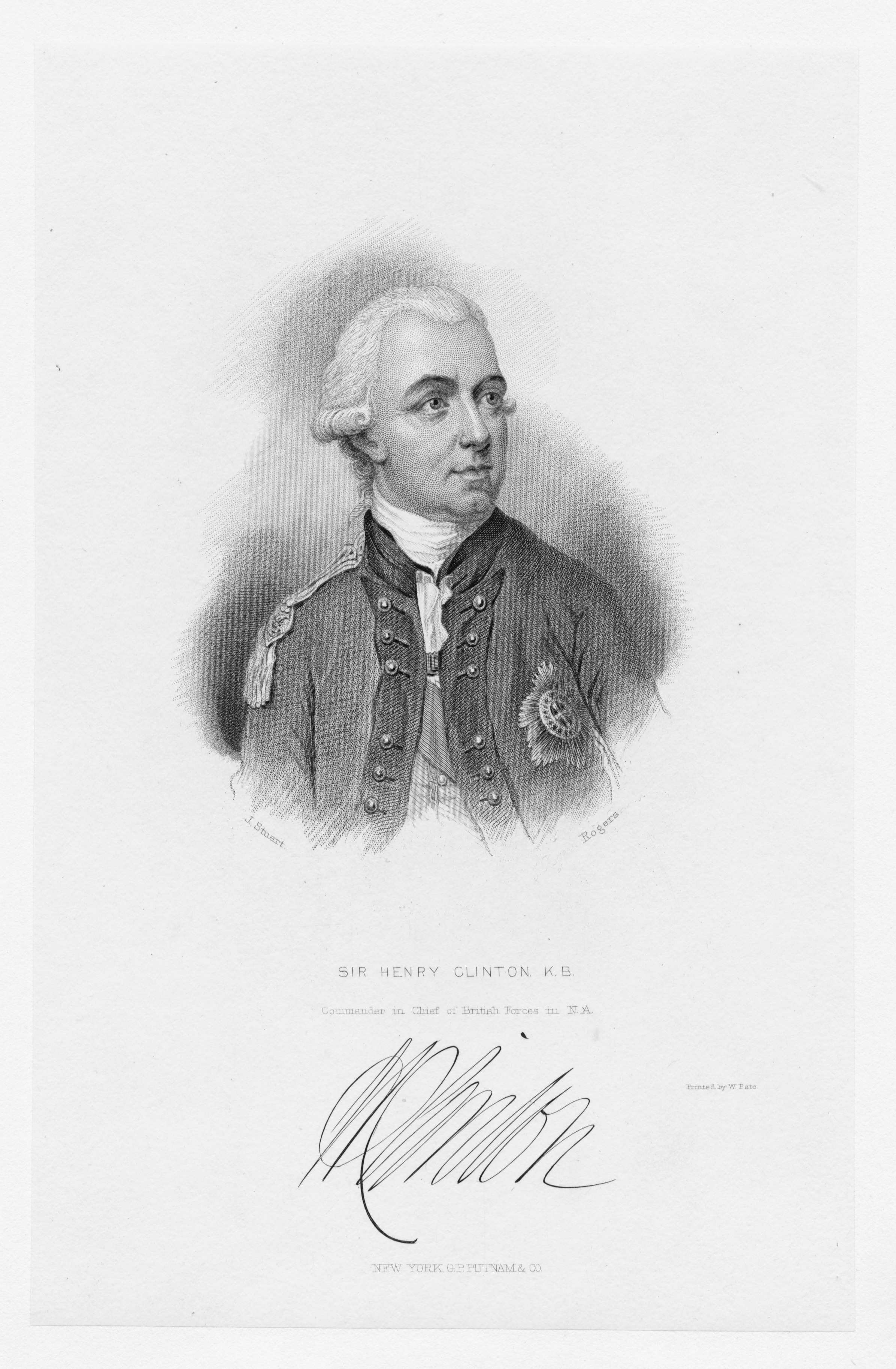
C2 - General_Henry_Clinton
Lt. Gen. Henry Clinton. New York Public Library Digital Collections. 

Upon arriving in the area during the afternoon of June 26, General Clinton established his headquarters just southwest of town along the Allentown Road in the home of Elizabeth and William Covenhoven. The sight of thousands of British and Hessian troops marching by the front of her property must have been spectacular, but terrifying, for the elderly Elizabeth, who was in her seventies and alone when the general and his military family arrived (her husband’s whereabouts are unknown). Fearful that her home, animals, and other possessions would be in danger, Mrs. Covenhoven begged Sir Henry to spare them. Very gentlemanly, he promised her, “on his honour that every thing she had should be protected and nothing injured.” Elizabeth was satisfied with the general’s promise.

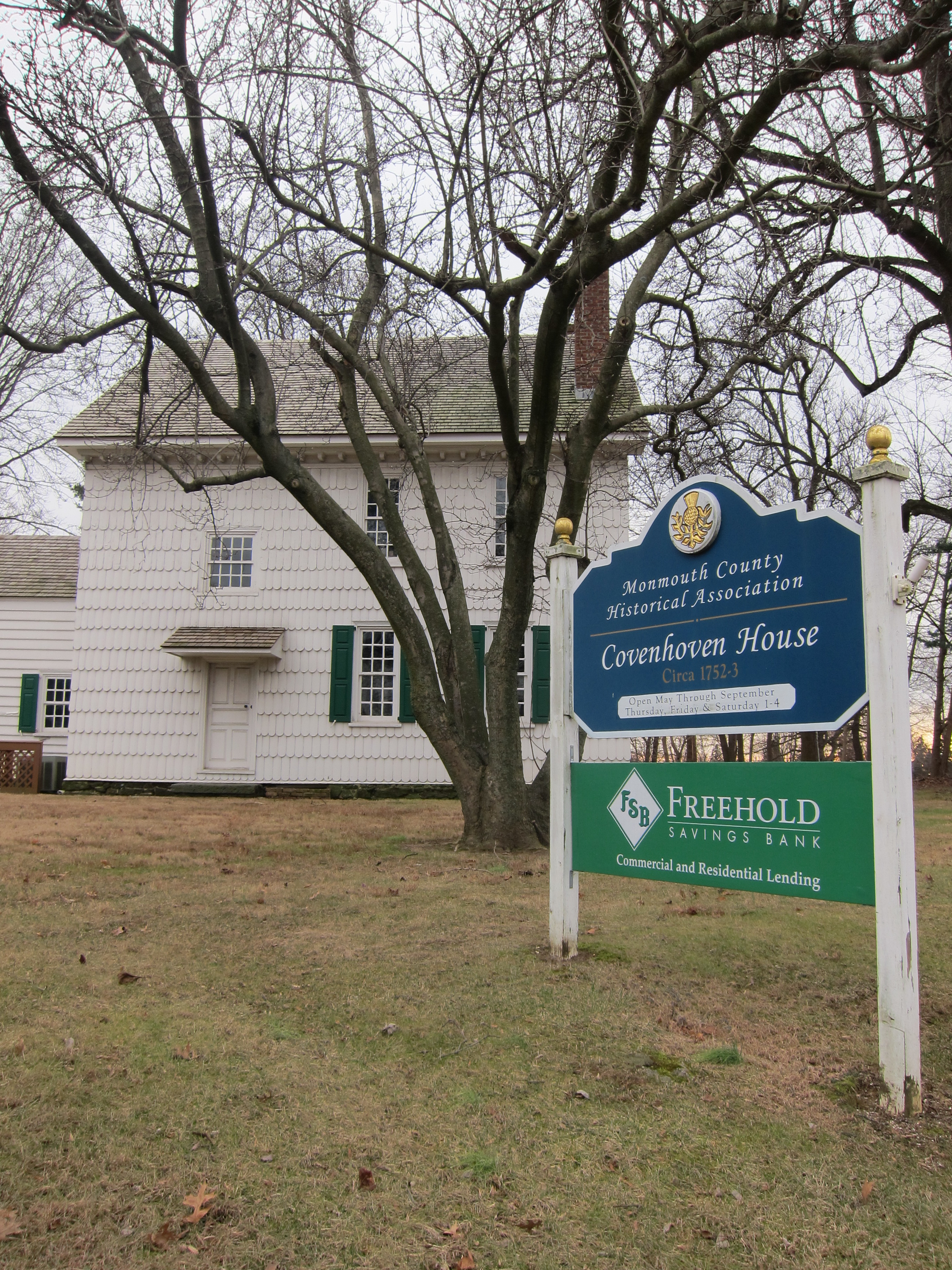
IMG_0136
The Elizabeth and William Covenhoven House, Freehold, NJ

For the next two days, her home became the nerve center of the British army then making its way across New Jersey, and the personal quarters of the General in Chief of His Majesty’s Forces in North America. On June 28, as General George Washington’s pursuing Continental Army caught up with Clinton’s rearguard, the battle of Monmouth commenced, further scarring the surrounding landscape. Everything had changed for those who lived in the tiny courthouse village. Some were spared the hard hand of war, but others, including Elizabeth, suffered greatly. A little over a month later, she delivered her deposition to the court reagrding her experiences during the British occupation of present-day Freehold:

Trenton, August 12, 1778

Be it remembered, that on the 30th day of July, Anno Domini 1778, personally appeared before me, Peter Schenck, one of the Justices of Peace for the County of Monmouth, Mrs. Elizabeth Covenhoven, who being duly sworn on the Holy Evangelists of Almighty God, deposeth and saith, That on the 26th of June last, when the enemy came into that county, General Sir Henry Clinton, with his suite, made his quarters at her house, and promised on his honour that every thing she had should be protected and nothing injured; That some time after they had been there, she saw a soldier driving her horses away, upon which she applied to them to perform their promises, and one of the General’s Aids said she should be paid for them; she answered she could not spare them; he then took down the marks, and declared they should be returned; but she heard no more of them. Some little time after she perceived all her cattle, including her milk cows, driving by in the same manner; she then made a like application and said, the must go without milk themselves if their cows were taken away; they then gave orders to have them stopped; but before they went off they killed and took every one of them, not leaving her a single hoof. This deponent further saith, That the General and his Aids finding her furniture chiefly sent away, were exceedingly urgent to have them sent for, declaring it likely they would be destroyed where they were concealed, but if they were in the house they should be safe; she told them she had no way to send for them; upon which they ordered a wagon and guard to go with the Negro wench to bring the goods, and they brought one wagon load home and placed a guard over it, and refused absolutely suffering her to have any thing out of it; That the next morning she found almost every thing of value was taken out of the wagon, and only a bible and some books, with a few trifles, left, which were scattered on the ground; she then applied to the General himself to have liberty to take these few things his Honour had left her—he ordered one of his Aids to go to the guards and suffer her to have them—she followed him, and he said, here you damned old rebel, with one foot in the grave, take them. This deponent also saith, That, though a very old woman, she was obliged to sleep on a cellar door in her milk room for two nights, and when she applied for only a coverlet it was refused her; That by the time they went away her house was stripped of her beds, bedding, the cloaths of her whole family, and every thing of any value. The farm was also left in the same situation; and that at a moderate computation, her loss amounted to 3000 £. And that she lost this in trusting to the personal honour of Sir Henry Clinton, which threw her off her guard, and made her perfectly easy, having solemnly engaged to protect or pay for every thing they used; and this deponent declares that the sum of 5£. 2s. which one of the officers gave her for 50 pounds of butter he had, was all the money or satisfaction she received for any thing she lost. And further saith not.[1]


For more information on the home of my great-great-great-great-great-great-great-grandparents, William and Elizabeth Covenhoven, please visit: https://www.monmouthhistory.org/covenhoven-house. The house is preserved by the Monmouth County Historical Association and is open to the public for tours and living history programs.

[1] “Deposition of Elizabeth Covenhoven, taken July 30, 1778 (thirty-two days after the Battle of Monmouth)” New Jersey Gazette Vol. 1, No. 36, August 12, 1778.

“Grateful Remembrance”: A Monument to General Montgomery

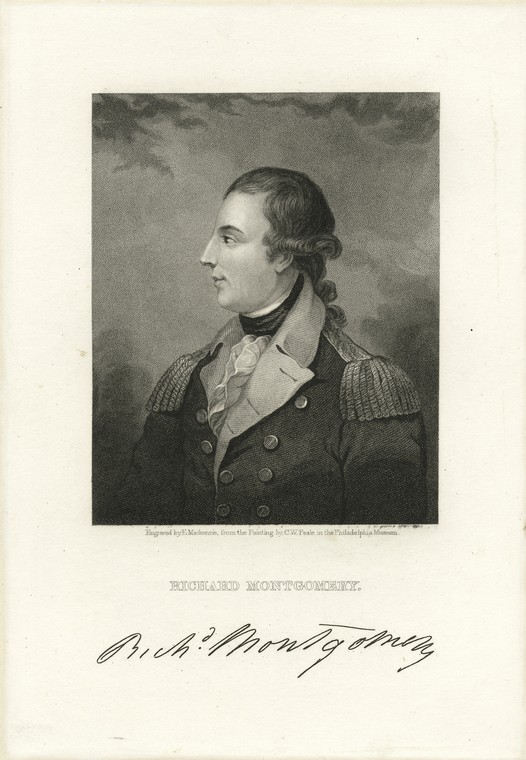
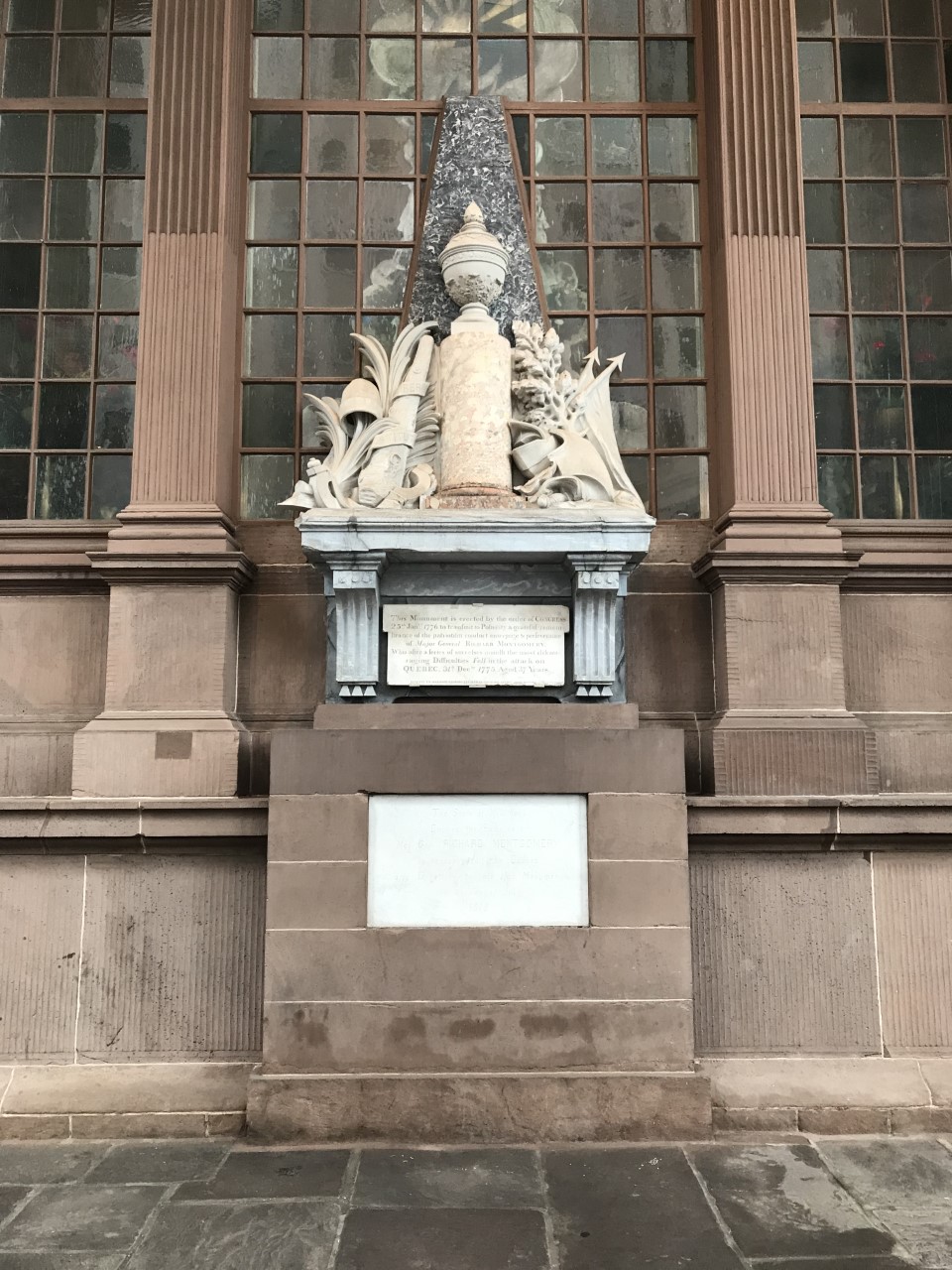
It was New Years’ Eve, 1775. An American army, divided into two wings, assaults the lower town outside the walls of British-held Quebec, Canada. Through a blinding snowstorm, Col. Benedict Arnold led 600 men along the northern edge of the city’s walls, while Gen. Richard Montgomery advanced to the southeast with roughly 300 Continentals. The attack was a disaster. Outnumbered nearly 2 to 1, the Americans were cut to pieces and close to 400 men, including Capt. Daniel Morgan, were taken prisoner. Arnold was wounded early in the offensive, his left leg (the same that would be shattered at Saratoga less than two years later) struck by an enemy ball. Montgomery, the commander of the expedition, was cut down at the head of his column by a blast of grapeshot at near point-blank range. With his heroic death, Montgomery would become one of the first high-profile martyrs of the American cause, and the Continental Congress would memorialize him by commissioning a monument in his honor less than a month later. This monument, now situated at the front of St. Paul’s Chapel along Broadway in New York City, was the first ever commissioned by the American government.

Richard_Montgomery
General Richard Montgomery (nypl)

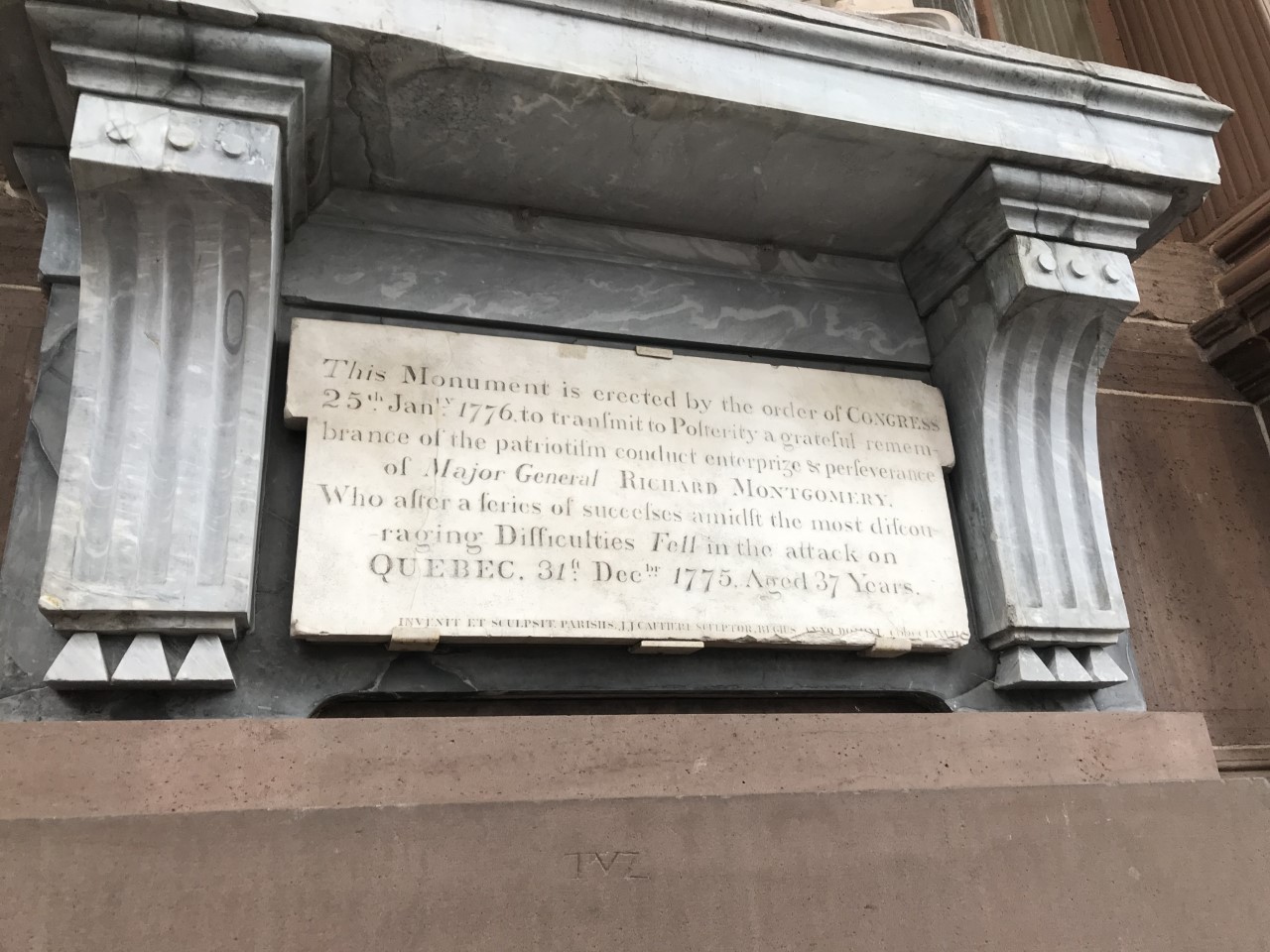
Following the news of his death, the public was quick to eulogize Montgomery through orations, sermons, songs, and poems. He became a symbol of American service and sacrifice in the great struggle for liberty. On January 25, 1776, the Continental Congress approved appropriations for a monument to be built in his memory to “transmit to Prosperity a grateful remembrance of the patriotism conduct enterprize & perseverance of Major General Richard Montgomery.” This monument would not be placed above the general’s grave as it is today—Montgomery’s body was still buried in Quebec. In fact, his remains would not be disinterred and transported to New York City until 1818.

Montgomery_Monument
Montgomery Monument and Tomb, St. Paul’s Chapel, New York City

The story of the Montgomery monument does not end yet. Jean-Jacques Caffieri, King Louis XVI’s personal sculptor, was commissioned by Benjamin Franklin in Paris on behalf of Congress to make the idea a reality. Upon its completion, the finished product was set to be shipped to Independence Hall in Philadelphia. Departing from the port in Le Havre, it journeyed to Edenton, North Carolina, where it was placed in storage. The war made its transfer to Philadelphia almost impossible, and the stone was seemingly lost and forgotten until after the conflict ended.

Montgomery_Monument_Inscription
Close-up of the Continental Congress’s Inscription

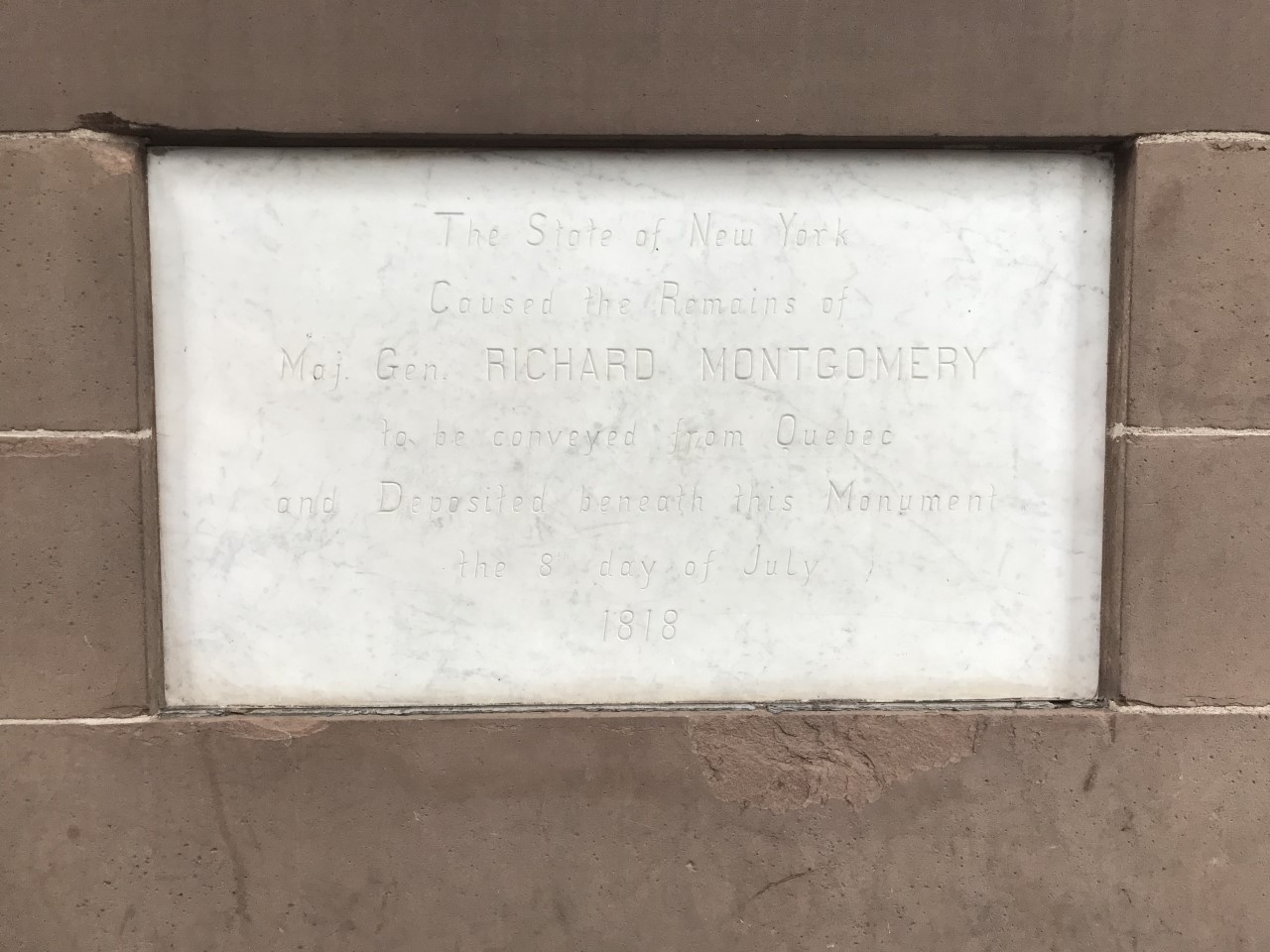
With peace came a renewed resolve to have one of the nation’s “first” heroes memorialized. Rediscovered, the Montgomery monument (after a long campaign of letter writing by both Franklin and the general’s wife, Janet) was installed in St. Paul’s Chapel in June 1788, over twelve years since it was first commissioned. Thirty years later, the New York State legislature approved to transport Montgomery’s remains to New York City and entomb them beneath the monument. On July 4, 1818, the general lay in state in the capital building in Albany, and four days later he was finally interred on American soil, his adopted home he had died in the service of.[1]

Montgomery_Tomb
1818 Tomb of General Montgomery Underneath the Monument

[1] More information on the Montgomery monument and its journey can be found at https://www.trinitywallstreet.org/blogs/archivists-mailbag/general-and-monument


Slaughter at Sabbath Day Point

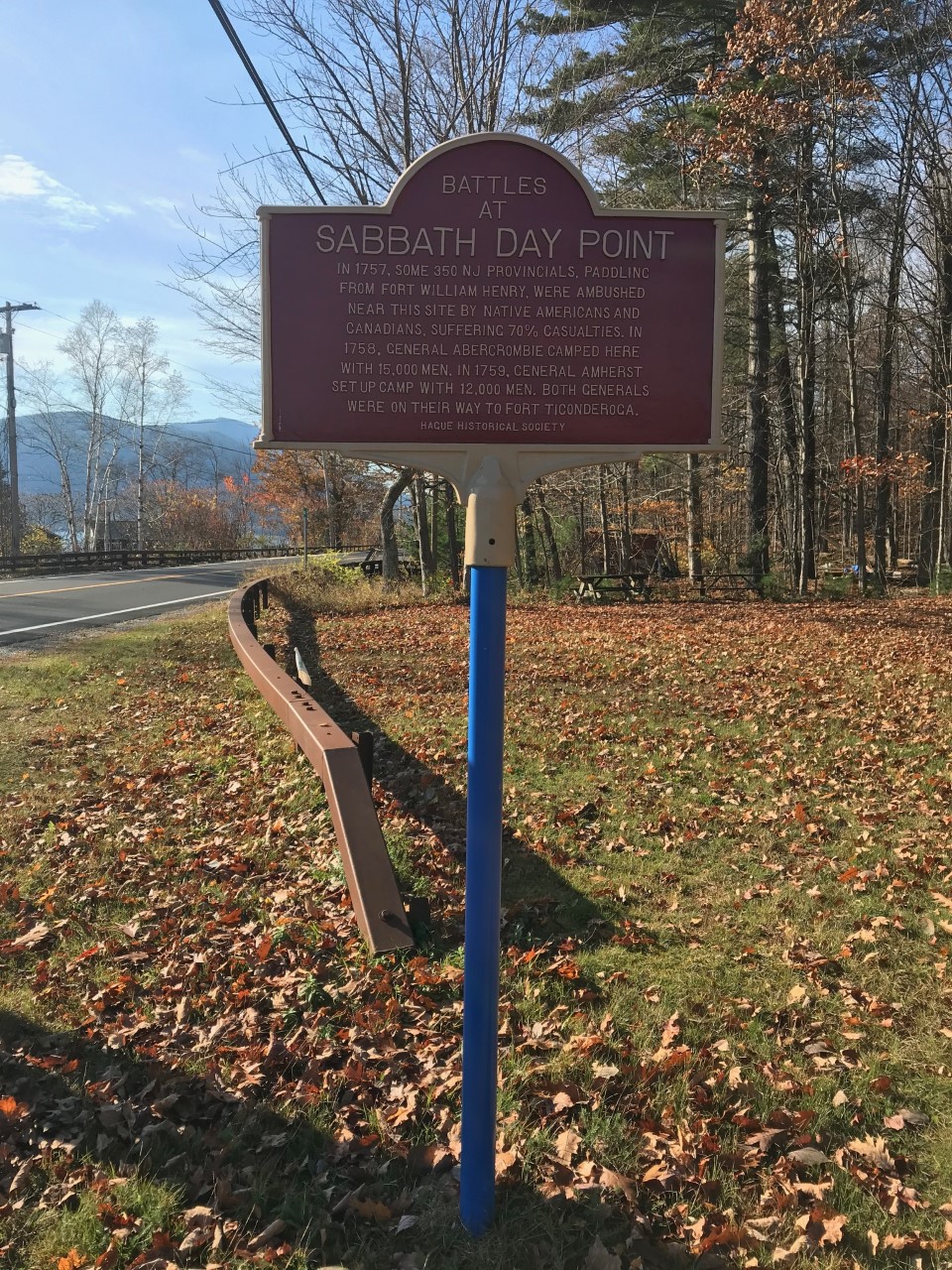
Last week during Emerging Revolutionary War’s annual getaway, we made our way north along the western shore of Lake George in New York’s Adirondack Mountains. Our destination was Fort Ticonderoga. The group made a quick stop at a new historical marker placed near Sabbath Day Point (about twenty miles or so north of the lake’s southern shore), which explained the military activity the site witnessed during the French and Indian War. The area was a strategic landing spot along the western shore of the lake and was constantly being utilized by the British and their French adversary. One tragic event in particular transpired here during late July 1757.

Sabbath_Day_Point_Marker
Hague Historical Society Marker at Sabbath Day Point

The summer of 1757 was an active month for British and French operations along the Lake Champlain-Lake George-Hudson River corridor—one of the most significant water highway systems in North America. The French and their Indian allies, under the command of the Marquis de Montcalm and situated at Fort Carillon (Ticonderoga) to the north of Lake George, were preparing to launch a campaign to besiege and destroy Fort William Henry along the southern shore. Patrols in this area were constant as both sides attempted to collect intelligence on enemy movements, numbers, and logistics.

At Fort William Henry, Lt. Col. George Monro of the 35th Regiment of Foot was in command of the British garrison of 2,500 regulars and provincials. Throughout July, word from prisoners and escapees from Canada continued to come in that Montcalm was amassing a force of 8,000 French regulars, Canadians, and Indians to march on his position. Desiring more intelligence, Monro ordered Col. John Parker of the 1st New Jersey Regiment (the “Jersey Blues”) to conduct a reconnaissance north towards Carillon with 350 men from his own unit and some from the 1st New York Regiment. The mission was simple on paper: gather intelligence on the enemy and cause as much damage to him as possible to hamper any advance.

On July 23, Parker and his detachment sailed north from Fort William Henry in twenty-two whaleboats. For many of the men, they would never step foot on land again. Waiting in ambush for them near Sabbath Day Point were hundreds of Canadians and Indians. The French were prepared to oppose any patrols along the northern end of the lake.

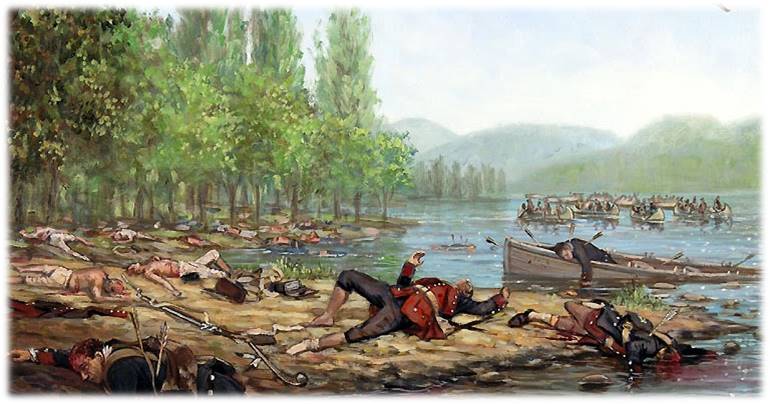
After spending the night on an island south of Sabbath Day Point, the British reconnaissance force continued onward during the morning of July 24. Sources are conflicting in regard to what happened next, but three of the boats, either separated from the group or ordered forward as an advanced party, were attacked by the Indians at the point. The boats were pulled up along the shore to serve as a decoy to lead Parker’s men closer to land. When the rest of the British column came rowing towards the ambush site, the entire shoreline was set ablaze with musket fire.

The New Jerseyans’ and New Yorkers’ fates were sealed as the French Indians began to push their canoes into the water and encircle the panic-stricken detachment, cutting off their escape. Many of the British were shot dead or pulled into the lake as their boats were overturned. “The Indians jumped into the water and speared them like fish…,” recorded Louis-Antoine de Bougainville, Montcalm’s aide-de-camp, “The English, terrified by the shooting, the sight, the cries, and agility of these monsters, surrendered almost without firing a shot.” The fighting, which was most likely over in a matter of minutes, left over 100 of Parker’s force dead. Another 150 were taken prisoner and brought to the French camps outside of Fort Carillon. Col. Parker and the men onboard four of the whaleboats managed to escape the terror and reported back to Monro the following day.

Jersey_Blues
“Massacre at Sabbath Day Point” by Mark Churms

For the prisoners, the horrors of that day continued when they reached Carillon, dragged onshore by ropes tied around their necks. Along with the captured Jerseymen, the French allied Indians had also taken another prize—the detachment’s rum supply. In the Ottawa camp outside the fort, the drunken Indians performed a cannibal ritual, cooking and eating three of the prisoners. Father Pierre Roubaud, a Jesuit missionary with the Abenaki at Carillon, watched in horror as the Ottawa indulged in “large spoonfuls of this detestable broth… The saddest thing was that they had placed near them about ten Englishmen, to be spectators of their infamous repast.” Roubaud attempted to stop the horrid supper, but a young Ottawa refused and told him, “You have French taste; I have Indian. This is good meat for me.” Eventually, the wretched act ceased, and preparations were made for the prisoners to be transported to Montreal where they would be ransomed back to the British.

Nine days after the action at Sabbath Day Point, Father Roubaud returned to the site of the ambush as Montcalm’s army marched and rowed along the western shore on its way to capture Fort William Henry.  Seeing the dead of Parker’s command strewn about the trees and shoreline, the priest recalled, “Some were cut into pieces, and nearly all were mutilated in the most frightful manner.” This was the true nature of warfare in North America during the French and Indian War, and a tragic chapter in New Jersey’s colonial history.


“A Very Handsom Retreet”: Lt. Colonel Nathan Whiting and the Fighting Retreat that Decided the Battle of Lake George

This is a post from September 2016. It focuses on a critical military action that occurred during the Battle of Lake George, 264 years ago, today:

When analyzing the key actions of a military engagement in order to pinpoint a decisive moment or turning point, one does not usually come across a retreat and/or rout that actually attributed to the success of an army. However, during the late morning of September 8, 1755, roughly three miles south of Lake George in New York’s Adirondack Mountains, a contingent of men from Connecticut and Massachusetts, and their Mohawk allies conducted quite possibly the first ever organized fighting retreat in American military history – one that would turn the tide of battle and save their army from potential destruction. It is easy for a maneuver like this to be overlooked, but without the crucial time bought for William Johnson’s provincial army at its encampment along the southern shore of the lake by Lt. Colonel Nathan Whiting’s courageous New Englanders, Baron de Dieskau’s French army may well have emerged victorious during the Battle of Lake George and subsequently pushed their way to Albany’s doorstep.

Around eight o’clock in the morning, September 8, 1755, a column of men 1,200 strong was marched out of William Johnson’s camp at the southern end of Lake George. The column’s destination was Fort Lyman, roughly fourteen miles to the south located beside the Hudson River (present-day Fort Edward, NY). There, intelligence gathered by Johnson’s army had placed the 1,500 strong French force led by Jean-Armand, Baron de Dieskau, which was believed to be preparing an assault against the 500 man garrison of New Hampshire and New York provincials.

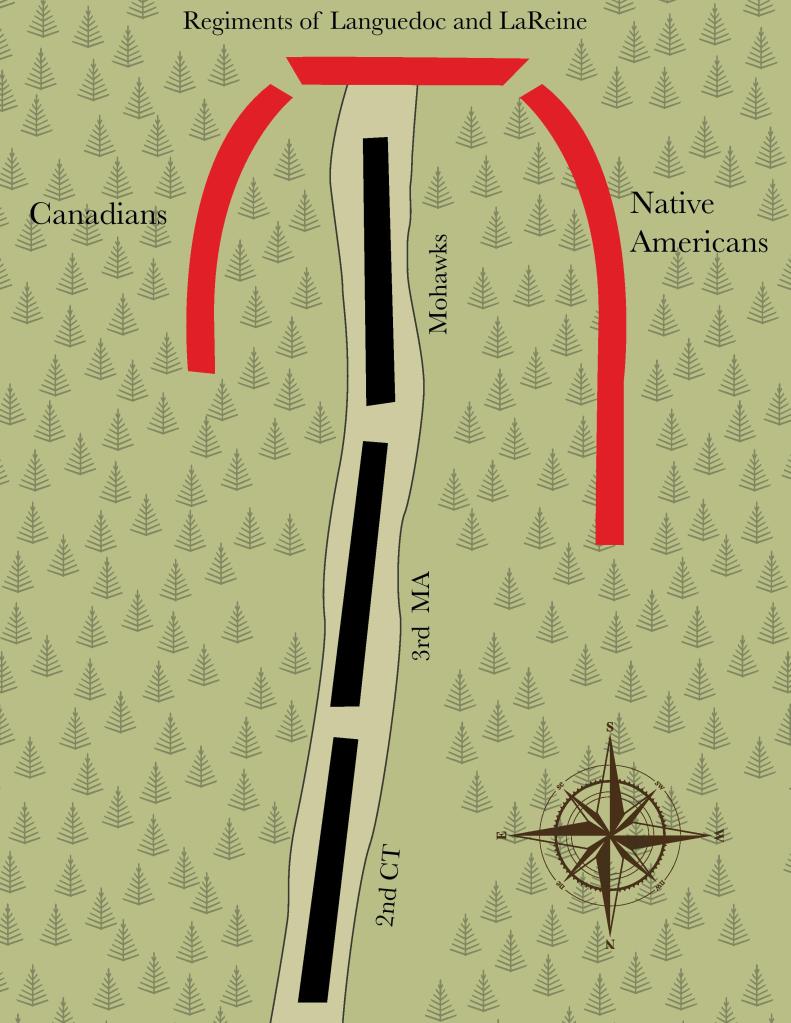
The contingent of reinforcements dispatched from the English camp was under the overall command of Colonel Ephraim Williams, 3rd Massachusetts Provincial Regiment, and was comprised of his own regiment, 200 Mohawk Indians, and another 500 men of the 2nd Connecticut Provincial Regiment led by Lt. Colonel Nathan Whiting. The column marched south down the military road with the Mohawk at its head, followed by the Massachusetts men, and Whiting’s regiment taking up the rear.

Nathan Whiting, born in 1724 and a resident of Windham, was 31-years-old in 1755 and one of William Johnson’s youngest field officers. He was a graduate of Yale and a veteran of the Louisbourg expedition during King George’s War – service which earned him a lieutenant’s commission in His Majesty’s Forces. When hostilities between England and France erupted in 1754 he was commissioned as the 2nd Connecticut Provincial Regiment’s lieutenant colonel and was sent to Albany to serve as part of the Crown Point Expedition, an offensive designed to oust the French from the Lake Champlain-Lake George-Hudson River corridor. The regiment’s colonel, Elizur Goodrich, was ill and bedridden during the Battle of Lake George, so Whiting served as the unit’s field commander during his absence. Whiting was a loyal officer and earnestly dedicated to the cause in which he was fighting for. Before reaching the southern shore of the lake on August 28, he penned a heartfelt letter to his wife that epitomized his character: “… [P]ray make your Self as easy as possible[.] I know your D[aily] prayers are for my preservation[.] Let it be an article of them that it not be obtained by any unworthy means, but in the prosecution of the Duty I owe at this time to my Self, my Country & my God.”[1]

About two hours or so and three miles into the march to Fort Lyman, the forward ranks of Ephraim Williams’s column of reinforcements were ambushed by Dieskau’s native allies, Canadian militia, and regular grenadiers of the Regiments of Languedoc and La Reine. The French outside of Fort Lyman had earlier uncovered dispatches from a dead courier that was sent to inform the English outpost that reinforcements were going to be sent from the lake encampment to assist it in case of an attack. Using this intelligence, Dieskau marched his army up the military road towards Lake George and prepared an ambush to surprise the oncoming party of reinforcements. Although the ambuscade was initiated prematurely before the entire column could march into Dieskau’s hook-like formation, it still succeeded in throwing the English force into confusion and sent it scurrying back up the road to Lake George. Both Ephraim Williams and Chief Hendrick (commanding the Mohawk contingent) were killed during the confrontation and all order was lost, leaving Whiting, who was now the highest ranking officer on the field, to try to prevent a disaster.

008
The Bloody Morning Scout, 10:00 a.m. Map by Nicholas Chavez.

Continue reading ““A Very Handsom Retreet”: Lt. Colonel Nathan Whiting and the Fighting Retreat that Decided the Battle of Lake George”

“Shaking Leaves” and a “Damned Poltroon”?: Charles Lee, George Washington, and the 241st Anniversary of the Battle of Monmouth Court House

Two-hundred and forty one years ago, today, one of the most famous, yet controversial, exchanges between two commanding generals on a battlefield occurred in a field west of Monmouth Court House (present-day Freehold), New Jersey.

George Washington had arrived in Englishtown roughly an hour and a half ahead of the Continental Army’s main body and sat down for breakfast sometime around ten in the morning, June 28, 1778. Six miles away, Major General Charles Lee’s vanguard of roughly 5000 men was just about to throw itself at the British rearguard north of Monmouth Court House.

Charles Lee
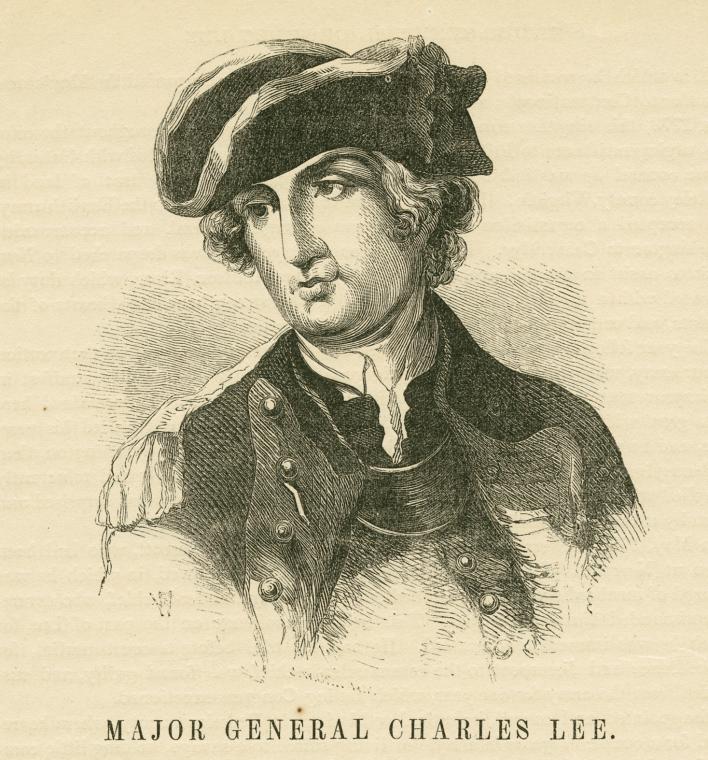
Maj. Gen. Charles Lee. NYPL.

When those elements came into contact, what resulted was anything but a general engagement. Within an hour Lee’s men were retreating west with newly arrived British troops committed by Lieutenant General Henry Clinton right on their heels. Disaster loomed for the Americans as a result of miscommunication, misunderstanding, and poor generalship on the part of Lee’s subordinates. The American vanguard’s commander had specific orders from Washington to fall upon Clinton’s rear as it marched out of Monmouth, and now Lee was desperately attempting to stave off defeat. Continue reading ““Shaking Leaves” and a “Damned Poltroon”?: Charles Lee, George Washington, and the 241st Anniversary of the Battle of Monmouth Court House”

An Interesting “What If?” Question: Benedict Arnold and the Monmouth Campaign

So recently I have been working on a Monmouth Court House project. Last night an alternate scenario popped into my head. I wanted to ask you, the readers, your opinion. During the spring of 1778, what if Charles Lee, recently exchanged from a year and a half imprisonment, had been appointed as military governor of Philadelphia instead of Benedict Arnold? What if Arnold had then been ordered to join Washington’s army? He obviously would have never gotten the chance to fall in love with Peggy Shippen (we know what happened next), but his widely known aggressiveness and leadership capabilities also could have played a significant role in the upcoming Monmouth Campaign. What do you think may have happened? Would Arnold have influenced Washington’s decision making? Could he have potentially commanded the Continental Army’s vanguard that opened the fighting at Monmouth like Lee did? How would he have behaved if he once again commanded American troops in the field? This is all counterfactual history, of course, but just something to have fun with and think about.