

After returning from the War of American Independence, George Washington turned to his pre-war focus on the west, the vast lands beyond the Appalachians that had launched his public career as young Virginia militia officer and messenger for Lieutenant Governor Robert Dinwiddie in 1753. In 1784, he ventured to southwestern Pennsylvania and held a meeting with prominent locals. The question he put before them was finding the best way to connect the Potomac River with the Ohio River. It was rough country and the task would never be easy, but opening a reliable and robust route between the two would open Virginia’s access to the Ohio Valley more easily than the narrow passes and valleys that led to the Kanawha River or along the spine of the Appalachians to the Cumberland Gap through Kentucky. Washington’s interests were, of course, personal. He had invested heavily in the Ohio Country and stood to make, protect, or lose a personal fortune.
But, Washington’s interests were also public. He had long viewed the west as critical to the future of Virginia, and now the new United States. With the war over and independence secured, it had only become more so. Washington had personally experienced the sectional and regional differences that threatened to tear the country apart. As people flooded into the new territories won in the war, the east-west divisions had grown worse. Everything produced in one section and consumed in another had to be hauled across the Appalachians, a time-consuming, back-breaking effort that couldn’t happen fast enough for agricultural products. By connecting the rivers, Washington hoped to bind east and west together, strengthening the economic, social, and political bonds that were critical to building the new country.
The father of his country wasn’t alone in that thought. The Swiss-born Albert Gallatin, who opted to make his home in the west, shared it. Rising through a series of political offices, from state representative, to Federal representative, to Pennsylvania Senator, to Secretary of the Treasury for both the Jefferson and Madison Administrations, Gallatin picked up the baton as Washington passed from the scene. Although they had radically different politics and ideas of national interest, Gallatin focused on establishing a national road at the federal expense by setting aside a portion of proceeds from land sales in the west. After much political maneuvering, Gallatin and the westerners got a law for their road enacted in 1806. The resulting work would become the National Road, America’s first federal interstate highway. A decade later, as work progressed, Gallatin moved from the Treasury Department and national finance to the work of a diplomat with postings as the ambassador to France and then the United Kingdom.
While Gallatin shifted his focus to foreign affairs, Henry Clay of Kentucky picked up the baton of tying the country together and using roads to build figurative, and literal, bridges among America’s different groups. Clay served in the U.S. Senate early in his career, but it may have been his position as Representative from Kentucky and Speaker of the House that he learned the art of compromise and established his reputation as someone with the skills to bring warring factions together, at least sufficiently enough to keep the country growing and getting stronger. The National Road became his project.
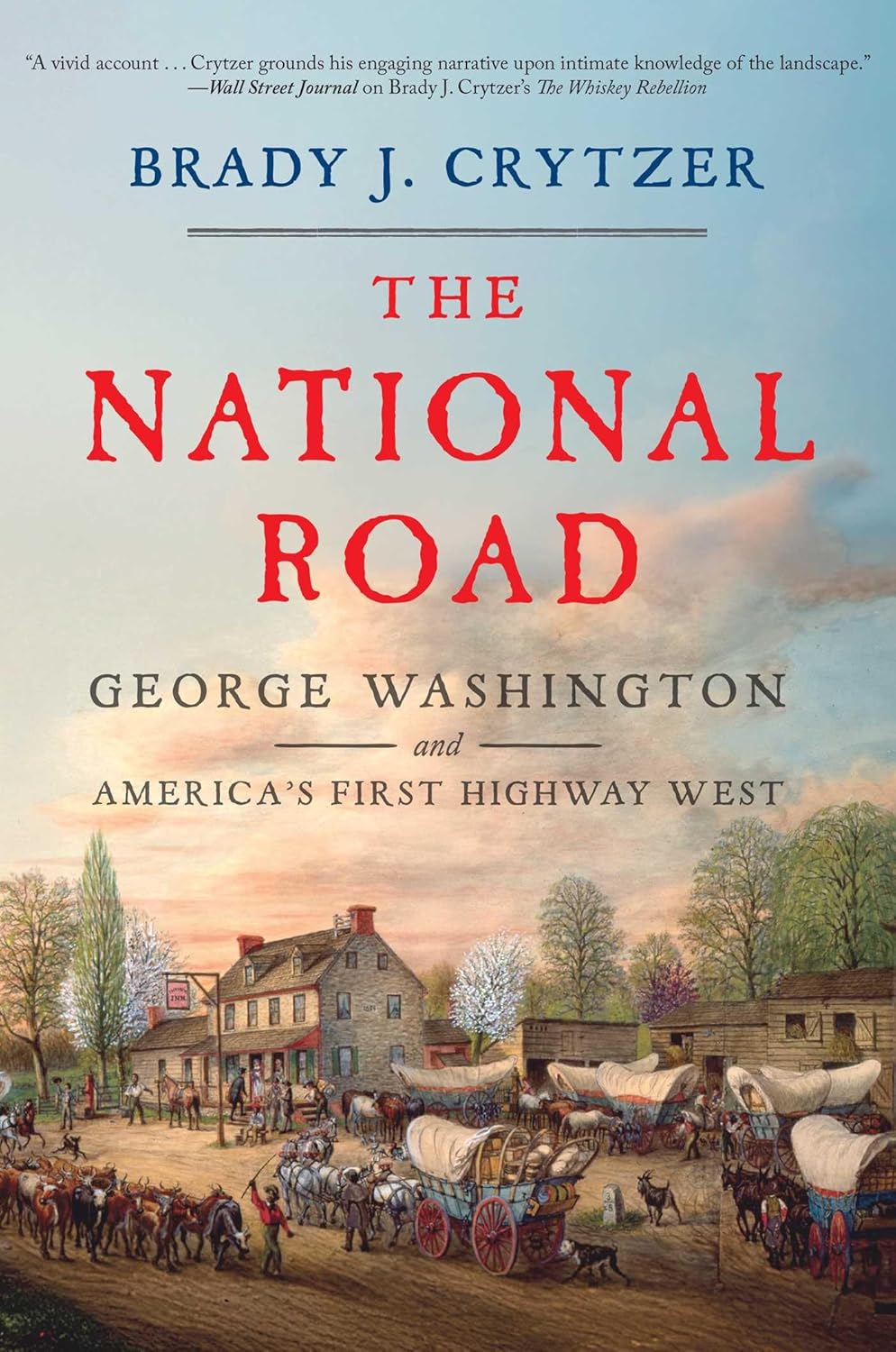
Award-winning historian Brady J. Crytzer takes up this broader tale of building a new country as it moved westward in his latest book: The National Road: George Washington and America’s First Highway West. Ostensibly, it’s about building the road and tackles the nitty-gritty job of exploring a route, surveying, cutting, hauling, pounding, and managing the construction of a road in the 19th century. Along the way, the technology changes, the money runs out, the road needs repairing, and competition crops up from canals and railroads. The road ran from Cumberland, MD to Vandalia, Il, but by the time it reached its western portions, the hard road painstakingly built through Maryland, Pennsylvania, Virginia and Ohio had become a slapdash affair of dirt, mud, ruts, and washouts. Eventually, time passed the road by and it fell into perpetual disrepair, useful more for local traffic than knitting states together.
Ultimately, though, The National Road is really about the people, from world historical figures like George Washington and national leaders like Gallatin and Clay to everyday drovers, bridge builders, settlers, and legendary Black teamsters like Sam Nimmey. The panoply of people that define a nation are all here. (Civil War buffs will even be pleased to find an appearance by Charles Ellet Jr., a civil engineer and bridge builder who went on to construct rams for United States Navy.) Building the road becomes a narrative structure for telling a larger story of the United States as it moved west from the time of the founding fathers through the time of governing compromises and pending Civil War. Solidly grounded in history, Crytzer clearly writes with an eye on the reader’s experience. With The National Road, Crytzer has given the public another excellent work of early American history and a wonderful peek into the complexities of doing big things. He ensures we understand it’s not just a road, it’s the story of diverse people coming together for a common purpose.

