The Jefferson Bible

Emerging Revolutionary War welcomes back guest historian Michael Aubrecht.

Thomas Jefferson rejected the “divinity” of Jesus, but he believed that Christ was a deeply interesting and profoundly important moral or ethical teacher. He also subscribed to the belief that it was in Christ’s moral and ethical teachings that a civilized society should be conducted. Cynical of the miracle accounts in the New Testament, Jefferson was convinced that the authentic words of Jesus had been contaminated.

His theory was that the earliest Christians, eager to make their religion appealing to the pagans, had obscured the words of Jesus with the philosophy of the ancient Greeks and the teachings of Plato. These so-called Platonists had thoroughly muddled Jesus’s original message. Firmly believing that reason could be added in place of what he considered to be “supernatural” embellishments, Jefferson worked tirelessly to compose a shortened version of the Gospels titled The Philosophy of Jesus of Nazareth. The subtitle stated that the work was “extracted from the account of his life and the doctrines as given by Matthew, Mark, Luke and John.”

 In 1820, Jefferson returned to his controversial New Testament research. This time, he completed a much more ambitious work titled The Life and Morals of Jesus of Nazareth Extracted Textually from the Gospels in Greek, Latin, French and English. The text of the New Testament appears in four parallel columns in four languages. Jefferson omitted the words he thought were inauthentic and retained those he believed were original. The resulting work is commonly known as the Jefferson Bible.

Using a razor and gum, Jefferson committed blasphemy. He cut and pasted his arrangement of selected verses from a 1794 bilingual Latin/Greek Bible using the text of the Plantin Polyglot, a French Geneva Bible and the King James Version. He selected excerpts from the gospels of Matthew, Mark, Luke and John in chronological order and combined the narrative with those of another to create a single chronicle.

No supernatural acts of Christ are included, as Jefferson viewed Jesus as strictly human. He also believed that Jesus himself recognized a more deistic belief system. In a letter to Benjamin Rush, Jefferson wrote, “I should proceed to a view of the life, character, and doctrines of Jesus, who sensible of incorrectness of their ideas of the Deity, and of morality, endeavored to bring them to the principles of a pure deism.” Jefferson also completely denied the resurrection. The book ends with the words: “Now, in the place where He was crucified, there was a garden; and in the garden a new sepulchre, wherein was never man yet laid. There laid they Jesus. And rolled a great stone to the door of the sepulchre, and departed.”

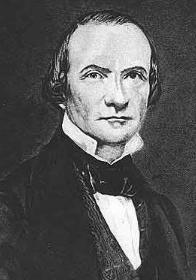
Jefferson engraving from 1867. Library of Congress.

Jefferson described the work in a letter to John Adams, dated October 12, 1813:

In extracting the pure principles which he taught, we should have to strip off the artificial vestments in which they have been muffled by priests, who have travestied them into various forms, as instruments of riches and power to them.…We must reduce our volume to the simple evangelists, select, even from them, the very words only of Jesus, paring off the Amphibologisms into which they have been led, by forgetting often, or not understanding, what had fallen from him, by giving their own misconceptions as his dicta, and expressing unintelligibly for others what they had not understood themselves. There will be found remaining the most sublime and benevolent code of morals which has ever been offered to man. I have performed this operation for my own use, by cutting verse by verse out of the printed book, and arranging the matter which is evidently his, and which is as easily distinguishable as diamonds in a dunghill. The result is an 8vo of 46 pages of pure and unsophisticated doctrines.

In a letter to Reverend Charles Clay, Jefferson described his results: “Probably you have heard me say I had taken the four Evangelists, had cut out from them every text they had recorded of the moral precepts of Jesus, and arranged them in a certain order; and although they appeared but as fragments, yet fragments of the most sublime edifice of morality which had ever been exhibited to man.” Most historians feel that Jefferson composed the book for his own satisfaction, supporting the Christian faith as he saw it. He did not produce it to shock or offend the religious community; he composed it for himself, for his devotion and for his own personal assurance.

After completion of the Life and Morals, Jefferson shared it with a number of friends, but he never allowed it to be published during his lifetime. The most complete form Jefferson produced was inherited by his grandson Thomas Jefferson Randolph.

The Life and Morals of Jesus of Nazareth.Monticello.org.

Revolutionary Era Connection in Orlando, Florida?

When one mentions the word “Orlando” what is the first thought to pop into your head?

Universal?

Or maybe two words; “Disney World or Walt Disney?”

In all likelihood, the name Francis Wayles Eppes, is not one of the people you would associate central Florida with. You may even be asking, who is Francis Wayles Eppes.

Eppes
Francis Wayles Eppes

Born on September 20, 1801, Francis was the only surviving child of Thomas Jefferson’s daughter Maria and her husband, John Wayles Eppes. When his mother died in 1804, his grandfather, the third president of the United States at the time, took young Francis under his care and the child resided at Monticello, Jefferson’s Virginia estate.

As young Francis grew, he spent time at Poplar Forest, Jefferson’s estate near Lynchburg, Virginia, which was bequeathed to him by his grandfather after the grandson married Mary Elizabeth Randolph in 1822. Francis, prior to marriage, studied law at both Georgetown College and South Carolina College.

With the death of his father and grandfather within three years of each other; 1823 and 1826 respectively, Francis and his wife joined the movement south, leaving Virginia for sunny Florida.

Initially settling outside Tallahassee and was instrumental in the formation of one of the first Episcopalian churches in the Florida territory, when he donated $500 to a construction of St. John’s Episcopal Church. He was a vestrymen, delegate to the Episcopalian convention in Florida, and also secretary of the local diocese for many years.

After a long public service record in Tallahassee, including serving as intendant or mayor of the capital for a few terms and being an early proponent of a school of higher learning–Jefferson-esque–which became the precursor to Florida State University, Eppes relocated to central Florida in 1869.

Even in his 60’s, Eppes stayed active, becoming a citrus farmer and was part of the group that founded the Cathedral Church of St. Luke in Orlando, the first Episcopal church in the growing town.

IMG_1446
Eppes’s home in Orlando. Plaque on front porch reads; “Site and home of Francis Eppes Grandson of President Thomas Jefferson Original House Built in 1868 Marker Placed by Orlando Chapter NSDAR December 3, 1998”

A historian, writing about Eppes’s contributions of that era summarized the Virginian in the following words; “Through the 40’s, 50’s, and 60’s [1800s] there were few civic, religious, or educational affairs in which he did not have a prominent  part.”

On May 30, 1881, Francis Wayles Eppes passed away at his home and would be buried in Greenwood Cemetery. He was 79 years old.

Independence and Contradiction: Our Founding Slaveholders

Emerging Revolutionary War welcomes guest historian Michael Aubrecht. A biography of Mr. Aubrecht is attached below. 

In 2011 an exhibit titled “Slavery at Jefferson’s Monticello: Paradox of Liberty” started running at the Smithsonian’s American History Museum from January 27, 2012 – October 14, 2012. This somewhat controversial exhibition explored slavery and enslaved people in America through the lens of Jefferson’s plantation and was a collaborative effort between the Thomas Jefferson Foundation at Monticello and the African American History and Culture Museum in Washington DC. It helped to instigate public discussion about the dichotomy between the Founders and freedom. The paradox of course is that Thomas Jefferson drafted the Declaration of Independence and called slavery an “abominable crime,” yet he was a lifelong slaveholder. The exhibition provides a glimpse into the lives of 6 slave families living at Monticello and reveals how the paradox of slavery in Jefferson’s world is relevant for generations beyond Jefferson’s lifetime.

founders-presidents-slaveowners
Founders, presidents, slave-owners

Continue reading “Independence and Contradiction: Our Founding Slaveholders”

Jefferson: Self-governance and “the field of knowledge”

RevWarWednesdays-header

tjmonticellostatueThe final part in a four-part series

“The field of knowledge,” said Thomas Jefferson, “is the common prosperity of all mankind.”

Jefferson’s words are inscribed in big bold letters in the entryway of Monticello’s visitor center. They’re written in architectural perpetuity in Jefferson’s “academical village,” the University of Virginia. They’re enshrined in the very concept of democracy.

“Whenever the people are well-informed, they can be trusted with their own government,” Jefferson said. Knowledge enables self-determination. Continue reading “Jefferson: Self-governance and “the field of knowledge””

Mr. Jefferson’s library: “a necessity of life”

RevWarWednesdays-header

Part three in a four-part series

tjstudy“I cannot live without books,” Thomas Jefferson wrote to John Adams in June of 1815. The former president had just packed his personal library—some 6,700 volumes—into a wagon train and shipped it north to the nation’s capital. He’d sold the collection to Congress for $23,950 to replace the collection burned by the British during the War of 1812.

His collection was, Jefferson rightly believed, “the choicest collection of books in the United States.”

And now he was left virtually bookless. Continue reading “Mr. Jefferson’s library: “a necessity of life””

Jefferson: The Man Who Moved Mountains

RevWarWednesdays-header

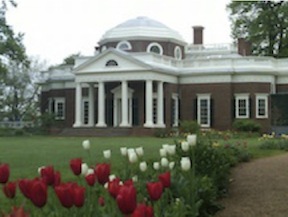
Montecello TulipsThe second in a four-part series

He leveled the top of the mountain with gunpowder.

He began the project in 1768, when he was twenty-five. He had his slaves literally sheer off the tip of the mountaintop, peeling away soil rich in iron and clay, revealing bedrock of a local variety known as Catoctin greenstone.

On the flattened plane, he built his dream home. Over the next fifty-eight years, Thomas Jefferson would significantly remodel the house twice more as his personal tastes evolved. The house has a splash of Cavalier Virginia to it, but it also has touches of the classical and the continental.

Jefferson called it “my essay in architecture.” He named his “essay” Monticello. Continue reading “Jefferson: The Man Who Moved Mountains”