On August 2, 1775, the Second Continental Congress wrapped up its summer session 250 years ago. Philadelphia’s heatwave that summer—described as “Very Close & Hot”—was too much for the delegates. “We have sat much longer than expected,” one Congressman grumbled. “We are all exhausted.”
The Congress had been working tirelessly since its session began on May 10, 1775. In just 12 weeks, the body accomplished an impressive list of tasks, many of which escalated the growing tension with Great Britain:
Declared a state of military readiness across the colonies
Appealed to Canadians for support in the Revolution
Raised companies of riflemen in Pennsylvania, Maryland, and Virginia to reinforce the Boston Army
Elected George Washington as Commander-in-Chief
Appointed four major generals and eight brigadier generals
Adopted the Olive Branch Petition in a final effort for peace
Released the “Declaration of the Causes and Necessities of Taking Up Arms”
Rejected Lord North’s Plan for Reconciliation
Established a postal department
Appointed commissioners to negotiate peace with Indian tribes
Rather than resting from the sessions of the last 12 weeks, many members of the Second Continental Congress continued to work tirelessly to support the colonies’ efforts against Great Britain. Many returned home to ensure these measures were implemented at the local level. But there was still uncertainty about how King George III would respond to the Olive Branch Petition. Would the King accept the offer of peace? Only time would tell.
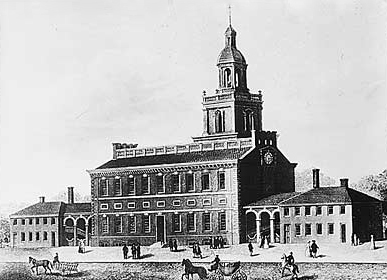
Pennsylvania State House, ca. 1770. Courtesy of the National Park Service
On May 10, 1775, the delegates convened their Second Continental Congress in Philadelphia. Unlike the First Continental Congress held a year before, this Congress had more delegates and met in the Pennsylvania State House and not Carpenters Hall. Also, events spiraled out of control since 1774, and the northern colonies were in outright rebellion with the battles of Lexington and Concord and the capture of Fort Ticonderoga. The delegates dived into several heavy topics as now blood was shed and an army of several thousand besieged the British in Boston.
Just before the Congress met John Adams wrote “our prospect of a Union of the Colonies, is promising indeed. Never was there such a Sprit.” It is evident that there were many discussions in the taverns around Philadelphia among the delegates that showed the feelings of many had changed since 1774. Though there were still a large portion of the colonies that were not ready to give up reconciliation with Great Britain. This tug in pull between men like John Adams and men like John Dickenson (more on the side of reconciliation) is shown in two documents passed by the Congress in early July. The “Olive Branch Petition” and the “Declaration of the Causes and Necessity of Taking Up Arms” reflect the mixed views of the Congress and the colonies as a whole of —conciliation and confrontation. Together, they illustrate the ideological crossroads at which the colonies stood, torn between loyalty to the British Crown and the growing necessity of armed resistance.
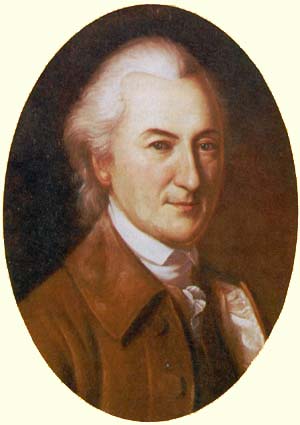
The “Olive Branch Petition”, drafted primarily by John Dickinson of Pennsylvania and approved by the Continental Congress on July 5, 1775, was a final attempt by the colonies to avoid a full-scale war with Great Britain. Despite the ongoing military engagements at Lexington, Concord, and Bunker Hill, many colonial leaders still hoped for a peaceful resolution to the growing conflict. The petition expressed loyalty to King George III and implored him to intervene in the escalating tensions caused by his ministers and Parliament.
John Dickinson was the leader of the moderates of the Second Continental Congress. Dickinson has the distinction of serving in the Congress as a representative from Pennsylvania and then Deleware. Courtesy of the National Park Service.
The document was rooted in the belief that reconciliation was still possible. It portrayed the colonies as loyal subjects who had been forced into resistance by the oppressive acts of the British government. The petition requested the King to repeal the Coercive Acts and halt hostilities, suggesting that harmony could be restored without further bloodshed.
Key to understanding the “Olive Branch Petition” is the deep-seated colonial belief in the distinction between the King and Parliament. Many colonists viewed Parliament as the source of tyranny but retained faith in the monarch as a potential protector. This petition, therefore, was not revolutionary but reformist. It sought to open a dialogue rather than sever ties.
However, the petition was rejected outright by King George III, who had already declared the colonies in open rebellion in August 1775 (before the Olve Branch petition arrived in London). He refused to read the document and issued the Proclamation of Rebellion, affirming Britain’s intent to suppress the colonial uprising by force. Many believed that the blood shed at Bunker Hill (226 killed and 828 wounded) combined with the fighting on April 19th backed the King into a corner. How could he accept peace when British soldiers were killed by rebels, especially since by the time he received the petition all the colonies were under arms against him. The rejection marked a turning point: it signaled the end of any realistic hopes for a peaceful compromise and pushed more colonists toward the idea of independence.
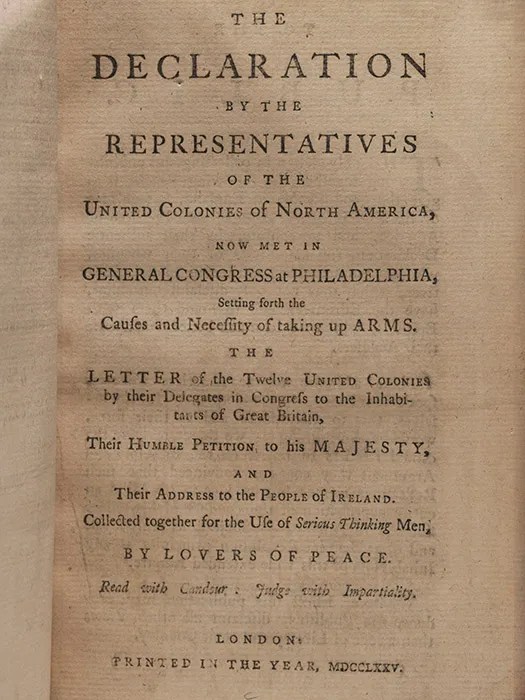
In stark contrast, the “Declaration of the Causes and Necessity of Taking Up Arms”, approved on July 6, 1775, just one day after the “Olive Branch Petition”, presented a much more assertive stance. Drafted by a committee including Thomas Jefferson and John Dickinson, the document aimed to justify the colonies’ decision to resist British authority through armed force.
The Declaration opened with a powerful assertion of the colonists’ natural rights and their entitlement to resist tyranny. It traced the history of British oppression, citing the Intolerable Acts, the imposition of taxes without consent, the quartering of troops, and the use of military force to suppress civil liberties. Unlike the Olive Branch Petition, which appealed to the King’s mercy, this document framed the conflict as a necessary defense of liberty and justice.
Although it still professed allegiance to the Crown, the Declaration was far more militant in tone. It acknowledged the seriousness of taking up arms but asserted that the colonies had been left with no other choice. It stated:
“Our cause is just. Our union is perfect. Our internal resources are great, and, if necessary, foreign assistance is undoubtedly attainable.”
This language revealed a shift in colonial thinking—from grievances to justification, from negotiation to resistance. The document was an attempt to rally public support and unify the colonies behind a common cause, portraying the struggle not as a rebellion but as a righteous defense against despotism.
Courtesy of Special Collections, University of Delaware Library
The coexistence of these two documents reflects the political complexity and emotional turmoil of the time. The Continental Congress, representing a wide spectrum of colonial opinion, tried to navigate between diplomacy and defiance. The “Olive Branch Petition” sought to appeal to moderates and loyalists who feared war, while the Declaration of the Causes aimed to galvanize patriots and articulate a coherent justification for resistance.
This dual approach was not merely political hedging but a reflection of genuine uncertainty. Many colonists still considered themselves British and hoped to remain within the empire, albeit under reformed governance. At the same time, the continued military aggression from Britain made armed resistance increasingly inevitable.
Ultimately, the failure of the “Olive Branch Petition” and the intensification of British military efforts helped consolidate revolutionary sentiment. The rejection by King George III confirmed to many that reconciliation was no longer possible. Over the following months, radical voices like Thomas Paine’s in Common Sense would build upon the groundwork laid by the “Declaration of the Causes” and push for full independence, culminating in the Declaration of Independence in July 1776.
The “Olive Branch Petition” and the “Declaration of the Causes and Necessity of Taking Up Arms” encapsulate the American colonies’ transition from loyal subjects to revolutionaries. They demonstrate how, in the face of unyielding imperial power, a people once desperate to avoid conflict found themselves compelled to fight. These documents not only reflect the diplomatic and ideological struggles of the Revolutionary era but also serve as enduring symbols of the tension between peace and justice in times of crisis.
The city of Boston, Massachusetts is steeped in American Revolutionary War history. The city has designed an entire trail–the “Freedom Trail”–a footpath that leads interested visitors around the city to the areas of most importance.
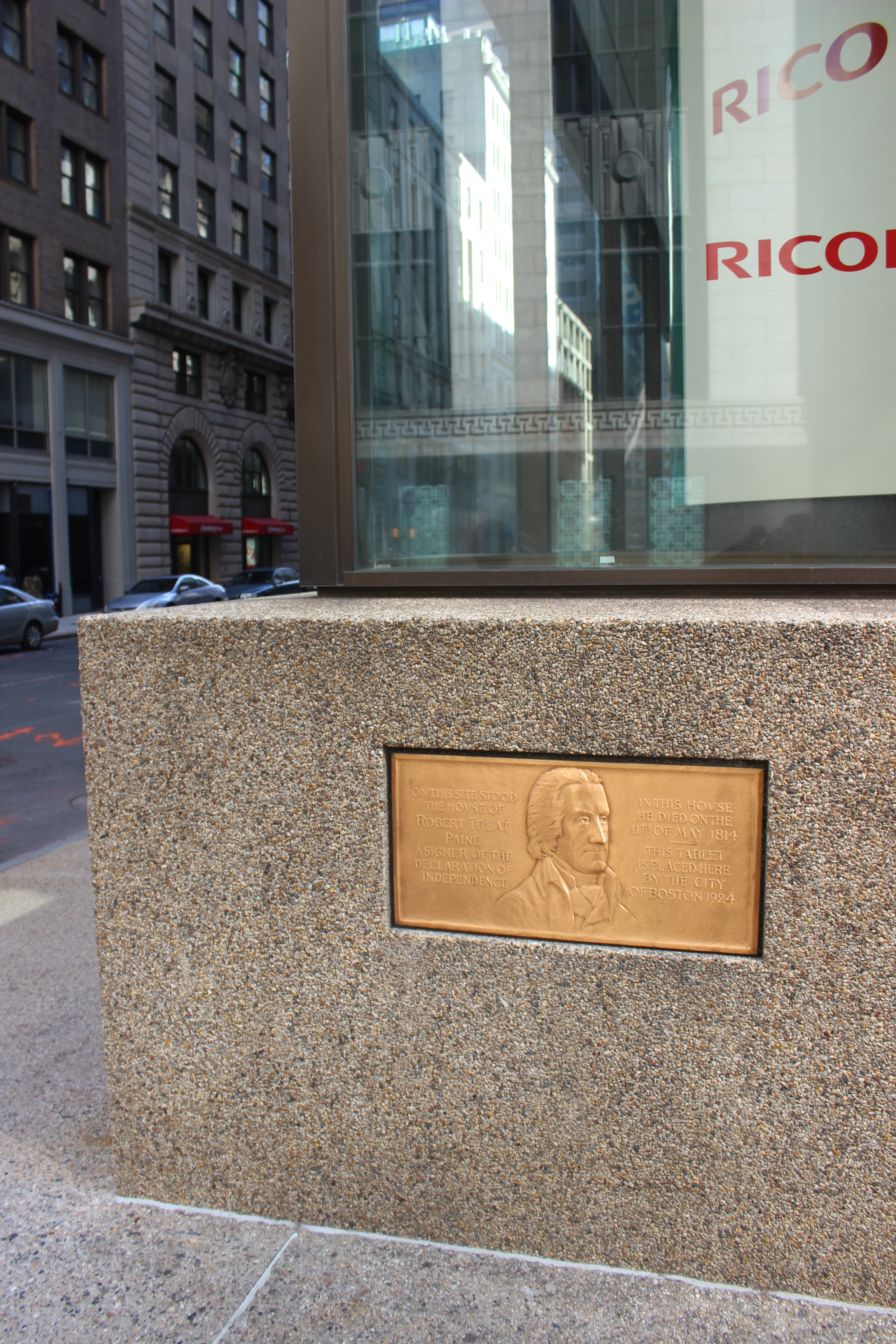
Yet, some history, is just, literally, stuck right on the walls of Boston. On the side of a modern office building, is situated the plaque below:
One of the 56 men that affixed his signature to the Declaration of Independence, Paine was born in Boston on March 11, 1731 and was actually given a middle name, a family tribute. His family legacy was well-established in the colonies and Paine himself was counted as an early advocate for the patriotic cause.
Yet, like the more famous John Adams, Paine also was a lawyer and dedicated to the law and order. He was the second attorney, along with the aforementioned Adams, to represent the British soldiers in the “Boston Massacre” trial. He continued to hope for reconciliation, hoping when he ventured to the Second Continental Congress, that the resolve of the colonies would bring the British Parliament to negotiate. On that same vein, Paine also put his signature on the Olive Branch Petition–the final attempt by the colonies to reach King George III and give their side of the story. When the king outright rejected the petition and did not even lay eyes on the document, Paine saw there was no hope and firmly planted himself in the camp of those clamoring for independence.
He became a vocal and valuable member of the Continental Congress and signed the Declaration of Independence on August 2, 1776. Returning to Massachusetts near the end of 1776, he became the Speaker of the Massachusetts House of Representatives the following year. In 1780 he was a member of the committee that drafted the state constitution and as attorney general he prosecuted members of Shays’ Rebellion in 1787.
His last public role was a justice of the Massachusetts Supreme Court from 1790 until his retirement in 1804. He was 83 years old when he died in the house that the plaque mentions. He was buried in the Granary Burying Ground in his native Boston, Massachusetts.
Another great patriot of the American cause, whose last house where his last days were spent, has a lasting memorial for those to discover. So, many historical treasures are just hanging there, waiting to be discovered in Boston.
Another view of the Robert Treat Paine plaque in Boston



 Emerging Revolutionary War Era