

Emerging Revolutionary War welcomes back guest historian Evan Portman for this review.
Among the pantheon of America’s Founding Fathers, Robert Morris is a name rarely mentioned beyond circles of historians. However, Michael Aubrecht sheds light on this phantom revolutionary figure with his book The Letters of Robert Morris: Founding Father and Revolutionary Financier. His work represents the first time the primary sources of Robert Morris have been compiled in print.
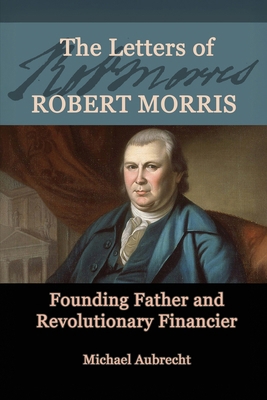
The Letters of Robert Morris spans the financier’s political life from his time in the Continental Congress to his time in debtors’ prison at the turn of the eighteenth century. Morris’s correspondence provides a fascinating window into his public life. His recipients often include the likes of George Washington, Thomas Jefferson, Benjamin Franklin, and Alexander Hamilton. Some of Morris’s most fascinating correspondence comes from late 1776 and early 1777, during which the financier provided Washington’s army with much needed supplies. His letters to Washington during the Ten Crucial Days reveal the anxiety and trepidation that pervaded the fledgling United States at that time.
Also compelling is Morris’s role in establishing the Bank of North America and a new national currency, which he outlined to a letter to John Hanson, the president of Congress, in 1782. His frequent exchanges with individuals like Hamilton and Franklin about the bank and its expenditures highlight Morris’s financial acumen but also how much of his own personal wealth he was willing to pledge to the American revolutionary cause.
Overall, Aubrecht’s editorial approach is sound and tactful. He adapts hundreds of Morris’s letters the National Archives’ online repository. While many of these letters are accessible on the internet, there is particular value in assembling them in print as Aubrecht has. While an online repository can sometimes feel disjointed, a printed volume can help readers to make connections and allow the editor to exert a bit more influence over the narrative.
However, Aubrecht places Morris’s voice at the center of this volume, intruding little on the language and meaning of the original texts. Aubrecht occasionally inserts a missing word or clarifies a misspelling, but his methodology essentially allows Morris to speak for himself. Aubrecht also provides useful biographical information on his subject in the introduction as well as advocates for his importance as one of the Revolution’s most prominent financiers.
The collection could, however, benefit from a bit more contextual information, particularly in between substantial time gaps between letters. While most readers need no introduction to many of Morris’s illustrious correspondents, a brief paragraph providing the context of a set of letters could prove useful in providing a more detailed picture of Morris’s life. The collection could also make more liberal use of footnotes in defining key terms and antiquated language, as well as elaborating on some of the lesser-known people Morris mentions in his correspondence.
Regardless, The Letters of Robert Morris is a welcome contribution to the existing literature on one of America’s underappreciated Founding Fathers. Aubrecht’s selection proves to be a key asset to researchers and history buffs alike.
Information:
The Letters of Robert Morris: Founding Father and Revolutionary Financier. By Michael Aubrecht. Berwyn Heights, MD: Heritage Books, 2025. Softcover, 431 pp. $43.00.
 Emerging Revolutionary War Era