

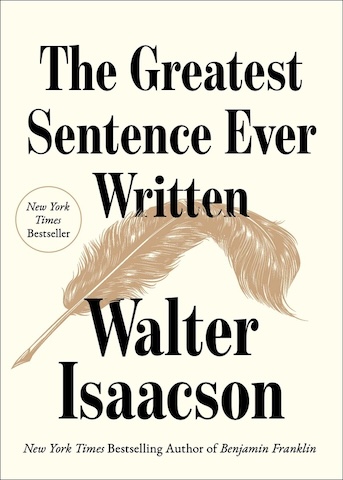
Is the second sentence of the Declaration of Independence the greatest sentence ever written?
That’s the contention of historian Walter Isaacson in his slim new book, The Greatest Sentence Ever Written. As a refresher:
We hold these truths to be self-evident, that all men are created equal, that they are endowed by their Creator with certain unalienable Rights, that among these are Life, Liberty and the pursuit of Happiness.
“[E]ach of its words and concepts bears scrutiny and appreciation,” Isaacson says, and then goes about in short chapter-length essays to do just that.[1]
Or almost so. His execution doesn’t go off with quite that kind of exactness. For instance, “hold” doesn’t get any particular attention. The verbs is always the most important word in a sentence because it’s the engine that drives the action. One could spend a little time on “hold” and its specific meaning and the perils inherent in it (anything held can be dropped!). Isaacson may or may not have missed opportunities by skipping some of the words that he apparently deemed unimportant.
But where he does parse out parts of the sentence, he shines. He explores the common ground of “We,” what made “truths” “self-evident,” and the restrictiveness behind the seemingly inclusive “all men.” What is “equality” in the context of the rest of the sentence? What did the Founders mean by any of these things?
Continue reading “The Greatest Sentence Ever Written?”
