

Emerging Revolutionary War welcomes guest historian Andrea Quinn.
In April 1875, Concord, Massachusetts, commemorated the centennial of the American Revolution’s beginning with a celebration that merged historical remembrance with contemporary national healing. At the heart of this tribute stood Major General Francis Channing Barlow, chosen as Chief Marshal for the event. His presence and leadership embodied the spirit of both Concord’s revolutionary origins and the sacrifices of the recent Civil War. Though his life included many achievements—from battlefield valor to public service—it was in this role as Chief Marshal that Barlow served as a living link between generations of American struggle and aspiration.

Barlow’s appointment was no mere formality. A Civil War general known for integrity, courage, and commitment to reform, Barlow had deep ties to Concord. As a youth, he was shaped by the town’s intellectual and moral environment, attending lectures by Ralph Waldo Emerson and immersing himself in the ideals of Transcendentalism. This upbringing instilled in him a strong sense of civic duty, justice, and personal responsibility—qualities that defined his wartime leadership and post-war public service.
The Concord Centennial was intended as more than a local remembrance—it was a national event. The town’s planning committee sought a figure who could represent both the revolutionary past and the post-Civil War Union. Barlow, whose own life had traced the arc of American idealism—from Brook Farm to the battlefields of Gettysburg and Spotsylvania—was their clear choice.
Barlow accepted the role of Chief Marshal with humility, writing: “I feel flattered at being so remembered and I will with great pleasure act as the Chief Marshal.” From that point forward, he immersed himself in organizing the celebration’s logistics, ensuring the centennial was both dignified and seamless. He coordinated invitations to prominent Civil War veterans, dignitaries, and national figures—including President Ulysses S. Grant and Rev. Phillips Brooks—reflecting the centennial’s significance beyond Concord.
As Chief Marshal, Barlow’s responsibilities were both ceremonial and executive. He managed the order of the grand procession, the coordination of military and civic groups, and the sequence of events that unfolded throughout the day. His leadership lent the celebration its structure and solemnity. True to his character, Barlow approached the task with clarity, precision, and seriousness—qualities that had defined his earlier military commands.
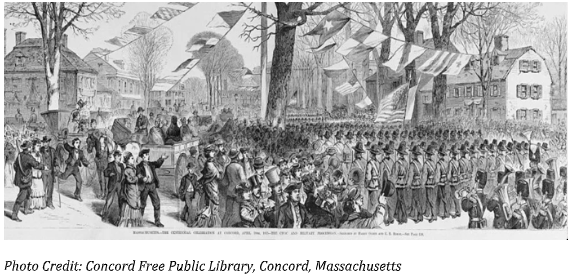
On the day of the celebration, Barlow led the formal procession through Concord on horseback. This act, highly symbolic, placed him at the forefront of a living tribute to American perseverance. Veterans from the Revolutionary War lineage, Civil War soldiers, civic groups, and ordinary townspeople followed in a march that connected 1775 to 1875. In this public moment, Barlow was more than a parade marshal—he became a symbol of the continuity of American ideals across centuries of conflict and change.
The centennial also featured the unveiling of Daniel Chester French’s Minute Man statue—cast from melted Union cannons and placed beside the Old North Bridge. French’s statue depicted the citizen-soldier leaving his plow to defend liberty, a quiet but powerful emblem of national resolve. Barlow stood near the unveiling, a modern embodiment of that very ideal. Just as the statue honored the past, Barlow’s presence honored the sacrifices of the Civil War generation.

Though Barlow did not speak during the celebration—confessing to the committee his discomfort with public oratory—others gave voice to the occasion’s moral and national resonance. Ralph Waldo Emerson, James Russell Lowell, and George William Curtis, all close to Barlow personally and philosophically, offered tributes that highlighted the centennial’s broader meaning. Curtis, in particular, called Barlow and his fellow Civil War veterans “the embodiment of the Republic’s conscience,” linking the service of 1861–65 to the ideals forged in 1775.
Barlow’s role as Chief Marshal was thus more than honorary—it was deeply symbolic. He was chosen not just for his military rank, but for the life he had led and the values he represented: duty over ambition, principle over popularity, and reform over complacency. His leadership gave the Concord Centennial its disciplined dignity and ensured it would be remembered as a thoughtful and unifying event.
In the long arc of Francis Channing Barlow’s life—from his Concord childhood to the trenches of war and the halls of justice—his return as Chief Marshal in 1875 represented a moment of both personal and national reflection. He stood at the head of the procession not just as a general, but as a son of Concord, shaped by its conscience and called to help it remember its soul.
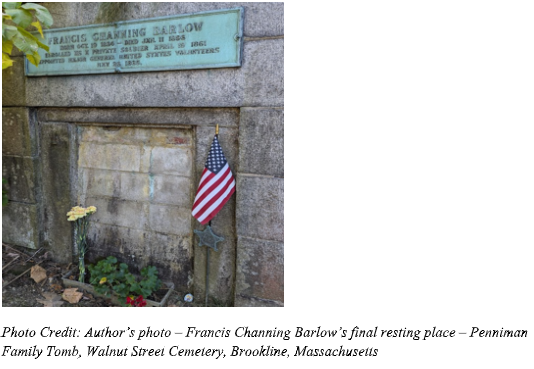
Barlow died on January 11, 1896, and is buried in Brookline, Massachusetts. Yet in April 1875, as he led the town of Concord in honoring its revolutionary past, he also helped it reclaim the ideals of liberty, sacrifice, and service that would carry forward into the next American century.
Sources:
Emerson, Ralph Waldo. *The Conduct of Life*. Houghton Mifflin, 1860.
Thoreau, Henry David. *Walden*. Ticknor and Fields, 1854.
Gross, Robert A. *The Minutemen and Their World*. Hill and Wang, 1976.
Richardson, Robert D. *Emerson: The Mind on Fire*. University of California Press, 1995.
Barlow, Francis C. *The Barlow-Gordon Letters: A Civil War Dialogue Between Friends*.
Edited by Frank J. Wetta, University Press of Kansas, 2009.
*History of Concord.* Concord Free Public Library, https://concordlibrary.org.
*Centennial Celebration Records, 1875.* Town of Concord Archives Collection.
*Apocrypha Concerning the Class of 1855 of Harvard College and Their Deeds and Misdeeds
During the Fifteen Years Between 1855 – 1880* by Edwin Abbot, Class Secretary, Boston,
Alfred Mudge & Son, Printers, 34 School Street.
 Emerging Revolutionary War Era
Excellent article.
LikeLike
Thank you!
LikeLike
Pingback: Emerging Civil War