

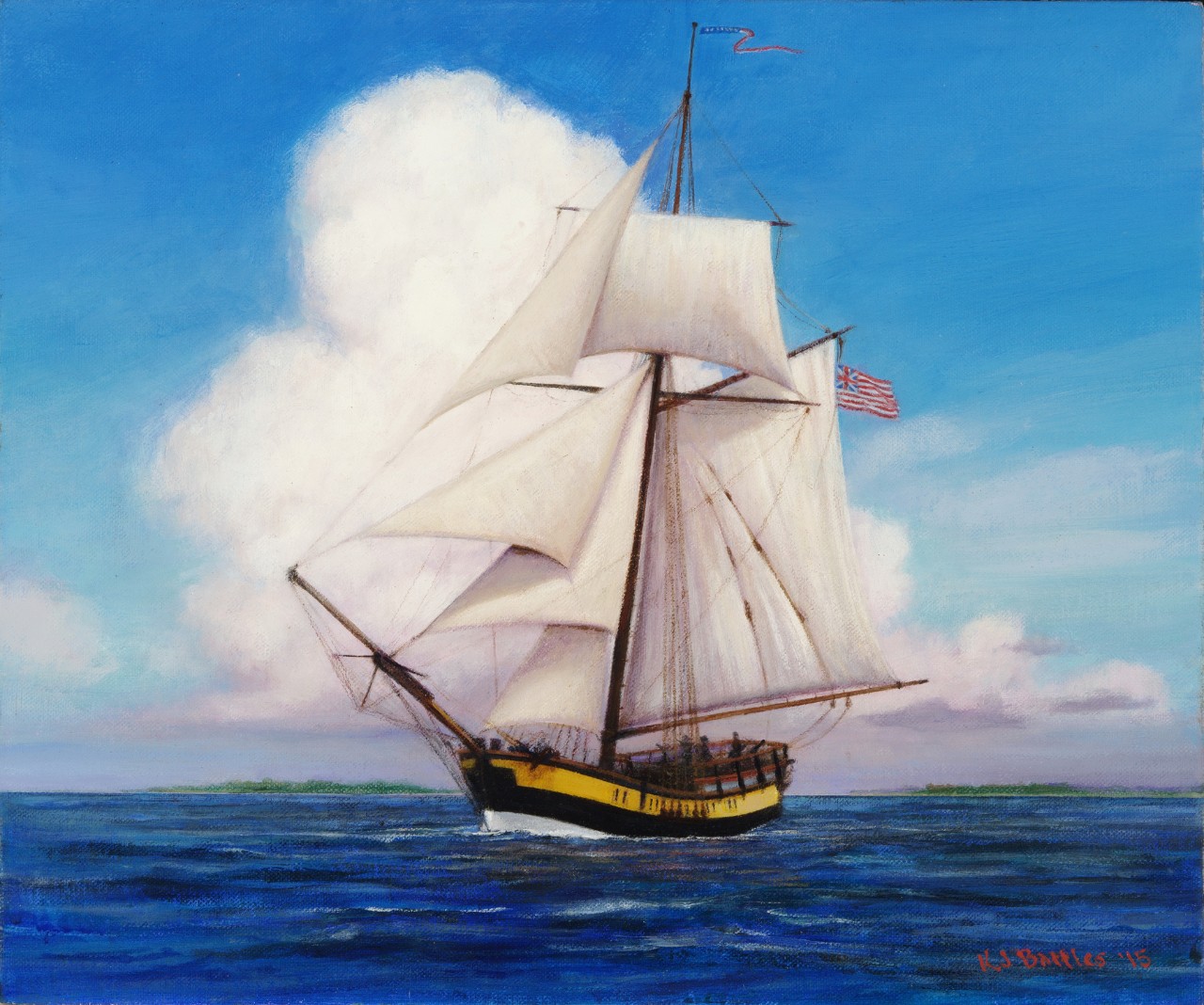
Since his brief visit in November 1774 and his longer term stay commencing in December, Captain James Wallace of the British ship Rose (20 guns), had patrolled Narragansett Bay to enforce the Coercive Acts and prevent Britain’s rebellious colonies from importing gunpowder and armaments. Loyalists had taken heart and rebels had been frustrated with his presence. Not only were his patrols interfering with local commerce by seizing ships and their cargos—his main mission—but he created a more visible symbol of Britain’s ability and willingness to force its colonists to comply with Parliament’s laws.
One of the loyalists encouraged by the Royal Navy presence in Narragansett Bay was a Newport merchant named George Rome. Wallace had visited Rome and was dining with him when a breathless messenger warned the captain that a mob was out to tar and feather him back in December, 1774. In the moment, nothing came of it, but Governor Joseph Wanton warned Wallace that the town was not safe for British officers, sailors, or loyal subjects. Things remained at a low simmer that winter and spring, including the initial weeks after the Lexington and Concord. Tensions, however, could not help but rise. Diarist Ezra Stiles, recorded on May 23 that some 90 Rhode Island soldiers under the command of Captains [John] Topham and [Thomas] Tew marched from the Newport courthouse and through town beating up volunteers to join the nascent American Army. Wallace was dining in town that day and no doubt heard the racket.[1] Stiles wrote, “The Tories were greatly mortified to see the daring Boldness of the Rebels as they called them. The Tories had said that the Men o’War would fire the To[wn] if any Soldiers were raised in it. But there was no Molestation.” From Stiles’ version of events, the march appears as nothing less than a provocation to determine whether the rumored threat of Wallace and his ships to Newport proper was a bluff. The lack of an immediate response may have demonstrated that it was. In truth, a significant portion of Newport’s population opposed the rebels and voluntarily supplied Wallace and contracted for grain to provide to the British army.
The May 23 march may have emboldened Rhode Island rebels to take another step. Throughout the winter and spring, Wallace had been seizing cargos of flour and produce. Foodstuffs were in great demand for the British Army in Boston and the captain was determined to do his part to meet the need, not to mention his admitted desire to deny resources to the American army surrounding Boston. In addition to the flour Wallace seized, loyalists like George Rome purchased it in large amounts with the intention of shipping it to the British Army. At some point on June 3, a large crowd assembled to destroy Rome’s stores of flour. According to Wallace, “The People took it in their heads…they stopped the Carts, threw about the Flour, flew to Arms with an avowed intent to destroy the Merchant’s House and Stores, crying out through the Streets now was the time to kill the Tories.”[2] Whether at Rome’s request, as reported by the Newport Mercury, or Wallace’s initiative, as he wrote Vice Admiral Graves, Wallace sent a hundred plus men ashore and threatened to put every last man to the sword and fire on the town “at the first act of hostility.” More, he seized one man who pressed too closely to him, but released him after promises to disperse. Altogether, Wallace and his men were ashore roughly four hours.[3] This was an entirely different kind of confrontation than seizing isolated civilian ships.
If the May 23 parade and June 3 uproar in Newport were the most visible challenges to Wallace’s power in Rhode Island, they were not the most important. On April 22, the General Assembly had voted to create an Army of Observation, appointing officers on May 3. At the same time, it essentially fired Governor Joseph Wanton, who opposed the creation of the Army and would not administer the oath to appointed officers. That left Nicholas Cooke, the lieutenant governor, as the chief executive. Unfortunately for Wallace, Cooke was more inclined to resist British authority than the moderate Wanton. On June 12, the Assembly asked Cooke to demand from Wallace the captain’s “reason of his conduct towards the inhabitants of this colony in stopping and detaining their vessels; and also to demand of him the packets which he detains.” In the same resolution, it directed the committee of safety, essentially an executive committee acting with the assembly’s authority when it was in recess, to charter two suitable vessels, “for the use of the colony, and fit out the same in the best manner, to protect the trade of this colony.”[4] Rhode Island was going to create a navy.
The Assembly laid out specifications for both vessels. One would be larger with a crew of eighty men and armed with ten four pounders, fourteen swivel guns, small arms, and associated equipment. The smaller was limited to a crew of thirty with no specifications on its armaments. Crew totals were to be included in the 1500-man Army of Observation approved in April. Abraham Whipple was named commander of the first vessel and the commodore for the two-ship squadron. Christopher Whipple was to command the smaller ship.
Lieutenant Governor Cooke wrote his letter to Wallace on the 14th: “Long have the good people of this colony been oppressed by your conduct, in interrupting their lawful trade, and preventing the importation of the provisions necessary for their subsistence. The acts of the British Parliament, already filled with restrictions of trade, oppressive in the highest degree, seem by you to be thought too lenient.” No doubt Cooke had Wallace frequent seizures of bulk foodstuffs, in which Parliament had not restricted trade, but which the Navy sought to keep out of the hands of the American army and put into the bellies of British soldiers in Boston. He went on to accuse Wallace of being out of control and demanded the captain’s reasons for his behavior.[5] The very same day, Wallace seized his latest ship, the sloop Drummond from Tobago with a load of rum and sugar.[6] For his part, Wallace casually dismissed Cooke’s letter:
“I have received your letter of the 14th inst.; although I am unacquainted with you, or what station you act in; supposed you write in behalf of some body of people; therefore, previous to my giving an answer, I must desire to know whether or not, you, or the people on whose behalf you write, are not in open rebellion to your lawful sovereign, and the acts of the British legislature!”[7]
Events were moving faster than Wallace, and perhaps Cooke, realized, however. Almost as quickly as the Assembly passed its June 12 resolution to acquire a navy, local merchant John Brown offered his vessel Katy. Even before the colony and Brown agreed on price, Whipple received his orders on the 15th, the same day Wallace dispatched his reply to the lieutenant governor. Orders in hand, Whipple promptly took Katy to sea looking for one of Rose’s tenders, the Diana.
Hearing that the rebels were outfitting a ship at Providence, Wallace had dispatched the Diana with just 12 men aboard to reconnoiter a river passage to Providence. Whipple found her and the two ships met an hour before dusk and exchanged fire, but did not do substantial damage. When a second American vessel joined the battle, the Diana ran ashore and its crew fled. The Rhode Islanders promptly seized the Diana, brought her off the shore, and headed north up the bay.[8] Residents of Newport could hear the firing, which meant Wallace could as well. He dispatched another tender into the bay to search for his lost ship, but it came back empty handed.[9] Although no blood had been spilled, rebel sailors had exchanged fire with sailors of the Royal Navy on the waters of Narragansett Bay. Wallace’s men returned aboard ship by noon the next day.
Despite the loss of Diana and the letter from Cooke, Wallace had no intention of changing his behavior; he would continue to seize ships carrying foodstuffs for dispatch to the army at Boston. As if to emphasize the point, Vice Admiral Graves sent him a note on the 16th reminding the captain that they were needed and passing on intelligence that he expected significant quantities of pork to begin shipping out of New England bound for the Caribbean.[10]
Things were about to get worse for Wallace. Diana’s loss to rebels prompted Wallace to take Roseand Swan up the bay in search of “pirates” he thought were near, presumably the Katy. At the time, June 17, he had gathered five ships laden with provisions under his care at Newport. But, the people of Newport had a surprise for him. “On our return to Newport we found a great number of Towns People had taken advantage of our absence Arm’d a number of Boats and Vessels—taken the Victuallers, carried them to Town, dismantled & unloaded them, and this done in the space of two or three hours.”[11] Wallace concluded that the town of Newport had joined the rebellion, not considering that his own actions in seizing ships that were not carrying contraband in order to supply the British Army at Boston had inadvertently given radical forces in Rhode Island political ammunition to use against Britain and local loyalists.
Back in Providence, on June 22 John Brown and the assembly’s committee of safety agreed on a price for Katy at 90 dollars a month, with an additional four hundred pounds should Katy be lost in the colony’s service, retroactive to June 12.[12] Rhode Island was leasing its navy, with an option to purchase at a later date.
When he learned of events in Rhode Island, Vice Admiral Samuel Graves, commanding Royal Navy assets on the North American Station, had to react. To date, his ships had concentrated on intercepting coastal trade, supplying and supporting the British Army in Boston, and providing governors with some modicum of force to maintain their rapidly shrinking authority amidst growing bands of shore-based rebels. Rhode Island’s navy, and rumors of ships outfitting for war in New London created a new problem. Reinforcements, supplies, and communications from Britain might be intercepted en route to the colonies, unaware and unprepared for the danger. He ordered Captain Tyringham Howe to take Glasgow out of Boston harbor and patrol from Nantucket to the western end of Long Island until some expected transports arrived, after which he was to place himself and his ship under Wallace’s command in Rhode Island.[13]
His timing was fortuitous, for similar thoughts were occurring in Rhode Island. Lieutenant Governor Nicholas Cooke realized that a small American fleet might do more than protect American trade. He wrote the Massachusetts Committee of Safety “if there were a few Vessels properly armed and mannd along the Coast in different parts it would be a great means of proteckting our own trade and allso of picking up many of the provision Vessels that they the Men of War take this way and send round to Boston.” Cooke noted that such supply ships were weakly crewed and armed with little more than small arms. They would be easy prey for a decently armed sloop, like Katey, or schooner and represented an opportunity to strike at the British Army’s logistical tail.[14] It was a germ of an idea that would continue to grow during the summer months of 1775.
[1] Era Stiles, The Literary Diary of Ezra Stiles, D.D., L.L.D., Volume I, Franklin Bowditch Dexter, ed. (New York: Charles Scribner’s Sons, 1901), 561. Stiles does not record the first names of Captains Topham and Tew. However, on May 3 the General Assembly passed an act naming members of the Committee of Safety and Officers in each of the companies of a new Army of Observation created by a prior act on April 22. John Topham became captain-lieutenant of the regiment of Newport and Bristol. Thomas Tew was listed as captain of a company in the same regiment for Newport and Bristol. “Proceedings of the General Assembly, held for the Colony of Rhode Island and Providence Plantations, at Providence, the first Wednesday of May, 1775,” John Russell Bartlett, ed., Records of the Colony of Rhode Island and Providence Plantations in New England, Vol. VII, 1770-1776(Providence: A. Crawford Greene, State Printer, 1862), 323.
[2] “Captain James Wallace, R.N. to Vice Admiral Samuel Graves, June 5th 1775,” William Bell Clark, ed., Naval Documents of the American Revolution, Volume I (Washington, DC: Government Printing Office, 1964), 615. Hereafter NDAR, Volume, Page.
[3] “Captain James Wallace, R.N. to Vice Admiral Samuel Graves, June 5th 1775,” NDAR, I, 615; “Newport Mercury June 5, 1775,” NDAR, I, 614. See also Stiles, The Literary Diary of Ezra Stiles, 566.
[4] “Journal of the General Assembly of Rhode Island, June 12 1775,” NDAR, I, 664.
[5] “Deputy Governor Nicholas Cooke to Captain James Wallace, June 14th, 1775,” NDAR, I, 680.
[6] “Remarks &C on Board his Majesty’s Ship Rose,” NDAR, I, 681.
[7] “Captain Hames Wallace, R.N., to Deputy Governor Nicholas Cooke,” NDAR, I, 686. Emphasis in original.
[8] Hope S. Rider, Valour Fore & Aft: Being the Adventures of the Continental Sloop Providence, 1775-1779, Formerly Flagship Katy of Rhode Island’s Navy (Annapolis, MD: Naval Institute Press, 1977), 23-24.
[9] “Diary of Ezra Stiles, June 15 1775,” NDAR, I, 686; Clarkson A. Collins, “The Patrol of Narragansett Bay (1774-1776) by H.M.S. Rose, Captain James Wallace,” Rhode Island History, Vol. 8, No. 3, July 1949, 80; “Journal of His Majesty’s Ship Rose, Captain James Wallace, Commanding, Friday, June 16th 1775,” NDAR, I, 695.
[10] “Vice Admiral Samuel Graves to Captain James Wallace, 16th June 1775,” NDAR, I, 692.
[11] “Captain James Wallace, R.N., to Vice Admiral Samuel Graves, 19th June 1775,” NDAR, I, 720-721; “Newport Mercury, Monday June 19, 1775,” NDAR, I, 722.
[12] “Agreement between John Brown and the Committee in Behalf of Rhode Island, June 22th 1775,” NDAR, I, 740.
[13] “Vice Admiral Samuel Graves to Captain Tyringham Howe, H.M.S. Glasgow, 27 June 1775,” NDAR, I, 761. As of June 30, Glasgow remained in in Boston harbor. “Disposition of the [British] Fleet on the 30th of June 1775,” NDAR. I, 785.
[14] “Nicholas Cooke, Deputy Governor of Rhode Island, to the Massachusetts Committee of Safety, June 27, 1775,” NDAR, I, 762.
 Emerging Revolutionary War Era
Pingback: On this day 250 years ago in the Revolution — June 12, 1775 – On This Day In The Revolution
Pingback: On this day 250 years ago in the Revolution — June 15, 1775 – On This Day In The Revolution
Pingback: On this day 250 years ago in the Revolution — June 22, 1775 – On This Day In The Revolution
Pingback: On this day 250 years ago in the Revolution — June 27, 1775 – On This Day In The Revolution