

Approximately two months after waging the defense of Breed’s Hill, on the Charlestown peninsula, against the British, Colonel William Prescott put quill to paper to write to John Adams. In this communique, he discussed the action at Breed’s Hill, known as the Battle of Bunker Hill, fought on June 17, 1775, to his fellow Massachusetts native. Take note that he even wrote his account about the orders he received and which hill that missive directed him to. Since the waft of smoke has drifted from the battle on that June day, veterans, officers, and historians have debated why Prescott and company chose Breed’s Hill instead of Bunker Hill. This letter is just another wrinkle in that timeless debate.
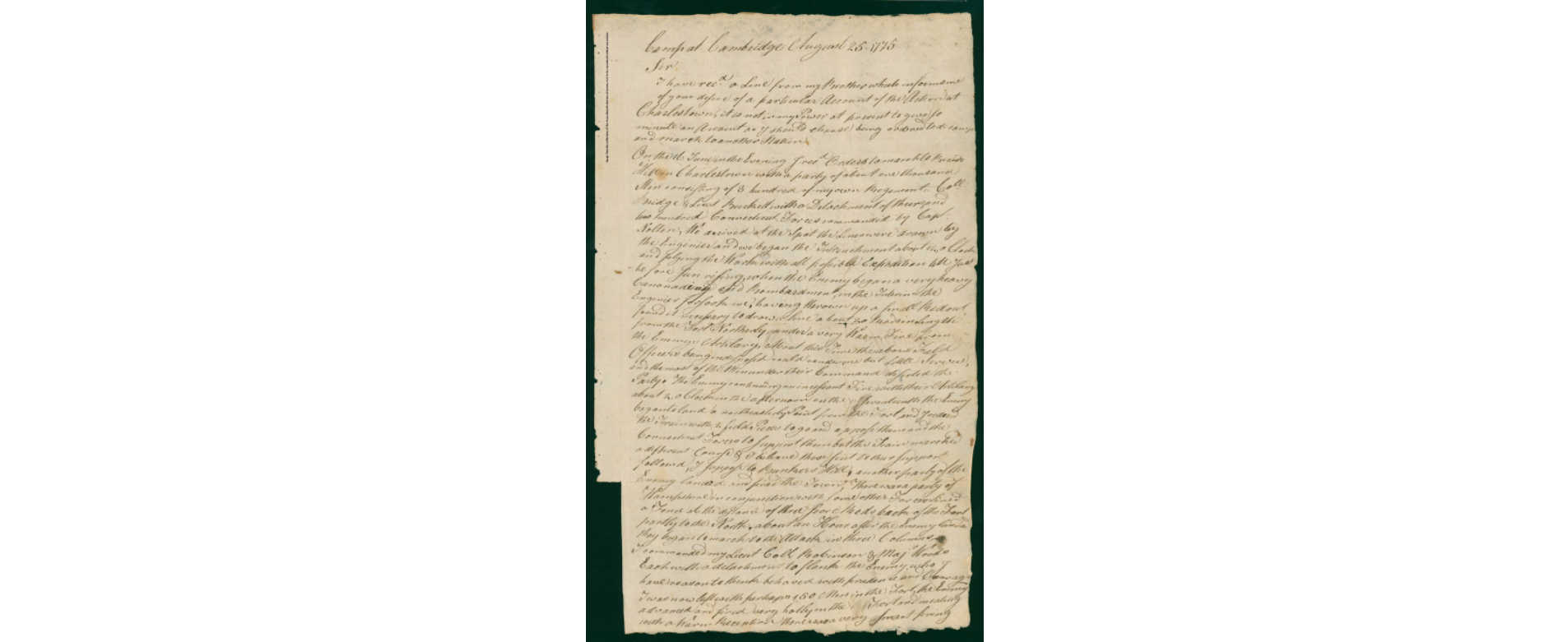
Camp at Cambridge August 25.1775
Sir
I have recd. a Line from my Brother which informs me
of your desire of a particular Account of the Action at
Charlestown, it is not in my Power at present to give so
minute an Account as I should choose being ordered to decamp
and march to another Station.
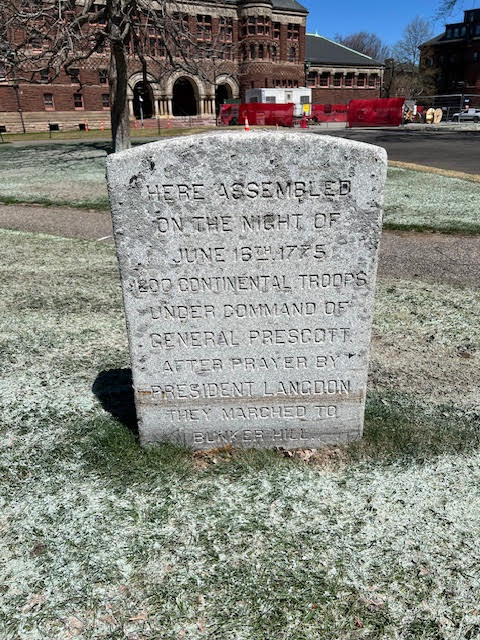
On the 16 June in the Evening I recd. Orders to march to Breeds
Hill in Charlestown with a party of about one thousand
Men consisting of 3 hundred of my own Regiment, Coll.
Bridge & Lieut Breckett with a Detachment of theirs, and
two hundred Connecticut Forces commanded by Capt.
Nolten, We arrived at the Spot the Lines were drawn by
the Enginier and we began the Intrenchmant about 12, o Clock
and plying the Work with all possible Expodition till Just
before sun rising, when the Enemy began a very heavy
Canonading and Bombardment, in the Interin [Interim] the
Enginier forsook me, having thrown up a small Redout,
found it necessary to draw a Line about 20 Rods in length
from the Fort Northerly, under a very Warm Fire from
the Enemys Artilary, About this Time the above Field
Officers being indisposed could render me but Little Service,
and the most of the Men under their Command deserted the
Party. The Enemy continueing an incessant Fire with their Artilary.
about 2, o Clock in the afternoon on the seventeenth the Enemy
began to land a northeasterly Point from the Fort, and I orderd
the Train with 2 field Pieces to go and oppose them and the
Connecticut Forces to support them but the Train marched
a different Course & I believe those sent to their support
followd, I suppose to Bunkers Hill, another party of
the Enemy landed and fired the Town, There was a party of
Hampshire in conjunction with some other Forces Lined
a Fence at the distance of three score Rods back of the Fort
partly to the North, about an Hour after the Enemy landed
they began to march to the Attack in three Columns,
I commanded my Lieut Coll. Robinson & Majr. Woods
Each with a detachment to flank the Enemy, who I
have reason to think behaved with prudence and Courage.
I was now left with perhaps 150 Men in the Fort, the Enemy
advanced and fired very hotly on the Fort and meating
with a Warm Reception there was a very smart firing on
both sides. after a considerable Time finding our
Amunition was almost spent I commanded a sessation
till the Enemy advanced within 30 yards when we gave
them such a hot fire, that the [y] were obliged to retire
nearly 150 yards before they could Rally and come again
to the Attack. Our Amunition being nea [r ]ly exaustid could
keep up only a scattering Fire. The Enemy being numerous
surrounded our little Fort began to mount our Lines and
enter the Fort with their Bayonets, we was obliged to
retreat through them while they kept up as hot a fire
as it was possible for them to make we having very few
Bayonets could make no resistance, we kept the fort
about one hour and twenty Minutes after the Attack with
small Arms, This is nearly the State of Facts tho’ imperfect &
too general which if any ways satisfactory to you will
afford pleasure to your most obedient humble Servt.
William Prescott
To the honble John Adams Esqr.
 Emerging Revolutionary War Era