On June 12, 1776 in Williamsburg, Virginia, the Fifth Virginia Convention took a momentous step in defining new American liberty. The Virginia Declaration of Rights stands as one of the most influential political documents in American history. Adopted on June 12, 1776, it established a comprehensive statement of individual liberties and principles of government at a pivotal moment in the struggle for independence from Great Britain. Written primarily by George Mason, the Declaration articulated ideas about natural rights, popular sovereignty, freedom of the press, religious liberty, and the limits of governmental power. Its impact extended far beyond Virginia, influencing the United States Declaration of Independence, the United States Constitution, and the Bill of Rights.
The Virginia Declaration of Rights emerged during a period of revolutionary change. Colonists increasingly believed that British policies violated their rights as Englishmen and threatened their political freedoms. In response, revolutionary leaders sought not only independence but also a clear statement of the principles upon which a new government would rest. The Virginia Declaration of Rights provided such a foundation, becoming a landmark in the development of democratic governance and constitutional liberty.
Virginia played a leading role in this revolutionary process. The colony possessed many influential political thinkers who believed that government existed to serve the people and protect their rights. When Virginia’s Fifth Convention met in Williamsburg in the spring of 1776, delegates recognized the need to define the principles that would guide the formation of a new state government. Before drafting a constitution, they decided to establish a declaration of rights that would set limits on governmental authority and affirm the liberties of citizens.
George Mason, a respected Virginia planter and political philosopher, was tasked with preparing the document. Drawing upon Enlightenment ideas, English constitutional traditions, and colonial experiences, Mason produced a draft that would become the Virginia Declaration of Rights. Born in 1725, Mason was a wealthy landowner and self-educated scholar who developed strong views regarding individual liberty and responsible government.
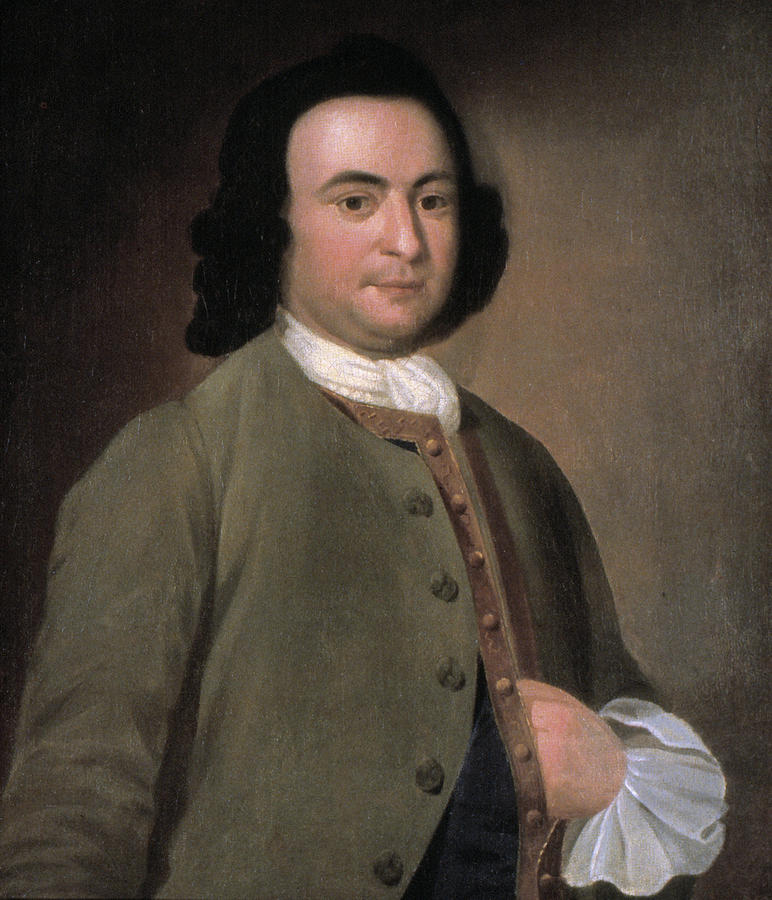
Encyclopedia of Virginia
Unlike some of his contemporaries, Mason was deeply concerned about the concentration of political power. He believed that governments derived their authority from the consent of the governed and that citizens possessed inherent rights that no government could legitimately violate. His ideas reflected the influence of Enlightenment thinkers such as John Locke, who argued that individuals possessed natural rights to life, liberty, and property.
Mason’s draft underwent revisions by the Convention, but its essential principles remained intact. His work established a model for future declarations and constitutional protections. Although Mason later refused to sign the United States Constitution because it lacked a bill of rights, his ideas eventually shaped the first ten amendments to the Constitution.
The Virginia Declaration of Rights contains sixteen sections, each addressing specific political and civil principles. Together, they create a coherent philosophy of government centered on liberty and popular sovereignty.
The first article is perhaps the most famous. It declares that all men are by nature equally free and independent and possess inherent rights that cannot be surrendered when entering society. These rights include the enjoyment of life and liberty, the means of acquiring property, and the pursuit of happiness and safety.
This statement represented a significant departure from traditional notions of government based on inherited privilege or monarchy. Instead, it asserted that rights existed before government and that government existed primarily to protect those rights.
The concept of natural rights became a cornerstone of American political thought. Thomas Jefferson echoed these ideas in the Declaration of Independence when he wrote that all men are created equal and endowed with unalienable rights.
Another fundamental principle is the idea that political power originates with the people. The Declaration states that government is instituted for the common benefit, protection, and security of the people, nation, or community.
This concept, known as popular sovereignty, rejects the doctrine of divine-right monarchy. According to the Declaration, rulers derive their authority from the consent of the governed rather than from hereditary privilege or divine appointment. If a government becomes destructive of the public welfare, the people have the right to reform, alter, or abolish it.
These ideas helped justify the American Revolution and became essential features of democratic government. The Declaration emphasizes the importance of dividing governmental authority among different branches. It argues that the legislative, executive, and judicial powers should be separate and distinct.
The purpose of this separation is to prevent tyranny and protect liberty. By ensuring that no single branch accumulates excessive power, the government can maintain accountability and preserve individual rights. This principle later became a central feature of both state constitutions and the United States Constitution.
The Declaration asserts that elections should be free and that citizens who have a permanent interest in and attachment to the community possess the right to vote and participate in government. Free elections are essential to representative government because they enable citizens to hold leaders accountable and ensure that governmental authority reflects the will of the people.
Several sections of the Declaration protect individuals against arbitrary government action. These provisions guarantee due process of law, prohibit excessive bail and cruel punishments, and affirm the right to a fair and impartial trial. Such protections reflect concerns about abuses of power by government officials. By requiring legal procedures and impartial justice, the Declaration seeks to safeguard individual liberty against arbitrary authority.
These principles later influenced the Fifth, Sixth, and Eighth Amendments to the United States Constitution. The Declaration proclaims that freedom of the press is one of the great bulwarks of liberty and can never be restrained except by despotic governments. This provision recognizes the importance of an independent press in informing citizens, exposing abuses of power, and promoting public debate. The protection of press freedom became an essential component of democratic society and influenced the First Amendment.
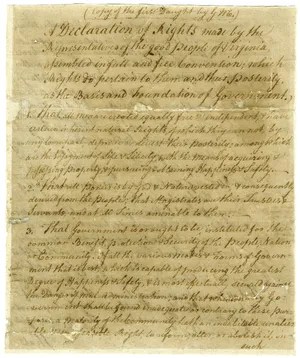
Virginia Declaration of Rights,
Courtesy Library of Virginia
The final section of the Declaration addresses religion and conscience. It states that religion can be directed only by reason and conviction rather than force or violence and that all individuals are entitled to the free exercise of religion.
Although the original language was somewhat limited, it represented a major step toward religious freedom. James Madison later strengthened these principles in Virginia’s Statute for Religious Freedom and in the First Amendment’s protections for religious liberty.
Thomas Jefferson drew heavily from Mason’s language and ideas when drafting the Declaration of Independence. The Declaration’s assertion that all men are by nature free and possess inherent rights closely parallels Jefferson’s statement that all men are created equal and endowed with unalienable rights. Similarly, the Virginia Declaration’s emphasis on government deriving its authority from the people and the right of citizens to alter or abolish oppressive governments appears prominently in the Declaration of Independence.
Perhaps the Declaration’s greatest legacy lies in its influence on the United States Bill of Rights. When delegates met at the Constitutional Convention in 1787, they created a new federal government but did not initially include a bill of rights. This omission concerned many Americans, including George Mason, who feared that the new government might threaten individual liberties.
The ensuing debate led to the adoption of the first ten amendments in 1791. James Madison, drawing heavily upon Virginia’s constitutional traditions, proposed amendments that reflected many principles found in Mason’s Declaration.
Examples include:
- Freedom of speech, religion, press, and assembly.
- Protection against unreasonable searches and seizures.
- Guarantees of due process.
- Rights to fair and speedy trials.
- Prohibitions against excessive bail and cruel punishments.
The parallels between the Virginia Declaration and the Bill of Rights are unmistakable. Many of the liberties Americans enjoy today can be traced directly to Mason’s work.
Despite its significance, the Virginia Declaration of Rights contained important limitations and contradictions. Political participation was largely restricted to property-owning white males. Women, slaves, Native Americans, and many others were excluded from the political community envisioned by the document. These contradictions highlight the gap between revolutionary ideals and social realities. Over time, however, reformers and civil rights advocates invoked the Declaration’s principles to challenge inequality and expand the scope of liberty.
More than two centuries after its adoption, the Virginia Declaration of Rights remains a landmark in constitutional history. It was among the first modern documents to articulate a comprehensive set of individual rights and establish the principle that government exists to serve the people.
Its influence can be seen not only in American constitutional law but also in international human rights traditions. Documents such as the French Declaration of the Rights of Man and of the Citizen and later human rights instruments reflect similar commitments to liberty, equality, and popular sovereignty.
The Declaration’s enduring significance lies in its assertion that rights are inherent to human beings and that governments must respect and protect those rights. These principles continue to shape democratic societies around the world 250 years later.