Book Review: The Last Men Standing

Book Review: Gabriel Neville, The Last Men Standing: The 8th Virginia Regiment in the American Revolution (Warwick, UK: Helion and Company, 2025).  $55.  460 pp.

Regimental histories can be dry recitations of facts piled one on top of another to amass a complete source of information about a military unit and its actions.   Alternatively, they can be narratives full of colorful characters and exciting events, but from necessity such histories often leave much out as a distraction from the heartbeat of a story.  Given those challenges, Gabriel Neville has done something remarkable in writing the history of the 8th Virginia Regiment in The Last Men Standing.  He has collected an immense amount of material, which could easily overwhelm a narrative, but presents it over time as the story of the 8th Virginia unfolds.  By organizing many of the facts in a series of charts, tables, and illustrations rather than integrating them into the text, Neville ensures that the story moves along without being buried in minutia.  It is an impressive accomplishment.

Virginia’s 8th Regiment was raised in Virginia’s near frontier, a vast tract of land that today starts in northeastern Tennessee and runs to the northeast, through the Shenandoah Valley, West Virginia, and southwestern Pennsylvania all the way to Pittsburgh.  The men were first or second generation immigrants, largely German or Irish, who had originally flocked to the British colonies in order to carve out a path free of Europe’s stagnating stratification.  The regiment’s most famous member was its colonel, Peter Muhlenberg, the famous “fighting parson” who legend has it completed a sermon and then marched off to war directly from the pulpit.  (Neville explores the legend and its embellishments.)  

Sometimes known as the “German regiment” given its large population of Germans, the 8th had the distinction of being the only Virginia regiment initially armed with rifles.  Most of the regiment fought under Washington across New Jersey in 1776 and early 1777 and then throughout the Philadelphia campaign, including the battle of Monmouth.  Some, however, were siphoned off to help defend South Carolina and were engaged at Sullivan’s Island in July 1776.  It is as if the regiment was everywhere at once.  Skilled riflemen were always in demand.  At the same time, The Last Men Standing relates events associated with recruiting, promotions, transfers, organizational adjustments, command relationships, and so on.  This can create a storytelling problem.  Because so many things are happening at the same time, a reader can get easily confused.  But, if we persist, The Last Men Standing becomes an immensely rewarding read.

Neville tackles the challenge by telling the regiment’s story from the bottom up.  We meet future recruits as boys and begin to understand their experiences growing up.   He moves forward by widening the aperture to address the communities in which they lived as tensions grew with the mother country, their experience as recruits, the organization of the regiment as Virginia mobilized for war, and their experiences of combat.   A conventional regimental history might have ended when the regiment disbanded and an epilogue describing or profiling the fates of individuals soldiers and officers.   Neville goes beyond that.  Several remained in service, either as Continentals or militia.  Rather than epilogue, he continues the story by exploring how the veterans moved on with life.  They shared some commonalities, primarily bounty lands in Kentucky.  Remarkably, Neville has visited many of the Kentucky homesites for these accomplished veterans and tracked more than a few of them to their graves.  The entire volume is blessed with a generous number of maps and illustrations that help tell the tale.

It’s clear from the get go that The Last Men Standing is a labor of love.  Those familiar with Neville’s website, the 8th Virginia, which has since involved to cover Virginia at war, will not be surprised at the volume he has produced from years of research.   It’s a top-notch book that honors the men who helped win a war and belongs in your Revolutionary War library.

“Rev War Roundtable with ERW” Looks West….

The majority of the study of the American Revolution centers on the main theaters of the war, chiefly east of the Appalachian Mountains and on the high seas. Obviously. Yet, what is considered today the Midwest or Great Lakes region saw action that had an impact on the outcome of the war, American independence, British occupation, and Native American life.

Termed “the west” this area encompassed the future states of Tennessee, Kentucky, Ohio, Missouri, Arkansas, and others along the Mississippi River and Great Lakes.

This area will be the focus of the next “Rev War Revelry” on Sunday, August 23 at 7 p.m. EST on our Facebook page. Join Emerging Revolutionary War historians, historian and Gabe Neville, of the 8th Virginia blog who will return for more discussion and revelry.

Joining us this evening will be another historian making his debut on “Rev War Revelry.” That newcomer is Joe Herron, Chief of Interpretation at George Rogers Clark National Historical Park in Vincennes, Indiana.

So, grab your favorite drink and join us for an evening talking the likes of George Rogers Clark, Daniel Boone, and the personas and campaigns of the American west during the American Revolution.

“Rev War Roundtable with ERW” An Evening with General Muhlenberg

This Sunday, at 7 p.m. EST, Emerging Revolutionary War invites you to a “Rev War Revelry” dedicated to General Peter Muhlenberg. This Continental Army officer is the subject of a new biography, by historian Michael Cecere, who, along with Gabe Neville, will be joining us for the evening.

Gabe Neville, the author of the blog, The 8th Virginia Regiment in the Revolutionary War, returns to “Rev War Revelry” for a second time. General Muhlenberg, at the time a colonel, was the first commanding officer of the 8th Virginia Regiment. Click here to access Gabe’s blog.

Michael Cecere, the author of the biography, is an active American Revolutionary reenactor, author, and high-school history teacher in Virginia. He is making his debut on “Rev War Revelry.” For more information on this and his other works, click here.

We hope you can join us, this Sunday, as we discuss the life and military career of Peter Muhlenberg, the 8th Virginia Regiment, and the broader military history of the American Revolution.

Stolen Honor in Georgia

Emerging Revolutionary War welcomes back guest historian Gabriel Neville.

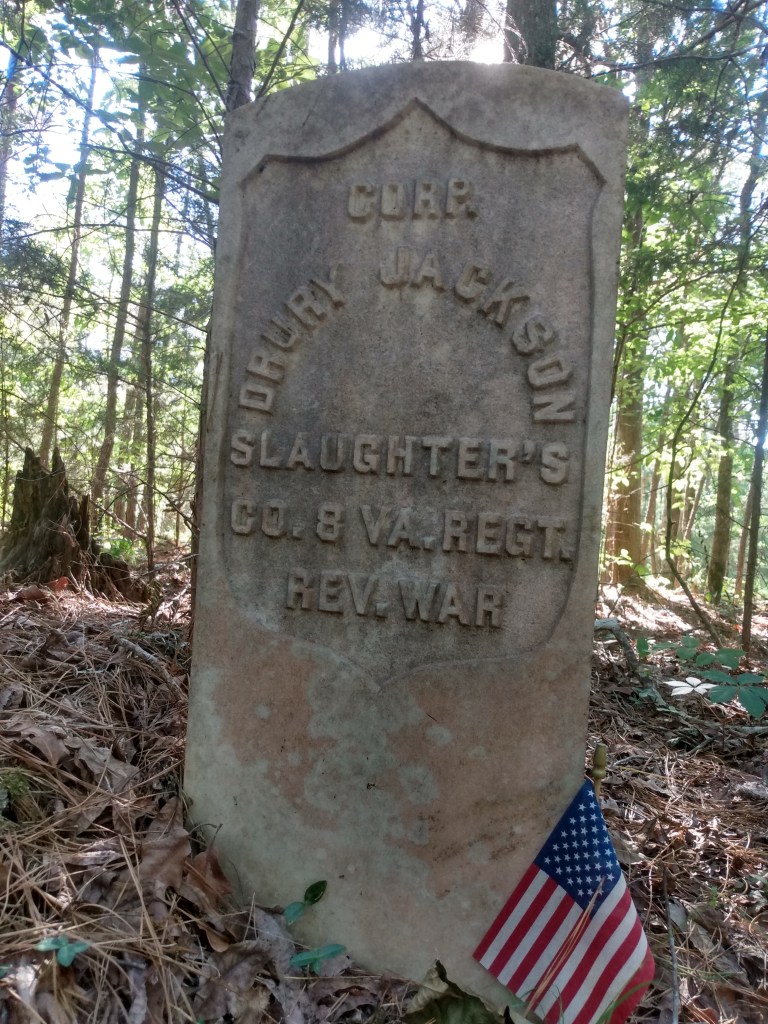
Thirty years ago, Dutch Henderson was “stomping through the woods” near Lake Sinclair in central Georgia when he stumbled upon an old gravestone. Some might have thought it an odd spot for a grave, but Dutch knew the history of the area and it made sense. In fact, the setting told him the man six feet under had played an important role in American history.

The inscription on the marker read: “CORP. DRURY JACKSON, SLAUGHTER’S CO. 8 VA. REGT. REV. WAR.” Why was this headstone for a Revolutionary War soldier all alone in the woods near a lake? Time changes things. Neither the lake nor the woods were there when Drury Jackson died. Back then the grave was on cleared ground overlooking the Oconee River. Depressions in the soil still reveal to the trained eye that Drury was buried in proper cemetery. The river became a lake in 1953 when it was dammed up to create a 45,000-kilowatt hydroelectric generating station. When Dutch found the grave, the cemetery had been neglected and reclaimed by nature. Today it is in a copse of trees surrounded by vacation homes.

The mysterious headstone for veteran Drury Jackson provides no dates to help us identify the man in the ground. (Dutch Henderson)

Dutch spends his free time studying local history and conducting archeology. He has made some important finds, including a string of frontier forts along what was once the “far” side of the Oconee. He’s pretty sure that Drury’s burial in that spot is an important clue to his life in the years following the Revolutionary War. From there, however, things get complicated.[1]

A genealogy site sporting a photo of the headstone tells us that Drury Jackson was born in Brunswick County, Virginia on February 2, 1745, married Lucy Dozier and then Nancy Ann Kennedy, and died in Wilkes County, Georgia before 1794. This seems possible, but Wilkes County is about seventy miles northeast of the grave. Another source tells us that Drury Jackson was born in 1767 in Franklin County, Tennessee, married Lucy B. Myrick, and died in Baldwin County, Georgia in 1823. This seems more likely, since the grave is in Baldwin County.

So, which of the two men is the right Drury Jackson? The easy assumption is that the stone properly belongs to the one who died nearby. The grave marker itself is of no help. It provides neither the date of his birth nor the date of his death. Moreover, it is the kind of marker that was issued after 1873 by the federal government for the graves of veterans of the Civil and Spanish-American wars (and the unmarked graves of veterans of earlier wars). It is clear that the marker was placed there long after the man’s death by descendants or others in the community.[2]

Continue reading “Stolen Honor in Georgia”