

On this date…The Jay Treaty

On this date in history…

On November 19, 1794, John Jay, representing George Washington’s administration, affixed his signature to a document bearing his name in history. The Jay Treaty. Although the official name of the pact was “The Treaty of Amity, Commerce, and Navigation, Between His Britannic Majesty and the United States of America.”
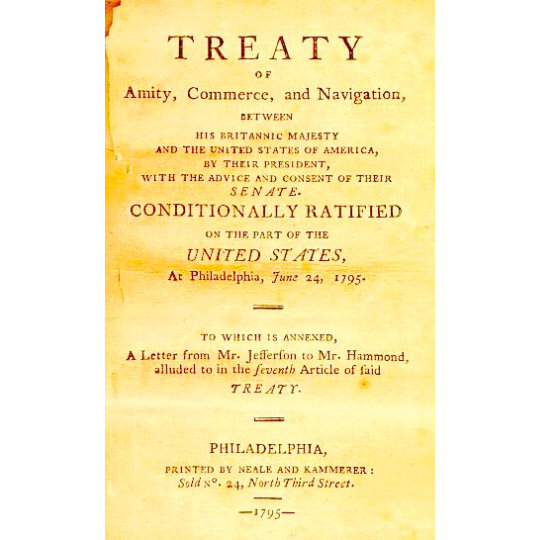
The treaty’s aim was to resolve outstanding issues from the conclusion of the American Revolutionary War and facilitate economic trade. Although some of the clauses were not fulfilled completely and another war, the War of 1812, erupted because of it, the treaty did serve a purpose. The agreement ushered in a decade of trade between the two countries and gave the fledgling nation a chance to gain footing, a major concern for George Washington, as first president. The treaty also cemented the promise that Great Britain would vacate the forts in the Northwest Territory and agreed to arbitration on the boundary between Canada and the United States and the pre-American Revolutionary War debt.

Yet, the treaty was divisive. Even Jay remarked that he could find his way in the dead of night by the illumination of his own effigy. The treaty angered the French as that country was amid its revolutionary throes, and bitterly divided the nation. Out of it came the separation into two political parties, the Federalists, who supported the treaty, and the Democratic-Republicans who stood opposed to it.

The treaty was ratified by the Senate on June 24, 1795, with an exact two-thirds majority, 20 to 10 along with being passed by William Pitt the Younger, prime minister of Great Britain and his government, and took effect on February 29, 1796.

Historian Joseph Ellis wrote that the Jay Treaty was “a shrewd bargain for the United States” and “a precocious preview of the Monroe Doctrine.” As one of Washington’s most fervent wishes, the treaty “postponed war with England until America was economically and politically more capable of fighting one.”
Another American in Paris

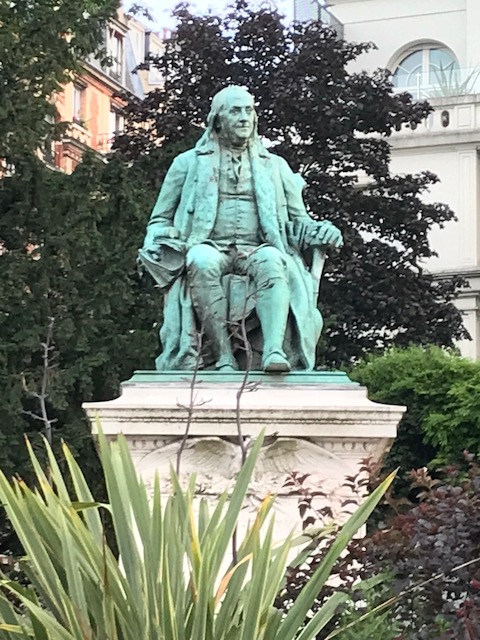
IMG_0931So, vacation time rolls around again and this year my family and I had an opportunity to travel to Paris, France for a few days.  Riding into the city from Charles de Gaulle Airport, our taxi driver, by chance, took us past an old, green-corroded bronze statue, set in the middle of a little flowered square.  From my vantage, I could only see the bottom portion of the statue; what appeared to be the lower portion of a man in buckled shoes, seated in a wooden chair, atop a marble pedestal.  My wife happened to be in the right spot in the vehicle as we quickly drove by.  “Looks like Benjamin Franklin, I think.” she said, and with those words, she sent me on a journey to find that statue again and, hopefully, other sites in Paris associated with Mr. Franklin.
Unlike his colleague from New England, John Adams, who was from good, plain Puritan stock, the pulse of a city like Paris, with its decadence, opulence and social intrigue, fit Benjamin Franklin like a glove.  As ambassador to France after the signing of the Declaration of Independence, Franklin was instrumental in helping to obtain for our fledging nation the financial and military support necessary for bringing our war for independence to a happy conclusion.  To the people of Paris, he was somewhat of a celebrity, due to his experiments with electricity. He spoke French and endeared himself to the people by displaying, in his dress and speech, what they considered his “rustic” demeanor.  In a word, they were charmed by Benjamin Franklin.  The fur cap he was fond of wearing only added to his disguise of “homespun rusticity”.  So, finding a monument to him in this city was not much of a surprise.  Continue reading “Another American in Paris”

Review: Constitutional Myths: What We Get Wrong and How to Get It Right by Ray Raphael

Review by Jim Howell

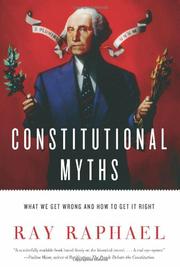
Constitutional Myths by Ray Raphael is a well written, if potentially controversial book that takes a fairly in-depth look at eight constitutional interpretations that are currently popular political positions. The 301-page monograph provides an excellent, brief synopsis for each topic, which is referred to as a “myth”. Each constitutional “myth” has a more elaborate explanation after the initial brief summary with a significant amount of supporting primary source evidence.

const_myths
Constitutional Myths by Ray Raphael

Raphael, a scholar of the Founding Fathers, has written extensively on the early United States and his frequent footnotes often refer to his previous research and primary documents from the period in question. Of particular note is his constant reference to the two most extensive constitutional documents, Notes of Debates in the Federal Convention and The Federalist Papers.

From the very beginning of the book, Raphael makes it clear that the Constitutional Convention set out to remedy the defects in the Articles of Confederation. Some of these defects were the inability of the central government to tax, draft citizens to form an army, or pass a variety of laws. In short order, this lead to a number of problems in the states and in all likelihood, the demise of a number of states to European powers. The pendulum that had swung to a severe distrust of a distant, powerful government was on its way back to establishing a strong government that could look out for the interests of its constituents.

Readers of the more conservative persuasion, who often take a position in favor of small government, impartial Founding Fathers, and originalism, will likely find some of the positions in Constitutional Myths controversial. Despite some of the positions that present day conservatives argue the founding fathers supported, Raphael goes to great lengths to refute those modern day positions and provide the context behind the decisions that were made in 1787.

One of the best examples of this in Constitutional Myths was the chapter devoted to The Federalist Papers. As detailed, The Federalist Papers were written by three authors; James Madison, Alexander Hamilton, and John Jay. They were written as a tool to advocate for the adoption of the Constitution, not to provide commentary on the finer points of the Constitution. Additionally, a number of the points in The Federalist Papers were made by delegates who did not necessarily agree with the argument they were making, but believed in the compromises of the constitution and were trying to sell the agreement to the necessary number of states for ratification.

Raphael’s treatment of originalism is especially thought provoking given its popularity in today’s political climate. The Constitution and its interpretation have been open for debate from the moment it was ratified. The delegates of the Constitutional Convention created a compromise and it would be a mistake to ascribe any specific meaning to the original intent; as any given founder may have had differing thoughts on what a particular clause might mean. The author makes the astute point that the Constitution is a framework inside which the various states, United States Congress, Supreme Court, and the president are meant to work.

Details:

336 pages, ISBN-13: 978-1595588326

Published by: New Press


*Jim Howell is a librarian in Northern Virginia and enjoys reading modern military history and science fiction*