

ERW is pleased to welcome back guest author Marianne Holdzkom.
July 4, 2026, was a big moment for the United States. This day marked the 250th anniversary of the adoption of the Declaration of Independence, what many call the birthday of the United States. As people were making plans, the question was always, “Where do you want to spend this important anniversary?” There were certainly many fantastic choices: New York City, Boston, Philadelphia, and Colonial Williamsburg, just to name a few. Yet I have known for a number of years where I would be. It was a no-brainer. I would spend that day in Quincy, Massachusetts. There is no place else for me. Not only was this 4th the 250th birthday of the Declaration of Independence, but it also marked the 200th anniversary of the deaths of John Adams and Thomas Jefferson—fifty years to the day that the Declaration was adopted by the Continental Congress. It was that anniversary that drew me to Quincy. As a John Adams scholar, I was compelled to be in the town where he lived and where he died. I needed to pay my respects. While others were deciding what fireworks display to see, I was on a mission: Quincy or bust!
Even when Adams was serving abroad, his hometown was never far from his thoughts. “I know not the Reason but there is some Strange Attraction between the North Parish in Braintree [now Quincy] and my Heart,” he wrote to Abigail. “It is a remarkable Spot. It has vomited Forth more Fire than Mount Etna. It has produced three mortals, Hancock and two Adams’s, who have, with the best Intentions in the World, set the World in a blaze.”[1] He was writing from Paris at the time. Now, as the locals will tell you, Quincy is full of history that goes well beyond the Adamses. From the early years of the Massachusetts Bay colony, this region has been one of the historically richest areas of the country. Even in the early colonial period, the South Shore was the center of controversy with the antics of Thomas Morton and some of the Puritan disputes of the 17th century taking place here. The city also honors the history of the Quincy family for which the town was named. In addition, Quincy is the birthplace of both Dunkin’ Donuts and Howard Johnson. There is also a Quincy Quarry and Granite Workers Museum in the city.[2] There is no doubt that the city’s history is fascinating. Yet the attraction for many is always the remarkable Adams family. In this Semiquincentennial year, when Americans are remembering their founding moment, many of us came to Quincy to honor John Adams.
My husband, Dr. Albert J. Churella, ever the good sport about my John Adams fandom, had secured hotel reservations for us in my home from home in Quincy. The hotel is conveniently located across the street from the Quincy North T Station and makes it easy to get around Quincy on the Red Line. On the evening of July 3, after settling into our hotel, we rode the two T stops to Quincy Center. From here, it is a short walk to the Hancock-Adams Common, United First Parish Church, the Adams National Historical Park Visitors Center, and the Quincy Historical Society. As we strolled to dinner, I took the time to pose with the statues of John Adams and Abigail Adams on the Common. We also visited the new John Quincy Adams statue which I had never seen. This statue and the little park surrounding it are nice additions!
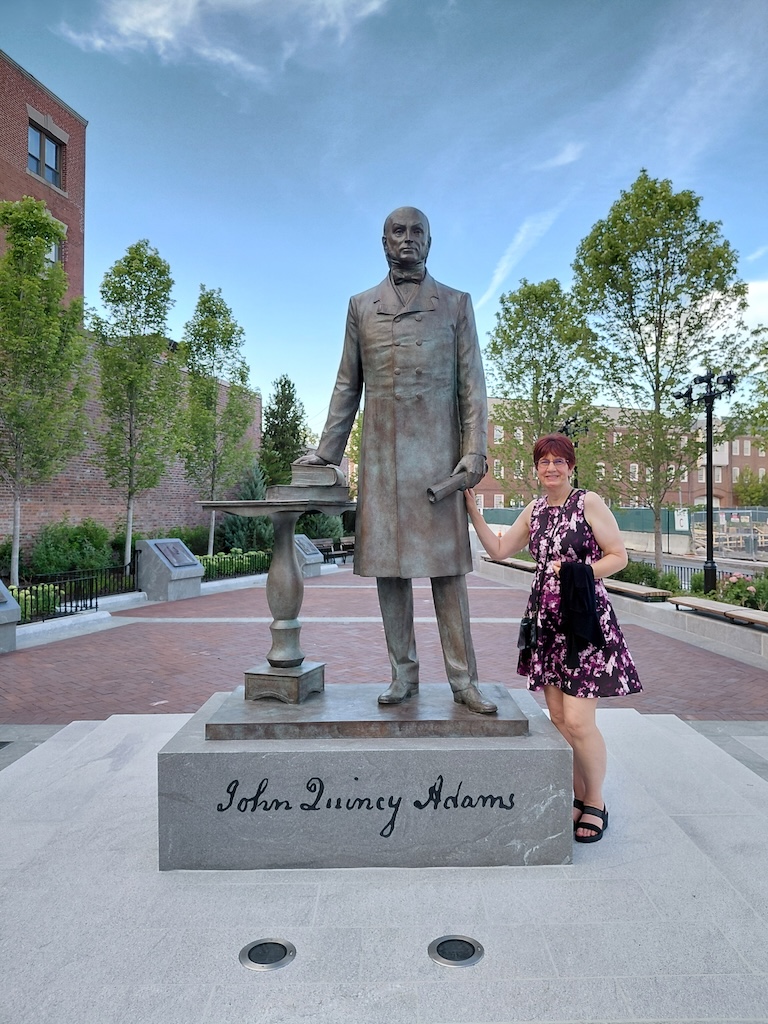
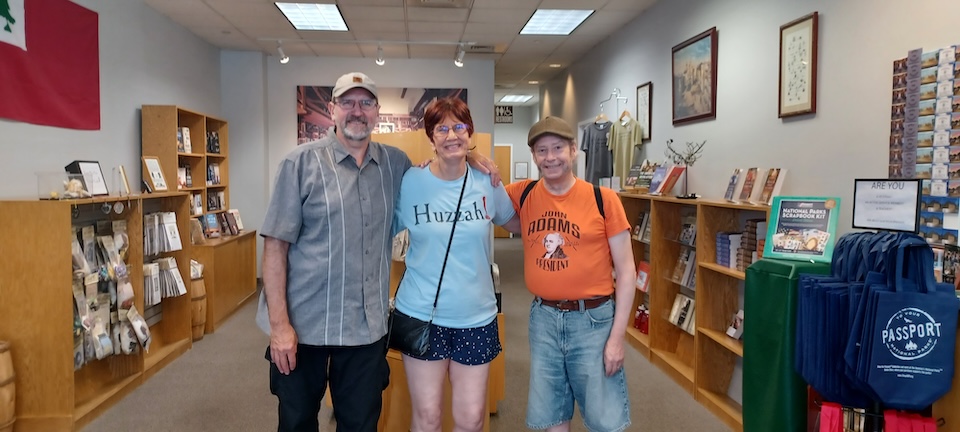
On the morning of July 4, the big day, we arrived early at the Adams National Historical Park. We knew the temperatures would soar, and the earlier we arrived the better chance we had of getting into the historic homes. Here, we met Mr. Scott McKinley, a fellow Adams family fan, and a talented voice actor as well as scholar. It was a delight to meet him and share part of the day with him.
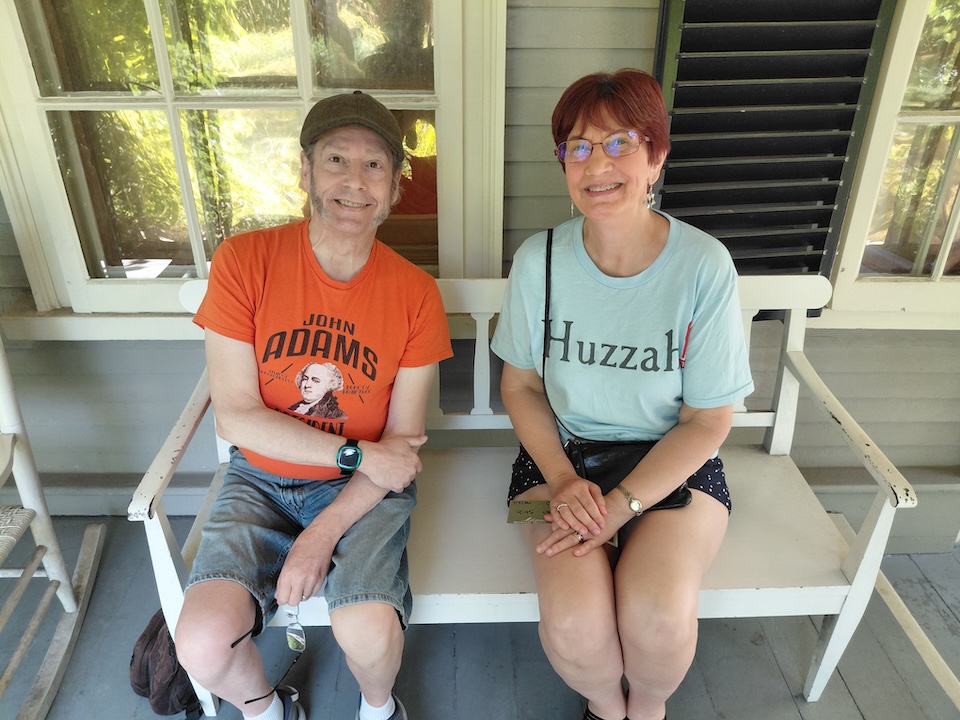
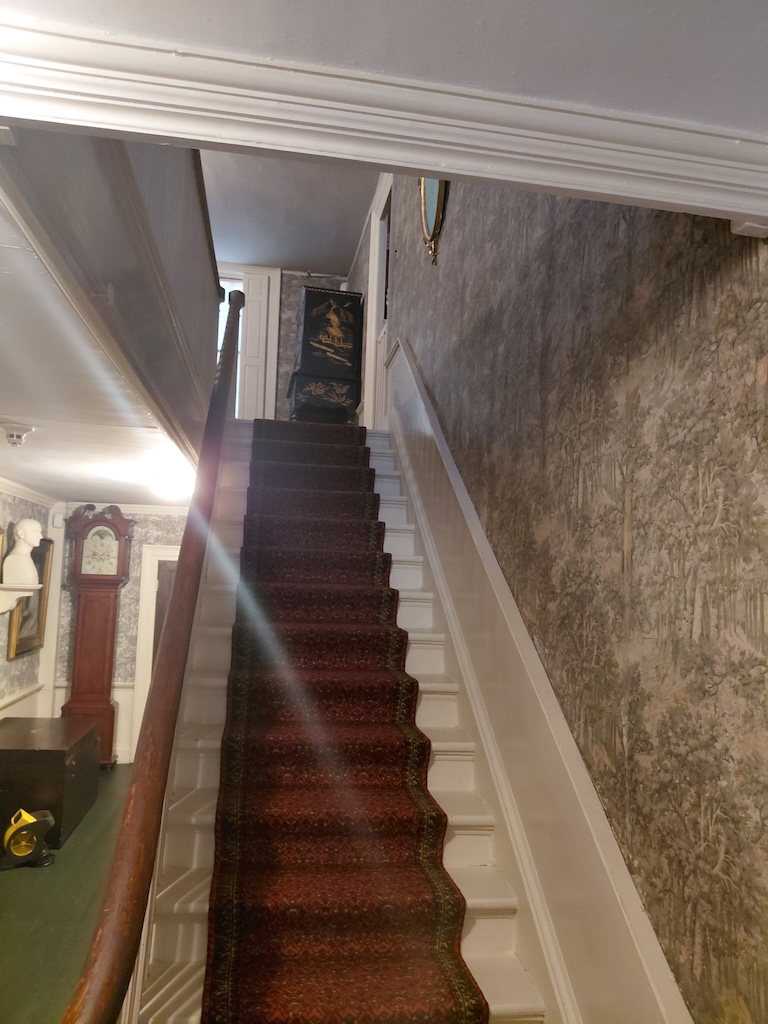
As the Visitors Center opened, we took our place in line with the other people who had decided to spend part of their day with the Adamses. We were fortunate to get a condensed tour of Peacefield in the morning as the temperatures in the house were becoming unbearable. Unfortunately, I could not see the one room that really mattered to me on that day. Reportedly, John Adams died in his upstairs study, and we were not allowed to go there due to the heat. The best thing I could do was take a picture of the staircase. However, according to our guide, one of the staff members at the park is doing some research into the exact place of John Adams’s death. He is not convinced that it happened in the study so stay tuned. I am still grateful that I was able to be in the house, however briefly.
One of the special events the park planned for that day was a public reading of the Declaration of Independence. Hilary Miller, Chief of Interpretation at the park, arranged for volunteers from the audience to read portions of the Declaration. Of course, all three of us in our party participated. It was a great way to remind ourselves of the power of those words. While I was disappointed that there was no programming surrounding the death of John Adams on that day (that happened the following weekend), I was happy to be a part of this nod to the Declaration of Independence.
I had several nice moments that day at Adams. I was happy to see, for example, that the park is still selling my book, Remembering John Adams: The Second President in History, Memory and Popular Culture. For an academic author, seeing one’s book on sale is always a win! Yet the nicest gift of all that day came from Hilary Miller. She remembered me from past visits and had something to share with me. Miller had requested a Cameo Video from William Daniels for her team as part of their July 4th celebration. She was kind enough to show it to me! The 99-year-old actor, John Adams to so many of us, recorded a wonderful tribute to the park and thanked them for all they are doing to preserve the legacy of John Adams and his family. I was touched that Hilary wanted to share that with me, knowing how much I would appreciate it.
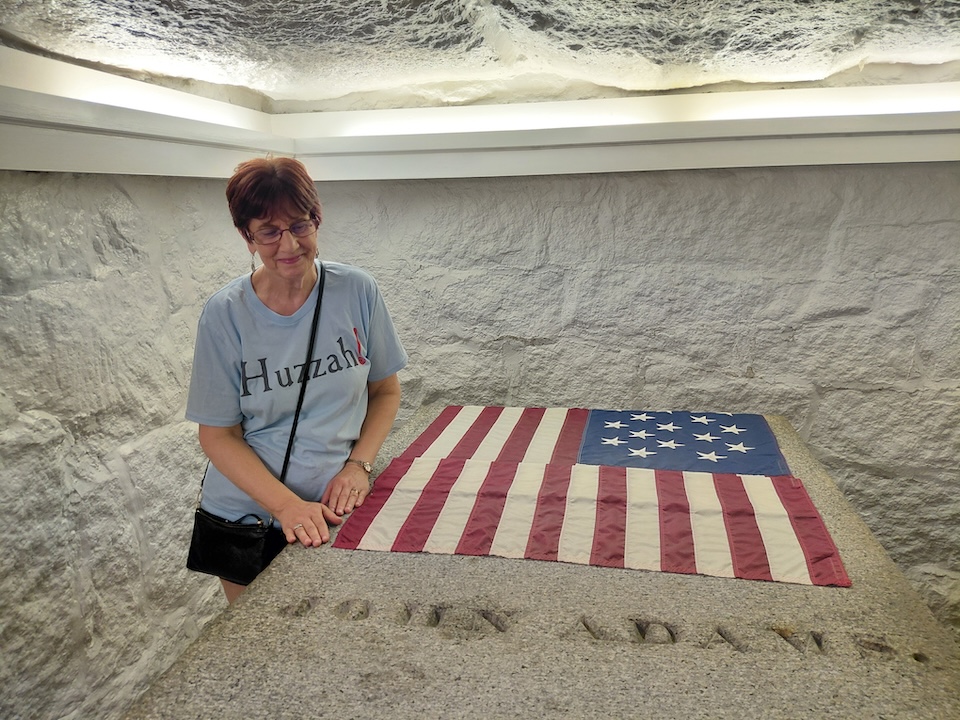
Finally, that afternoon, we arrived at United First Parish Church, or The Church of the Presidents. The church was completed in 1828 and built in part from granite donated by John Adams. He was a life-long member of the congregation here and wished to see a “Stone Temple” built to replace the wooden meeting house in his beloved town. He, along with Abigail, John Quincy Adams, and Louisa Catherine Adams, are buried in the church’s crypt. This is where I had to be, more than any other place that day. As we met up with Bill Westland, the delightful church historian who has been a tremendous help to me in my research, I prepared myself for my visit to John Adams’s grave. I knew that I would not have a moment alone there. That just doesn’t happen although I have never requested it. I was just hoping to be able to shut out everything else and pay my respects. John Adams’s words were swirling around in my brain. “Posterity! You will never know, how much it cost the present Generation, to preserve your Freedom! I hope you will make a good Use of it. If you do not, I shall repent in Heaven, that I ever took half the Pains to preserve it.”[3] “Yet through all the gloom, I can see the rays of Ravishing Light and Glory.”[4] Meanwhile, my husband was taking pictures of me so that I could remember the moment. This was my chance to pay my respects. He understood how important that was to me as did Scott.
As I was standing by John Adams’s tomb, another woman came up and said that she was there to pay her respects and thank him for his service. I was touched by this and didn’t mind sharing the moment with her. Then I had to try and put into words what I was feeling. I looked down at the tomb and asked Mr. Adams, “What do we do now?” The woman standing with me thought that was a very good question. I asked this question because I have been struggling to see those rays of ravishing light and glory lately. I love the optimism and hope in the statement, and I remind myself daily that if John Adams could say this given what he was up against then surely I can, too. Still, I needed his help that day. However, we did not get an answer to my question. Silence.
When you spend as much time studying a historical figure as I have John Adams, you believe that you can know how they would respond to questions or statements in conversation. I know what I wanted to communicate, and I was only getting started. Next, I said to John, “I’ve done the best I can for you and your legacy. Thank you for everything.” It was then that I could imagine a reply. “Thank you, Madam. And I have done the best I can for you. For all of you! What do you do now, you ask? That is up to you. I can do no more but to wish you well!” Fair enough, President Adams. Message received. And thank you!
Marianne Holdzkom, Professor of History at Kennesaw State University, is the author of Remembering John Adams: The Second President in History, Memory and Popular Culture. She is also an Adams Memorial Foundation Scholar.
[1] John Adams to Abigail Adams, 15 August 1782, Adams Family Papers, An Electronic Archive, Massachusetts Historical Society, https://www.masshist.org/digitaladams/archive/doc?id=L17820815ja.
[2] For the early history of this region of Massachusetts, see Nina Sankovitch, American Rebels: How the Hancock, Adams and Quincy Families Fanned the Flames of Revolution (New York: St. Martin’s Press, 2020); For exhibits and resources concerning all aspects of Quincy history, visit the Quincy Historical Society and Museum, https://quincyhistory.org/; For more info on Quincy granite, see the Quincy Quarry and Granite Workers Museum, http://www.quincyquarrymuseum.org/
[3] John Adams to Abigail Adams, 26 April 1777, Adams Family Papers: An Electronic Archive, Massachuetts Historical Society, https://www.masshist.org/digitaladams/archive/doc?id=L17770426ja.
[4] John Adams to Abigail Adams, 3 July 1776, Adams Family Papers: An Electronic Archive, Massachusetts Historical Society, https://www.masshist.org/digitaladams/archive/doc?id=L17760703jasecond.
 Emerging Revolutionary War Era