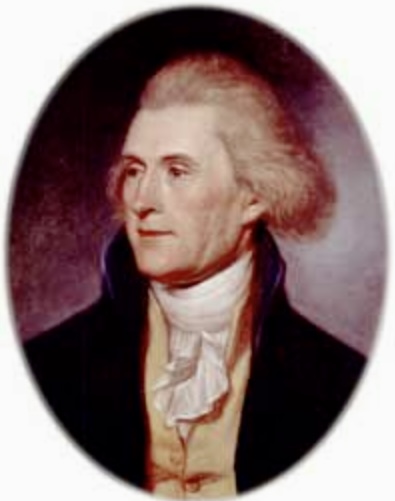
On the anniversary of Thomas Jefferson’s birthday, Emerging Revolutionary War welcomes back guest historian Madeline Feierstein.
Alexandria, Virginia, is famous for its presidential native son: George Washington. The Old Town has maintained its colonial charm, in spite of raging warfare and demolition waves since its founding in 1749. This port city, however, has hosted numerous other American presidents – especially Thomas Jefferson. Our third president visited and stayed in Alexandria on several occasions, and his connections to this Northern Virginia locale extended past his death in 1826.
While enroute to Philadelphia, Jefferson typically went north of Alexandria to cross the Potomac into Maryland. It was not until after the Revolution, and with his emergent friendship with George Washington, that his visits to Alexandria became regular and expected. But as an Alexandrian, I’ve heard more “town lore” about Washington’s longstanding affiliation with the city than any other president. The following accounts are not exhaustive, but they aim to spotlight the reasons for Jefferson’s presence and his impact on the city itself.
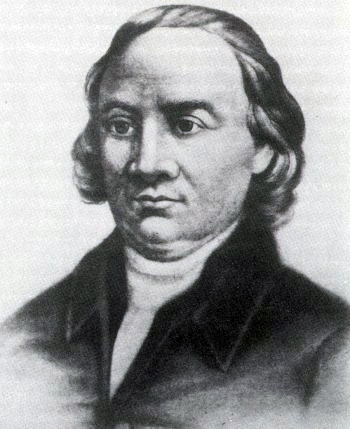
1790 was a critical year for the region. The National Capital Act was hotly debated. Where would America’s main city be located? Mayor William Hunter extended an invitation to Jefferson in March 1790 for dinner in his honor at the Fountain Tavern, which no longer stands, and where he had previously stayed.[1] At this time, his passage through Alexandria coincided with his trip to New York to assume the role of Secretary of State.
Jefferson understood Alexandria’s importance as a thriving commercial and political center, especially since the next nearest urban hubs were days away in Richmond and Baltimore. Mayor Hunter hoped that Alexandria would be in the running for capital selection, and that this dinner would confirm the statesman’s opinion: “You have returned to your native Country [from France]. Permit us the inhabitants of Alexandria to join with the rest of our fellow citizens in the warmest congratulations to you on that happy event. As a commercial town, we feel ourselves particularly indebted to you for the indulgencies which your enlightened representations to the Court of France have secured to our trade. You have freed commerce from its shackles…”[2]
In September of that year, Jefferson met with George Washington back in Alexandria to continue the discussion of where to assign the new capital. He and James Madison, along with notable figures in the Georgetown and Great Falls neighborhoods, negotiated the boundaries of the new federal city. Jefferson and Madison stayed overnight in Alexandria on September 14 before turning homeward bound.[3]
Gadsby’s Tavern is one of the most famous spots in Old Town. Famous for being the site of Washington’s farewell (to the presidency in New York), and a general meeting spot for the city’s elites, it’s no wonder that Jefferson also frequented this establishment! In January 1801, he stayed at the Tavern before his first inauguration. Ten days later, the ceremony, a banquet was held for him at Gadsby’s – and it apparently had the honor of being the “largest event ever given in the city.”[4]
There is no evidence that Jefferson came back to Alexandria after this 1801 visit. Additionally, no business interests here are documented, which is odd considering Alexandria’s reputation for commerce and industry. He appeared to prefer to travel north of the city to and from Monticello at this point, once again taking the ferry across the Potomac from Georgetown and continuing through what is now Loudon County southward. But the Jefferson connection did not end with the President’s change of scenery.
Granddaughter Virginia Jefferson Randolph Trist (1801-1882) and her husband moved to Alexandria in 1874. Her own daughter, Martha Burke, Jefferson’s great-granddaughter, resided in the city with her family. After Virginia’s husband died, she moved in with Martha until her own death.[5] Another granddaughter, Virginia’s sister, Cornelia Jefferson Randolph (1799–1871) joined niece Martha’s home, where she also died.[6]
Extensive family members of Thomas Jefferson are buried in Alexandria’s Ivy Hill Cemetery. Martha Burke’s daughter, Ellen Coolidge Burke, was quite active in the city’s civic causes. A reference and catalogue librarian, she is notable for expanding library services and opening branches in the surrounding neighborhoods.[7] A few miles away from where her great-great-grandfather wined and dined, a library was named in her honor before she died in 1975.
[1] “Washington, D.C.,” Thomas Jefferson Encyclopedia, Thomas Jefferson’s Monticello, n.d., https://www.monticello.org/encyclopedia/washington-dc.
[2] “Address of Welcome from the Mayor of Alexandria, 11 March 1790,” Founders Online, National Archives, https://founders.archives.gov/documents/Jefferson/01-16-02-0129.
[3] “Memorandum from Thomas Jefferson, 14 September 1790,” Founders Online, National Archives, https://founders.archives.gov/documents/Washington/05-06-02-0209.
[4] “George Taylor to Thomas Jefferson, 9 March 1801,” Founders Online, National Archives, https://founders.archives.gov/documents/Jefferson/01-33-02-0191.
[5] “Virginia Jefferson Randolph Trist,” Thomas Jefferson Encyclopedia, Thomas Jefferson’s Monticello, n.d., https://www.monticello.org/encyclopedia/virginia-jefferson-randolph-trist.
[6] “Cornelia Jefferson Randolph,” Thomas Jefferson Encyclopedia, Thomas Jefferson’s Monticello, n.d., https://www.monticello.org/encyclopedia/cornelia-jefferson-randolph.
[7] “Women’s History in Alexandria,” Office of Historic Alexandria, 19 November 2025, https://www.alexandriava.gov/historic-alexandria/womens-history-in-alexandria.
Bio:
Madeline Feierstein is an Alexandria, VA historian and founder of the educational and historical consulting company Rooted in Place, LLC. A native of Washington, D.C., her work has been showcased across the Capital Region. Madeline is a writer for Emerging Civil War and the National Museum of Civil War Medicine. She leads significant projects to document the sick, injured, and imprisoned soldiers that passed through Alexandria and Washington, D.C. Madeline holds a Bachelor of Science in Criminology from George Mason University and a Master’s in American History from Southern New Hampshire University. Explore her research at www.madelinefeierstein.com.