

“You do it.”
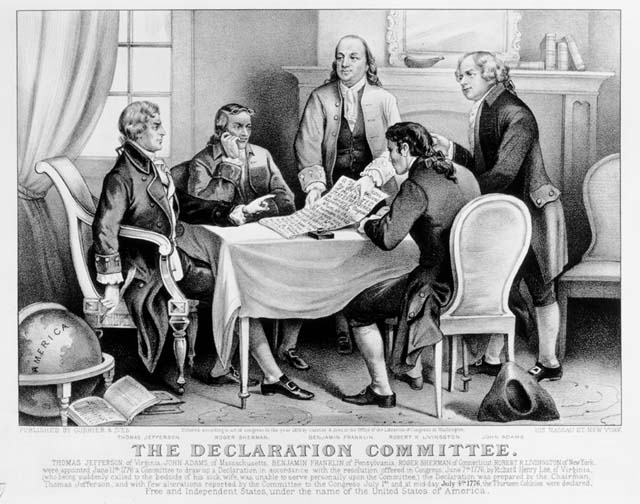
“No, you do it.”
“No, you do it.”
“No. YOU do it. You’re a Virginian, and you write ten times better than me.”
“Okay.”
To read John Adams’s telling of the tale, that’s basically how he, as chair of the drafting committee, drafted Thomas Jefferson to draft the Declaration of Independence.[1] Jefferson’s version, of course, sounds a little different: “[T]hey unanimously pressed on myself alone to undertake the draught. I consented; I drew it. . . .”[2]
While we may never know the details of the discussion, we do know that the drafting committee first met 250 years ago today, on June 11, 1776. Along with Adams and Jefferson—representing Massachusetts and Virginia—the committee included Benjamin Franklin of Pennsylvania, Robert Livingston of New York, and Roger Sherman of Connecticut.
Livingston and Sherman tend to end up as footnotes to the story of the committee. Livingston, an ally of John Dickinson, was added to the committee as a concession to those cool, conservative men. Sherman, meanwhile, had a knack for footnote-ism. Aside from serving as an asterisk on the drafting committee, he’s also famous as a trivia answer for being the only person to sign all four Founding documents: the charter of the Continental Association, the Declaration of Independence, the Articles of Confederation, and the U.S. Constitution.
Franklin’s presence on the committee surprised no one. As the most famous man in America—and, by extension, in the Congress—his celebrity would provide a useful boost to the committee’s final work. It helped, too, that much of his fame came from his pen, which made him a natural fit for the committee.
Adams had the legal mind and the deepest knowledge of government and politics. He was not slouch as a writer, either. But Jefferson had earned his very place in Congress because of his felicity of expression with a pen. His Summary View of the Rights of British Americans (1774) earned him wide recognition in his native Virginia and appointment to the Second Continental Congress. The ideas he expressed also clearly marked him as a radical aligned with the independence movement. Adams admired Jefferson for being “prompt, frank, explicit and decisive” even if he was also notoriously silent for most of his time in Congress.
Jefferson didn’t want to be in Philadelphia to begin with, and in fact, he absented himself from August 1, 1775 until May 14, 1776, citing his wife’s ill health and obligations at home. When he returned to Congress, he did so only from a begrudging sense of obligation. “I am here in the same uneasy, anxious state in which I was in the fall without Mrs. Jefferson, who could not come with me,” he wrote.[3]
Yet Jefferson and his “masterly Pen,” as Adams called it, returned to Philadelphia just in time to put that pen to use. On the drafting committee. Jefferson really wanted to be putting that pen to use writing the constitution for the state of Virginia. He would even go so far as to draft a Constitution of his own and send it to Williamsburg since he couldn’t be there himself, but the document never received consideration. George Mason would end up leading that effort.
By all accounts, the members of the drafting committee saw the task as a throwaway assignment. When Congress eventually voted in favor of independence on July 2, John Adams thought that would be the day the nation would forever commemorate; no one thought of the first public reading of the Declaration on July 4 as being much more than a formality.
Only later, once the document assumed a position in American myth, did the members begin to attach significance to their participation in the drafting process—ergo the dueling versions Adams and Jefferson recalled in their (much) later years. Adams laid out his version in 1822; Jefferson in 1823.
Jefferson took about two weeks to write the first draft, then showed it to Franklin and Adams, “requesting their corrections; because they were the two members of whose judgments and amendments I wished most to have the benefit before presenting it to the Committee. . . .”[4] (Apparently, this established the practice of treating Livingston and Sherman as footnotes.) Adams and Franklin suggested a few important refinements. For instance, Franklin deftly turned “We hold these truths to be sacred and undeniable” into the subtler but more powerful “We hold these truths to be self-evident.” Adams’s handwriting on the original document shows him adding a reference to “their Creator” in an astute instance of knowing his audience. Overall, though, Adams “was delighted with its high tone, and the flights of Oratory with which it abounded,” he later wrote.[5] (Walter Isaacson’s recent The Greatest Sentence Ever Written offers a wonderful exploration of the writing and editing process.)
On June 28, Jefferson would submit his final draft, which Congress would take up for discussion and approval on July 3 (after a painful editing-by-committee process that made Jefferson nearly despondent).
Like all great myths, the details of the committee’s work—from its origins to its final revisions—are brilliantly gauzy enough that we can see what we want to if we squint just right. The real story never quite comes into focus. That’s the frustrating reality for historians but the bewitching charm for everyone else.
And it’s a perfect metaphor for the entire Founding, isn’t it: Adams and Jefferson, both there at the beginning, both explaining a different interpretation of events. Their visions continue to duel today—and if we’re wise, we’ll listen to what both of them have to say.
Chris Mackowski is the author of Atlas of Independence: John Adams and the American Revolution, part of the Emerging Revolutionary War Series from Savas Beatie.
[1] Adams’s full account can be found here: “From John Adams to Timothy Pickering, 6 August 1822,” Founders Online, National Archives, https://founders.archives.gov/documents/Adams/99-02-02-7674.
[2] Jefferson’s account can be found here: “From Thomas Jefferson to James Madison, 30 August 1823,” Founders Online, National Archives, https://founders.archives.gov/documents/Jefferson/98-01-02-3728.
[3] “From Thomas Jefferson to Thomas Nelson, 16 May 1776,” Founders Online, National Archives, https://founders.archives.gov/documents/Jefferson/01-01-02-0153. [Original source: The Papers of Thomas Jefferson, vol. 1, 1760–1776, ed. Julian P. Boyd. Princeton: Princeton University Press, 1950, pp. 292–293.]
[4] “Thomas Jefferson to James Madison, 30 August 1823,” Founders Online, National Archives, https://founders.archives.gov/documents/Madison/04-03-02-0113. [Original source: The Papers of James Madison, Retirement Series, vol. 3, 1 March 1823 – 24 February 1826, ed. David B. Mattern, J. C. A. Stagg, Mary Parke Johnson, and Katherine E. Harbury. Charlottesville: University of Virginia Press, 2016, pp. 114–116.]
[5] “From John Adams to Timothy Pickering, 6 August 1822,” Founders Online, National Archives, https://founders.archives.gov/documents/Adams/99-02-02-7674.

