

In March, 1776 Commodore Esek Hopkins led the bulk of the Continental Navy on a raid to the Bahamas, where it occupied the town of New Providence on Nassau Island for two weeks. Hopkins and his captains were drawn by a report of gunpowder stored in the town, which the patriot cause desperately needed.[1] Unfortunately for Hopkins, the colony’s governor had spirited away some 150 barrels the night before the American flotilla’s arrival. Not all was lost as the Marines quickly demanded and received the surrender of two small forts defending the town and its harbor. With those in hand, Hopkins and his men quickly got to work removing artillery, military stores, and other useful supplies.
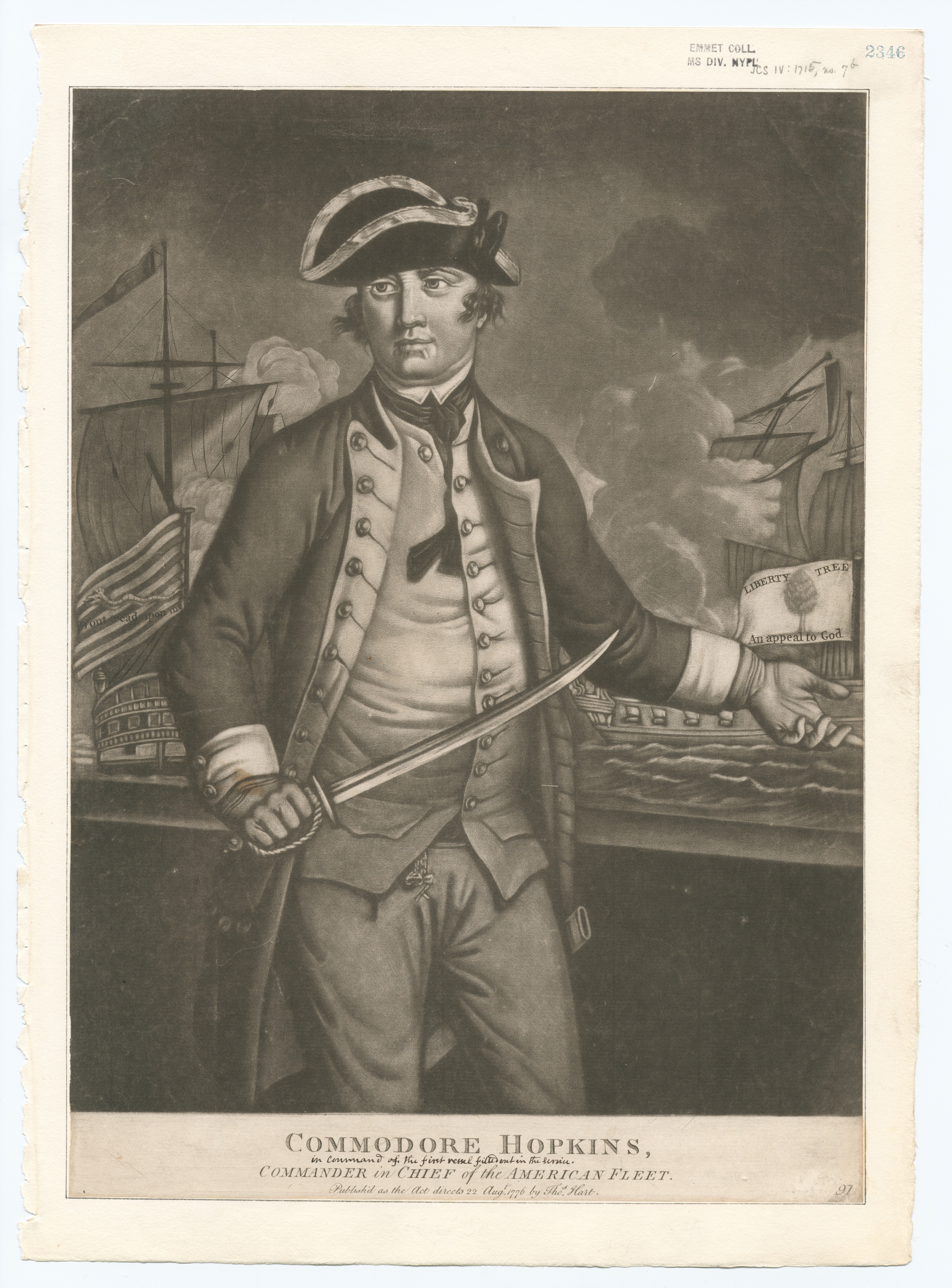
While the American Marines and sailors managed to recover just 24 casks of powder, their haul in sizeable artillery pieces and mortars was impressive: 88 cannon ranging from 9- to 36-pounders; 15 mortars from 4-11 inches; 5,458 shells; 11,071 roundshot; 165 chain & double shot, plus fuses, rams, sponges, carriage trucks, mortar beds, copper hoops, and various stores not required for artillery.[2] It was a boon to be sure. The curious part of Hopkins’ inventory of captured war material, however, is that he sent it to Connecticut Governor Jonathan Trumbull, not a representative of the Naval Committee that had issued his orders. To John Hancock, president of the Continental Congress, he sent a report of his mission, but only mentioned “I have taken all the Stores onboard the fleet.”[3] Indeed, his report of the armaments aboard the British schooner Hawke, which the fleet captured on its return to American waters, was more complete. It took another day, until April 9, for Hopkins to forward the inventory of seized cannon. Congress merely resolved that an extract of his letter should be published for delegates to peruse.[4] Perhaps inadvertently, Hopkins exacerbated regional political conflicts and undermined his own command.
Hopkins’ behavior revealed a loyalty to New England that trumped his relationship with Congress. Even before leaving the Bahamas the commodore ordered Lieutenant Elisha Hinman of the Cabot to take command of a sloop from the Bahamas and set out for Providence, Rhode Island, where he was to land his cargo of captured guns and stores and report to Rhode Island’s Governor Nicholas Cook or Governor Jonathan Trumbull.[5] Reunited at New London Connecticut, Hopkins ordered the officer to take command of the Cabot and deliver ten guns to General Henry Babcock, commanding the troops of Rhode Island, at Newport.[6]
Hopkins further made plans to disperse two 9-pounders and shot to the town of Dartmouth.[7] On the same day he reported on the results of his mission to John Hancock, the commodore reported the same to Governor Cook, requesting the Rhode Islander send him a list of what stores the government might want from Hopkins’ captured war materiel.[8] In short, Hopkins was taking steps to distribute his captured artillery among the states of New England, from where he hailed, rather than leaving those decisions to the civil authorities in Congress, which had raised the fleet.
Upon his return, Hopkins faced a shortage of manpower. He asked Gurdon Saltonstall to write his counterpart in the army, George Washington, on his behalf and request permission to enlist 150-200 seamen from among Washington’s troops.[9] For his part, Washington stopped in New London Connecticut and went aboard Hopkins’ flagship, Alfred, to confer. He presented a list of his own artillery needs to Hopkins, most likely during that meeting on April 9.[10] Hopkins did not act on Washington’s request, which was reasonable if he intended Congress to allocate the resources. But, it was after his meeting with Washington that Hopkins sent Hinman and Cabot on their mission to deliver ten guns to General Babcock. Washington repeated his request to Hopkins on April 14, then, on April 15, asked Congress sort the matter out.[11] The body acted on April 19, resolving that “General Washington may order as many of the cannon and military stores as are not necessary for the continental fleet, and which were lately brought into New London, by the commander thereof, to any other place he may think proper; having regard only to the permission of Congress relative to the defence of the harbour of New London.”[12] Congress further requested to see the list of stores required to defend New London along with the list of artillery stores that had been sent to Congress on April 9, as if Washington had not seen such a list during or after his meeting with Hopkins.
Congressional intervention seemed to contain any growing tension for the moment, but greater issues were coming to the fore. Hopkins had been ordered by Congressional Naval Committee to sweep the coasts of Virginia, the Carolinas, and Rhode Island of British vessels, something he had failed to attempt. That proved a bigger bone of contention than the allocation of his cannon and eventually led to a resolution of censure. Still, the question of artillery rankled some, at least in the south. Thomas Jefferson, who reconstructed the debate over Hopkins’ censure, noted in particular the lack of cannon in North Carolina and believed that the “Carolinas or Southern colonies” were “the main object of his expedition..[and]..the object of equipping the Navy.”[13] Surely, Hopkins’ predilection for allocating cannon among the towns and governors of New England was an undercurrent in his eventual sacking.
[1] “Journal Prepared for the King of France by John Paul Jones,” Naval Documents of the American Revolution, Volume 4 (Washington, DC: The U.S. Navy Department, 1969), 133. The Naval Documents will hereafter be cited as NDAR, volume, page.
[2] “Commodore Esek Hopkins to Governor Jonathan Trumbull,” NDAR, IV, 711-712.
[3] “To the honble. John Hancock Esqr. Presdt. Of the Congress at Philadelphia, April 8th 1776,” Alverda S. Beck, ed., The Letter Book of Esek Hopkins, Commander-in-Chief of the United States Navy 1775-1777 (Providence, RI: Rhode Island Historical Society, 1932), 46-48.
[4] “April 16, 1776,” Journals of the Continental Congress, Volume IV (Washington, DC: Government Printing Office, 1906), 285. Hereafter JCC, volume, page.
[5] “Orders given to Lieutt. Elisha Hinman,” Letter Book of Esek Hopkins, 46.
[6] “To Elisha Hinman Esqr. Lieutt. of the Cabot, April 16. 1776,” Letter Book of Esek Hopkins, 51.
[7] “To the Committee of the Town of Dartmouth, March 18th 1776,” Letter Book of Esek Hopkins, 46.
[8] “To the honble. Nicholas Cooke Esqr. Governor of the Colony of Rhode Island at Providence, April 8th 1776,” Letter Book of Esek Hopkins, 50-51.
[9] “Gurdon Saltonstall to George Washington, April 8. 1776,” NDAR, IV, 710.
[10] “Expenses of Journey to New York, 4-13 April 1776,” notes, Founders Online, National Archives, https://founders.archives.gov/documents/Washington/03-04-02-0030.
[11] “From George Washington to Commodore Esek Hopkins, 14 April 1776,” Founders Online, National Archives, https://founders.archives.gov/documents/Washington/03-04-02-0049; “April 19 1776,” JCC, IV, 295.
[12] “April 19, 1776,” JCC, IV, 296-297.
[13] “Jefferson’s Outline of Argument Concerning Insubordination of Esek Hopkins, 12 August 1776,” Founders Online, National Archives, https://founders.archives.gov/documents/Jefferson/01-15-02-0547. The manuscript is dated 12 August 1783, but archivists believed Jefferson simply made a mistake when reorganizing his papers.
 Emerging Revolutionary War Era