

Emerging Revolutionary War welcomes guest historian Evan Portman
Overlooking the Grand Parade at Valley Forge National Historical Park is a statue almost as solid as the man it portrays. Baron von Steuben helped transform the American army into an effective and efficient fighting force in the winter of 1777-1778, but he also aided the country nearly a century and a half later. Yes, Baron von Steuben helped the United States through World War I—or at least the social turmoil on the home front.

Friedrich Wilhelm August Heinrich Ferdinand Steuben was born in Prussia (modern day Germany) in 1730 and served in the Prussian army through the Seven Years’ War. By 1775, Steuben had accrued a considerable amount of debt (despite his stature within the aristocracy), so he sought a foreign military appointment. Failing to catch the eye of the British, French, or Austrians, the Baron set his sights on the fledgling American government. Congress arranged for Steuben to be paid, depending on the outcome of the war, and sent him to the winter encampment at Valley Forge. There, he began drilling the Continental army and instituted better hygiene and sanitation practices. He also wrote a drill manual, which he published in 1779 as Regulations for the Order and Discipline of the Troops of the United States. After the encampment at Valley Forge, Steuben participated in the Southern Campaign of the Revolutionary War. After the Siege of Yorktown, Congress awarded the Baron a tract of land in New York where he died in 1794.
Steuben’s name lived relatively dormant in American memory until nearly a century later, when America entered yet another military and political crisis. Germany, now united under one national banner instead of separate kingdoms, had declared war on France, England, and their allies in response to a decades-long arms race between the European powers. The United States remained neutral, but aggressive actions from the German government and military, like the sinking of the Lusitania (in which 128 U.S. citizens perished), further inflamed public opinion toward Germany. Prejudice against German Americans resurfaced in propaganda and acts of unrest throughout the country. Those that vehemently opposed Germany sought to erase every trace of Germanic culture in American society.
German Americans reacted to this movement in two ways: preserving their German cultural heritage while also affirming their American patriotism. The National German American Alliance, (NGAA), formed in 1901 and devoted itself to both missions. In addition to promoting German language instruction in schools and founding German heritage societies, the NGAA also championed the German American role throughout U.S. history.[1] Naturally, Baron von Steuben became a figure that represented this cause. The NGAA commissioned two statues of Steuben, first in Utica, New York in 1910 and then in Washington, D.C. in 1914.
The Alliance chose Jakob Otto Schweizer to design the Steuben monument in Utica and called upon him again to sculpt an exact replica for Valley Forge. Schweizer was a Swiss immigrant and proud member of the German Society of Pennsylvania. His sculpture of Peter Muhlenberg (now located in the Philadelphia Museum of Art) caught the attention of a national audience. In accordance with the NGAA’s wishes, Schweizer reproduced his Utica statue almost down to its exact height and width. The only addition he made was a bronze relief depicting Steuben drilling the Continental army. Schweizer honored Steuben’s well-documented sternness in his sculpt. The general looks out upon the fields of Valley Forge with an expression that “reflects determination, but not harshness.”[2]
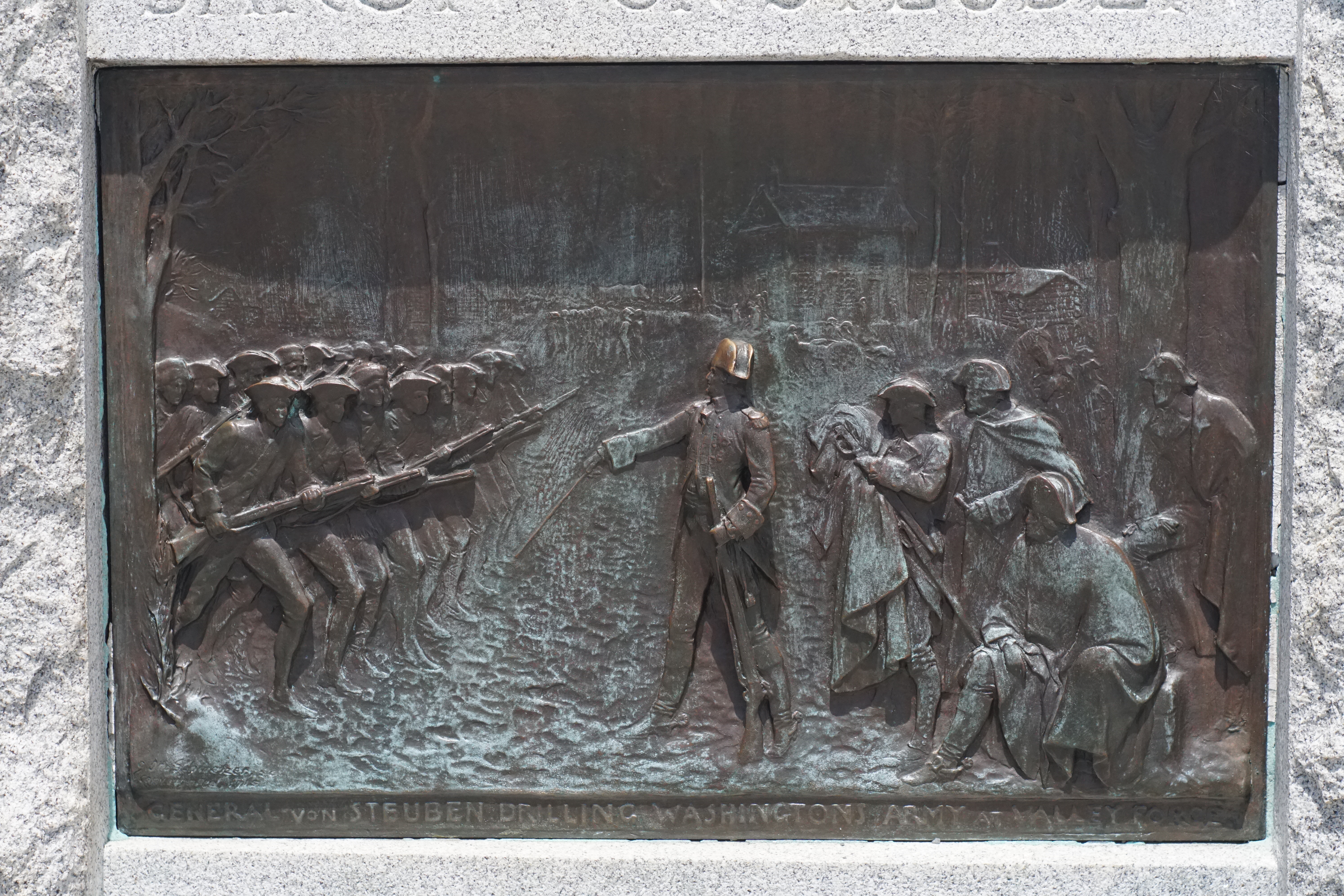
The statue was initially placed on Outer Line Drive, near the monument to Gen. Anthony Wayne and dedicated on October 9, 1915. Dignitaries and citizens from far and wide traveled to the fields of Valley Forge to witness the unveiling of the statue. Pennsylvania Governor Martin G. Brumbaugh was scheduled to attend the ceremony, but his trip was delayed by rainy weather, so Adjutant General Thomas J. Stewart spoke in his stead. An immigrant himself, Stewart recognized the importance of von Steuben’s service to the Continental Army. “As long as this flag flies, these hills endure, the fields remain, and history tells the story of all that was done and suffered here, the memory of Baron von Steuben will not be forgotten, but will be cherished forever,” he exclaimed.[3]
B. Herman Ridder, the son of a prominent German American newspaper editor, affirmed that von Steuben embodied the German militarism needed by the Continentals in 1777. “He brought into Washington’s army the thing most needed, the thing for which Prussian militarism stands—order, discipline, organization,” Ridder suggested. “He did not have to come here, but he came because he wanted to be an American, and, with Washington and Lafayette, he combined the Germanic ideal with the Anglo-Saxon and Gaelic, producing the American ideal and viewpoint.”[4] This testimony is noteworthy, as German Americans sought to meld their traditions with an existing American culture to be less conspicuous. The early 1900s also saw the onset of the melting pot theory, in which American ethnic identity drew from various foreign customs.
Then, Dr. Charles Hexamer, president of the National German-American Alliance, addressed the issue of German loyalty to the United States. He quoted correspondence between von Steuben and Gen. Washington “to show that the sole motive which brought the Baron here was the desire to aid in erecting the Republic.” After a brief flourish by the United Singers of Philadelphia, Miss Hildegard Hexamer received the honor of unveiling the statue. “[It] is a handsome bronze figure, mounted on Barre granite,” the Philadelphia Inquirer trumpeted.[5]
Despite the ethnic vitriol of the early 20th century, the von Steuben statue was well received. “Much as is to be regretted the tendency to fill Valley Forge Park with monuments and statues,” the Inquirer later wrote, “there can be no doubt that in honoring Baron von Steuben with a bronze effigy the authorities have acted wisely.” Another newspaper, The Morning Union, professed that “Baron von Steuben is one of the few foreign officers who possess a warm place in the hearts of Americans.”[6]
The Steuben monument may have quelled nativist fervor in eastern Pennsylvania for a while, but harsh rhetoric toward Germans resumed in the months and years that followed. As mentioned above, on February 1, 1917, Germany returned to a policy of unrestricted warfare after it had stopped following the sinking of the Lusitania. Two months later, on April 6, 1917, the United States declared war on Germany, thereby entering World War I.
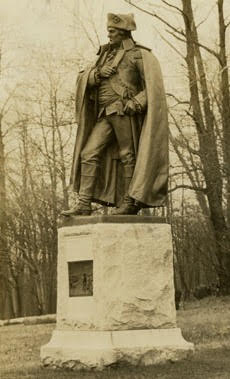
While anti-German sentiments remained high during America’s involvement in the war, patriots like Baron von Steuben helped stymy the prejudice. In the hundred years since the First World War, von Steuben’s statue has served as a testament to his valuable service to the army during that harsh winter at Valley Forge. On September 10, 1979, the statue was moved to its current location overlooking the Grand Parade.
Even today, von Steuben stands as a symbol of the United States as a nation of immigrants. In 2023, twenty new American citizens took the oath of allegiance in front of the von Steuben statue.[7] Indeed, the monument serves as a reminder that without von Steuben’s help, and that of countless other foreigners[pg1] the American Revolution likely would never have been won. Their ideals, contributions, and sacrifices ensured ultimate victory—all of which are embodied by von Steuben at Valley Forge.
[1] Don Heinrich Tolzmann, The German-American Experience, (New York: Humanity Books, 2000), 262-268.
[2] Hans A. Pohlsander, German Monuments in the Americas: Bonds Across the Atlantic, (Bern: Peter Lang, 2010), 29; Ernst Jockers, J. Otto Schweizer: The Man and His Work, (Philadelphia: International Printing Company, 1953), 56-57.
[3] “Unveil Statue to General Steuben: German-American Alliance Honors Drillmaster’s Memory at Valley Forge,” The Philadelphia Inquirer, October 12, 1915, Newspapers.com (accessed August 8, 2024).
[4] “Unveil Statue to General Steuben,” The Philadelphia Inquirer, October 12, 1915, Newspapers.com (accessed August 8, 2024).
[5] Unveil Statue to General Steuben,” The Philadelphia Inquirer, October 12, 1915, Newspapers.com (accessed August 8, 2024).
[6] “Honor Memory of Baron von Steuben,” The Morning Union, November 29, 1915, Newspapers.com (accessed August 8, 2024).
[7] “Twenty New American Citizens Sworn In at Valley Forge National Historical Park,” National Park Service, October 19, 2023, (accessed August 9, 2024), https://www.nps.gov/vafo/learn/news/twenty-new-american-citizens-sworn-in-at-valley-forge-national-historical-park.htm.
Evan Portman has been passionate about history for as long as he can remember. He has enjoyed reading, writing, speaking, and learning about the Civil War ever since he took a trip to Gettysburg as a seven-year-old. Evan majored in history and secondary education at Saint Vincent College and is currently pursuing a master’s degree at Duquesne University.
After serving as an intern with the American Battlefield Trust education department, he now works as a video editor helping to create the Trust’s educational content. Evan enjoys speaking at a variety of Civil War roundtables and also writes for Emerging Civil War, the Westmoreland County Historical Society, and the Catholic Historical Society of Western Pennsylvania.
 Emerging Revolutionary War Era