

Emerging Revolutionary War welcomes guest historian David Stowe.
William Billings looked like an oaf, wrote poetry, snuffed small fistfuls of tobacco in company, taught himself to write music, was a street-cleaner, was an artist.
-David McKay and Richard Crawford, William Billings of Boston (1980)
I knew I wanted to write a book about William Billings. I just wasn’t sure which kind would be possible. I’ve been writing about the quirky Boston composer since my second book, How Sweet the Sound (2004) and always find more to say about him. His colorful adaptation of a Hebrew psalm to the American Revolutionary cause helped fuel my interest in what became Song of Exile: The Enduring Mystery of Psalm 137 (2016).
So how did I come to write a historical novel about him?
Partly because I came to the end of my sources and didn’t have nearly enough to tell the story I thought he deserved. There were many parts of Billings’s experience, including the most important ones, I’d never have access to. But his life was too rich and interesting to leave alone. So I was left with no choice but to make it up.
There were some other, possibly better reasons. One had to do with audience.
I thought historical fiction might be a way to reach a broader readership than a standard biography would, especially for a non-household name like Billings. Back in 2020 I published my first novel, Learning from Loons, and mostly enjoyed the process.
Finally, a novel seemed the best way to get Billings’ fascinating life story out to readers when it would matter most: during the 250th anniversary of 1776 and the beginning of American independence.
Once I started creating the novel I didn’t look back. I continue to work on a more conventional biography but for now I’m happy to have historical fiction representing my research.
For those unfamiliar with the name, William Billings was the first major composer in North America. Born in 1746, he lived in Boston, worked as a leather tanner, taught singing schools, and published several collections of psalms, hymns, and anthems, more than 340 in all. Several of these continue to be sung regularly in churches and choral groups.
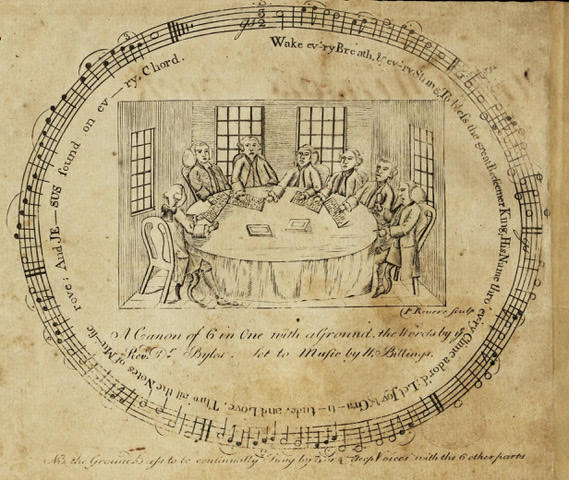
Billings was self-taught, a lifelong member of Boston’s South End working-class, an active associate of the Whigs who spearheaded the American Revolution. He was a companion of Samuel Adams, with whom he often sang psalms. Paul Revere engraved the frontispiece for his first tunebook. And he tanned leather for most of his life.
Not surprisingly he’s been the subject of scholarly work, including at least three monographs, but they are written by music historians. Their focus is musicological. These books make some passing connections between Billings’s music and his life and times, but provide little linear narrative and granular detail of the sort expected in biography.
They leave much work to be done reconstructing his family life and situating Billings in the political and cultural events of revolutionary Boston.
As Louis Benson wrote in 1915, “The personality and work of this one-eyed, illtaught, and enthusiastic natural genius, form an engaging theme, from whatever view-point it be approached. The only adequate materials for studying him are the music, treatises, prefaces, &c., contained in the series of his tune books.”
Billings’ life follows a kind of fall, rise, and fall—not quite rags to riches and back, but close. He apparently received some schooling. At age 14, his father died, leaving his wife and children nothing from his estate.
Billings was apprenticed to a tanner and began learning the trade, while also picking up sufficient knowledge of music to become a singing school instructor. He began composing his own music and at age 24 published his first tunebook, The New-England Psalm-Singer, in 1770.
Four years later Billings married Lucy Swan a few months after meeting her at a singing school he taught in Stoughton, Mass. They had six children that survived childhood. He continued composing and teaching prolifically during the 1770s and 1780s, allowing him to buy a house on fashionable Newbury Street.
And then, surprisingly, Billings turned his attention to literature. During the 1780s he published several works of fiction and became editor of Boston Magazine for one issue, after which he was removed for his alleged poor taste.
After that, Billings’s fortunes declined. In the 1790s, when he was required to take work as a scavenger and streetcleaner. His last musical work was an anthem, now lost, performed after the death of George Washington. Billings himself died in 1800 and was buried in an unmarked grave on Boston Common, which his devotees commemorate each year.
Another fact about Billings: he had a voracious appetite for snuff. And his appearance was unforgettable. “Billings was somewhat deformed in person,” wrote Nathaniel Gould in 1853, “blind with one eye, one leg shorter than the other, one arm somewhat withered, with a mind as eccentric as his person was deformed.”
A draft of The Musical Tanner is now complete. But I faced an unusual kind of deadline pressure. It seemed crucial to make the novel available this year, when many people are (or will be, however briefly), thinking about the events of 1776. I realized there was no time to get a manuscript through the editorial process in time.
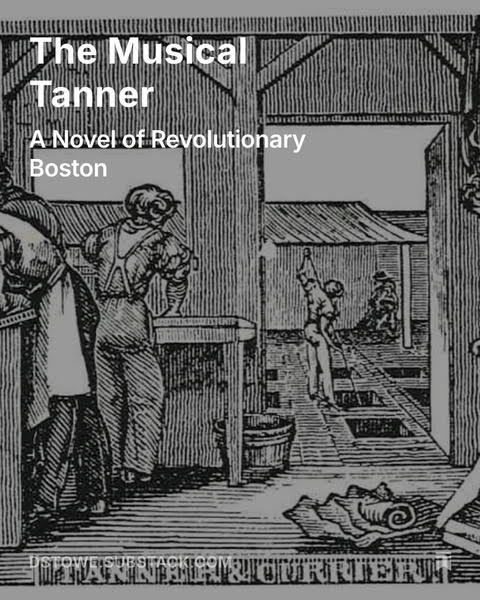
So I decided to serialize The Musical Tanner on Substack. Every Friday appears a new chapter, finishing up sometime around July 4, 2026. I encourage you to dip into the novel, for which I’m also posting an audio version. There is no subscription fee. It’s time this unique and prolific early American got some of the recognition he deserves. To read more about Billings and the novel, click here.
Biography:
David Stowe is a professional historian and musician who’s taught about American culture and music for more than 30 years. He’s published one novel, “Learning from Loons” (2020), some short stories and poetry, and several works of non-fiction, one of which won the Deems Taylor Award from ASCAP. Stowe has published on the New York Times op-ed page and been interviewed by CBS Sunday Morning about his research.
 Emerging Revolutionary War Era