

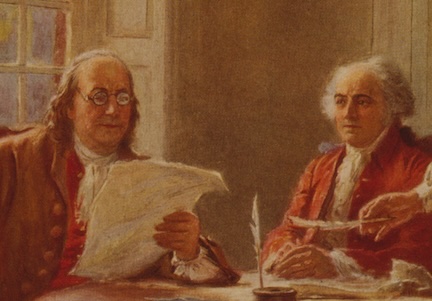
War and politics can both necessitate some strange bedfellows, and that was certainly the case 250 years ago today when two of the Revolution’s leading figures found themselves literally sharing a bed.
During the battle of Long Island on August 27, 1776, the British captured Gen. John Sullivan of New Hampshire. They then paroled Sullivan and sent him to Philadelphia bearing a message from the British Peace Commissioners, Admiral Lord Richard Howe and his brother, General William Howe. The Howes invited the Continental Congress to discuss terms for peace.
Most in Congress considered the overture disingenuous, and some even bore ill-will toward Sullivan for bringing such an odious message. However, delegates also understood that if they rebuffed the overture out of hand, it would look as though they, not Great Britain, were to blame for continued war. On September 6, Congress decided to appoint a three-man delegation to travel to the British headquarters on Staten Island, New York, to hear what the British had to say.
In a move intended to underscore Congress’s seriousness about America’s newly declared independence, they chose John Adams as one of the three commissioners to make the trip. Adams would represent New England. Representing the South, the delegate chose Edward Rutledge of South Carolina, the youngest member of Congress but as fervent as Adams in his support for independence. As the final member of the delegation, Congress chose Benjamin Franklin, representing the mid-Atlantic states. Franklin was easily the member of Congress with the most experience diplomat, having lived in Britain for 15 years as the official agent of several colonies. Franklin also knew Lord Richard Howe personally.
The trio set out on Monday, September 9, breaking their journey into three stages. Franklin and Rutledge shared Rutledge’s coach while Adams accompanied them on horseback. On the first night, they spent the evening in Brunswick, New Jersey. On the second, they traveled as far as Perth Amboy. On the third, they arrived in New York and met with Howe. All along the way, the commissioners saw fallout from the battle two weeks earlier. “On the Road and at all the public Houses, We saw such Numbers of Officers and Soldiers, straggling and loytering,” Adams wrote, noting that it gave him “a poor Opinion of the Discipline of our forces and excited as much indignation as anxiety.”
On that night of September 9 in Brunswick, the travelers found themselves lodging in an overcrowded inn. Adams and Franklin were forced to share a room. “[B]ut one bed could be procured . . .” Adams recounted, “in a Chamber little larger than the bed, without a Chimney and with only one small Window.”
The two men had worked together on the committee that had reviewed Jeffersons draft of the Declaration of Independence as well as on a committee to develop a great seal for the new government. By all accounts, they worked well together and enjoyed each other’s company during their many interactions in Congress. And so it was with good humor that the two men approached their cramped quarters.
As they prepared to turn in, Adams shut the window. “Don’t shut the Window,” Franklin entreated. “We shall be suffocated.”
Adams explained that he was “an invalid and afraid of the Air in the night.”
“[T]he Air within this Chamber will soon be, and indeed is now worse than that without Doors,” Franklin tried to assure him. “Come! open the Window and come to bed, and I will convince you: I believe you are not acquainted with my Theory of Colds.”
Acquiescing, Adams shut the window and leapt into bed. He had, in fact, heard of Franklin’s theory, but admitted, “the Theory was so little consistent with my experience, that I thought it a Paradox.” Adams encouraged Franklin to explain. “I had so much curiosity to hear his reasons, that I would run the risque of a cold,” Adams conceded.
As Adams later recounted, “The Doctor then began an harrangue, upon Air and cold and Respiration and Perspiration, with which I was so much amused that I soon fell asleep, and left him and his Philosophy together. . . .” But even as Adams drifted off to sleep, he had the distinct impression that Franklin, too, was drifting off: “the last Words I heard were pronounced as if he was more than half asleep.”
For anyone interested in Franklin’s full theory of colds, as explained to Adams, you can read the details for yourself in the September 9, 1776, entry of Adams’s diary. According to the Massachusetts Historical Society, “Franklin was long and deeply interested in the causes of common colds and projected a treatise on the subject.”
The next morning, the commissioners continued on with their journey (which we’ll cover in an upcoming blog post). The effective working relationship between Adams and Franklin would survive the trip but, in the years ahead, would become fraught and deeply dysfunctional.
Thus it was—with a degree of grim satisfaction and perhaps smugness—that Adams would recount, years later, the circumstances of Franklin’s eventual death: “he fell a Sacrifice at last . . . to his own Theory; having caught the violent Cold, which finally choaked him, by sitting for some hours at a Window, with the cool Air blowing upon him.”
————
Check back on September 11—the anniversary of the Staten Island Peace Commission—for part two of this series.
Adams quotes in this piece come from: John Adams, diary (vol. 3), 9 September 1776. https://www.masshist.org/publications/adams-papers/index.php/view/ADMS-01-03-02-0016-0187


Great piece, Chris! I have heard that they filmed this incident for “1776,” but the scene didn’t make the cut. I would have loved to see William Daniels and Howard Da Silva act this!
LikeLiked by 1 person
That would have been a hilarious scene, particularly with Daniels and DiSilva!
LikeLike