In another installment of #TrentonTuesday we look at Washington’s plan of attack. George Washington, who had been mulling the prospect of an attack for weeks, saw an opportunity in the Hessian outpost at Trenton. Much of his information was coming from his spies and he also realized that the British employed numerous spies in his own camp, so he would need to conceal his plans. Secrecy and stealth would be the most important aspects if he wished to keep the element of surprise on his side. Washington though needed to act. His aide, Colonel Joseph Reed wrote to Washington that “Our affairs are now hasting fast to ruin if we do not retrieve them by some happy event. Delay is now equal to total defeat.”
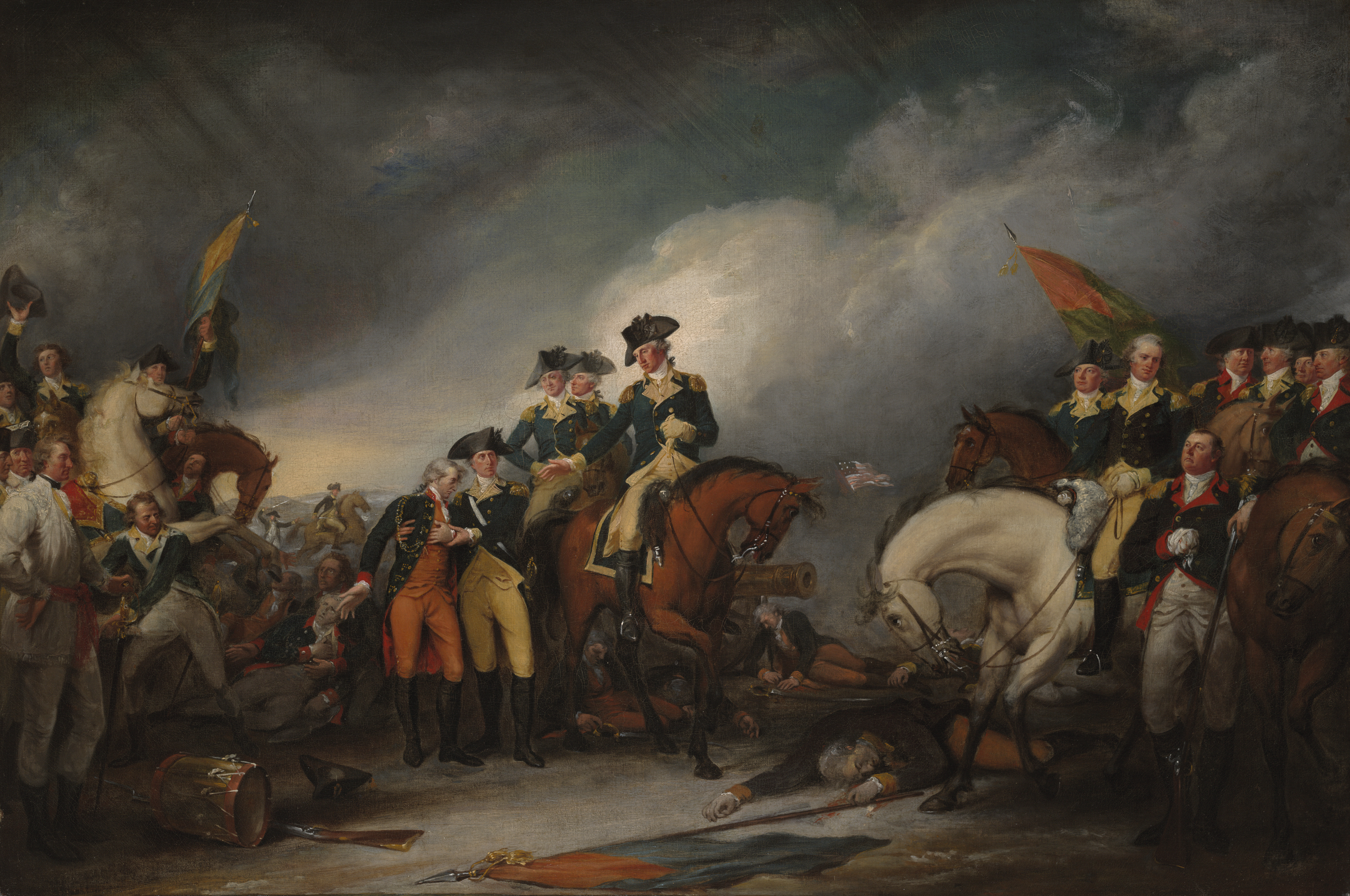
John Trumbull’s painting of the surrender of the Hessians at Trenton depicts a wounded James Monroe lying behind the dying Colonel Rall.
Join ERW historians Mark Maloy and Rob Orrison as we welcome Scott Harris, Executive Director of the James Monroe Museum, to discuss James Monroe’s service in the American Revolution. Monroe had a well-known and distinguished political career, but it all started as a solider in George Washington’s army. Leaving his studies at the College of William & Mary in 1776 he would distinguish himself on numerous battlefields during the war. We will highlight Monroe’s role in the Battle of Trenton as we gear up for our November bus tour! At the Battle of Trenton, Monroe was nearly killed in some of the fiercest fighting in that pivotal engagement. Tune in on Sunday to learn more and join us in November to see where it actually happened!
To watch it live, visit our Facebook page at 7p.m. EST on Sunday, September 19. If you can’t make it on Sunday, you can watch it and dozens of other programs on our YouTube page.
For this week’s edition of #TrentonTuesday, check out the recent presentation by ERW author Mark Maloy for the American Battlefield Trust’s 2021 Virtual Conference. In it he gives a broad overview of the campaign and touches on some of the places we’ll be visiting this November as part of our 2021 bus tour. If you haven’t already, check out the book here. Enjoy!:
In another installment of #TrentonTuesday, we look at the desperate situation George Washington found himself at in December of 1776. With the Delaware River serving as a barrier between his army and the British and Hessians, Washington was hoping to stave off the entire dissolution of the army. He had already seen his army melt away from over 23,000 to just about 5,000 soldiers due to battle casualties, disease, and desertion. By January 1, 1777, the enlistments of many of those remaining soldiers would be up, and he would lose the basic core of his army. Washington wrote on December 18 to his brother John Washington about how his army had “less than 3,000 men fit for duty owing to the dissolution of our force by short enlistments—the enemies numbers by the best accounts exceeding ten, and by others 12,000 men.” He added that “between you and me I think our affairs are in a very bad way.”
Washington deep in thought by a fireplace. (NYPL)
He needed to recruit more soldiers. In the same letter to his brother, Washington wrote that “In a word my dear Sir, if every nerve is not strained to recruit the new army with all possible expedition I think the game is pretty near up.” Here was the commander-in-chief of the Continental Army writing that war was nearly lost.
Today, we begin a series of #TrentonTuesdays. Every Tuesday for the next few weeks we’ll highlight interesting stories related to the Battles of Trenton and Princeton as we approach the inaugural Emerging Revolutionary War bus tour in November. Today we look at the story of Thomas Paine.
As Washington and his army marched quickly across the state of New Jersey from Fort Lee to Trenton in November and December of 1776, they were joined by a young writer. His name was Thomas Paine, and he was well known as the author of the famous patriot pamphlet “Common Sense” that was published earlier in 1776.
Statue of Thomas Paine writing the American Crisis (revolutionarynewjersey.com)
Paine, watching the American army melt away from more that 23,000 men in August of 1776, to less than 5,000 men by December, seemed to be witnessing the destruction of the nascent American nation. During the retreat Paine put quill to parchment to write another pamphlet that he would have published that December, titled “The American Crisis.” With Washington’s army on the verge of dissolution, it was an apt title. He started with a phrase that duly summed up the situation: “These are the times that try men’s souls.”
He goes on to exhort Americans to rally for the cause of liberty in spite of the hardships they faced, an exhortation that still evokes a sense of patriotism hundreds of year later. “The summer soldier and the sunshine patriot will, in this crisis, shrink from the service of their country; but he that stands it now, deserves the love and thanks of man and woman. Tyranny, like hell, is not easily conquered; yet we have this consolation with us, that the harder the conflict, the more glorious the triumph.”
In December 1776, the American Cause for independence was at an all-time low. After losing New York to the British, General George Washington’s Continental army limped into eastern Pennsylvania broken and on the verge of defeat. Against all odds, Washington chose to attack the garrison at Trenton on December 26. The crossing of the Delaware River and victory that followed are widely recognized as having saved the American Revolution. What is less known are the events that occurred in Burlington County, New Jersey that affected this battle.
Between December 21-23, 1776, Hessian detachments under the command of Colonel Carl von Donop were busy prodding the countryside south of Bordentown. American Colonel Samuel Griffin, with a force of 600 mixed units (more than half no older than 15 years old), established a foothold at Mount Holly. Two days of harassment at Petticoat Bridge (Mansfield Township) convinced von Donop that rumors of an American force of 3,000 at Mount Holly were true. On his own authority, the Hessian colonel moved his force of 2,400 on the morning of December 23. What transpired were a series of firefights at Petticoat Bridge, the Mount (along Woodlane Road) and finally at Iron Works Hill on the southside of the Rancocas Creek. The American forces retreated to Moorestown, leaving Mount Holly fully occupied by the Hessian forces. Instead of returning to Bordentown, von Donop stayed. Why? Our answer comes in the journals of Burlington resident Margaret Hill Morris and Hessian Jager Captain Johann Ewald. Both write of a “beautiful young widow” who kept von Donop occupied for three days. The Hessians remained at Mount Holly, more than a day’s march from Trenton. On December 26, a bugler rode into town delivering the news of Washington’s victory. Had Colonel von Donop remained or returned to Bordentown prior to the attack, he would have been readily available to reinforce Colonel Johann Rall at Trenton, likely changing the outcome of the battle.
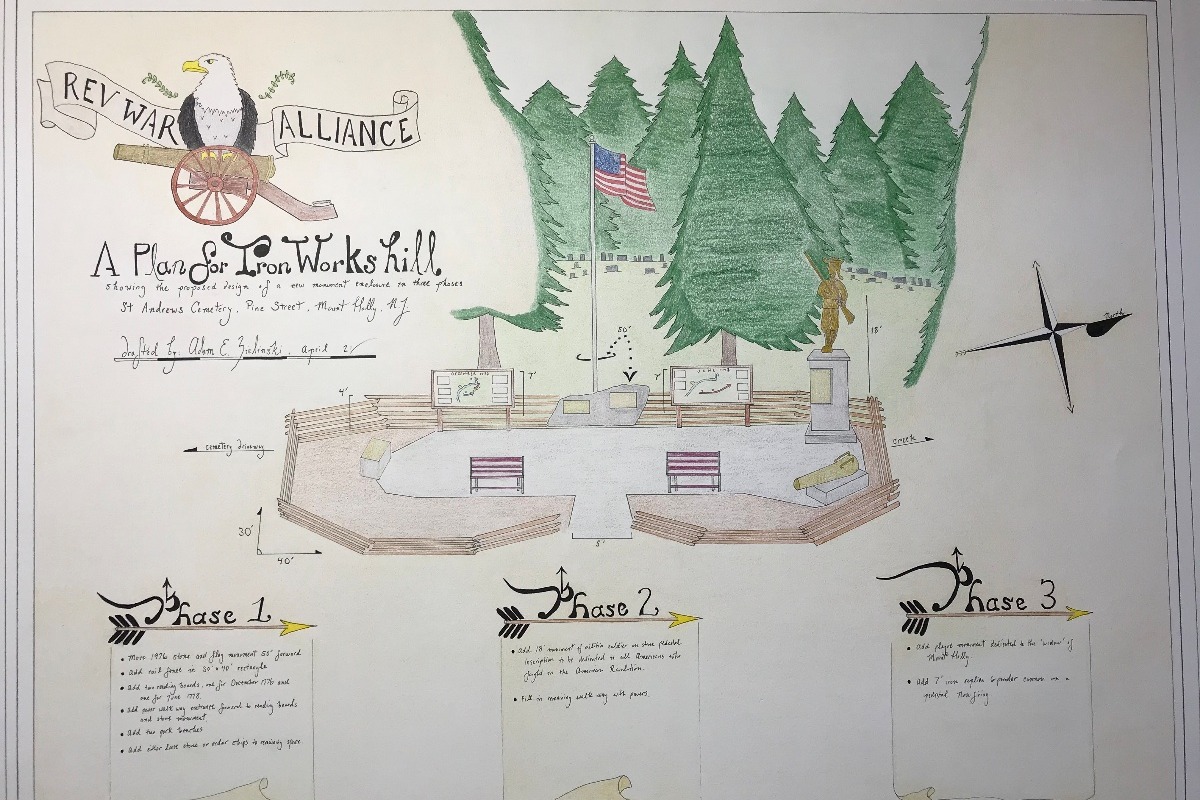
In 1976, a stone monument was erected at St. Andrew’s Cemetery on Pine Street in Mount Holly to honor the events that took place in December 1776. While this monument has served its purpose, we, the Rev War Alliance of Burlington County, feel the time has come to enhance the visitor experience with a new monument project. To coincide with the coming 250th of American Independence, we have received permission to add/build to the existing monument along Pine Street.
The provided sketch/plan is broken down into three phases with Phase 1 being the purpose of this fundraiser.
On May 12, 1780, around noon, the Southern Continental Army formed up in the tabby Hornwork (near present-day Marion Square), marched out of the fortifications and laid down their weapons between their main defensive line and the Hornwork. Their flags were cased and they were forced to play a Turkish march on their drums. This was humiliating to the Patriot defenders. British and Hessian grenadiers entered the Hornwork and the British flag was raised over the American fortifications. Charleston, South Carolina had officially fallen.
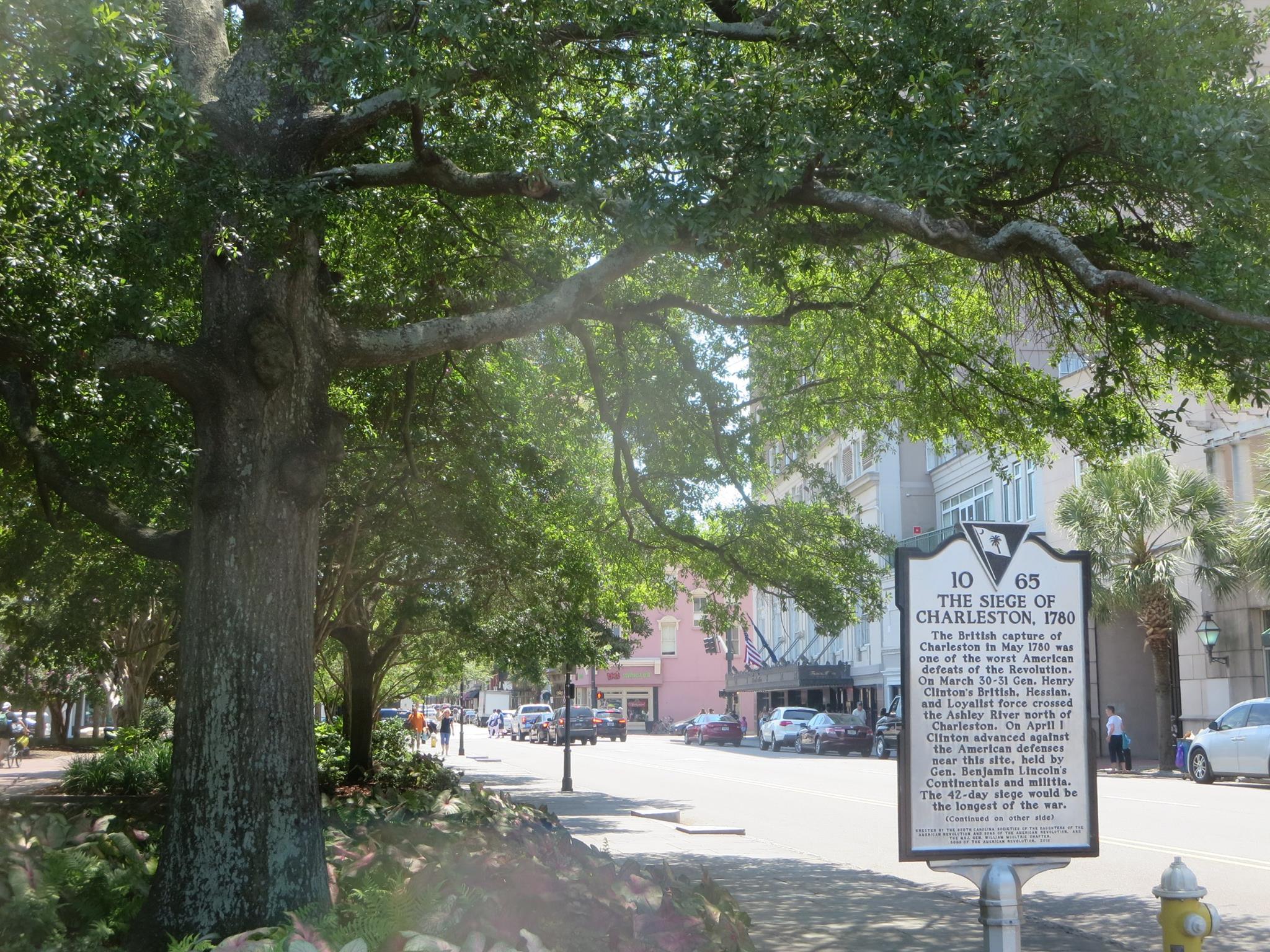
Today a state historic marker marks the location of where the Americans surrendered.
During the surrender ceremony, the British Army lined up to watch the American Continentals surrender their arms. They were amazed to see the wretched condition of the American soldiers. They noted their clothes were ragged and torn and many had no shoes. Despite this, they were extremely disciplined and professional. One British officer noted that it was “admirable that these people still fight for the chimerical freedom of America with such ardor.” Many Continental soldiers were too sick to march out and lay down their arms. Seeing how small a force was surrendering, some of the British were amazed that so few had “made a gallant defense.”
Over the course of the 42 day siege leading up to the surrender, the Americans had lost 89 men killed and 138 wounded. The British had lost 99 killed and 217 wounded. The British were successful in capturing the city, but more importantly than the city, the British had captured the entire Southern Continental Army: 5,618 men, 400 cannon, 15 stands of flags, and 5,000 muskets. Of the men captured 3,465 were hardened Continental veterans who were irreplaceable to Americans. In one swoop, the Continental lines of Virginia, North Carolina, and South Carolina ceased to exist.
Among the prisoners were three signers of the Declaration of Independence: Arthur Middleton, Edward Rutledge and Thomas Heyward. This was the largest defeat the American cause would suffer in the Revolutionary War. The next time America surrendered a larger force to a foreign enemy was at the surrender of Bataan in World War II.
In Philadelphia, John Adams wrote simply that “This is the severest blow we ever received.”
Over the following two years, a bloody civil war erupted throughout the backcountry of South Carolina. As British General Lord Cornwallis marched into the wilderness to subdue the Patriots in the interior of the state, he met initial success, but eventual failure, and ultimately total defeat at Yorktown, Virginia in October of 1781.
The road to Yorktown began at Charleston on May 12, 1780.
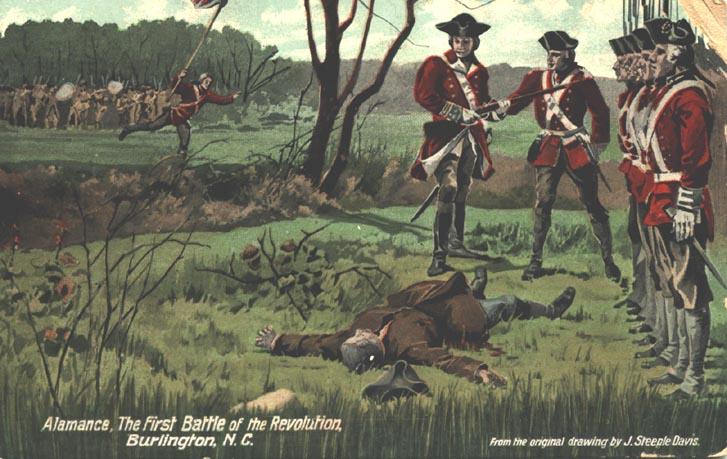
The month of May will mark the 250th anniversary of a little known event that occurred in the North Carolina piedmont called the Battle of Alamance. This battle was the result of an uprising of western North Carolinians who were opposed to the corruption in the colonial government and called themselves “Regulators.” The North Carolina colonial militia under the command of Royal Governor William Tryon marched from the east to quell the rebellion. The two North Carolina forces met at Alamance in May of 1771.
Emerging Revolutionary War welcomes Jeremiah DeGennaro, Historic Site Manager of Alamance Battleground to the “Rev War Revelry” historian happy hour. We will discuss the history of the Battle of Alamance, from what unfolded in North Carolina in 1771 to how this engagement has been remembered. Most recently, the battle was featured in an episode of the TV show, “Outlander.”
Some have suggested that this engagement was the “First Battle of the American Revolution.” But was it? Tune in on May 2 at 7 p.m. ET on the Emerging Revolutionary War’s Facebook page to hear the discussion on this and other questions. If you can’t make it on Sunday night, remember you can watch it later (and all our past “Rev War Revelry’s”) on our YouTube page.
On April 7, 1780, 750 Virginia soldiers completed a nearly 800 mile trek from Morristown, New Jersey to Charleston, South Carolina, only to be captured and sent to prison ships in Charleston harbor.
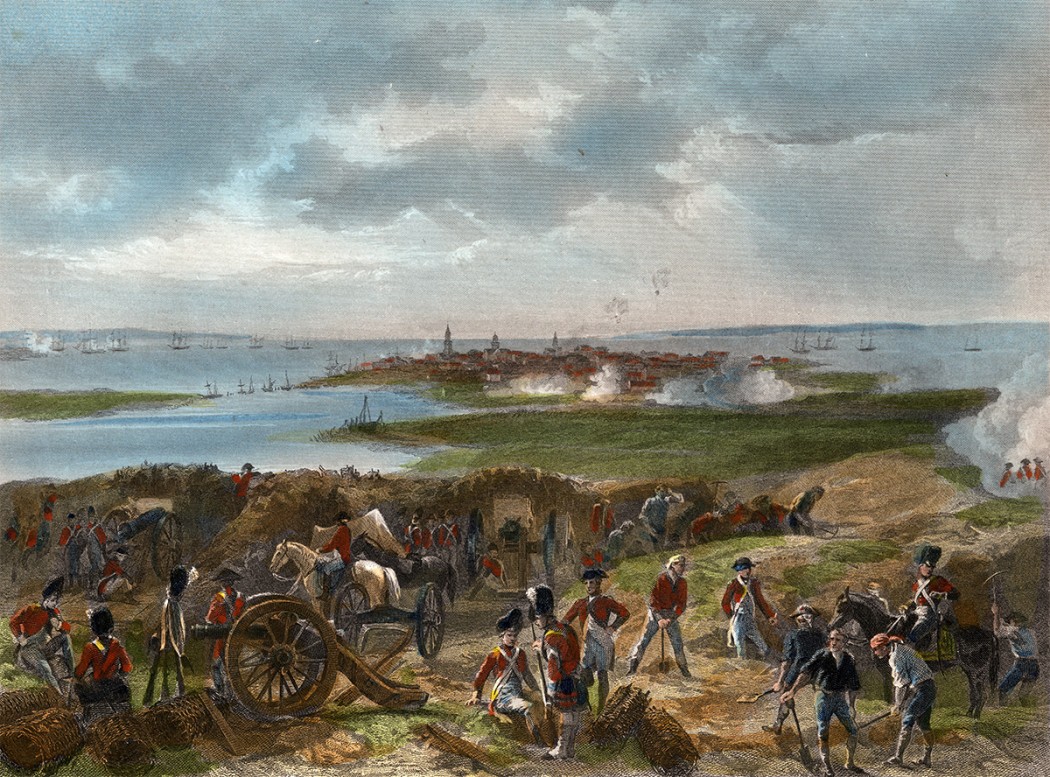
In November and December of 1779, both British General Sir Henry Clinton in New York City and American General George Washington in Morristown, New Jersey, began to turn their eyes south. A combined Franco-American force under the command of General Benjamin Lincoln and Count d’Estaing had made a bloody assault to try and capture the Southern city of Savannah to no avail. The Count d’Estaing took his French force and returned to the Caribbean, and Lincoln took his demoralized American army back to Charleston, South Carolina. With only about 2,400 Continentals and militia, Lincoln’s army (and the city of Charleston) looked like a ripe target for Clinton, who had been part of the botched attempt to capture that city in June of 1776.
Siege of Charleston by Alonzo Chappel
Clinton made the bold decision to take about 9,000 men from his army in New York City and sail them down to South Carolina to make an attempt to capture Charleston and Lincoln’s army.
Washington, learning that Clinton was preparing part of his army to disembark from New York City, began to direct efforts to help defend the city of Charleston. Washington was repeatedly receiving letters requesting troops and supplies from Lincoln and Congress. In November, Washington dispatched the North Carolina Continental line regiments (almost 1,000 men) to reinforce Lincoln, but after talking to his former aide-de-camp Lt. Col. John Laurens, who visited him personally after fighting at Savannah, Washington understood how desperate a situation Lincoln was in. Congress and Washington made the bold decision to send the entire Virginia Continental line regiments (almost 2,500 men) to join Lincoln’s army that December. Washington parted with these venerable veteran soldiers even though it weakened his position guarding against the main British Army at New York City.
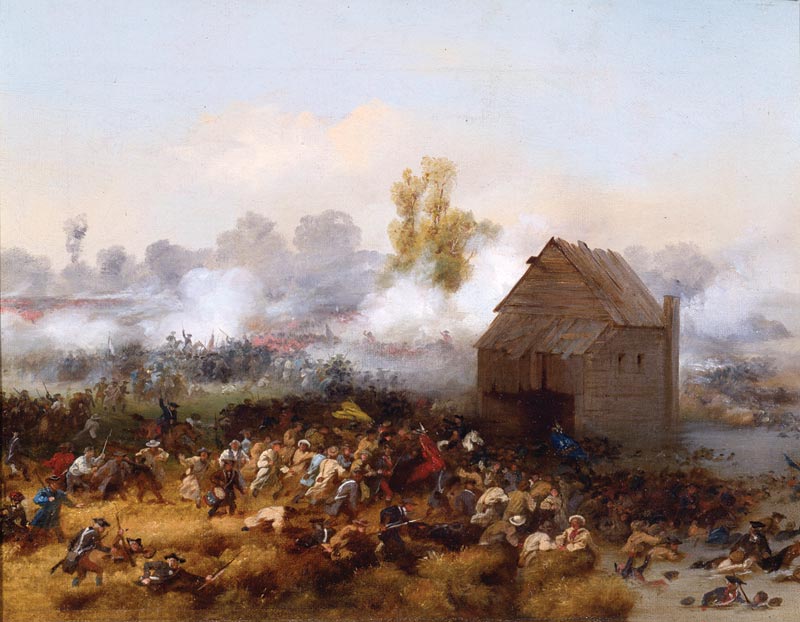
New York City is well known for skyscrapers, pizza, Broadway, and the Statue of Liberty. What is less known, is the fact that it was the site of one of the largest and most consequential battles of the Revolutionary War. Major fighting occurred all over New York City at Brooklyn, Kips Bay, Harlem, and Fort Washington and Fort Lee.
The Battle of Long Island
These were major battles that cost Washington some of his best soldiers. Though the Americans were driven from the city, the area became the center of focus for the Northern theater for the remainder of the war. Today, though these battlefields have been greatly altered and built over, remnants and markers of this important military history still exist.
Grab your favorite adult beverage and join us for the next “Rev War Revelry” historian happy hour on Easter Sunday (April 4) at 7 pm ET on our Facebook page as we discuss the Battles of New York with Mark Maloy, Dan Welch, and Adam Zielinski. To watch, simply click this link to our Facebook page. If you can’t make it at that time, you can watch it later on our YouTube page. There you will find dozens of hours of videos about all sorts of topics related to the Revolutionary War. Enjoy!





 Emerging Revolutionary War Era